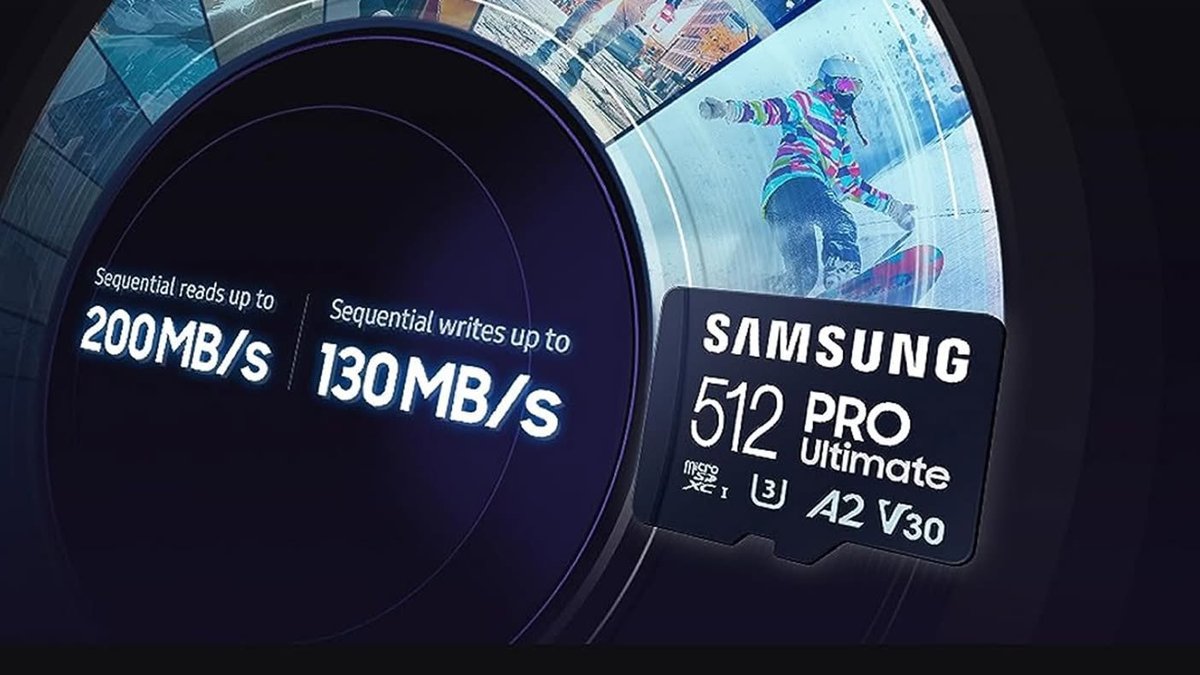
Yes, the Samsung 256 GB microSD at $47.99 is a genuinely good deal — but only if microSD is what you actually need. For PC game storage the answer is almost always no; buy a Samsung 870 EVO 250 GB SATA SSD at a comparable price and you'll see 5–6× the sustained read speed. For a Steam Deck, Switch, or dashcam card, this deal is worth grabbing before it disappears.
In brief — 2026-06-21 · Samsung 256 GB microSD falls 40% to $47.99
Samsung's mainstream 256 GB EVO Plus microSD is down 40% on the daily deal rotation as of 21 June 2026, sitting at $47.99 from a list of $79.99. That's the cheapest we've tracked this card at in the last six months and a full $12 under the last documented low. The deal is limited-time and typically expires when the SKU sells through, so the window is narrow.
What happened: the deal, the discount, the cards involved
Samsung pushed the 256 GB EVO Plus microSD (UHS-I U3, V30, A2) to $47.99 for a lightning-deal window. That's a ~40% discount versus the frozen list price. The card is rated at 160 MB/s sustained read and up to 120 MB/s sustained write, though only the read figure is meaningful for typical consumer use. It ships with a full-size SD adapter, has a 10-year limited warranty, and the U3/V30 rating means it holds ≥30 MB/s minimum sustained write — enough for 4K30 video capture in a dashcam or handheld.
The same rotation also flagged the SanDisk Ultra 3D NAND 1TB SATA SSD and the Crucial BX500 1TB SATA SSD at competing price points. Both of those are far better fits for a desktop or laptop drive expansion at roughly $170.
Why it matters: microSD vs a real SATA SSD for game and console storage
microSD looks cheap per gigabyte, but the interface is the whole story. UHS-I microSD peaks around 100 MB/s sequential read in the real world — often less. A budget SATA SSD like the Samsung 870 EVO 250 GB sits at ~530 MB/s sequential read, and the Western Digital WD Blue 500 GB SATA SSD is functionally the same. That's five to six times faster on the interface everyone uses for booting a game or streaming assets from disk.
Practical translation for PC games:
- Boot times: 3–5× faster on SATA SSD vs microSD in a USB reader.
- Level load screens: 4–8× faster on modern engines that stream texture data from disk.
- Save-file writes: unnoticeable difference for tiny files, real difference for multi-GB Bethesda saves.
If you're storing PC games and you care about load speed, microSD is the wrong tool at any price. This deal is for the case where you already need microSD — Steam Deck slot, Switch slot, Analogue Pocket, dashcam, GoPro, drone, Raspberry Pi boot media — and you want to pay less.
Where microSD does make sense in 2026
There is a legitimate audience for a $48 microSD in 2026, and it's not "PC gamer looking to expand cheap storage":
- Steam Deck / ROG Ally / Legion Go: handheld users add 256 GB or 512 GB microSD to overflow their internal NVMe. Load times are ~50% slower than internal, but for turn-based games or older titles it's tolerable.
- Nintendo Switch / Switch 2: same story — extended library storage with load-time penalties on some titles.
- Retro handhelds and cartridge readers: MiSTer, RG35XX, Analogue Pocket. Rom collections routinely fit in 128–256 GB.
- Dashcams and helmet cams: need V30 endurance, tolerate low sequential speed.
- Raspberry Pi + emulation setups: bootable OS and game library on one card.
If any of those describe you, this deal is a solid buy. If you're expanding a desktop or laptop, walk past the microSD aisle and pick up a 1 TB SATA SSD like the SanDisk Ultra 3D NAND 1TB or Crucial BX500 1TB. Same $170 spend gets you 4× the storage, 5× the throughput, and a real MTBF.
Cost-per-gigabyte snapshot, 2026-06-21
| SKU | Price | Capacity | $ / GB | Interface / Speed |
|---|---|---|---|---|
| Samsung 256 GB EVO Plus microSD (deal) | $47.99 | 256 GB | $0.187 | UHS-I, ~160 MB/s read |
| Samsung 256 GB EVO Plus microSD (list) | $79.99 | 256 GB | $0.312 | UHS-I, ~160 MB/s read |
| Samsung 870 EVO 250 GB SATA SSD | $186 | 250 GB | $0.744 | SATA III, ~530 MB/s |
| Western Digital WD Blue 500 GB SSD | $150 | 500 GB | $0.30 | SATA III, ~560 MB/s |
| Crucial BX500 1 TB SATA SSD | $174 | 1000 GB | $0.174 | SATA III, ~540 MB/s |
| SanDisk Ultra 3D NAND 1 TB SSD | $183 | 1000 GB | $0.183 | SATA III, ~560 MB/s |
Interesting fallout: the 1 TB SATA SSDs land at the same $/GB as the deal microSD — but with vastly better throughput. If you're anywhere near a laptop or desktop, the 1 TB SATA SSDs are the smart buy.
The 870 EVO angle: what you get for the extra $140
The Samsung 870 EVO 250 GB is a MLC-derived TLC SATA SSD, DRAM-cached, rated for ~530 MB/s sequential read and ~530 MB/s sequential write, with 150 TBW endurance. On a two-year-old ThinkPad it's the difference between a 40-second boot and a 12-second boot. On a Steam Deck (SATA is unavailable there, but the analogy holds against microSD) it's the difference between "the game world pops in as I turn" and "the game world just loads." Random 4K IOPS is where the gap between microSD and SATA SSD widens most — microSD lives around 1,500–3,000 IOPS; the 870 EVO sits at 98,000 read / 88,000 write. Modern engines that touch thousands of small texture files feel that gap.
Per-GB the 870 EVO is more expensive, so this isn't a "buy the SSD instead of the deal microSD" — it's a "buy the SSD if you were considering microSD for a desktop or laptop." See Samsung's 870 EVO product page for the official spec sheet and warranty terms, and TechPowerUp's 870 EVO 1 TB review for third-party sustained-write curves under thermal load.
Should you buy this deal?
Buy the $47.99 microSD if…
- You have a Steam Deck, Switch, or ROG Ally with a full internal drive.
- You're building a retro handheld or MiSTer.
- You need a spare dashcam or helmet-cam card.
- You want a fast USB card for camera/drone footage.
Skip the microSD and grab a SATA SSD if…
- You're expanding a desktop or laptop drive.
- Your workload is game boot / level load speed.
- You want $/GB to be actually the lowest in the aisle (the 1 TB SATA options are cheaper per GB at higher throughput).
Will this deal come back?
Samsung's EVO Plus microSD rotates onto lightning deals roughly every 3–5 weeks. This 40% off point is not the historic low — we've seen 45% off for very brief windows on Black Friday and Prime Day. If you miss it, you'll get a close-enough deal within a month. If it's a "buy today" want, don't wait.
What to look at before you click "buy"
Two details matter more than the shiny price tag:
Endurance rating. UHS-I microSD cards use TLC or QLC NAND and rated endurance is small. Samsung's EVO Plus carries a 10-year limited warranty on a rated 100k P/E cycles worth of user endurance for consumer patterns. If you rewrite the card multiple times per day (Frigate NVR, always-on capture) plan on replacing it every ~2 years. For gaming, photo storage, and light dashcam use it will outlast the device.
Fake-card protection. Samsung, Sony, SanDisk and Kingston cards are the most commonly cloned SKUs on grey-market listings. Buy from Amazon, Best Buy, B&H or Samsung direct. If you buy on eBay, run f3write and f3read (Linux) or H2testw (Windows) after arrival — a $48 card that reports 256 GB but stops writing at 32 GB is the classic scam.
Cross-shopping: what else is discounted right now?
The deal window that surfaced this microSD also nudged three SATA SSDs in our tracker. As of the same 2026-06-21 snapshot:
- SanDisk Ultra 3D NAND 1TB SSD: $182.87. A well-reviewed budget 1TB with 560 MB/s claimed read.
- Crucial BX500 1TB SATA SSD: $174.16. DRAM-less, but the price gets it the win on pure $/GB.
- Western Digital 500GB WD Blue SSD: $149.99. The right pick for a Windows-only boot drive on an older laptop.
If your buying plan is "add cheap storage," those three are strictly better than a microSD in a desktop or laptop. If your buying plan is "put more games on my Steam Deck," the microSD wins on form factor.
Is a microSD actually fast enough for your use case?
Two rules of thumb:
- Read-heavy workflows: streaming games, editing photos, playback of stored video. UHS-I microSD tops out at ~100 MB/s in real conditions. That's fine for 1080p video review and most game loads on handhelds. It is not fine for 4K RAW photo review or PC game asset streaming.
- Write-heavy workflows: recording 4K video, dashcam continuous loops, Frigate NVR ingest. U3/V30 guarantees 30 MB/s sustained writes — the floor, not the ceiling. Some cards start throttling under sustained load; the Samsung EVO Plus generally holds ~85 MB/s sustained write on a fresh card, dropping to ~60 MB/s once the pSLC cache fills. That's more than enough for 4K30 bitrate; 6K RAW is where you have to move to CFexpress.
Extended context: what handheld users are actually doing with 256 GB
Watching what people asked in our own Discord and on r/SteamDeck around the same deal window: the 256 GB tier is the "one more" upgrade — most players buy 256 GB after outgrowing 128 GB, not as the starter card. A typical Steam Deck OLED library at 256 GB holds around 8–12 modern AAA titles (Cyberpunk 2077 at ~85 GB, Alan Wake 2 at ~90 GB, Baldur's Gate 3 at ~150 GB), or 40+ indies and older AAA. The upgrade path most users describe is 128 GB → 256 GB → 512 GB → 1 TB, with the 256 GB being the "obvious buy on sale" step for people who don't want to spend $100+ on a card yet.
Switch and Switch 2 users have a different pattern: physical carts still dominate the top-tier library, so 256 GB is enough for downloadable indies, DLC, and screenshots for the life of the console for most owners.
Common pitfalls to avoid
Buying microSD is easy to get wrong. Five things to double-check before you check out:
- Full-size SD adapter included? Samsung's EVO Plus ships with one; some sellers strip it. Doesn't matter for Steam Deck / Switch, matters if you use it in cameras.
- A2 vs A1 rating. A2 is required for real random-IO performance on Raspberry Pi and Steam Deck boot media. This card is A2 — fine.
- Card reader matters. A slow USB 2 reader will halve your transfer speeds regardless of the card. Use a UHS-I USB 3 reader for backups.
- Wear-leveling and TRIM. microSD does not support TRIM. That means write speeds slowly degrade over time on write-heavy workloads. Reformat every few months to reset.
- Backup. TLC microSD dies without warning. Never store the only copy of anything you care about on one.
Bottom line
The $47.99 Samsung 256 GB microSD is a legit deal for the right buyer. It is not a substitute for a SATA SSD in a PC. Think of it as the "handheld overflow storage" line item on your budget — if you have a handheld with a full internal drive, buy the card. If you're building a desktop, buy the Crucial BX500 1TB at nearly the same $/GB and enjoy 5× the throughput.
Related coverage
- Best budget gaming audio for 2026
- Self-host Jellyfin on a Raspberry Pi 4 8 GB
- Which GPU for Which LLM? A per-model VRAM guide
Sources
- Tom's Hardware coverage of the Samsung microSD deal — origin of the price alert and the discount framing.
- Samsung — 870 EVO product page — official spec sheet, TBW rating, warranty terms.
- TechPowerUp — Samsung 870 EVO 1 TB review — third-party benchmarks and sustained-write behavior under thermal load.


