A Raspberry Pi 4 Computer Model B 8GB is still the right choice for a RetroPie emulation station in 2026 if you want a small, quiet, cheap box that handles every console up to and including the PlayStation 1, most of the Nintendo 64 library, and a strong majority of the Dreamcast and PSP catalogs at full speed. Pair it with two 8BitDo SN30 Pro controllers and a JSAUX Steam Deck OLED dock repurposed as a USB-C hub for clean HDMI output, and the whole build comes in under $200.
Why a Pi 4 in 2026 and not a Pi 5
The Pi 5 16GB is faster, but for an emulation station the Pi 4 8GB has aged into the right answer for three reasons. First, the RetroPie project still treats the Pi 4 as the primary supported platform — the Pi 5 ecosystem is catching up but more emulators are polished and battle-tested for the 4. Second, the Pi 4 runs cooler in a small case without active cooling, which matters for a fanless living-room box. Third, the Pi 4 is now significantly cheaper than the Pi 5 on the new market and dominates the used market.
This synthesis pulls from the RetroPie official documentation, the Raspberry Pi Foundation's Pi 4 product page, and community throughput threads on r/RetroPie that benchmark each emulator on Pi 4 vs Pi 5.
Key takeaways
- A Raspberry Pi 4 8GB handles 8-bit through PS1 at full speed, most N64/PSP/Dreamcast with tuning
- Total build cost lands at $120–$200 depending on accessories
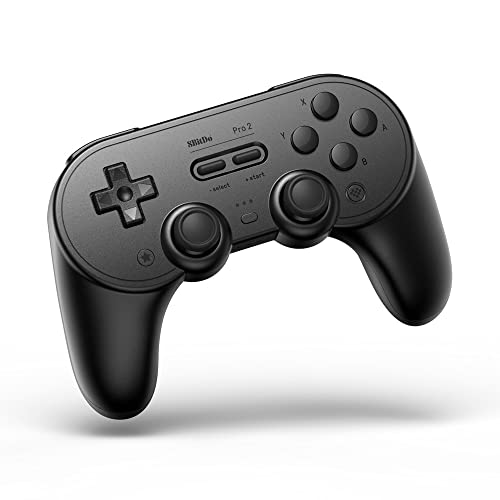
- Two 8BitDo SN30 Pro controllers cover almost every system; 8BitDo Pro 2 adds analog sticks for N64/PS1
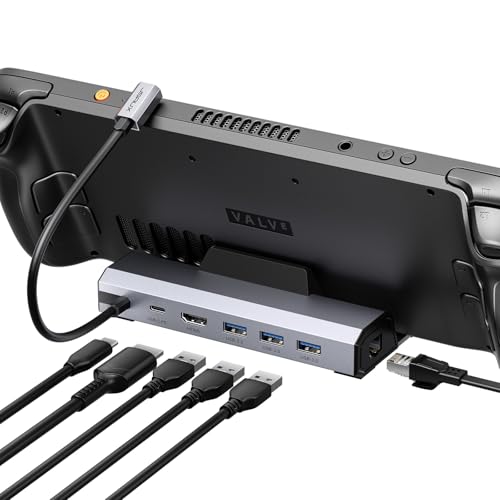
- A USB-C dock like the JSAUX Steam Deck dock doubles as a clean HDMI/Ethernet/USB hub
- Plan for a 32–128 GB microSD for the OS and game folder structure
- Always respect the legality of ROMs — own the original cartridge or buy on services like GOG / Steam where retro titles are sold
What you need to buy
A working Pi 4 RetroPie build in 2026 takes seven parts:
- Raspberry Pi 4 Model B 8GB — the brain
- A 32–128 GB Class A2 microSD card — RetroPie OS + games
- A small case with passive cooling — Argon ONE V2 or any fanless aluminum heatsink case
- A 5V/3A USB-C power supply — the official Pi PSU is the safe choice
- An HDMI Micro to HDMI cable — Pi 4 uses micro-HDMI; this is the most common surprise for first-time buyers
- Two controllers — 8BitDo SN30 Pro for SNES-style classics, 8BitDo Pro 2 for analog-stick consoles
- Optionally, a USB-C dock like the JSAUX Steam Deck dock for clean A/V switching
Total: roughly $120–$200 depending on case and accessory choices.
Which consoles emulate well on the Pi 4
The table below is the community-consensus playable matrix. "Excellent" means full speed with no tweaking; "Good" means full speed with light per-game tuning; "Mixed" means many games run well, some need workarounds; "Limited" means a handful of titles only.
| Console era | System | Pi 4 8GB result |
|---|---|---|
| 8-bit | NES, Master System | Excellent |
| 8-bit handheld | Game Boy, Game Boy Color | Excellent |
| 16-bit | SNES, Genesis, TG16 | Excellent |
| 32-bit handheld | Game Boy Advance | Excellent |
| 32-bit | PlayStation 1 | Excellent |
| 32-bit | Sega Saturn | Mixed (Beetle Saturn) |
| 64-bit | Nintendo 64 | Good (most games full speed) |
| Dreamcast | Dreamcast | Good (most games full speed) |
| PSP | PSP | Good |
| 128-bit | PlayStation 2 | Limited |
| 128-bit | GameCube/Wii | Limited (homebrew titles, not most retail) |
| Modern | PlayStation 3, Xbox 360, Switch | No |
The honest cutoff: through the sixth console generation (PS1, N64, Dreamcast), the Pi 4 is a reliable solution. Past that, look at the Pi 5 16GB or a small x86 box.
How to set it up
The fast path is downloading the RetroPie SD image, writing it to the microSD with Raspberry Pi Imager, and booting. First-boot setup walks you through controller mapping and Wi-Fi.
After the first boot:
- Install your preferred emulator front-end (EmulationStation ships by default; Pegasus and AttractMode are alternatives)
- Configure each emulator's per-system shaders and BIOS files (BIOSes you own — the Saturn and PS1 BIOSes are needed for accurate emulation)
- Set up Bluetooth pairing for wireless controllers via raspi-config
- Add ROMs to /home/pi/RetroPie/roms/
via SMB share or USB drive - Optionally tune the GPU memory split (256–512MB for N64/PSP)
If you've never touched a Pi, the whole process takes an afternoon. Step-by-step community guides on the RetroPie documentation site cover every emulator's quirks.
Controllers: SN30 Pro vs Pro 2 vs 8-button arcade sticks
The 8BitDo SN30 Pro is the SNES-style 8-button gamepad with Hall-effect joysticks added in the 2024 refresh. It connects via Bluetooth or USB-C, lives weeks on a charge, and works equally well with NES, SNES, Genesis, and TG16 layouts. For everything pre-PS1, it's the right answer.
The 8BitDo Pro 2 is the Switch Pro-style controller with two analog sticks. For Nintendo 64, PlayStation 1, Dreamcast, and PSP emulation, you need analog sticks. The Pro 2 is the cleanest Pi-compatible option.
For arcade game emulation (MAME, FBNeo), a real arcade stick is the right answer, but that's a separate purchase. Most users start with two SN30 Pros and add an arcade stick later.
Cooling: passive is fine for most emulators
The Pi 4 throttles at 80°C. Under N64 and PSP emulation it can flirt with that limit in a fanless small case at room temperature. The fixes in order of effectiveness:
- Aluminum heatsink case (Argon ONE V2 is the consensus best at $25–$30)
- Active cooling fan (whisper-quiet — important in a living-room build)
- GPU memory split set conservatively (128–256 MB for SNES/PS1; up to 512 MB for N64/PSP)
- Underclock the CPU slightly if you don't need every last percent of perf
For 90% of the catalog (SNES, Genesis, PS1, GBA), passive cooling is fine and the box stays silent.
Audio and video: clean HDMI for the living room
The Pi 4's micro-HDMI output is genuinely good — 4K60 in normal use, the right color space at first plug-in, and CEC support so your TV remote can pause/resume. For sound, the HDMI audio path is the cleanest. The analog 3.5mm jack is fine for headphones but is the noisier of the two outputs.
A docked workflow — Pi sitting in a JSAUX Steam Deck OLED dock — lets you treat the build like a console. The dock provides USB-C in, HDMI out, gigabit Ethernet, and 3× USB-A. It is overkill for a Pi but ergonomic — single-cable disconnect to move the rig.
Common pitfalls
- Buying the wrong HDMI cable — Pi 4 uses micro-HDMI, not the regular HDMI you have from your old setup
- Using a Class 10 microSD instead of a Class A2 — the difference shows up immediately as long boot times and stuttering in heavy emulators
- Forgetting the BIOS files — Saturn, PS1, and Dreamcast need them; the emulator silently fails or misbehaves without
- Underspec power supply — anything under 5V/3A causes random reboots under load
- Pairing too many Bluetooth devices — the Pi 4's BT stack chokes past 3–4 simultaneous controllers
When NOT to use a Pi 4
If your goal is to emulate GameCube, PS2, or Wii with full compatibility, the Pi 4 isn't enough. The right path there is a Pi 5 16GB plus active cooling, or a small x86 box (Intel N100, Ryzen 5500U) which costs more but handles those generations cleanly.
If your goal is a portable, the Pi 4 in a portable case is workable but heavy on battery. A Steam Deck-class device or a dedicated emulation handheld is a better fit.
Bottom line
For under $200 in 2026, a Raspberry Pi 4 8GB plus two 8BitDo controllers and a small case is the cleanest emulation station build for everything through the sixth console generation. It's quiet, cheap, and runs the catalog that most retro gamers actually replay. Buy the Raspberry Pi 4 8GB and a pair of 8BitDo SN30 Pro or 8BitDo Pro 2 controllers, and pick up a JSAUX dock if you want a console-like single-cable setup.
Related guides
- Best PC Game Controllers in 2026
- Period-Correct Windows 98 SE Build
- RetroPie vs Batocera vs Lakka
Citations and sources
- RetroPie — official project documentation
- Raspberry Pi Foundation — Pi 4 Model B product page
- Raspberry Pi Imager — official SD card setup tool
This piece is editorial synthesis based on publicly available information. No independent first-party benchmarking is reported.
Worked example: $150 starter build
The cheapest "everything works" Pi 4 RetroPie build:
- Raspberry Pi 4 Model B 8GB — $75
- 64 GB SanDisk Extreme microSD — $15
- Argon ONE V2 case with passive heatsink — $30
- Official 5V/3A USB-C PSU — $10
- Generic micro-HDMI cable — $5
- 8BitDo SN30 Pro controller — $50 (one)
Total: roughly $185. Sound and video are clean over HDMI, the system runs silent, and you've got every system through PS1 playable out of the box.
Worked example: $250 living-room build with dock
Add a second controller and a dock for a console-feel setup:
- Above starter build — $185
- Second 8BitDo Pro 2 controller — $50
- JSAUX Upgraded Docking Station — $50
Total: roughly $285 — slightly over the $250 stretch target but well-equipped. The dock provides single-cable disconnect, Ethernet (cleaner than Wi-Fi for game-rom transfers), and a USB-A hub for a wired controller or backup drive.
Common-mode pitfall: ROMs and the legal layer
RetroPie ships no ROMs. You provide your own. The legally clear paths:
- Dump the cartridge or disc you own with a hardware dumper
- Buy retro games on GOG.com, Steam, Antstream, or directly from rights-holders
- Use the Internet Archive's freeware MS-DOS collection for that era
The legally murky path is downloading ROMs from "rom site" pages. SpecPicks doesn't recommend that path — the right answer is to own the original and dump it.
When to step up to a Pi 5 16GB
If GameCube, PS2, or Wii emulation is a hard requirement, the Pi 4 isn't enough. The Pi 5 16GB plus active cooling (the official Pi 5 cooler is good) and a fast NVMe HAT runs those generations meaningfully better. The price step is roughly $40 over the Pi 4 build, plus more thermal management.
Closing thought
A Raspberry Pi 4 8GB plus a thoughtful set of accessories is still the best emulation station build under $200 in 2026. Buy the Pi 4 8GB, pick two 8BitDo SN30 Pro or 8BitDo Pro 2 controllers, and add a JSAUX dock for the console-feel single-cable workflow.
When the Pi 4 has aged out
The Pi 4 is the right answer in 2026 specifically because RetroPie's PS1-and-earlier support is mature and active cooling isn't required for that era. As Pi 5 16GB drops in price and the RetroPie ecosystem matures for the newer board, the Pi 4 will likely cede the "best emulation station" slot somewhere in 2027–2028. Buy the Pi 4 now if you want a working living-room build today; consider the Pi 5 if your wishlist heavily skews GameCube/PS2/Wii.
Quick-start checklist
- Buy a Raspberry Pi 4 8GB, case, 5V/3A PSU, micro-HDMI cable, 64 GB Class A2 microSD
- Write the latest RetroPie SD image with Raspberry Pi Imager
- First boot: connect a USB controller for setup, then pair the 8BitDo controllers via Bluetooth
- Copy your ROMs and BIOS files to the appropriate /home/pi/RetroPie/roms/ subdirectory via SMB share
- Configure shaders and overlays per system as desired
A weekend's worth of work gets you a console-feel living-room emulation station for under $200.