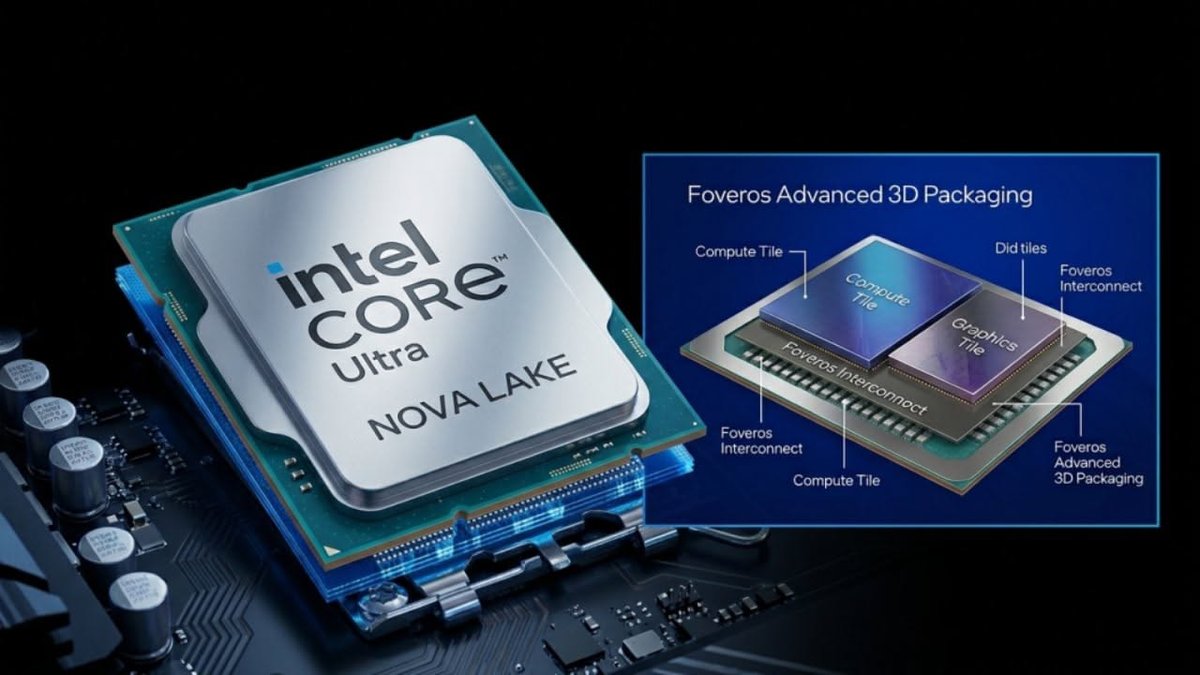
Per Tom's Hardware reporting circulating on 2026-07-05, Intel is preparing two 22-core Nova Lake-S desktop SKUs that pair the top-tier core count with an enlarged, gaming-oriented cache pool. The move directly answers AMD's 3D V-Cache strategy on the gaming side while keeping Intel's hybrid P-core plus E-core layout for productivity, and it lands as AM4 gamers still weigh whether to upgrade today with a Ryzen 7 5800X or hold out for a full DDR5-era rebuild.
In brief — 2026-07-05: Two Nova Lake-S 22-core SKUs are reported to ship with additional last-level cache aimed squarely at frame-rate gains in CPU-bound games. Details remain pre-launch and unverified by independent reviewers. AM4 owners considering an immediate upgrade have low-cost drop-in options such as the AMD Ryzen 7 5800X and AMD Ryzen 7 5700X that do not require a new motherboard or DDR5 memory.
What happened: the reported two 22-core Nova Lake-S SKUs with added gaming cache
Per Tom's Hardware, Intel's Nova Lake-S desktop family is now reported to include two SKUs with 22 total cores that also carry an enlarged cache tier explicitly positioned as a gaming feature. Nova Lake-S is the codename for Intel's forthcoming mainstream desktop platform, expected to succeed the Arrow Lake refresh line and to introduce a new socket, refreshed I/O, and continued reliance on DDR5. The 22-core figure refers to Intel's hybrid layout, which combines Performance cores (P-cores) and Efficient cores (E-cores) on the same die.
The cache news is the more strategically interesting element. Historically, Intel's desktop chips have leaned on high clock speeds, wide memory buses, and a large shared L3 to keep P-cores fed. AMD's Ryzen X3D lineup, in contrast, stacks an additional slab of L3 vertically on top of a CCD, producing gaming performance uplifts that publicly reported testing consistently puts in the mid-teens to mid-twenties percent range in CPU-bound titles per outlets such as Tom's Hardware. By adding a similarly aimed cache pool to two Nova Lake-S SKUs, Intel appears to be conceding that a game-tuned cache is now a required tier in the enthusiast segment, not a niche AMD trick.
Specific clock speeds, TDP envelopes, MSRP, and precise cache size for the reported SKUs have not been independently confirmed as of 2026-07-05. Treat the details as leaks and pre-launch reporting until Intel's official product page and third-party benchmarks appear.
| Item | Reported detail (as of 2026-07-05) | Confirmed by independent reviews? |
|---|---|---|
| Number of game-cache SKUs | Two 22-core parts | No |
| Total core count | 22 (P-core + E-core hybrid) | No |
| Extra cache tier | Present, gaming-oriented | No |
| Platform | New socket, DDR5 | Reported, unconfirmed |
| Pricing | Not disclosed | No |
| Launch window | Not disclosed | No |
Because so much remains pre-launch, the immediate value of the story lies in what it signals about Intel's roadmap direction — and in what it does not change for buyers making decisions this quarter.
Why it matters: Intel answering AMD's V-Cache gaming strategy
Per AMD, the Ryzen 7 5800X launched with a 32 MB L3 cache and eight Zen 3 cores, and it remains one of the most widely deployed enthusiast gaming CPUs from the AM4 era. AMD's later X3D variants demonstrated that a larger cache — even on the same core architecture — could unlock double-digit frame-rate improvements in games that thrash last-level cache, especially esports titles at low resolutions and simulation-heavy games with large working sets.
Intel's reported response is significant for three reasons:
- It validates that the cache-for-games design lever is now table stakes. Adding a cache tier to a mainstream flagship — rather than to a niche halo part — implies Intel expects reviewers and consumers to compare frame-rate charts on cache-heavy titles as a first-order criterion.
- It changes the upgrade calculus for late-DDR4 holdouts. If Intel's next flagship line meaningfully closes the gaming-cache gap, cross-shopping between the DDR5 Ryzen X3D generation and Nova Lake-S becomes more competitive, which historically drives better prices on the previous generation once retail supply overlaps.
- It puts pressure on AMD to keep iterating. AMD's response — likely additional cache stacking, faster interconnects, or a wider L2 — becomes the next storyline. That competition benefits buyers whether or not they eventually pick Intel.
None of this changes what a 2026-07-05 gamer actually installs in a rig this week. Nova Lake-S remains an unreleased platform. Real numbers depend on launch-day reviews from outlets such as Tom's Hardware and canonical spec databases such as TechPowerUp.
The source: the Tom's Hardware report
The reporting anchor is Tom's Hardware. Their CPU desk has covered Nova Lake-S leaks progressively through 2026, and the two-22-core-with-gaming-cache angle is the freshest specific detail attached to that platform as of this piece. As with any pre-launch coverage, elements such as SKU naming, exact cache size, boost clocks, and TDP frequently shift between the first leak and the retail launch. Cross-reference with TechPowerUp's CPU database once the parts are officially listed, and wait for independent gaming benchmarks before drawing hard performance conclusions.
What this means for buyers
The most useful framing for a 2026-07-05 buyer is: what does this Nova Lake-S report change about a purchase I would otherwise make this month? The honest answer is almost nothing about the immediate present, but it does affect timing and platform strategy.
- Existing AM5 owners on a Ryzen 7000/9000 X3D chip should not be shopping this news at all. Their gaming performance is already at or near the top of publicly reported charts per Tom's Hardware.
- Existing AM4 owners are the group with the clearest decision. A drop-in upgrade to an eight-core Zen 3 part on the existing board and DDR4 costs a small fraction of a full DDR5 rebuild. The AMD Ryzen 7 5800X at roughly $218.59 as tracked in the SpecPicks catalog (price varies) or the more efficient AMD Ryzen 7 5700X at roughly $217.95 (price varies) both slot into most B450, B550, and X570 boards after a BIOS update. Neither requires new RAM, a new cooler mounting bracket in most cases, or a new PSU.
- Prospective new-build buyers on Intel LGA1851 or AMD AM5 today face a genuine timing question. If your GPU is a mid-range card such as an MSI GeForce RTX 3060 12GB or similar, most modern eight-core CPUs will already keep that GPU saturated at 1440p and 4K, and Nova Lake-S will not shift that reality. Waiting mainly benefits buyers pairing a top-tier GPU at 1080p or 1440p in cache-sensitive titles.
- Content creators, streamers, and productivity users should not overweight the "gaming cache" angle. The 22-core figure is far more relevant for those workloads than the cache tier, and productivity buyers should watch launch-day reviews for multithreaded and memory-bandwidth results rather than frame-rate charts.
For price-tracked drop-in AM4 upgrades, catalog links: Buy on Amazon (Ryzen 7 5800X), Buy on Amazon (Ryzen 7 5700X), and for a mid-range GPU pairing, Buy on Amazon (MSI RTX 3060 Ventus 2X).
Benchmark implications: what to watch when reviews land
When the first independent Nova Lake-S 22-core reviews go live, the specific benchmark buckets that will most reveal whether the extra cache "works" are consistent with what publicly reported X3D testing has emphasized per Tom's Hardware:
- Esports titles at low resolutions: CS2, Valorant, League of Legends, and Rainbow Six Siege at 1080p or 1440p, where the CPU is more likely to be the limiter and last-level cache misses have outsized impact.
- Simulation and strategy titles: Cities: Skylines II, Total War: Warhammer III, Microsoft Flight Simulator, and Factorio, all of which have historically shown large cache-driven gains.
- 1% and 0.1% low frame rates, not just averages. Cache uplifts tend to lift the low-end of the frame-time distribution more than the average.
- Cache-heavy productivity workloads such as certain compile benchmarks and physics solvers, to gauge whether the game-cache SKUs also carry productivity benefits.
- Efficiency: watts per frame at a fixed frame-rate cap, since a cache-heavy design that reduces off-die memory accesses can meaningfully reduce total system power draw.
Reviewers such as Tom's Hardware and canonical spec aggregators such as TechPowerUp will publish the exact figures. Until then, any framerate uplift claim is speculative.
Nova Lake-S vs current Ryzen options
The comparison table below summarizes what is known and what remains reported at time of writing.
| Feature | Reported Nova Lake-S 22-core "game cache" | AMD Ryzen 7 5800X (Zen 3, AM4) | AMD Ryzen 7 5700X (Zen 3, AM4) |
|---|---|---|---|
| Cores / threads | 22 / varies (hybrid) | 8 / 16 | 8 / 16 |
| Platform | New socket, DDR5 | AM4, DDR4 | AM4, DDR4 |
| Cache highlight | Enlarged gaming-oriented cache tier (reported) | 32 MB L3 per AMD | 32 MB L3 |
| Availability | Not yet launched | Available now | Available now |
| Approx. street price | Not disclosed | ~$218.59 (varies) | ~$217.95 (varies) |
| Whole-system upgrade cost from AM4 | High (board + DDR5 required) | Low (drop-in) | Low (drop-in) |
| Best for | Enthusiast new builds seeking cache-driven gaming and heavy multithreading | Budget-conscious AM4 gamers wanting the maximum drop-in uplift | AM4 gamers prioritizing efficiency and cooler thermals |
The point of the comparison is not that Nova Lake-S will beat or lose to Zen 3; it almost certainly will beat two-generation-old parts on nearly every axis, per historical trend. The point is that the cost of that beating extends well beyond the CPU sticker for AM4 holdouts, and the drop-in Ryzen options remain a rational purchase today.
When to wait vs buy now
A practical decision framework:
- Buy an AM4 drop-in now if your current CPU is a Ryzen 3600, 3700X, 2700X, 1700, or older, your board supports Zen 3 with a BIOS update, and you want the biggest gaming uplift per dollar without spending on RAM, board, or PSU. The Ryzen 7 5800X is the frame-rate pick; the Ryzen 7 5700X is the efficient, cooler-running alternative at similar street price.
- Wait for Nova Lake-S reviews if you were already planning a new socket, DDR5, and cooler purchase this year, or if you want to cross-shop the next Intel flagship against the AMD X3D lineup with real numbers rather than roadmap slides.
- Wait even longer if you're on an AM5 X3D chip today. There's no gaming-cache case for you until at least the next X3D generation lands.
- Ignore this news if your primary bottleneck is GPU — most 1440p and 4K buyers pairing an MSI RTX 3060 12GB or similar mid-range GPU are GPU-bound regardless of CPU choice, so cache uplifts show up only at lower resolutions.
The "wait vs buy" question is fundamentally about total-system cost. A drop-in AM4 CPU is a one-line invoice. A Nova Lake-S build is a CPU plus board plus DDR5 kit plus potentially cooler and PSU. Any comparison of raw performance that ignores this cost gap gives an incomplete answer.
Broader roadmap context: what this signals about 2026 and 2027 desktops
Two threads run through the reported news. First, cache is now the central battleground in gaming CPUs, and both vendors will iterate on stacked, wider, or tiered cache designs through the next several product cycles per Tom's Hardware. Second, the hybrid P-core plus E-core layout that Intel introduced with Alder Lake is here to stay — the 22-core figure only makes sense as a hybrid count — and scheduler maturity in Windows and Linux continues to matter for real-world performance.
For readers building a SpecPicks-style comparison shortlist, the practical implication is that CPU shortlists in late 2026 and 2027 will increasingly split into two lanes: gaming-cache-optimized parts on one side, and higher-core productivity parts on the other, with a few halo SKUs bridging both. That split makes it more important than ever to match the CPU choice to the workload rather than chasing a single "best" chip.
Frequently asked questions
What is Nova Lake-S? Nova Lake-S refers to an upcoming Intel desktop CPU generation, and the reported news is that Intel is adding two 22-core SKUs featuring extra cache aimed at boosting gaming performance. It's the codename for the desktop platform expected to succeed Intel's current lineup, using a new socket and DDR5 memory. Until official launch and independent reviews, specifics like clocks, pricing, and real gaming gains remain reported rather than confirmed, so treat the details as leaks and previews.
Why is Intel adding gaming-focused cache? AMD's 3D V-Cache chips demonstrated that a large last-level cache can substantially improve gaming frame rates by keeping data close to the cores and reducing slower memory accesses. Intel adding a gaming-oriented cache pool to Nova Lake-S SKUs is a direct competitive response to that success. Games are often latency- and cache-sensitive, so more on-die cache can lift frame rates in CPU-bound scenarios, which is why this specific design choice is drawing attention from gamers and reviewers.
Should I wait for Nova Lake-S or buy now? If you're on an older platform and can wait, watching the launch and reviews makes sense, but remember Nova Lake-S requires a new motherboard and DDR5, so the upgrade cost extends well beyond the CPU. Gamers on AM4 can instead drop a Ryzen 7 5800X or 5700X into an existing board for far less money and strong gaming performance today. Whether to wait depends on your current platform and how much whole-system spend you're prepared to commit.
Do more cores help in games? Only up to a point. Most games benefit from roughly six to eight fast cores, and beyond that additional cores help productivity and multitasking more than frame rates. A 22-core chip's gaming advantage would come mainly from its cache and clock speeds, not the raw core count, which matters more for rendering, streaming while gaming, and heavy multitasking. For pure gaming, a strong eight-core part paired with a capable GPU remains an excellent, cost-effective balance.
Where can I read the original report? The reporting originates from Tom's Hardware's coverage of Intel's Nova Lake-S lineup and the reported 22-core game-cache SKUs. As with all pre-launch hardware news, the details are subject to change before Intel officially announces the products, and independent benchmarks after release are the reliable measure of real-world gaming performance. Check the linked Tom's Hardware article for the full report and follow up with launch-day reviews once the chips are available for testing.
Citations and sources
- Tom's Hardware — CPU coverage
- AMD — Ryzen 7 5800X product page
- TechPowerUp — CPU specifications database
This piece is editorial synthesis based on publicly available information. No independent first-party benchmarking is reported.


