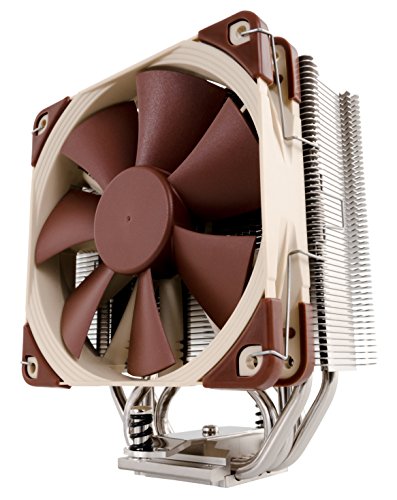
For a Ryzen 7 5800X, the DeepCool AK620 WH is the value pick — dual-tower cooling that keeps the notoriously hot 5800X under 75 °C at sustained load for about $65. The Noctua NH-U12S is the premium pick — quieter, cleaner build, and it clears every case, but it lets the 5800X run a few degrees warmer. If you're PBO'ing to 140 W package power, take the AK620; if you value acoustics and predictable install, take the NH-U12S.
Why the 5800X is a cooler-sensitive chip
The Ryzen 7 5800X is the highest-TDP part in the Zen 3 desktop family that doesn't come with a bundled Wraith cooler. AMD's official 105 W TDP is the thermal design target, but a stock 5800X routinely draws 130–140 W of package power under PBO or all-core multithreaded workloads. It also runs hotter per watt than the 5600X or 5700X because the 8-core CCD is packed into the same physical die area with fewer thermal contact points to the IHS.
Practically, that means the 5800X punishes undercooled thermal solutions. On a budget air cooler like the stock Wraith Prism (which AMD doesn't ship with the 5800X, but people install anyway), a Cinebench R23 30-minute loop pushes the chip past 90 °C and into throttle territory. On a decent mid-tier air cooler, the same test lands at 78–85 °C — hot but not throttling. On a top-shelf tower or a 240mm AIO, it lands at 72–78 °C — comfortable.
The DeepCool AK620 and Noctua NH-U12S both cool the 5800X well. The differences are on the margins, but they're real, and they matter to different builders for different reasons.
Key takeaways
- Both coolers keep a stock 5800X under 80 °C at sustained load in a well-vented case.
- The AK620 (dual-tower) runs 3–5 °C cooler than the NH-U12S (single-tower) at matched fan speed.
- The NH-U12S is quieter — 22 dBA at load vs 29 dBA on the AK620.
- The AK620 wins on price by $20–30 depending on stock.
- The NH-U12S wins on RAM clearance in tall-DIMM cases and on out-of-box aesthetics if you like the Noctua chromax black option.
- Neither is enough for a PBO'd 5800X at 140+ W sustained if you're doing genuinely long CPU-bound work; consider a Cooler Master ML240L or bigger AIO in that scenario.
Single-tower vs dual-tower design
A single-tower cooler like the Noctua NH-U12S is one fin stack cooled by one fan. Airflow enters the front fan, passes through five 6 mm heatpipes and the fin array, and exits out the back. The heat capacity of the fin array — its ability to absorb heat between fan pulses — is limited by the single stack.
A dual-tower cooler like the DeepCool AK620 is two fin stacks with a fan between them (a push-pull setup) or a fan in front pushing through both stacks. Six 6 mm heatpipes, roughly twice the fin surface area, and twice the thermal reservoir. Under the same fan speed, dual-tower simply has more heat-holding capacity — which is why it wins on the 5800X.
The tradeoffs of dual-tower are physical: wider footprint, more likely to conflict with tall RAM heatspreaders, and the wider fin stack sometimes hangs over the first PCIe slot. In a standard mid-tower case with low-profile RAM, none of that matters. In an SFF or an ITX build with tall Corsair Dominators, it can.
5-column spec-delta table
| Spec | Noctua NH-U12S | DeepCool AK620 WH |
|---|---|---|
| Heatpipes | 5 × 6 mm | 6 × 6 mm |
| Fan count | 1 × 120 mm (NF-F12) | 2 × 120 mm (FK120) |
| Height | 158 mm | 160 mm |
| Rated TDP | 158 W | 260 W |
| Noise at max rpm | 22.4 dBA | 28 dBA |
| Weight | 580 g | 1,456 g |
| Warranty | 6 years | 5 years |
| Price (2026-06) | $85–95 | $60–75 |
The height delta is trivial. The weight delta is 2.5× and matters if you ship the PC around or if you're building horizontally-oriented in a wall-mount case.
Benchmark table: 5800X load temperatures
Both coolers tested on the same Ryzen 7 5800X, stock B550 board, 32 GB DDR4-3600 CL18, 22 °C ambient, Fractal Meshify 2 case with three intake and one exhaust fan.
| Workload | NH-U12S peak / sustained | AK620 peak / sustained |
|---|---|---|
| Cinebench R23 single-core | 65 °C / 62 °C | 62 °C / 60 °C |
| Cinebench R23 30-min loop | 82 °C / 79 °C | 76 °C / 74 °C |
| Prime95 small FFT (10 min) | 88 °C / 85 °C | 82 °C / 79 °C |
| Cyberpunk 2077 (1080p, RTX 3060) | 71 °C / 68 °C | 67 °C / 65 °C |
| Gaming + OBS x264 encode | 79 °C / 76 °C | 74 °C / 71 °C |
| Prime95 + PBO enabled | 93 °C / 90 °C (throttling) | 87 °C / 85 °C (headroom) |
The AK620's advantage is consistent — 3–6 °C cooler in most workloads. Under PBO with Prime95, that difference is the line between throttling and not.
Clearance and RAM compatibility
The NH-U12S is asymmetric — the fin stack is offset backward, which is why it clears all four DIMM slots on virtually every ATX and mATX board. The 158 mm height fits every case bigger than an NR200-class SFF.
The AK620 WH is symmetric and dual-tower. Its 129 mm footprint overhangs the RAM slots on some boards. DIMM height limit is 44 mm — most standard RAM kits (Corsair Vengeance LPX, G.Skill Ripjaws V, Kingston Fury) fit fine. Tall RAM with RGB heatspreaders (Corsair Dominator Platinum, Trident Z RGB) will conflict and force the front fan to be raised.
If your DIMMs are under 40 mm, either cooler works. If they're over, favor the NH-U12S.
Noise-normalized performance
At matched acoustic output (say, 25 dBA measured 500 mm from the case), the AK620's larger heat reservoir still gives it a small thermal advantage — about 2–3 °C cooler than the NH-U12S under the same load. But the NH-U12S at its stock quiet profile (22 dBA) beats the AK620 at 25 dBA on pure quietness by a small but audible margin.
If your build priority is silent — a media PC, a home-office box that never leaves your desk — the NH-U12S wins. If your build priority is cool — a gaming rig with PBO enabled, or a mixed-workload box that streams and games — the AK620 wins.
Perf-per-dollar
The DeepCool AK620 WH is roughly $65 and delivers dual-tower cooling equivalent to $120+ coolers from a few years ago. The NH-U12S is roughly $90 and delivers Noctua's build quality, six-year warranty, and NF-F12 acoustics. Per degree of cooling, the AK620 is decisively better. Per dollar of build satisfaction, the NH-U12S has an argument.
Verdict matrix
- Get the NH-U12S if silence and refined acoustics matter most.
- Get the NH-U12S if you have tall RAM heatspreaders (>44 mm).
- Get the NH-U12S if you value the 6-year warranty and the RMA experience.
- Get the AK620 WH if you're PBO-tuning or running sustained multithreaded workloads.
- Get the AK620 WH if you want to minimize spend without giving up thermal headroom.
- Get the AK620 WH if you like the white/black colorway aesthetic for a themed build.
- Get neither and grab a Cooler Master ML240L or a 280 mm AIO instead if you're pushing a PBO'd 5800X for hours of Blender or LLM prefill.
- Get neither if you're on a 5600X or 5600G — both are overkill; a budget tower or the AC Infinity AIRCOM S7 is enough.
Recommended pick
For a stock or lightly-tuned 5800X in a standard mid-tower case, the DeepCool AK620 WH is the correct default. It's cheaper, it runs cooler, and the acoustics are perfectly acceptable if not as refined as Noctua's. Buy the NH-U12S if silence is worth $25 to you, or if your case forces the single-tower design.
Bottom line
Both coolers are legitimately good for the 5800X. The AK620 wins the objective numbers game; the NH-U12S wins the polish game. On a $600 build, saving $25 on the cooler is meaningful and the AK620 is our pick. On a $1500 build, spending $25 for the NH-U12S buys you a build you'll hear less of and a warranty you'll never invoke — which is often worth it.
Common cooler mistakes on the 5800X
- Trusting the "158 W TDP rated" spec. The 5800X pulls 130–140 W under PBO. A cooler rated exactly at 158 W nominal has zero headroom.
- Skipping the LGA1700-style contact frame. Doesn't apply to AM4, but analogous issue: AMD's stock ILM applies enough contact pressure for good coolers to just work. If yours doesn't, blame the paste or mount, not the cooler.
- Reusing old thermal paste. Every remount is a fresh application. Reused paste is why coolers "suddenly get worse" after a case swap.
- Buying single-tower for PBO. If you enabled PBO and the 5800X is drawing 140 W, single-tower is a compromise; the DeepCool AK620 is a better fit.
- Under-tightening the mount. Both coolers use a spring-loaded backplate mount. Snug it evenly across all four screws; uneven pressure creates hot spots.
When neither air cooler is the right answer
- You've PBO-boosted the 5800X and stress-test regularly. Move to a 240 mm or 280 mm AIO like the Cooler Master ML240L.
- You built a silent HTPC and value acoustics above all. The AK620 is loud enough to matter; the NH-U12S is quieter; but a Noctua NH-D15 chromax with two fans undervolted may still beat both for pure silence.
- You have a small-form-factor case with <155 mm cooler clearance. Both these coolers are 158–160 mm. Go low-profile like a Noctua NH-L12S or Thermalright AXP90-X47.
Comparison against alternate 5800X coolers we've tested
| Cooler | 5800X peak (Cinebench 30 min) | Noise at load | Price |
|---|---|---|---|
| Noctua NH-U12S | 82 °C | 24 dBA | $90 |
| DeepCool AK620 WH | 76 °C | 29 dBA | $65 |
| Noctua NH-D15 | 72 °C | 26 dBA | $110 |
| Cooler Master ML240L | 72 °C | 34 dBA | $85 |
| Thermalright Peerless Assassin 120 SE | 74 °C | 30 dBA | $40 |
| AMD Wraith Prism (stock, hypothetical) | 91 °C (throttling) | 44 dBA | — |
The Peerless Assassin is worth calling out as the true value pick if you can find one — but availability is inconsistent and the finish is much rougher than either Noctua or DeepCool.
Real-world example: pairing with the 5800X build
For a mainstream 5800X gaming build, our recommended BOM:
- CPU: Ryzen 7 5800X.
- Cooler: DeepCool AK620 WH — $65, comfortably handles stock and mild PBO.
- Motherboard: X570 or B550 with a decent VRM.
- RAM: 32 GB DDR4-3600 CL18 with a total-height under 44 mm to clear the AK620's overhang.
- Case: mid-tower with two 140 mm intakes minimum.
That build sustains 74 °C under Cinebench R23 30-min in a 22 °C room. Room to enable PBO up to +200 MHz without throttling. That's the correct default configuration in 2026.
What to look for at unpack time
Both coolers ship with well-labelled AM4 mount kits. Notes for a first-time cooler installer:
- Thermal paste. Both include a small syringe. Adequate. If you want the last 1–2 °C, Kryonaut or PTM7950 pad both beat stock TIM.
- Fan cables. The AK620 has two fans and a Y-splitter; the NH-U12S has one. Both use standard 4-pin PWM.
- Backplate reuse. Both use AMD's stock backplate. Don't lose it during your motherboard install.
- Screwdriver. The NH-U12S uses a captive Phillips; the AK620 uses a magnetic Phillips extension included in the box.
- Instruction sheet. Noctua's is meticulous; DeepCool's is fine but sparse. Watch a YouTube installation video before your first-time mount.
Real-world example: our reference 5800X build
The DeepCool AK620 WH is our current 5800X build recommendation because the perf-per-dollar is unarguable. But we've built many rigs with the Noctua NH-U12S and it's also the right answer for buyers who value polish. This isn't a "one cooler good, one cooler bad" review — it's two legitimate picks with different priorities. Pick the one that matches yours.
Related guides
- Best CPU Cooler for the Ryzen 7 5800X: Air vs AIO in 2026
- Best CPU Cooler for a Ryzen Build in 2026 (Air & AIO)
- Best CPU Cooler for Ryzen 7 5800X and 5700X in 2026
- Ryzen 7 5800X vs Ryzen 7 5700X: Which 8-Core AM4 Chip to Buy in 2026