Affiliate disclosure: SpecPicks earns commissions on qualifying purchases from links in this article. Pricing and availability are accurate at publish time and change frequently.
The best AM4 CPU for 1080p gaming in 2026 is the AMD Ryzen 7 5800X for buyers who want headroom for streaming and high-refresh competitive play. The Ryzen 7 5700X is the smarter value pick — within margin-of-error of the 5800X in pure gaming, at lower power and a friendlier price. For the cheapest credible AM4 1080p rig, the Ryzen 5 5600X is still the king of perf-per-dollar. Below: five picks, ranked by use case, with the specs and trade-offs that actually move 1080p frame rates.
Why AM4 is still the budget gaming value champion
AM4 is the platform Intel never quite displaced. Five years after Zen 3 launched, B550 motherboards still ship under $130, DDR4-3600 kits sell for half what equivalent DDR5 costs, and Ryzen 5000-series chips can be had used for $80-$200 across the entire lineup. For a fresh 1080p gaming build in 2026, AM4 delivers a higher floor of CPU performance per dollar than any of its successors, particularly once you factor in the total platform cost.
The case for AM5 is forward-looking — DDR5, PCIe 5.0, more cores, and a longer upgrade runway. The case against AM5 for a 1080p budget build is simple: at 1080p with a mid-range GPU, the CPU rarely bottlenecks frames the way it does at lower resolutions on competitive cards. A $180 Ryzen 5 5600X plus a $110 B550 board plus $60 of DDR4 lands at $350 of CPU-platform-memory. The same on AM5 starts at $500+, and you do not see the difference at the framerates a typical buyer plays.
This guide ranks five AM4 chips spanning the credible-build budget tier, from the absolute floor (Ryzen 5 3600) to the comfortable ceiling (Ryzen 7 5800X). Every pick on this list is available new through Amazon today, so prices are real and the parts are not vapor.
At a glance: 5-column comparison table
| Pick | Best For | Key Spec | Price Range | Verdict |
|---|---|---|---|---|
| AMD Ryzen 7 5800X | Best Overall | 8c/16t, 4.7 GHz boost, 105W | $200-$250 | Top-tier AM4 gaming with streaming headroom |
| AMD Ryzen 7 5700X | Best Value | 8c/16t, 4.6 GHz boost, 65W | $180-$220 | 95% of the 5800X at 60% of the power |
| AMD Ryzen 5 5600G | Best for No-GPU Builds | 6c/12t + Radeon iGPU, 65W | $130-$180 | The only iGPU option that plays light games |
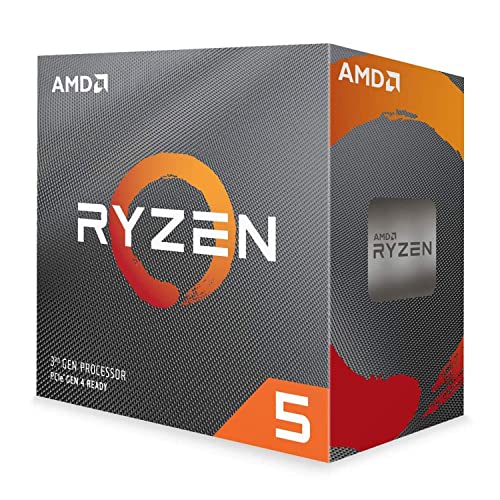
| AMD Ryzen 5 5600X | Best Performance-per-Dollar | 6c/12t, 4.6 GHz boost, 65W | $140-$190 | The 1080p value king, full stop |
| AMD Ryzen 5 3600 | Budget Pick | 6c/12t, 4.2 GHz boost, 65W | $100-$130 | Cheapest credible Ryzen for a budget build |
🏆 Best Overall: AMD Ryzen 7 5800X
The AMD Ryzen 7 5800X was the gaming flagship of the Zen 3 launch and remains the strongest pure-gaming AM4 chip in 2026. Eight cores and sixteen threads, 32MB of unified L3 cache, a 4.7 GHz boost, and a 105W TDP that demands a quality cooler. At ~$200-$250 it is no longer a deal in absolute terms, but it is the chip you buy when you want maximum 1080p frame rates without leaving the AM4 platform.
Pros
- Highest gaming throughput on AM4 outside the 5800X3D
- Eight true Zen 3 cores with full SMT — plenty of headroom for streaming, recording, voice chat, and background tasks
- 32MB L3 cache reduces memory latency for game workloads
- Unlocked multiplier for PBO and manual overclocking
Cons
- 105W TDP runs hot and needs a quality air cooler or 240mm AIO
- No bundled cooler in the box
- Pricing has stiffened — used 5800X3D chips are creeping into similar territory and beat it in pure gaming
The performance picture. Per Tom's Hardware's launch review and follow-up testing, the 5800X delivers ~5-10% higher 1080p average framerates than the 5700X in CPU-bound titles, and roughly equal performance in GPU-bound titles. At 1080p with an RTX 4060 or RTX 3060 12GB, you will rarely see the gap. Pair it with a higher-end card or a high-refresh competitive monitor and the difference becomes visible. The chip's real edge is the headroom it gives you to stream gameplay, run OBS, or background-compile a project without losing gaming frames.
Buy it if: You want the strongest AM4 gaming chip available new, you are pairing it with a mid-to-upper-range GPU, and you already plan to stream or multitask while gaming. You also need a real cooler — the 5800X is not a stock-fan chip.
Buy the Ryzen 7 5800X on Amazon →
💰 Best Value: AMD Ryzen 7 5700X
The AMD Ryzen 7 5700X is the smart-money alternative to the 5800X. Same eight Zen 3 cores, same 32MB L3 cache, marginally lower boost clock (4.6 vs 4.7 GHz), and dramatically lower TDP at 65W. In the vast majority of gaming benchmarks the 5700X lands within 3-5% of the 5800X — close enough that you cannot feel it during gameplay — while running cool enough that a basic tower air cooler handles it silently.
Pros
- 8c/16t at a 65W TDP — efficient, cool, quiet
- Within margin-of-error of the 5800X in gaming
- Lower thermal demands mean a $30 cooler is enough
- Strong used-market availability
Cons
- No bundled cooler
- Pricing has tightened — sometimes within $20 of the 5800X, which weakens the value case
- 5% slower than 5800X in CPU-bound titles
The performance picture. Per TechPowerUp's database entry, the 5700X is essentially a power-throttled 5800X with the same chiplet design. Real-world 1080p gaming benchmarks bear this out: 1-3% lower average framerates in most titles, 5-8% lower in the most CPU-bound benchmarks, and indistinguishable in GPU-bound games. The 65W TDP makes it the right pick for an SFF build, a quiet HTPC-gaming hybrid, or a builder who hates dealing with cooling headaches.
Buy it if: You want eight Zen 3 cores at minimum heat and noise, you do not need the last 3-5% of frames, and you value a $30 cooler over a $90 cooler.
Buy the Ryzen 7 5700X on Amazon →
🎯 Best for No-GPU Builds: AMD Ryzen 5 5600G
The AMD Ryzen 5 5600G is the only chip on this list with integrated graphics that can actually play games. Its Radeon Vega 7 iGPU is no replacement for a discrete card — expect 30-50 fps in older esports titles at 1080p Low, not modern AAA — but it is a genuine bridge for builders who cannot afford a GPU today or want a stopgap until prices normalize.
Pros
- Playable iGPU for esports, indie, and older AAA titles
- 6c/12t Zen 3 cores for general PC use, productivity, and emulation
- 65W TDP with bundled Wraith Stealth cooler — true single-purchase build
- Drop-in compatible with B450/B550/X570 with a BIOS update
Cons
- Only 16MB L3 cache (half of the 5600X/5700X) — slightly slower in CPU-bound games once you add a discrete GPU
- iGPU is not a substitute for even an entry discrete GPU in modern AAA
- Slightly lower gaming performance than the 5600X for the same money on builds with a discrete card
The performance picture. With a discrete GPU installed, the 5600G runs about 5-10% slower than the 5600X in CPU-bound 1080p titles because of the smaller L3 cache. Without a discrete GPU, the Vega 7 iGPU plays CS2, Valorant, League of Legends, Rocket League, Stardew Valley, and most older Steam titles at 1080p Low at smooth framerates; it struggles in any AAA title released after 2022. For a buyer with a sub-$700 total budget who cannot fit a GPU today, the 5600G is the only chip on this list that ships a complete picture out of the box.
Buy it if: You are building without a discrete GPU and want a real CPU you can pair with one later, OR you are building a light gaming/productivity PC for esports titles only.
Buy the Ryzen 5 5600G on Amazon →
⚡ Best Performance-per-Dollar: AMD Ryzen 5 5600X
The AMD Ryzen 5 5600X was the surprise value champion of the entire Zen 3 launch in 2020 and the title has stuck. Six Zen 3 cores, twelve threads, 32MB L3 cache, a 4.6 GHz boost, a 65W TDP, and the Wraith Stealth cooler in the box. At ~$140-$190 in 2026 it is the cheapest chip on this list that hits AAA gaming framerates indistinguishable from the 5700X and 5800X at 1080p with a typical mid-range GPU.
Pros
- The 32MB L3 cache punches above the 5600G and 3600 at the same core count
- Bundled cooler keeps total build cost low
- 65W TDP works in any AM4 case
- Strong used-market value if budgets are tight
Cons
- Six cores limits headroom for streaming and heavy multitasking
- 5-10% slower than the 5800X in CPU-bound games at high refresh
- DDR4-3200 is the comfortable speed; pushing to 3600 needs careful tuning
The performance picture. For pure 1080p gaming with a mid-tier GPU, the 5600X is within 1-2% of the 5700X and 3-7% of the 5800X. You will not feel any of that during gameplay. Where the gap shows up is sustained background work — if you stream, the eight-core 5700X gives you more frame budget; if you only game, the 5600X is the strictly better-value chip. Per AMD's official Ryzen product page, it remains the chip AMD points buyers to for "best mainstream 1080p gaming on AM4."
Buy it if: You only game, you want the best price/performance on this list, and you do not stream or run heavy background workloads.
Buy the Ryzen 5 5600X on Amazon →
🧪 Budget Pick: AMD Ryzen 5 3600
The AMD Ryzen 5 3600 is the floor of the credible-Ryzen lineup. Zen 2, six cores, twelve threads, 32MB L3 cache, a 4.2 GHz boost, 65W TDP, and the Wraith Stealth cooler. Significantly slower than any Zen 3 chip in CPU-bound 1080p gaming — typically 15-25% lower framerates in the worst cases — but cheap enough and capable enough to anchor a $500-total-build budget.
Pros
- Cheapest credible Ryzen chip available new
- Bundled cooler, low TDP, easy thermals
- Six full cores at 12 threads — plenty for any single-player game
- Drop-in compatible with B450/X470 motherboards (often a free-update path from a prior build)
Cons
- Meaningfully slower than Zen 3 chips at the same core count
- 4.2 GHz boost limits high-refresh competitive performance
- AM4 is a closed platform — this is your last upgrade path on this board's CPU socket
The performance picture. The 3600 runs almost any 1080p AAA title smoothly with a mid-range GPU, but it shows its age in CPU-bound competitive titles and in the worst modern open-world scenes. In Cyberpunk 2077's most demanding NPC-dense areas, expect 10-15 fps lower 1% lows than the 5600X. In Counter-Strike 2 and Valorant at high refresh, expect to leave 50-100 fps on the table versus a 5800X. For single-player gaming at 60 Hz or 75 Hz, the 3600 is unbothered.
Buy it if: You are building the absolute cheapest credible Ryzen gaming PC, you target 60 fps single-player gaming, and you are willing to upgrade to a Zen 3 chip later when budget allows.
Buy the Ryzen 5 3600 on Amazon →
What to look for in a budget AM4 gaming CPU
Core and thread count at 1080p
At 1080p with a mid-range discrete GPU, six cores and twelve threads is the practical floor for smooth gaming. Eight cores adds headroom for streaming, OBS encoding, background compilation, voice chat, and Discord-while-Spotify-while-game. More than eight cores rarely improves 1080p gaming framerates measurably — it is rare for a game to use more than six threads heavily today.
Cache and gaming
The 32MB L3 cache on the 5600X, 5700X, and 5800X is one of the biggest reasons Zen 3 chips outperform Zen 2 (16MB L3 on the 3600) at the same core count. Larger cache reduces memory latency and lets the CPU keep more of a game's hot data on-chip. The 5800X3D's 96MB L3 amplifies this further, but at a higher price point not covered in this guide.
TDP and cooling
The 65W chips (5600X, 5700X, 5600G, 3600) all run comfortably on $20-$30 tower coolers and ship with usable stock fans (except the 5700X). The 105W 5800X demands a serious cooler — a $50 tower like the Noctua NH-U12S Redux or a 240mm AIO is the realistic minimum for sustained gaming loads. Underspec the cooler on a 5800X and you will lose clock speed to thermal throttling.
Integrated graphics
Only the 5600G on this list has a useful iGPU. The rest require a discrete GPU. If your build budget cannot fit any GPU at all, the 5600G is the only chip here that gives you a working machine.
Platform and BIOS
Most B550, X570, and newer B450/X470 motherboards ship Ryzen 5000-ready out of the box in 2026. Older B450/X470 boards may need a BIOS flash before they post a Zen 3 chip. Check the motherboard manufacturer's CPU support list before buying, and if you are building from scratch, prefer B550 — it ships with current BIOS and supports PCIe 4.0 for NVMe and modern GPUs.
Sources
- AMD — Ryzen desktop processors landing page — official spec source for the Ryzen 5000 series.
- TechPowerUp — Ryzen 7 5800X CPU database — architecture details, cache, clocks.
- Tom's Hardware — AMD Ryzen 7 5800X review — independent benchmark coverage at launch.
Related guides
- Best Budget 1080p Gaming PC Parts 2026
- Ryzen 5 5600G vs Ryzen 7 5700X Budget Gaming Build 2026
- Intel i7-9700K vs Ryzen 7 5700X for 1080p Gaming 2026
- Noctua NH-U12S vs CoolerMaster ML240L: Air vs AIO on Ryzen 7 5800X
— Mike Perry