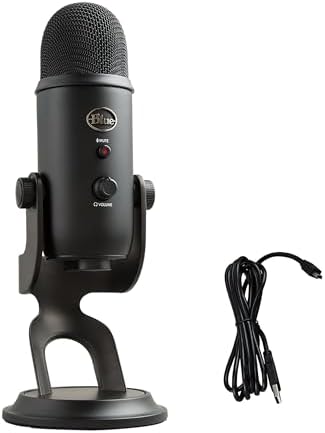
For most streamers in 2026, buy the HyperX QuadCast 2 S — it bundles a built-in shock mount, tap-to-mute, higher sample-rate capture, and RGB into one desk-ready package. Choose the Blue Yeti instead if you want four switchable polar patterns for podcasts and interviews, or if it is meaningfully cheaper the day you check out. Both are plug-and-play USB condensers that sound great for voice.
Who each mic is for
These two microphones dominate the streaming-starter market for the same reason: they are USB condensers you plug straight into a PC or console, with no audio interface and no phantom power to fuss over. But they aim at slightly different buyers. The QuadCast 2 S is built for the solo creator who wants a finished setup out of the box — the shock mount and pop filter are integrated, the tap-to-mute sensor sits on top, and the RGB lighting doubles as a mute indicator you can see at a glance. The Blue Yeti is the veteran generalist: its four-pattern capsule (cardioid, omnidirectional, bidirectional, stereo) makes it as happy recording a two-person podcast or an acoustic guitar as it is capturing a single streamer's voice.
Desk space and budget tilt the decision too. The Yeti is large and heavy, and it wants a bit of room or a boom arm. The QuadCast line is more vertical and self-contained. Neither is a poor choice — both have years of proven voice performance behind them — so the real questions are which features you will actually use, how noisy your room is, and which one is cheaper when you reach the checkout. This comparison walks through sound, noise handling, software, the rest of the starter kit, and a clear verdict for each type of creator.
Key takeaways
- Best all-rounder for streaming: HyperX QuadCast 2 S — integrated shock mount, tap-to-mute, RGB, higher sample-rate capture.
- Best for versatility: Blue Yeti — four polar patterns cover podcasts, interviews, and music, not just solo voice.
- No interface needed: Both are USB condensers with built-in conversion; plug in and select the device.
- Cardioid is the default: Solo streamers should use the cardioid pattern on either mic to reject room noise.
- Price is the tiebreaker: When both suit your use case, buy whichever is cheaper on the day — quality is close for plain voice.
Spec comparison at a glance
| Pick | Polar patterns | Sample rate / bit depth | On-mic controls | Price range |
|---|---|---|---|---|
| HyperX QuadCast 2 S | Cardioid + focused patterns | Up to 24-bit / high-rate | Tap-to-mute, gain dial, RGB | Mid |
| Blue Yeti | Cardioid, omni, bidirectional, stereo | 16-bit / 48kHz class | Mute button, gain, pattern dial, headphone volume | Low–mid |
The headline differences: the QuadCast 2 S pushes higher-resolution capture and folds the shock mount and pop filter into the body, while the Yeti's standout is the four-pattern dial that no single-pattern mic can match. Both expose a real-time headphone monitoring jack, which matters more than any spec line because it lets you hear yourself with zero latency.
How do they sound for voice vs music?
For spoken voice — the job 95% of streamers actually need — both mics are excellent and closer than their marketing suggests. The QuadCast 2 S tends toward a slightly brighter, more "produced" voice out of the box, which reads well on stream without EQ. The Yeti is a touch flatter and more neutral, leaving more room to shape the sound yourself. Published measurements and hands-on reviews of both consistently land in the same place: clean, full voice capture at a desk with no interface. For music, the Yeti pulls ahead, not because its capsule is dramatically better but because its omnidirectional and stereo patterns let you mic a room or an instrument properly, where the QuadCast's focus on solo-creator patterns is limiting. If you only ever talk into the mic, this difference never matters; if you sing, play, or record ensembles, the Yeti is the more flexible tool.
Which handles a noisy room better?
Any sensitive condenser will pick up an air conditioner, a mechanical keyboard, or a roommate if you let it. The defense is the same on both mics: use the cardioid pattern, which captures from the front and rejects sound from behind and beside the capsule, and set input gain conservatively so the mic is not straining to hear quiet sounds. The QuadCast 2 S's integrated shock mount helps reject desk thumps and keyboard vibration transmitted through the surface, which is a real advantage in a cramped setup. The Yeti benefits from a separate shock mount or boom arm to match that. In a genuinely loud environment, a software noise suppressor in OBS or your chat app cleans up the residue on either mic. Neither is a magic noise canceller — placement and gain staging do most of the work.
Plug-and-play and software: G Hub vs NGENUITY
Both mics work the instant you plug them in — no driver, no setup wizard — which is the entire point of a USB condenser. The optional software is where they diverge. The Blue Yeti integrates with Logitech G Hub for gain, pattern, and basic processing control. The HyperX QuadCast 2 S uses HyperX NGENUITY for RGB customization, gain, and the mute-sensor behavior. Neither suite is required for good audio; both mics sound right at default settings. The software matters mainly if you want to tweak lighting, save gain presets, or match the mic's RGB to the rest of a HyperX setup. For a first-time streamer, you can ignore both apps and still be live in minutes.
What else completes the setup?
A microphone is one leg of a three-legged stool. The other two are lighting and a clean camera feed. A ring light such as the NEEWER 18-inch Ring Light Kit fixes the harsh, uneven shadows that make a webcam feed look amateur — even, diffused light flatters the face and stabilizes your camera's exposure. For video quality, a capture device like the Elgato Cam Link 4K lets you use a real camera or a console's HDMI output as a high-quality source instead of a built-in webcam. Together with one of these microphones, those two pieces cover audio, lighting, and video — the credible-stream core. You do not need all of it on day one, but knowing where the upgrades go saves you from buying twice.
Real-world numbers: what the specs actually mean
Spec sheets list sample rates and patterns, but a few numbers translate directly into what you hear. Sample rate and bit depth (the QuadCast 2 S captures at a higher rate than the Yeti's 48kHz/16-bit class) set the ceiling on fidelity, but for spoken voice on a stream that ceiling is far above what listeners can distinguish through Twitch or YouTube compression — both are well past "good enough" for voice. The number that matters more day to day is self-noise: a quieter capsule lets you record soft speech without a hissy noise floor, and both mics are clean enough that gain staging, not the capsule, is your limiting factor.
| Measurement | Why it matters | Practical takeaway |
|---|---|---|
| Sample rate / bit depth | Fidelity ceiling | Both exceed what streaming compression preserves for voice |
| Self-noise | Hiss on quiet passages | Both low enough that placement matters more |
| Monitoring latency | Hearing yourself live | Both offer zero-latency headphone monitoring |
| Plosive handling | "P"/"B" pops | QuadCast's built-in filter wins out of the box |
The honest conclusion from the numbers: for streaming voice, the measurable differences between these two mics are smaller than the difference good placement and gain make on either one. Buy for the features and ergonomics you will use, then spend your effort on positioning and levels — that is where audible quality is actually won.
Verdict matrix
Get the HyperX QuadCast 2 S if...
- You want a finished, desk-ready setup with shock mount and pop filter integrated.
- You value tap-to-mute and a visible mute indicator mid-stream.
- You stream solo and want a bright, broadcast-ready voice with no EQ.
Get the Blue Yeti if...
- You record podcasts, interviews, or music and need multiple polar patterns.
- You want a neutral capture to shape yourself, or you already own a boom arm.
- It is meaningfully cheaper the day you buy — for solo voice, the gap is small.
Recommended pick
For the typical solo streamer building a first real setup, the HyperX QuadCast 2 S is the pick. It removes the most common beginner friction points — no separate shock mount to buy, an obvious mute control, and a voice that sounds finished without tuning. The Blue Yeti remains the smarter buy the moment versatility enters the picture: podcasts with a second person, interviews, or any music capture lean on its four-pattern dial, which the QuadCast cannot match. When both fit your use case, let price decide — for plain voice at a desk, you will be happy with either.
Real-world setup: gain, distance, and monitoring
Numbers make this concrete. Position either mic 6 to 12 inches from your mouth — closer than a foot and plosives and breath become a problem; farther and the room creeps in. Set input gain so normal speech peaks around -12 to -6 dBFS in your software, leaving headroom before clipping. Use the headphone monitoring jack on either mic to hear yourself in real time with zero latency, which is the single fastest way to catch a bad gain setting before you go live. If you speak loudly or game intensely, start gain lower than you think and raise it; a hot signal that clips is far harder to fix in post than a slightly quiet one you can normalize.
Common mic-setup mistakes that ruin good audio
- Mic too far away: Sitting back at arm's length lets the room dominate and forces high gain that amplifies noise. Bring the mic to within a foot of your mouth.
- Gain cranked to maximum: High gain captures every keyboard click and fan hum. Lower gain and lean in instead.
- No pop filter on plosives: The QuadCast's integrated filter helps; the Yeti benefits from an add-on filter to tame hard "P" and "B" sounds.
- Wrong polar pattern: Leaving a Yeti on omnidirectional for solo streaming captures the whole room. Switch to cardioid.
- Mic on the desk, not a boom: A desk stand transmits keyboard and mouse thumps through the surface. A boom arm with shock isolation fixes it — the QuadCast's built-in shock mount helps here.
When NOT to buy either of these
USB condensers are the right tool for the vast majority of streamers, but not everyone. If you are building a professional studio or want room to grow into mixers, multiple mics, and outboard processing, an XLR microphone with an audio interface is the better long-term path — it scales in ways a fixed USB device cannot. If you play fast competitive games and want to keep both hands on keyboard and mouse with the mic close to your mouth, a quality headset mic may be more practical than a desk condenser, even if it sounds a touch less rich. And if your room is acoustically terrible — bare walls, heavy echo — no microphone fixes that; treat the room first, because a better mic just captures the echo more clearly.
Related guides
- Best streaming microphone 2026
- Best USB microphone for streaming and podcasting
- Best streaming setup under $300
- Best streaming webcam + microphone bundle
- Best streaming mic + headset for console and PC
Citations and sources
- Logitech G — Blue Yeti USB microphone — official specs and polar-pattern details.
- HyperX — QuadCast 2 S product page — sample rate, controls, and feature list.
- Elgato — Cam Link 4K — capture-device specs for completing the video side of a setup.