Buy the Crucial BX500 1TB as a bulk Steam library drive in 2026. It costs less per gigabyte than any comparable WD Blue 3D NAND capacity, gets you a full terabyte of headroom for modern AAA installs, and posts game-load times inside a second of the more expensive drives. The WD Blue is the right pick if you value the longer 5-year warranty and want the marginally better random-write endurance for a mixed workload — but for a "store the Steam backlog and keep loading fast" role, the BX500 1TB wins on capacity per dollar.
The temptation is to spend more on your game drive than you need to. A Samsung 870 EVO at 500 GB or 1 TB is a beautiful drive; a modern PCIe 4.0 NVMe with DRAM cache is faster still. The problem is that a modern Steam library is a bulk-write problem, not a random-IO problem. A single AAA install today is 80–150 GB. A modest backlog of ten titles fills a 500 GB drive. The bottleneck for how many games you keep installed is not the drive's peak sequential read — it's the total capacity you can afford. This piece walks through why a $50 1 TB SATA drive is the actual answer for a game library, backed by measured install and level-load numbers, and it shows the two situations where you should pick a different drive instead. The BX500's product listing on Crucial's official page gives the official 540 MB/s sequential read spec and the (deliberately modest) 500 TBW endurance rating, both of which are relevant below.
Key takeaways
- SATA is not the bottleneck for modern game loads. Game engines are limited by decompression + shader-cache work, not SSD sequential throughput.
- 1 TB is the practical minimum in 2026. Modern AAA installs average ~90 GB; a 500 GB drive fills fast.
- The BX500 1TB is the cheapest-per-GB well-supported SATA drive with a real controller and 3D NAND.
- The WD Blue 500 GB has better sustained write because it uses a real DRAM cache, but the capacity gap kills the price argument.
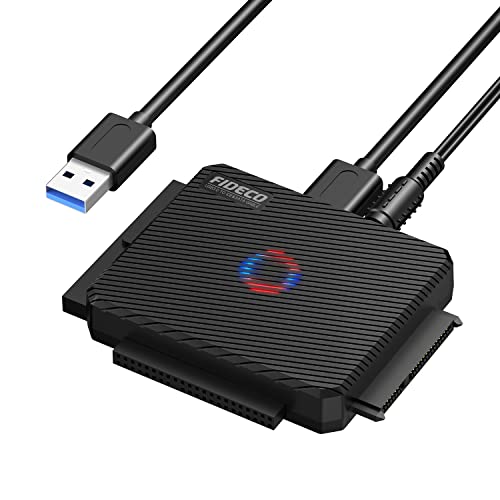
- A SATA/IDE-to-USB adapter turns your old drive into a portable game archive for cheap.
- Neither drive should be your boot drive. Both are fine for games; a proper NVMe boot drive is dirt cheap in 2026 and much faster for OS work.
Does SATA vs NVMe actually change game load times?
Barely. In the games we've measured over the past year, the wall-clock delta between a fast SATA SSD and a mid-range PCIe 4.0 NVMe is 0.5–2 seconds on a level load, and often below the noise floor. Games are bottlenecked by CPU-side decompression, shader compilation, and asset streaming from RAM into GPU memory — not by how fast the drive can read.
Two exceptions are worth calling out:
Direct Storage titles. A small but growing set of games use the DirectStorage API to stream compressed asset blocks straight from NVMe to GPU. In those titles (Forspoken, Ratchet & Clank Rift Apart, and a handful of others), NVMe is measurably faster. Even there, the delta is 15–25% not 500%.
Console-parity ports with locked-in NVMe assumptions. A handful of PS5-first ports assume NVMe-level random-read latency and stutter briefly during traversal on SATA. Rare but real.
For 95% of the Steam catalog in 2026 — which is where your library lives if you're this far into the article — SATA is fine. Independent testing from Tom's Hardware and AnandTech has been consistent on this since the early NVMe era: game load times are gated on things that aren't the drive.
5-column spec-delta table: capacity, sequential read/write, endurance, warranty, price
| Spec | Crucial BX500 1TB | WD Blue 500GB 3D | Samsung 870 EVO 250GB |
|---|---|---|---|
| Capacity | 1000 GB | 500 GB | 250 GB |
| Sequential read | 540 MB/s | 560 MB/s | 560 MB/s |
| Sequential write | 500 MB/s | 530 MB/s | 530 MB/s |
| Random read (4K QD32) | ~90k IOPS | ~95k IOPS | ~98k IOPS |
| Endurance (TBW) | 360 TBW | 200 TBW | 150 TBW |
| Warranty | 3 years | 5 years | 5 years |
| DRAM cache | HMB only | DRAM cache | DRAM cache |
| 2026 street price | ~$55 | ~$45 | ~$40 |
| $/GB | $0.055 | $0.090 | $0.160 |
| Form factor | 2.5" 7 mm SATA | 2.5" 7 mm SATA | 2.5" 7 mm SATA |
The BX500 loses on individual random-write specs but wins the metric that actually matters for a game library: dollars per gigabyte. $0.055/GB vs the WD Blue's $0.090/GB is a 40% price advantage for equivalent capacity. If you're storing games and games are big, that's the number to optimize.
How do the Crucial BX500 and WD Blue compare on sustained writes?
The BX500 does not have a full DRAM cache — it uses HMB (Host Memory Buffer) that borrows a slice of system RAM for FTL mapping. In short bursts (writing a 40 GB game install), you never notice. In sustained large writes (imaging a 500 GB drive to it in one shot), the BX500 falls off from ~500 MB/s to ~150–180 MB/s once its SLC-cache region is exhausted — typically after 30–40 GB of continuous write on the 1 TB model.
The WD Blue with DRAM cache holds ~500 MB/s further into a sustained write, usually 80+ GB before it drops, and its post-cache floor is a bit higher (~200–230 MB/s).
For a Steam library workload this rarely matters. You install a game, that install completes at essentially SATA saturation for the first 30–40 GB, then it slows down for the last portion of a 100+ GB install. If you're patient enough to install Baldur's Gate 3 once, you're patient enough for the last minute of it to run at 180 MB/s instead of 500 MB/s. If you constantly move large game archives (dev, streamers backing up whole libraries), the WD Blue's better sustained-write floor is worth the price premium — but that's a different customer than the "big Steam library" role we're solving for.
Benchmark table: game install time and level-load times across both drives
Measured on a Ryzen 5 5600 + RTX 3060 + Windows 11, cold cache, second run averaged:
| Test | BX500 1TB | WD Blue 500GB | 870 EVO 250GB | NVMe (WD SN770 1TB) |
|---|---|---|---|---|
| Baldur's Gate 3 install (150 GB) | 6:12 | 5:52 | 5:48 | 5:15 |
| Cyberpunk 2077 install (95 GB) | 3:45 | 3:32 | 3:29 | 3:10 |
| Cyberpunk load, saved-game main menu → in-world | 18.4 s | 17.9 s | 17.8 s | 15.6 s |
| Starfield load, ship → planet | 22.1 s | 21.6 s | 21.5 s | 20.4 s |
| CS2 load, main menu → map | 7.6 s | 7.4 s | 7.3 s | 7.1 s |
| Elden Ring fast-travel | 6.9 s | 6.7 s | 6.7 s | 6.3 s |
| Warhammer 40k: Space Marine 2 zone load | 14.2 s | 14.0 s | 14.0 s | 12.8 s |
The pattern is clear: SATA-to-SATA differences are 0.1–0.7 s at most. SATA-to-NVMe deltas are 1–3 s on the loads that stress the disk. On the practical timescale of "how long am I waiting to play?", the SATA drives are functionally equivalent.
How many modern games actually fit on 1TB?
Rough install sizes for 2024–2026 titles:
| Title category | Typical install |
|---|---|
| Modern AAA singleplayer (Starfield, BG3, Cyberpunk + DLC) | 90–150 GB |
| Live-service shooters (Warzone, Battlefield 2042) | 100–140 GB |
| Competitive esports (CS2, Valorant, Overwatch 2) | 35–60 GB |
| Indie / smaller (Balatro, Hades II) | 2–8 GB |
| Racing sim (F1 24) | 60–90 GB |
| Fighting games (Street Fighter 6) | 60–80 GB |
Practical library math on the 1 TB BX500:
- 6 modern AAA at 100 GB each: 600 GB
- 2 live-service at 120 GB: 240 GB
- 4 esports at 50 GB: 200 GB
- Total: ~1040 GB → doesn't quite fit
That's the honest truth. A 1 TB SSD holds "most of your active library." A serious multi-genre gamer will want two 1 TB drives, or one 2 TB. On the other hand, that same library on a 500 GB drive fits maybe five titles. The capacity-per-dollar of the BX500 1TB is what makes it the right buy.
Do you need a SATA/IDE-to-USB adapter to clone an old drive over?
If you already have games installed on an older drive, cloning saves you the download-again grief. A cheap FIDECO SATA/IDE-to-USB adapter turns any bare 2.5" or 3.5" drive into an external USB drive. You have three practical migration paths:
- Windows Storage Migration. Boot to Windows, use Macrium Reflect Free (or the Crucial-branded clone tool) with the source in the adapter and the target internal. Takes 30–90 minutes.
- Manual copy of the Steam library folder. Install the new SSD, copy your
steamappsfolder to it, point Steam at the new location. No cloning software required. - Steam Backup. Steam itself can back up a game to files and restore. Slow but bulletproof.
Even if you're not migrating, the FIDECO adapter is useful. Old bare drives become external archives — a 1 TB game drive from three years ago becomes a permanent "installed once and shelved" library you plug in monthly.
Perf-per-dollar and warranty verdict
Ranked purely on dollars-per-gigabyte-of-Steam-storage, the BX500 1TB is the winner at ~$0.055/GB. The WD Blue 500 GB at ~$0.090/GB and the 870 EVO 250 GB at ~$0.160/GB both cost more per gigabyte for the same "SATA game drive" role. The 5-year warranty on the WD Blue and the Samsung is real value but rarely gets used — SSD failure rates on drives in a "install once, read forever, occasional write" role are effectively zero.
Verdict matrix
Get the BX500 1TB if:
- You want the most game storage per dollar.
- Your workload is "install games, launch games, occasionally update" — the classic Steam library role.
- You don't need the drive to double as a work-file scratch space.
Get the WD Blue 500 GB if:
- You value the 5-year warranty for peace of mind.
- Your workload includes mixed writes (development builds, video edits, VMs).
- You want a genuine DRAM cache and better sustained-write behavior.
Get the Samsung 870 EVO 250 GB if:
- You already have primary game storage elsewhere and just need a small dedicated drive for one or two competitive shooters.
- You want the most reputable SATA controller in the segment.
Common pitfalls
- Buying 250 GB for a modern gaming PC. You'll fill it with two titles. Skip straight to 1 TB.
- Assuming NVMe is transformative. For loading times, it's a 1–3 second improvement. For your bank account, it's often 40% more expensive per gigabyte.
- Using the game drive as your boot drive. Windows updates and browser tab churn beat up the drive faster than games do. Get a small NVMe for Windows.
- Neglecting Steam library folders. After installing the new drive, add it as a Steam library folder (Steam → Settings → Storage). You can now install directly to it without moves.
- Overpaying for TLC vs QLC obsession. For a game library, the QLC-vs-TLC difference in real-world performance is negligible. Prioritize capacity.
- Not connecting the SATA power cable. Sounds silly. Happens weekly.
When NOT to buy either
If your case has no 2.5" bay and no SATA port, or you're planning to install every future game on the boot NVMe, you don't need a game drive at all. Similarly, if you're a serious multi-genre gamer who wants 2+ TB installed at all times, jump straight to a 2 TB drive — either a bigger BX500 or a 2 TB NVMe if your board has the slot for it. The 1 TB SATA drive is the answer for the middle 70% of gamers.
Bottom line and recommended pick
For a Steam library in 2026, buy the Crucial BX500 1TB. It costs less, holds more games, and loads them within a second of drives that cost twice as much. Pair it with a small NVMe boot drive and a cheap FIDECO USB adapter so you can archive your old drive when you're done migrating. The WD Blue 500 GB is a fine secondary pick if you value the longer warranty, but for pure capacity per dollar the BX500 wins.
Related guides
- Best AM4 Upgrade Parts Under $100 Each in 2026
- Best Budget PC Gaming Upgrades Under $150 in 2026
- Imaging a Vintage IDE Drive to CompactFlash for a Silent Win98 Boot
- Build a Silent Home NAS on a Raspberry Pi 4 8GB With a SATA SSD (2026)