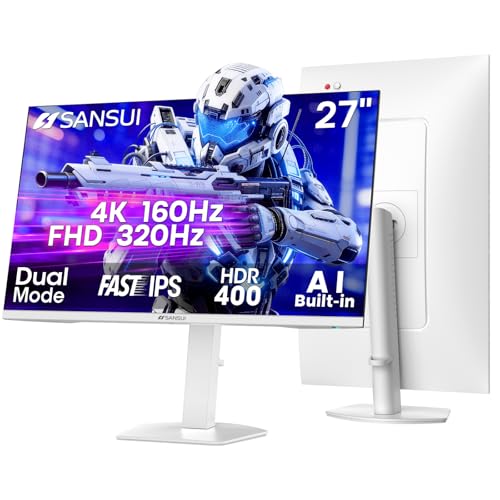
For an RTX 3060 12GB, a 27-inch 1440p high-refresh IPS monitor like the ASUS TUF Gaming VG27AQ is the sweet spot — the card sustains 60-120 FPS at 1440p in most titles with adaptive sync smoothing the rest. Step up to a KOORUI 27" 4K QD-Mini LED or SANSUI 27" 4K only if you also do creative work; otherwise 4K is a poor pairing for the card.
Step 0 — can the RTX 3060 actually drive 1440p at high refresh?
In most titles, yes — but with realistic expectations. The RTX 3060 12GB averages 80-120 FPS at 1440p high settings in esports titles (CS2, Valorant, Apex Legends, Rocket League), 50-80 FPS in modern AAA titles at high settings (Hogwarts Legacy, Spider-Man Remastered, Forza Horizon 5), and 30-50 FPS in path-tracing or heavy-RT titles unless you enable DLSS or drop settings to medium.
That envelope makes 1440p the right native resolution for the card. 1080p leaves a lot of GPU on the table — the 3060 routinely runs into CPU bottlenecks in esports titles at 1080p that 1440p alleviates by shifting more work back to the GPU. 4K is a stretch — the card runs out of GPU first, dropping frame rates into the 30-50 FPS range in modern AAA titles, where adaptive sync and DLSS only partially close the gap.
Key takeaways
- 1440p high-refresh IPS is the textbook match for the 3060 12GB.
- 144Hz is not wasted — the 3060 frequently exceeds 100 FPS at 1440p in many titles.
- Adaptive sync (FreeSync / G-Sync Compatible) is non-negotiable.
- 4K monitors pair better with 4070-tier cards or higher; the 3060 is a poor 4K pairing.
- IPS panels suit mixed gaming + general use; VA panels suit darker games.
What frame rates does the RTX 3060 hit at 1440p?
Public testing from RTINGS and TechPowerUp's RTX 3060 specs-based reviews puts the card in the following 1440p envelope for typical modern PC games:
| Title tier | Settings | Approx FPS |
|---|---|---|
| Esports (CS2, Valorant, Apex) | high | 90-130+ |
| Mid-2020s AAA (Cyberpunk 2077, no RT) | high | 50-75 |
| Late-2020s AAA (Spider-Man, Hogwarts Legacy) | high | 50-70 |
| Heavy RT (path tracing) | balanced + DLSS | 30-50 |
| Older / indie games | max | 100-200+ |
The 3060 averages around 60-70 FPS in modern AAA at 1440p high settings — comfortably above the 30 FPS console-equivalent floor, comfortably below the 144 FPS+ esports target. That's the right range for a 1440p 144Hz monitor with adaptive sync: the variable refresh keeps motion smooth across the 50-140 FPS range the card actually delivers.
The picks
#1 — ASUS TUF Gaming VG27AQ (best 1440p match)
The ASUS TUF Gaming 27" 2K HDR is the cleanest 1440p pairing for the RTX 3060 12GB. 27 inches, 2560×1440 IPS, 165 Hz refresh, G-Sync Compatible. The price band ($270-$310) lands at the sweet spot where you're not paying for refresh rates the card can't feed or resolution it can't drive.
When it's right: pure 1440p gaming, mixed gaming + general use, builders who specifically want IPS color and viewing angles, anyone who values ASUS's TUF build and warranty. When it's not: builders who do significant creative work (color-critical photo or video editing benefit from higher-tier panels), or builders who specifically want OLED or mini-LED HDR.
#2 — KOORUI 27" 4K QD-Mini LED (step-up if you also do creative work)
The KOORUI 27" 4K QD-Mini LED is a 4K dual-mode panel — UHD 160Hz or FHD 320Hz — with QD-mini LED backlighting that delivers genuinely impressive HDR. Roughly 2x the price of the ASUS TUF.
When it's right: builders who do photo or video work alongside gaming, anyone who watches significant 4K video content on the same display, builders who want the higher-tier HDR experience and don't mind paying for it. When it's not: pure gaming-first builds — the 3060 doesn't drive 4K at high enough frame rates to justify the panel's resolution and refresh capabilities. We covered the GPU pairing in Best budget 4K monitor for RTX 3060 build.
#3 — SANSUI 27" 4K (budget 4K option)
The SANSUI 27" 4K Gaming Monitor is the budget 4K pick — a fast IPS dual-mode (UHD 160Hz or FHD 320Hz) panel that lands well below the KOORUI on price.
When it's right: builders who want 4K resolution on a budget, those who plan to upgrade the GPU later and don't want to replace the monitor too, anyone who specifically wants 27-inch 4K for content consumption. When it's not: pure 1440p gaming builds (the ASUS TUF is the right answer at a lower price), or builders who want premium HDR (the SANSUI's HDR is functional, not premium).
Spec-delta table
| Monitor | Size | Native res | Refresh | Panel | Sync | Price band |
|---|---|---|---|---|---|---|
| ASUS TUF VG27AQ | 27" | 2560×1440 | 165 Hz | IPS | G-Sync Compatible | $270-$310 |
| KOORUI 27" 4K QD-Mini LED | 27" | 3840×2160 | 160 Hz | QD-mini LED | FreeSync | $480-$550 |
| SANSUI 27" 4K | 27" | 3840×2160 | 160 Hz | IPS | FreeSync | $280-$340 |
The ASUS TUF's $270-$310 price for 1440p 165Hz IPS is the value benchmark in this comparison. The two 4K options demand meaningfully more for resolution the 3060 doesn't reliably drive.
Refresh rate vs resolution: why 1440p suits the 3060 better than 4K
The trade is straightforward. Going from 1080p to 1440p at the same refresh adds roughly 30-50% load on the GPU; going from 1440p to 4K adds another 50-80%. The 3060 absorbs the 1080p→1440p step well — frame rates drop from 130-150 FPS to 90-120 FPS in many titles, well within the variable refresh window of a 144Hz monitor. The 1440p→4K step is harder — frame rates drop from 90-120 FPS to 40-60 FPS in many titles, and below the 60 FPS floor in heavier ones.
That's why a 1440p high-refresh panel matches the card's output curve better than a 4K panel. The 4K panel asks for frame rates the card can't reliably deliver in modern AAA titles; the 1440p panel runs comfortably above its refresh ceiling in esports and within its adaptive sync range in AAA. We covered the 1080p case in Best budget GPU for 1080p esports — for the 3060 specifically, that piece argued 1080p was leaving GPU on the table.
What to look for
- Adaptive sync support. FreeSync or G-Sync Compatible is non-negotiable for an RTX 3060 build. The card's variable frame rates make tear-free smooth motion impossible without it.
- Response time. 1ms GTG specs are marketing; real response time on an IPS panel is 4-7ms. For esports, look for verified low-latency reviews (RTINGS, TFTCentral).
- Refresh rate. 144Hz is the floor for a modern gaming monitor; 165-180Hz is the practical ceiling for the 3060's typical output. Beyond 240Hz is wasted on this GPU.
- Panel tech. IPS for color and viewing angles; VA for deeper blacks and contrast in dark games; OLED for premium HDR (typically out of budget here).
- Resolution-to-GPU match. The 3060's sweet spot is 1440p. Buying for the next GPU is fine if you're upgrading soon, otherwise match the panel to the card.
Perf-per-dollar closing math
The ASUS TUF at $270-$310 plus the 3060 12GB at $310-$390 is a $580-$700 display + GPU pair that delivers honest 1440p 144Hz gaming. The KOORUI 4K at $480-$550 plus the same GPU is a $790-$940 pair that compromises on frame rates in modern AAA. The SANSUI 4K at $280-$340 splits the difference but inherits the same 4K-on-a-3060 problem.
For pure gaming dollars, the 1440p ASUS TUF is the best math. For mixed gaming + creative dollars, the KOORUI 4K is the better all-rounder. For a build that will get a 4070-class GPU later, the SANSUI 4K is the future-proof play.
Verdict matrix
- Get the ASUS TUF VG27AQ if you want the cleanest 1440p high-refresh experience for a budget GPU. This is the right answer for most builders.
- Step up to the KOORUI 4K QD-Mini LED if you also do creative work and want premium HDR. Accept the 4K-vs-3060 tradeoff in modern AAA.
- Take the SANSUI 4K if you want 4K resolution on a budget and plan to upgrade the GPU later.
- Skip OLED for now — premium OLED monitors are out of budget for an RTX 3060 build. See our ASUS ProArt OLED 4K coverage for the higher tier.
Bottom line
A 27-inch 1440p 144Hz IPS monitor with adaptive sync is the textbook match for the RTX 3060 12GB. The ASUS TUF VG27AQ delivers exactly that at the right price. Step up to a 4K panel only if you have other reasons (creative work, content consumption, future GPU upgrades) — the 3060 isn't a 4K gaming card, and a 4K panel asks for frame rates it can't reliably deliver in modern AAA. The card and the right monitor together cost $580-$700; that's the value sweet spot for honest 1440p high-refresh gaming in 2026.
Common buyer mistakes
- Buying a 4K monitor for an RTX 3060. The card doesn't reliably drive 4K at high frame rates in modern AAA. The monitor will spend most of its time running at non-native or with heavy upscaling.
- Buying a high-refresh panel without adaptive sync. The 3060's variable frame rates make this a wasted purchase — you'll see tearing or input lag depending on how you compensate.
- Buying a monitor with a 1ms-marketed response time but slow real-world response. Marketing specs aren't measured response. Look at RTINGS for verified numbers.
- Buying a curved ultrawide for an RTX 3060. Ultrawides at 3440×1440 are equivalent to running at 1440p with extra GPU load on the sides. The 3060 handles it but the math is tighter than a regular 1440p panel.
- Overpaying for OLED on a budget GPU. OLED is incredible for the right buyer, but the price-per-pixel-quality math is much better on a $280-$310 IPS 1440p panel for a 3060 build.
- Going 27-inch on a small desk. 24-inch 1440p is sharper text and a more dense pixel layout; 27-inch is more screen real estate but at 1440p the pixel density drops slightly. Match the size to the desk.
A worked example: 1440p high-refresh on a budget build
For a builder pairing the ZOTAC RTX 3060 12GB with the ASUS TUF VG27AQ, here's what the experience looks like at typical settings in 2026 titles:
| Game | Settings | Avg FPS | 1% Low |
|---|---|---|---|
| CS2 | high | 180-220 | 100+ |
| Valorant | high | 200+ | 140+ |
| Apex Legends | high | 100-130 | 70+ |
| Cyberpunk 2077 (no RT) | high | 55-70 | 40+ |
| Spider-Man Remastered | high | 60-75 | 45+ |
| Hogwarts Legacy | high | 50-65 | 35+ |
| Forza Horizon 5 | high | 80-100 | 65+ |
| Elden Ring | max | 60 (cap) | 60 |
Adaptive sync keeps everything smooth across that 35-220 FPS range. The 144Hz refresh isn't wasted in esports titles; the 50-70 FPS floor in AAA is well-served by the variable refresh and DLSS where available.
When NOT to buy a 1440p monitor for a 3060
A few scenarios where this pairing is the wrong call:
- You're upgrading the GPU within 6 months. Buy the monitor that matches the next GPU, not this one.
- You play exclusively competitive esports at the highest possible framerate. A 1080p 240Hz panel may serve you better — the 3060 will push 240+ FPS at 1080p in esports titles.
- You do significant photo or video editing. Step up to a color-calibrated panel (often 4K or higher color gamut) and accept the gaming tradeoffs.
- Your desk is tiny. A 32-inch monitor won't fit comfortably; consider a 24-inch 1440p instead.
Pairing notes for the 3060 build
For a complete 1440p gaming build around the RTX 3060 12GB:
- CPU: Ryzen 7 5800X for headroom, or 5600G for the budget tier (see our CPU shootout).
- Memory: 32GB DDR4-3200 minimum, 3600 if you tune.
- Storage: WD Blue SN550 1TB NVMe boot + Crucial BX500 1TB SATA SSD for games.
- PSU: 650W gold-rated.
- Monitor: ASUS TUF VG27AQ is the recommended pairing.
Total build cost: roughly $1100-$1300 including the monitor. The 3060 + ASUS TUF combo at ~$580-$700 is the price-anchored sweet spot for honest 1440p high-refresh in 2026.
Related guides
- Best budget GPU for 1440p gaming on the RTX 3060
- Best budget 4K monitor for an RTX 3060 build
- Best budget GPU for 1080p esports
- ASUS ProArt PA27USD OLED 4K gaming monitor