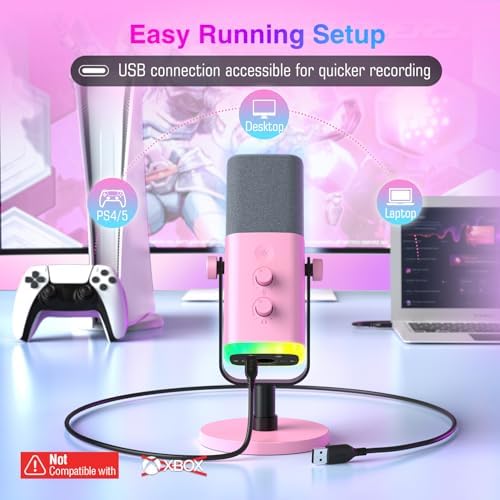
The best USB microphone for most streamers and podcasters in 2026 is the HyperX QuadCast 2 — it sounds broadcast-clean out of the box, the tap-to-mute and built-in shock mount remove two common headaches, and it costs a fraction of an XLR rig. If you want a warmer, more forgiving voice for spoken-word podcasting, the Shure MV7+ is the upgrade pick; on a tighter budget, the Samson Q2U delivers genuinely good sound for around $70. Below is how the field actually stacks up, who each mic is for, and the trade-offs nobody mentions until you're live.
🛒 Prices on USB mics move constantly. Each pick links to a live Amazon search so you see current pricing rather than a stale number.
Our picks at a glance
| Mic | Best for | Pattern(s) | Why it makes the list |
|---|---|---|---|
| HyperX QuadCast 2 | Overall / streaming | Cardioid, omni, bi, stereo | Clean condenser sound, tap-to-mute, internal shock mount |
| Shure MV7+ | Podcasting / voice | Cardioid (dynamic) | Dynamic capsule rejects room noise, USB + XLR, onboard DSP |
| Logitech Yeti GX | Versatile value | Cardioid (dynamic) | Lightning-fast setup, LightSync RGB, strong rejection |
| Elgato Wave DX | Stream-deck ecosystems | Cardioid (dynamic) | Wave Link mixing, clip-free at high SPL |
| Samson Q2U | Budget | Cardioid (dynamic) | XLR + USB, near-broadcast value under $80 |
HyperX QuadCast 2 — the default recommendation
The QuadCast 2 earns the top slot because it gets the fundamentals right with the fewest accessories. The condenser capsule is detailed and present without sounding brittle, four polar patterns cover solo casting, two-person podcasts, and instrument capture, and the elastic shock mount is built in rather than a $30 add-on. The capacitive tap-to-mute is the feature you'll use every session, and the gain dial on the base means you're not diving into software mid-stream. Its one real weakness is the flip side of being a condenser: in an untreated, echoey room it will pick up your keyboard, your AC, and your dog. If your space is reflective, skip to the dynamic options below.
Check the HyperX QuadCast 2 on Amazon →
Shure MV7+ — the podcaster's choice
The MV7+ is the closest thing to a "cheat code" for people who can't treat their room. As a dynamic mic with a tight cardioid pattern, it ignores most of what isn't directly in front of it — fan noise, keyboard clatter, room echo — so your voice stays the focus. It carries both USB-C and XLR, meaning it grows with you from a laptop today to an audio interface later without rebuying. Onboard DSP adds real-time denoise, reverb, and tone shaping through Shure's MOTIV software. The catch is gain: like the SM7B it's modeled after, it wants a lot of clean input level, so position it close (a fist-width away) and don't expect it to flatter a quiet talker from across the desk.
Check the Shure MV7+ on Amazon →
Logitech Yeti GX — versatile value
The Yeti GX is Logitech's dynamic redesign of the mic that defined the category, and it fixes the original Blue Yeti's biggest flaw: sensitivity. Where the classic Yeti was a condenser that heard everything, the GX uses a dynamic capsule with much better off-axis rejection, so it's far more usable on a normal desk. Setup is effectively plug-and-play, G HUB handles gain and EQ, and LightSync RGB ties it into a streaming aesthetic if you want it. It's a cardioid-only mic, so the multi-pattern flexibility of the QuadCast is gone — but for a single-host stream that's rarely missed.
Check the Logitech Yeti GX on Amazon →
Elgato Wave DX — for the Stream Deck crowd
If your setup already revolves around Elgato gear, the Wave DX is the natural fit. It's a dynamic cardioid mic that pairs with Wave Link, Elgato's software mixer that lets you balance mic, game, chat, and music on independent channels and route them where you want — a genuine advantage for live production. The DX handles loud sources without clipping thanks to Clipguard-style headroom, and it looks at home on a low-profile boom arm. Outside the Elgato ecosystem its appeal narrows, since the software integration is most of the value.
Check the Elgato Wave DX on Amazon →
Samson Q2U — the budget standout
The Q2U has quietly been the smart-money pick for years, and 2026 hasn't changed that. For roughly $70 you get a dynamic cardioid mic with both USB and XLR outputs and a headphone jack for zero-latency monitoring — a feature set that reads like a mic costing twice as much. The sound is warm and broadcast-adjacent, the dynamic capsule keeps room noise down, and the dual outputs mean it's the rare budget mic you won't outgrow the moment you buy an interface. The bundled accessories are basic and the styling is utilitarian, but on pure audio-per-dollar nothing here beats it.
Check the Samson Q2U on Amazon →
Condenser vs dynamic: the choice that actually matters
Before price or brand, decide on capsule type, because it determines how forgiving the mic is. Condensers (the QuadCast 2) are more sensitive and detailed — fantastic in a quiet, treated space, punishing in an echoey one. Dynamics (the MV7+, Yeti GX, Wave DX, Q2U) are less sensitive by design, so they reject room noise and tolerate untreated spaces, at the cost of needing more gain and closer mic technique. If you stream from a bedroom with bare walls, a dynamic will sound more professional than a pricier condenser. If you've got carpet, curtains, and a closed door, a condenser rewards you with more air and detail.
How to get broadcast sound from any of these
The mic is half the equation; placement and gain are the other half. Keep the capsule about a fist-width from your mouth and slightly off-axis to reduce plosives, add a pop filter for any condenser, and set gain so normal speech peaks around -12 dB with headroom to spare. A cheap boom arm does more for your audio than upgrading the mic, because it lets you position the capsule correctly and isolates it from desk thumps. Finally, monitor with headphones — every mic here except the entry RGB models offers zero-latency monitoring, and hearing yourself is the fastest way to fix technique.
