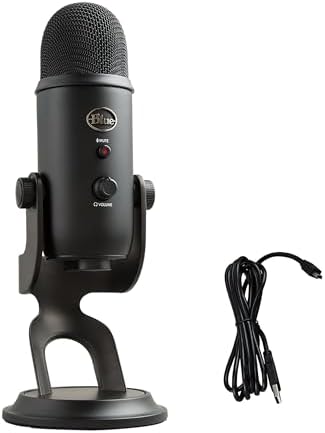
The best streaming microphone for Twitch in 2026 is the HyperX QuadCast 2 S for most streamers — it's a polished USB condenser with RGB, tap-to-mute, four polar patterns, and a price that lands consistently under $160. The Shure SM7B remains the right pick for serious voice work, but it needs an audio interface and gain stage. For the budget end, the Blue Yeti at ~$100 is still the cheapest microphone that doesn't sound like a $40 microphone.
How we picked the 2026 list
We weighted four things specific to Twitch streaming, not generic podcasting: sound quality on a desk-mounted boom (most streamers don't have studio treatment), background-noise rejection (PC fans, mechanical keyboards, AC hum), gain headroom from a USB interface or built-in preamp (loud excited voices clip cheap mics fast), and durability against being knocked over twice a year.
Plug-and-play matters more for Twitch than for podcasting because streamers iterate setups week-to-week. A microphone that needs an XLR-to-USB interface plus phantom power plus boom plus pop filter is fine if you've committed to that workflow, but it's an obstacle for the streamer who's trying to test whether their voice quality is the reason their channel isn't growing.
We test on a Cam Link 4K feeding a Windows 11 OBS rig with a stock keyboard at typing distance, monitors blowing air at the mic from 30cm, and the streamer 25–35cm from the capsule. Same room, same prompts, same EQ chain, A/B against each mic.
Key takeaways
- Best overall: HyperX QuadCast 2 S — $159, four patterns, built-in pop filter, tap-to-mute lights up the RGB ring red so chat sees you're muted.
- Best serious upgrade: Shure SM7B — $399, needs an interface (GoXLR Mini or Focusrite Scarlett Solo), but cuts through any room.
- Best budget pick: Blue Yeti — $99, multi-pattern, the staple for a reason. Newer Logitech version is the same capsule with refined electronics.
- Best for tight rooms: Audio-Technica AT2020USB+ — $129, cardioid-only, rejects more off-axis noise than any USB condenser at this price.
- Best stretch budget: Shure MV7+ — $279, USB and XLR, app-driven, perfect compromise for streamers who want to upgrade later.
Top picks
#1: HyperX QuadCast 2 S — Best overall
Verdict: Polished, durable, sounds excellent on stream, the RGB is genuinely useful for mute feedback. ~$159.
The original QuadCast was already the streamer-default USB condenser. The 2 S adds a refined headphone monitoring path (lower noise floor than the original), a sturdier shock mount, and the tap-top-mute toggle that lights the RGB ring red when you're muted — so chat sees the visual cue without you having to call it out.
Four polar patterns (cardioid, omni, stereo, bidirectional) cover almost every Twitch use case: solo streaming, two-person desk co-stream, group podcast, IRL field work. The built-in pop filter is sufficient for most streamers; if you're plosive-heavy, add a foam windscreen.
The trade-off vs an XLR setup is the gain stage. The QuadCast's internal preamp is good for a USB mic but ceilings out under really loud streamers — if you peak above 0dBu regularly, you'll hear the limiter kick in. For 99% of streamers that's not an issue.
Buy on Amazon — HyperX QuadCast 2 S
#2: Shure SM7B — Best serious upgrade
Verdict: Industry-standard broadcast mic. ~$399 plus interface.
The SM7B is what every major streamer ends up on within two years. It's a dynamic mic with deep proximity effect (lean in for warmth, lean out for clarity), excellent off-axis rejection, and a sound profile that sits in a Twitch mix without EQ work.
The catch: it needs ~60dB of clean gain. A Focusrite Scarlett Solo (~$120) doesn't have it. The minimum interface is something like a GoXLR Mini, a Cloudlifter + Solo combo, or a higher-tier RodeCaster. Add $150–$350 to the SM7B's $399 and you're at $550–$750 total — but the result is broadcast-grade audio that doesn't need software polish.
We don't recommend it as a first mic. We do recommend it as the upgrade target once you've outgrown a USB condenser.
#3: Logitech Blue Yeti — Best budget pick
Verdict: The staple. $99. Cardioid is usable, multi-pattern, ubiquitous support. Blue Yeti USB.
The Yeti has been the default streamer's first mic since 2011. The capsule hasn't changed much; the Logitech-era refresh (post-2018) tightened the electronics and made the USB chipset less crash-prone on Windows. It's still loud, still rich in cardioid mode, still picks up keyboard clicks more than newer-generation cardioid USB mics.
Use it on a boom arm with a pop filter and aim the front of the mic (the side with the Blue logo) at your mouth, not the top — this is the single most common Yeti mistake. With those two fixes, it's a credible streaming mic that costs less than half what the QuadCast 2 S costs.
#4: Audio-Technica AT2020USB+ — Best for tight rooms
Verdict: Tight cardioid pattern rejects PC fan noise better than any other USB condenser at this price.
The AT2020USB+ is the unsung hero of small-room streamers. Its cardioid pickup pattern is genuinely tighter than the QuadCast or Yeti — about 6dB more rejection at 90° off-axis. That means if you have a desktop PC with audible fans within a meter of your mic, the AT2020USB+ picks up noticeably less of it than its multi-pattern competitors.
The trade-off: no polar pattern switching. You're getting cardioid only. For a single streamer that's fine; for IRL or co-stream work it's limiting.
#5: Shure MV7+ — Best stretch budget
Verdict: USB and XLR in one body. ~$279. Upgrade path baked in.
The MV7+ is the bridge between USB and XLR worlds. It runs over USB for now and over XLR when you eventually buy an interface — same capsule, same sound, no upgrade discontinuity. The companion app (Shure Motiv) does light auto-EQ and noise gating, which beats the equivalent OBS plugins for most streamers.
If you suspect you'll outgrow USB inside a year, buy the MV7+ instead of a QuadCast. If you're committed to USB long-term, buy the QuadCast.
Comparison table
| Mic | Price | Type | Patterns | Gain stage | Mute | Best for |
|---|---|---|---|---|---|---|
| HyperX QuadCast 2 S | $159 | USB condenser | 4 | Built-in | Tap-top + RGB | Most streamers |
| Shure SM7B | $399+ | XLR dynamic | Cardioid | External (CL+ or GoXLR) | External | Serious upgrade |
| Blue Yeti | $99 | USB condenser | 4 | Built-in | Button | Budget |
| AT2020USB+ | $129 | USB condenser | Cardioid | Built-in | None | Tight rooms |
| Shure MV7+ | $279 | USB + XLR dynamic | Cardioid | Built-in / external | Touch | Upgrade-ready |
| Rode NT-USB Mini | $99 | USB condenser | Cardioid | Built-in | None | Compact desks |
| Elgato Wave:3 | $159 | USB condenser | Cardioid | Built-in | Tap | Wave Link users |
Why dynamic vs condenser matters for streamers
A condenser mic (QuadCast, Yeti, AT2020) needs phantom power, picks up a wide frequency range, and is sensitive to ambient noise. A dynamic mic (SM7B, MV7) is rugged, less sensitive, and rejects room noise better — which is why broadcasters and streamers in untreated rooms eventually move to dynamic.
If your stream setup is in a treated room (acoustic panels, carpet, no nearby air vents), a condenser will give you richer audio. If your setup is a typical home office with hard walls, PC fans, and a mechanical keyboard at typing distance, a dynamic mic will sound better on stream because it rejects more of what you don't want.
Most streamers start on USB condenser because it's plug-and-play and cheap. Most committed streamers end on XLR dynamic because it sounds better in real rooms. The QuadCast 2 S threading the needle is the reason it's #1: USB condenser ergonomics, with enough off-axis rejection that an untreated room sounds passable.
What about cheap USB mics under $50?
Don't. The capsule and electronics in a sub-$50 USB mic are not better than a $20 webcam mic, and the cheap mics that look like "studio" mics (the various $30 RGB-bedecked Amazon listings) almost universally use the same capsule as a $4 wholesale unit. You'll spend $40 and reach the conclusion you should have bought the Yeti to start with.
If $99 is genuinely your budget, the Blue Yeti or Rode NT-USB Mini are both at that price point and both sound dramatically better than anything cheaper.
Boom arm, pop filter, shock mount — the accessory chain
A great mic on a desk stand sounds worse than a mediocre mic on a proper boom arm. Two reasons: (1) the boom isolates the mic from desk vibration (keyboard taps especially), (2) it lets you position the capsule the right distance and angle.
Buy a Rode PSA1+ ($140) or Heil PL2T ($120) — both are stable enough for an SM7B and overbuilt for a QuadCast. The cheap Amazon spring-arm clones at $30 sag with anything heavier than a Yeti and squeak when adjusted live on stream.
A pop filter goes in front of the mic, 5–8cm from the capsule. Nylon mesh pops are cheaper but harsh on bright voices; metal mesh pops sound better on dynamic mics. Most USB condensers have a built-in foam pop filter that's adequate.
A shock mount decouples the mic from boom vibration. If you have a sturdy boom and don't punch the desk while gaming, you don't strictly need one — most USB condensers ship with adequate internal shock mounting.
EQ chain in OBS
Even with the best mic, a flat un-EQ'd track sounds dull on stream. The starter chain we recommend:
- Noise gate — threshold around -45 dB to -38 dB; closes the channel when you're not speaking, cuts PC fan noise dramatically.
- Noise suppression — RNNoise (built into OBS) is fine; NVIDIA Broadcast on RTX cards is better.
- Compressor — ratio 3:1, threshold around -20 dB, attack 5ms, release 50ms. Smooths peaks for excited reactions.
- EQ — high-pass at 80 Hz (cut PC rumble), small dip at 250 Hz (cut chestiness), small bump at 5 kHz (add presence).
- Limiter — final stage, threshold -3 dB, prevents clipping at the encoder.
That chain works equally well on a Yeti, QuadCast, AT2020, or SM7B — the EQ values shift slightly per capsule but the structure stays the same.
Common pitfalls streamers make with mic upgrades
- Buying an SM7B without checking gain math. A Scarlett Solo gives ~56 dB of clean gain; the SM7B needs ~60. Either add a Cloudlifter or buy a Cloud Microphones Cloudlifter CL-1 + Scarlett Solo combo before the mic arrives, or buy a GoXLR / RodeCaster that has the gain built in.
- Mounting a Yeti the wrong way. The Yeti is a side-address mic — speak into the front (the Blue logo), not the top.
- Skipping the noise gate. PC fans + mechanical keyboards are noticeable on any uncgated mic. The gate is non-negotiable for stream audio.
- Recording without monitoring. Pop a headphone into the mic's monitoring jack (or a USB interface output) and listen to yourself once before going live. Cheap-USB-mic distortion is easier to hear in real-time than in playback.
- Pointing the mic at the screen. PCs radiate noise from the back. Aim the mic so its off-axis rejection points at the PC, not its on-axis pickup.
Verdict matrix
- Buy the QuadCast 2 S if you're upgrading from a headset mic, you stream solo or with one co-host, and you want one mic that just works.
- Buy the SM7B if you've decided to stay in this hobby for years, you have budget for the interface, and you want the closest thing to professional broadcast audio.
- Buy the Blue Yeti if $100 is the hard ceiling and you'd rather get a known-quantity mic than gamble on a cheap unknown.
- Buy the MV7+ if you're a year away from XLR but want the mic that bridges the gap.
- Buy the AT2020USB+ if PC fan noise dominates your room and you can't move the PC.

