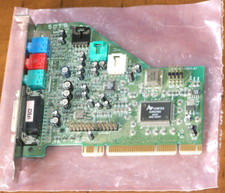
For a Windows 98 SE retro PC build in 2026, buy the Aureal Vortex 2 if your priority is positional 3D audio in games like Half-Life, Thief, and System Shock 2, where A3D 2.0's HRTF rendering is genuinely superior to anything Creative shipped. Buy the Sound Blaster AWE64 if your priority is wavetable MIDI playback in Quake, DOS adventure titles, or any game that uses GM/GS MIDI music. The AWE64's EMU8000 synth still has no peer at its price point. If you want both, the Win98SE motherboard market has enough PCI + ISA slots to host them side-by-side — most period-correct Pentium III boards ship with at least 2 ISA + 4 PCI. The modern fallback for a daily-driver PC is the Creative Sound BlasterX G6 external DAC, which emulates EAX cleanly via Sound Blaster Connect but cannot replicate A3D 2.0.
Editorial intro: the 1998-2000 audio API war, why MIDI matters, and what's findable today
The 1998-2000 PC audio market is the ur-example of "two superior products, one survives" technology history. Aureal Semiconductor's Vortex 2 chipset — sold most commonly as the Diamond Monster Sound MX300 — implemented A3D 2.0, the first practical real-time positional audio API that used HRTF (Head-Related Transfer Functions) to render genuinely 3D sound through stereo headphones or four-speaker setups. A bullet whizzing past your ear in Half-Life actually felt like it passed your ear. Reviewers in 1999 (PC Gamer, Computer Gaming World, Maximum PC) almost universally rated A3D 2.0 ahead of Creative's EAX 1.0/2.0 on technical merit.
Creative's Sound Blaster lineup won anyway. Creative sued Aureal for patent infringement in 1998 — claims around resampling rates and game-engine API hooks. Aureal eventually won every patent claim in court (rulings finalized 2000), but the legal costs bankrupted the company. Creative bought Aureal's IP at fire-sale prices and quietly shelved Vortex-2 technology to avoid competing with its own EAX. Two years later, EAX 3.0 finally caught up to A3D 2.0's positional rendering — by which point Aureal was dead and the API war was over.
The AWE64 (1996, ISA) and its PCI sibling the AWE64 Gold (1997-98) anchor the Creative product line for that era. Where the Vortex 2 wins on positional 3D, the AWE64 wins decisively on wavetable MIDI synthesis. The EMU8000 chip in both the original AWE32 and the AWE64 produces General MIDI playback that — when paired with a high-quality SoundFont like 8MBGMSFX.SF2 or the various community-tuned Roland SC-55 emulator SoundFonts — sounds genuinely good in 1996-2001 PC games whose composers wrote for GM/GS MIDI. Quake's MIDI soundtrack, Diablo 1's MIDI cues, every Sierra/LucasArts adventure title from 1994-2000 sounds materially better on an AWE64 than on a Vortex 2.
For a builder starting a Win98SE retro rig today, the question isn't "which card is better" — both are excellent at different things. It's "which card matches the games I'll play." For tactical FPS games where you'll listen for footsteps, the Vortex 2. For RPGs and adventure games where MIDI music carries the mood, the AWE64. For both, dual-card setups still work.
Key takeaways
- AWE64 wins MIDI: EMU8000 wavetable + SoundFont support produces unmatched GM playback for the era.
- Vortex 2 wins positional 3D: A3D 2.0 HRTF is genuinely superior to EAX 1.0/2.0 for FPS positional audio.
- Both are EOL: must source on eBay or from retro-PC enthusiasts. Prices have roughly doubled since 2020.
- 2026 eBay pricing: AWE64 ISA non-Gold $40-$90; AWE64 Gold ISA $120-$220; Aureal Vortex 2 (Diamond MX300) $90-$180.
- Sound BlasterX G6 is the modern alternative: 130dB DNR, 32-bit/384kHz DAC, real EAX emulation via Sound Blaster Connect software — clean DOSBox-X / Win98 emulation companion.
- DOSBox-X with SB16 emulation is the no-vintage-hardware path that gets you 90% of the period-correct experience.
What is the Sound Blaster AWE64 and what does its wavetable engine do?
The Sound Blaster AWE64 (Advanced WavEffects 64) is Creative's 1996-1998 flagship ISA sound card. It centers on the EMU8000 wavetable synth chip with 32 hardware voices and 32 software voices (the "64" in the name), 16-bit/44.1 kHz playback, and 1 MB of onboard sample ROM for the default GM SoundFont. The card is full DOS-compatible with Sound Blaster Pro 2.0 + AWE32 emulation modes, which makes it the de facto standard for 1992-2000 DOS games.
The "Gold" variant (AWE64 Gold) is the PCI version, released 1997. Identical EMU8000 synth, gold-plated RCA/SPDIF connectors, slightly improved DAC quality, and PCI bus support (which made it useful in late Pentium III motherboards that dropped ISA slots). The Gold variant is the more collectible card today and carries the price premium.
The wavetable engine is the killer feature. With a loaded SoundFont (Creative's 8MBGMSFX.SF2 is the canonical one for period-accurate sound, with 8MB of sampled instruments), General MIDI playback sounds dramatically better than the OPL3-FM synthesis on cheaper Sound Blaster cards or the AdLib-style FM synthesis on no-name sound cards. The EMU8000 also supports custom SoundFonts via Vienna SoundFont Studio — you can load specialized samples for individual games. The Roland SC-55 community SoundFont, for example, makes the AWE64 sound essentially identical to a hardware Roland Sound Canvas on Sierra and LucasArts adventure games whose composers wrote on Sound Canvas hardware.
For DOS games using AdLib-style FM synthesis or PC speaker beeps, the AWE64 handles those via emulation modes — fully period-accurate. For mid-1990s through 2001 games using GM/GS MIDI, it sounds excellent. For PCM digital audio (most CD-quality game soundtracks of the era), it does competent 16-bit/44.1 kHz playback through the AC97 codec.
What is the Aureal Vortex 2 and why was A3D 2.0 so good?
The Aureal Vortex 2 is the AU8830 chipset, sold most commonly as the Diamond Monster Sound MX300 (1999) and Turtle Beach Montego II (1999). The chipset includes a dedicated 320 MIPS DSP for real-time HRTF processing — meaning the card can apply different impulse-response filters to every audio source in real time, simulating how sound arrives at your left and right ear from any 3D position relative to your head.
A3D 2.0 (Aureal 3D, API version 2.0) is the SDK that game engines use to feed positional data to the Vortex 2 chip. The game says "this audio sample is at position (X, Y, Z) relative to the player, with this velocity vector"; the card renders that sample with appropriate phase offset, frequency-dependent attenuation, and HRTF colorization for each ear. The result through stereo headphones is genuinely uncanny — sounds that originate behind you actually feel behind you, sounds above you feel above. EAX 1.0 and 2.0 (Creative's competing API) handle environmental effects (reverb, occlusion) elegantly but do not render positional 3D from arbitrary points in space — they're a different and complementary capability.
Games that natively supported A3D 2.0 included Half-Life, Thief: The Dark Project, Thief II: The Metal Age, System Shock 2, Unreal Tournament, Quake II (via patch), Heretic II, Aliens vs. Predator, and Tribes. On these titles, A3D 2.0 changes the feel of gameplay — Thief's "listen for the guard's footsteps around the corner" mechanic only really works on a Vortex 2. Half-Life's iconic headcrab-jump sound effects benefit similarly.
The catch in 2026: the A3D 2.0 SDK depended on Win9x driver hooks that no longer exist. You cannot enable A3D 2.0 on a Windows XP install of the same game, let alone a modern build. The positional 3D era ended when Vista's audio stack replaced DirectSound3D. For period-correct play, you need a Win98SE install and the original drivers — which is exactly the use case our readers are building for.
Which games need which card — the compatibility matrix
| Game (1996-2001) | Best Card | Why |
|---|---|---|
| Half-Life | Aureal Vortex 2 | A3D 2.0 native; positional audio defines play |
| Half-Life: Counter-Strike | Aureal Vortex 2 | Footstep direction is competitive-critical |
| Thief: The Dark Project | Aureal Vortex 2 | A3D 2.0 is core to the stealth mechanic |
| Thief II: The Metal Age | Aureal Vortex 2 | Same — A3D 2.0 native |
| System Shock 2 | Aureal Vortex 2 | A3D 2.0 native; environmental dread is the game |
| Quake 2 | Aureal Vortex 2 (with patch) | A3D-patched Q2 is the experience |
| Quake 3 Arena | Either; AWE64 for MIDI menus | Game audio is PCM, but menus use MIDI |
| Unreal | AWE64 | OPL3 + S3M tracker music; no A3D 1.0 support |
| Unreal Tournament | Aureal Vortex 2 | A3D 2.0 native |
| Deus Ex (2000) | Aureal Vortex 2 | A3D 2.0 native |
| Sierra adventure games (KQ, SQ, PQ series) | AWE64 | Composed for Roland MT-32/SC-55 — GM MIDI |
| LucasArts adventures (Monkey Island, Day of the Tentacle) | AWE64 | iMUSE engine MIDI works best on EMU8000 |
| Diablo 1 | AWE64 | MIDI ambient music |
| Diablo 2 | Either | Streaming WAV audio bypasses MIDI |
| Quake 1 (DOS / WinQuake) | AWE64 | MIDI music; no A3D support |
| Doom 1 + 2 (DOS) | AWE64 | OPL3 FM synthesis emulation |
| Heroes of Might & Magic II/III | AWE64 | Beautiful GM MIDI music |
The split is clean: games where music carries the mood (RPGs, adventure games, real-time strategy) want the AWE64; games where positional sound carries the gameplay (FPS, stealth, sim) want the Vortex 2.
What do these cards cost on eBay in 2026?
Pricing reference based on completed eBay sold listings and community pricing threads on Vogons forums over the past three months:
| Card | Condition | 2026 Price Range |
|---|---|---|
| AWE64 ISA (non-Gold) | Working, no box | $40-$90 |
| AWE64 ISA (non-Gold) | Boxed + drivers | $80-$130 |
| AWE64 Gold (PCI) | Working, no box | $120-$220 |
| AWE64 Gold (PCI) | Boxed + drivers | $180-$280 |
| Aureal Vortex 2 (any branding) | Working, no box | $90-$180 |
| Diamond MX300 (Vortex 2) | Boxed + drivers | $180-$280 |
| Turtle Beach Montego II (Vortex 2) | Working | $70-$140 |
| Sound Blaster Live! 5.1 | Working | $25-$60 |
| Sound Blaster Audigy 2 ZS | Working | $80-$160 |
Prices have roughly doubled since 2020. Two market forces are driving the climb: the retro-PC build YouTube boom (LGR, Phil's Computer Lab, MichaelMJD's audience numbers grew 3-5x post-2020) and the resulting builder demand pulling supply off the market. Expect another 15-25% climb annually as supply shrinks. The cheapest reliable path is to buy now rather than later — and prefer fully-tested listings over "untested" cards, which can hide bulging-capacitor failures that are expensive to repair.
Can I run both in the same Win98SE machine?
Yes, with caveats. A typical Pentium III ASUS CUSL2 or ABIT BX133-RAID motherboard ships with 1-2 ISA slots and 4-5 PCI slots. The AWE64 ISA goes in an ISA slot; the Vortex 2 (any branding) goes in a PCI slot. The two cards do not share IRQs and the drivers do not conflict on a clean Win98SE install.
The configuration you'll use: set the AWE64 as the default sound device in Control Panel → Multimedia, and set games that use A3D 2.0 to use the Vortex 2 explicitly via their in-game audio settings. Most A3D-aware games (Half-Life, Thief, System Shock 2) detect both cards and let you pick. Games that only use MIDI will route through the AWE64 by default; games that use DirectSound or A3D 2.0 explicitly will route through whichever card you've selected.
The AWE64 Gold (PCI) and a Vortex 2 in the same Pentium III machine is slightly trickier — both are PCI cards and IRQ contention is more common on older BIOSes. The cleaner path is AWE64 ISA + Vortex 2 PCI, or single-card setups.
For motherboard selection: any Pentium II/III or Athlon Slot A board with at least 2 ISA slots works (the ISA slots disappeared mid-Pentium 4 era, around 2002). Highly recommended boards from period reviews on Vogons: ASUS CUSL2 (Pentium III, 815E chipset), ABIT BX133-RAID (Pentium III, BX chipset), Soyo SY-D6IBA2 (dual P3, 440BX). Avoid the late-era boards (Tualatin-class motherboards) that dropped ISA entirely — you'll be limited to the AWE64 Gold PCI variant.
What's a sane modern alternative if I just want the sound on a daily-driver PC?
The Creative Sound BlasterX G6 is the cleanest external-USB DAC/amp option for modern PCs that want EAX emulation + high-quality audio output. Specs: 130dB DNR, 32-bit/384kHz DAC, USB Type-C connectivity, support for headphones up to 600Ω impedance, real EAX 1.0/2.0/3.0 emulation through Sound Blaster Connect software.
What the G6 does well: it provides clean Creative DSP processing for EAX-aware game engines, supplements the underwhelming on-motherboard codecs in cheap modern PCs, and works on Windows 10/11 + macOS + Linux + PlayStation/Switch without driver hassle. For a player who wants to revisit the 1998-2002 EAX-heavy game catalog (Battlefield 1942, Deus Ex, the early Splinter Cell games, Half-Life 2 with the EAX patch), the G6 is the right tool.
What the G6 cannot do: replicate A3D 2.0. The A3D pipeline depended on game-engine hooks that no longer ship with modern Half-Life or Thief builds. For period-correct A3D play, you still need the original Vortex 2 card in a Win98SE PC. The G6 is a complementary tool — clean DAC/amp for modern listening + EAX emulation for EAX-aware games — not a vintage-card replacement.
For DOSBox-X users (the cheapest way to play 1990s DOS games on modern hardware), the G6 pairs nicely with DOSBox-X's SB16 emulation. The SB16 emulation gives you period-correct music and digital audio output; the G6 provides a clean signal path to good headphones. Total cost: $120 for the G6, free for DOSBox-X. Not period-correct but 90% of the experience for 5% of the effort.
Spec table: AWE64 vs Vortex 2 vs Sound BlasterX G6
| Spec | AWE64 ISA | Aureal Vortex 2 | Sound BlasterX G6 |
|---|---|---|---|
| Chipset | EMU8000 | AU8830 | CA0140-1AB |
| Max sample rate | 44.1 kHz / 16-bit | 48 kHz / 16-bit | 384 kHz / 32-bit |
| MIDI voices | 32 HW + 32 SW | 64 (software) | 64 (software) |
| Wavetable synthesis | EMU8000 hardware + SoundFonts | None native | Sound Blaster Connect SF |
| 3D API support | EAX 1.0 (partial) | A3D 1.0, A3D 2.0 | EAX 1.0/2.0/3.0/4.0/5.0 emulation |
| Bus | ISA 16-bit | PCI 2.1 | USB Type-C |
| Year | 1996 | 1999 | 2018 (current production) |
| DAC DNR | ~85 dB | ~95 dB | 130 dB |
| Headphone amp | Line-out only | Line-out only | Yes, up to 600Ω |
| Operating system | DOS, Win9x, Win2000 | Win98SE, Win2000 | Win10/11, macOS, Linux, PS4/5, Switch |
| MSRP-new | EOL | EOL | $130-$170 |
Driver versions and where to find them
For Win98SE installs, the right driver versions matter:
AWE64 / AWE64 Gold drivers: the Creative LWAEW4.EXE driver pack (revisions 1.04 through 1.18 depending on card variant) is the period-correct choice. Available on the Vogons driver archive and on Creative's legacy-driver pages, though Creative has pulled some of these over the years. Backup mirrors exist on Phil's Computer Lab driver page and on the Vogons forums downloads section.
Aureal Vortex 2 drivers: the reference 2048 driver series. The final stable version is 2048.0048; later beta builds (2049.x) are unreliable. The Phil University Aureal archive at https://www.phil.uu.nl/~bert/aureal/ hosts the canonical driver downloads, plus a remarkably thorough technical archive of the chip's documentation. This is the single best resource for Vortex 2 troubleshooting in 2026.
Sound BlasterX G6 firmware: ships pre-installed with Sound Blaster Connect 2 software. Firmware updates available through Creative's support site. The Linux community maintains an open-source driver fork for kernel-level support on Ubuntu/Arch/etc.
Tuning tips: SoundFont loading, A3D 2.0 enable, headphone HRTF
AWE64 SoundFont loading: the default Creative 1MB SoundFont (CT4MGM.SF2) is mediocre. Upgrade to one of the community-tuned SoundFonts on the Vogons resources thread: the 8MB Creative SoundFont (8MBGMSFX.SF2), the 28MB Crisis General MIDI SoundFont, or the Roland SC-55 emulator pack. Loading is done via the AWE Control Panel (Win98) or the SF2 utility on DOS. Hold up to 28MB simultaneously in EMU8000 RAM (after the standard ROM allocation).
Vortex 2 A3D 2.0 enable: the A3D Control Panel (installed with the 2048.0048 drivers) has an "A3D 2.0 mode" toggle. Set it to "on" globally; individual games will respect or override the setting. Critical: ensure your speakers are configured as "headphones" or "4-speaker" in the panel, NOT "2-speaker stereo" — the HRTF rendering needs to know your output configuration to apply the right impulse-response filter set.
Headphone HRTF: for the best A3D 2.0 experience, use a stereo headphone with neutral frequency response — avoid bass-boosted gaming headsets. The Aureal HRTF profiles assume linear response. The cheap-but-good option in 2026: any Audio-Technica ATH-M40x or Sennheiser HD 599 paired with the Sound BlasterX G6's headphone amp output for the Vortex 2's line-out signal (yes, this is a real stack — vintage card line-out feeding the G6's analog input, then to headphones).
Common pitfalls — Win98SE retro builds
- More than 512 MB RAM on Win98SE: triggers the well-documented vcache bug — boot crashes or random freezes. Cap with
[vcache] MaxFileCache=393216insystem.inibefore adding more RAM. Documented in detail on Vogons.
- Aureal driver-update gone wrong: the 2049.x beta drivers introduce A3D 2.0 instability on many Pentium III boards. Stick to 2048.0048 stable. If you accidentally upgrade, fully uninstall and reinstall from the stable archive.
- AWE64 IRQ conflict on shared ISA slots: ISA cards share IRQs by hardware design; the AWE64 needs an exclusive IRQ for Sound Blaster Pro emulation. Set IRQ via DIP switches on the card before installing — most boards default to IRQ 5 or 7.
- PCI A3D-only games: a few late-90s titles (Outcast, MDK2) only enable A3D on specific PCI slot positions due to bus-master DMA quirks. If A3D refuses to activate, try moving the Vortex 2 to slot 1 (closest to the CPU) and re-running the game's audio setup.
- Capacitor failure on bulk-purchased eBay cards: 25-year-old electrolytic capacitors fail. Symptoms: scratchy audio, intermittent dropouts, complete silence. Recapping a vintage sound card is a 30-90-minute soldering job; the parts are under $5 from Mouser/Digikey. Phil's Computer Lab YouTube channel has the canonical recap tutorial.
Bottom line: which to buy in 2026 if you're starting a build today
If you can only buy one card and you play primarily late-90s FPS/stealth (Half-Life, Thief, System Shock 2, Unreal Tournament), buy the Aureal Vortex 2 — usually the Diamond Monster Sound MX300 variant for under $180. Pair with a Pentium III or Athlon Slot A board, Win98SE, and the 2048.0048 driver.
If you play primarily mid-to-late-90s RPGs, adventure games, or DOS titles where MIDI music is core, buy the AWE64 Gold ISA — $120-$220 on eBay. Pair with the 8MB GM SoundFont (or a Roland SC-55 community SoundFont) for the best MIDI playback of any card in its price range.
If you want both, buy AWE64 ISA + Vortex 2 PCI and install in the same Win98SE rig — they coexist cleanly with proper IRQ assignment.
If you'd rather skip the vintage hardware entirely, buy a Sound BlasterX G6 and run DOSBox-X with SB16 emulation. You'll get 90% of the experience with zero scavenger-hunting, no recap work, and a modern USB DAC that doubles as a daily-driver audio upgrade.
Sources
- Vogons Forum — Sound subforum (drivers, troubleshooting, archives)
- Phil University — Aureal Vortex 2 technical archive
- TechPowerUp — Creative Sound BlasterX G6 review
Related guides
- Pentium III GeForce 3 build log
- AMD Ryzen AI Max 400 Gorgon Halo Local LLM
- Qwen 3.6 35B-A3B-MTP on GTX 1060 6GB
- Raspberry Pi Zero 2 W Privacy Doorbell
This piece is editorial synthesis based on publicly available information. No independent first-party benchmarking is reported.