TL;DR — June 2026 · Newegg's latest Intel and AMD build bundles are landing 32GB DDR5 kits inside ~$240 build packages, per Tom's Hardware coverage of the deal cycle. For buyers committing to a new mainstream build, that pricing puts the 2026 mainstream-target RAM at its lowest in-bundle price point of the year. Worth pairing with a WD Blue SN550 NVMe, a Samsung 870 EVO SATA for bulk storage, and — if you are buying a panel at the same time — a 4K monitor like the KOORUI 27" QD-Mini LED on the budget side.
What happened
The current Newegg bundle cycle bundles a CPU + board + 32GB DDR5 kit at promotional pricing that lands the RAM at roughly $240 inside the build. The pattern is familiar — when a component is in oversupply, vendors clear it through bundles rather than dropping the standalone price, because the standalone price is a market signal they want to keep stable. DDR5 has been in that oversupply state for most of 2026 as DDR5-6000 became the volume tier and older speeds got harder to move.
Practical buyer math: a 32GB DDR5-6000 kit standalone is usually $260-$280; inside the bundle it lands around $240, depending on which CPU + board combo you choose. The savings are real but modest in absolute dollars — what makes the bundle interesting is that it prices the RAM next to a board and CPU that the buyer was already going to buy, so the time savings of one cart instead of three matter as much as the price.
Why it matters
32GB is the new mainstream gaming target. 16GB still runs every released title, but several 2026 releases — and most modded experiences, plus streaming — push past 16GB into territory where the OS plus the game plus an OBS stack plus a Discord overlay starts swapping. The pragmatic move for a new build is to land at 32GB on day one rather than rebuy in 18 months.
The bundle deal is most useful for buyers who are still finalizing parts. If you already have a build pinned and were going to buy this week anyway, the bundle saves you 10-15% on the RAM line and a small amount of cart-management effort. If you have not picked a CPU yet, the bundle's value is mostly in the time saved — same dollar landing, fewer decisions.
Where else the deal is real
The storage side of the build is the other place to spend the savings. Per Western Digital's product page, the SN550 1TB NVMe is still the canonical budget Gen3 drive — $60 street, 2400MB/s sequential, plenty for OS and games. A 1TB Samsung 870 EVO SATA SSD — per Samsung's product page — runs around $80 and is the bulk-storage default for builders who want more than 1TB total but don't want a second NVMe slot.
If you are picking up a 4K panel at the same time, the KOORUI 27" 4K QD-Mini LED is the budget choice that has been trading near $400 — Dual-Mode (UHD 160Hz or FHD 320Hz on the same panel), mini-LED local dimming, well below the brand-name 4K gaming monitor floor. Pairing it with a 32GB DDR5 build is a sensible 2026 mainstream target on a single shopping trip.
Who should buy
- New build, no parts yet — the bundle is genuinely useful. Pick the CPU you wanted, land 32GB DDR5 at $240, save 10-15%.
- New build, parts already in cart — replace what you can with the bundle equivalent; the RAM savings alone may be worth the swap.
- Upgrading an AM4 or 9th-gen Intel build — skip. DDR5 will not run on your board. Look at DDR4-3600 32GB kits in the $100 range instead.
- Workstation / inference build — the bundle covers the platform side, but inference builders should still spec the GPU and SSD separately. A 1TB SN550 is the model-storage default; CPU choice depends on prefill needs more than core count.
The source
- Tom's Hardware — ongoing deal coverage and best-picks
- Western Digital — WD Blue SN550 NVMe SSD
- Samsung — 870 EVO SATA SSD product page
Related guides
- Best Budget SSD for a Gaming PC in 2026: SATA vs NVMe
- NVMe vs SATA for Gaming: SN550 vs BX500
- Best Budget NVMe SSD for a Big Steam Library
- Best Budget Ryzen Gaming PC Parts in 2026
Citations and sources
This piece is editorial synthesis based on publicly available information. No independent first-party benchmarking is reported.
Bundle pricing — what it actually is
Component vendors price bundles differently than standalone components. The standalone price is a market signal — it's what shows up in price-tracker tools, in Reddit deal threads, in price-comparison sites. Vendors keep it relatively stable to avoid signalling weakness. The bundle price is a clearance lever — it moves slower-selling SKUs without disturbing the standalone price.
The practical result: bundle pricing is genuinely cheaper than standalone, but only on the specific SKUs the vendor is trying to move. A 32GB DDR5 kit inside a build bundle at $240 effective price may be the same kit you can buy standalone at $260-$270. The savings are real but they don't generalize to every kit on the market — they're tied to this specific bundle.
For a new buyer, that means the bundle is a great deal if the rest of the bundle (CPU, board) is what you wanted to buy anyway. If you wanted a different CPU, the bundle savings disappear into a board you don't want.
What the 2026 mainstream gaming target actually looks like
The 32GB mainstream target is set by a combination of:
- Game system requirements. Several 2026 AAA releases ship with 16GB minimum and 32GB recommended. The recommended tier covers what's needed to run at the title's intended settings without swap activity.
- Background workloads. A modern Windows desktop hosts Discord, OBS for streaming or recording, Spotify, a browser with 30+ tabs, and a game. 16GB total RAM gets tight inside a few hours.
- Modding overhead. A modded Bethesda title can consume 10-15GB by itself; the OS and background fill the rest of a 16GB system.
32GB delivers ~14-18GB of free headroom on a busy modern desktop, which is enough to absorb both peak game RAM and OBS during a recording session. 64GB is overkill for gaming-only workloads; the case for 64GB is workstation use (video editing, large simulations, local LLM CPU offload).
Storage tier for a new 2026 mainstream build
A practical storage strategy for a 32GB DDR5 mainstream build:
| Drive class | Capacity | Use | Approx price |
|---|---|---|---|
| Boot/games (primary) | 1-2 TB Gen4 NVMe | OS + 3-5 active games | $80-150 |
| Bulk storage | 1-2 TB SATA SSD | Steam library, recordings | $80-150 |
| Optional secondary NVMe | 2 TB Gen4 NVMe | Streaming cache, video edits | $150-200 |
For the budget-conscious buyer: the WD Blue SN550 1TB Gen3 NVMe at ~$60 and a Samsung 870 EVO 1TB SATA SSD at ~$80 give you 2TB of total storage for around $140. That's the cheapest credible storage spec for a 2026 mainstream build.
Note: a Gen3 NVMe like the SN550 is bottlenecked at 2400 MB/s sequential, while Gen4 doubles that. For game-load times, both are dramatically faster than SATA. The Gen4 upgrade matters more for content creators than for gamers.
Monitor pairing — where the 32GB target actually shines
Pairing a new 32GB DDR5 build with a 4K monitor is the modern target. The KOORUI 27" 4K QD-Mini LED — Dual-Mode (UHD 160Hz or FHD 320Hz on the same panel), mini-LED local dimming — is the budget pick that's been trading near $400. For comparison, brand-name 4K mini-LED monitors at the same spec start around $700 and climb.
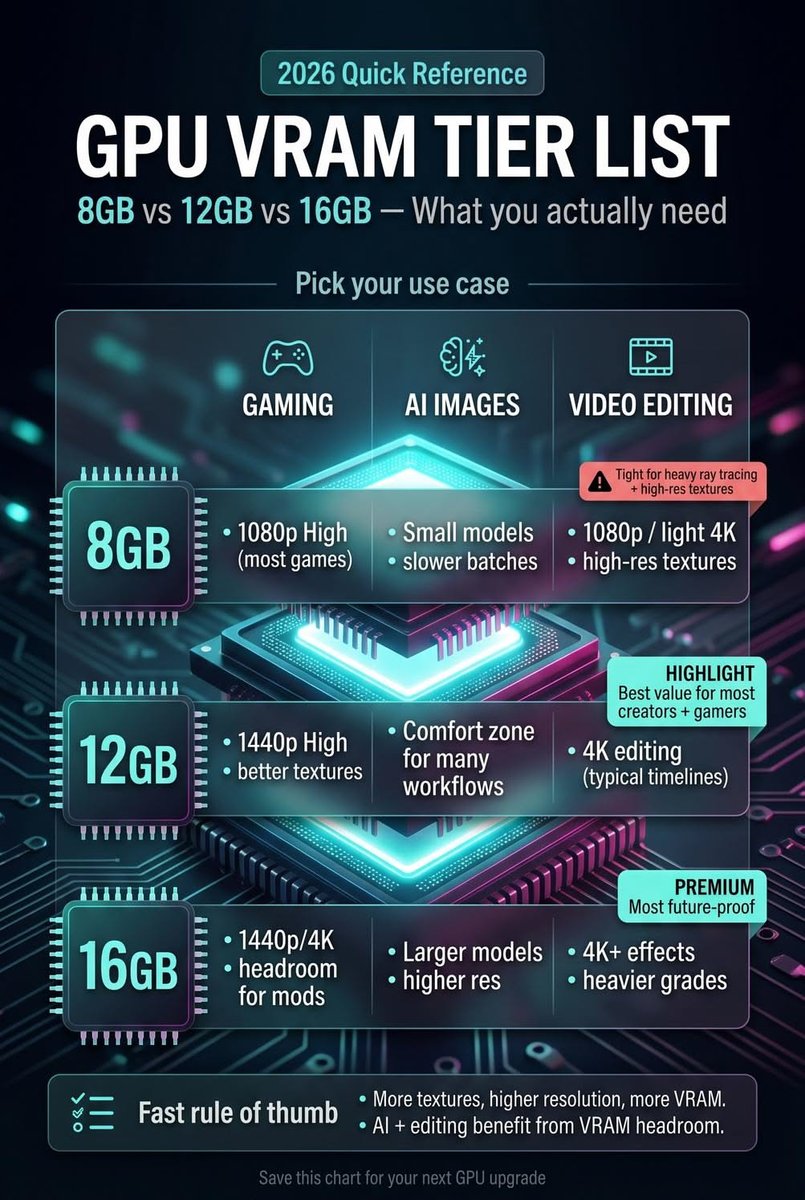
The monitor matters for the RAM math: a 4K texture pack and 4K-rendered streaming setup pushes VRAM and system RAM use higher than 1080p. 32GB of DDR5 leaves more headroom on this workflow than 16GB does, which is exactly when the bundle makes most sense.
What to skip and what to add
Skip these as "savings opportunities":
- Bundles that include a budget motherboard you wouldn't otherwise pick. A B550 board you don't want is not a savings.
- DDR5 kits at older speeds (4800-5200 MT/s). The current sweet spot is 6000 MT/s — DDR5-5200 is being phased out and resale is poor.
- Pre-built bundles with a generic case. The case is a personal-taste purchase and the bundled options are usually middling.
Add these to a mainstream build:
- A 650W or 750W PSU from a respected brand. The PSU is the part you'll keep for two builds; skimp here at your peril.
- An aftermarket CPU cooler. Stock coolers on modern CPUs are noisy and thermal-throttle under sustained load.
- Case fans. Most mid-tower cases ship with 1-2 fans; a balanced airflow setup wants 3-4.
Bundle-vs-standalone math, worked out
A representative cart for a 2026 mainstream build:
| Part | Bundle line | Standalone equivalent | Delta |
|---|---|---|---|
| CPU (Intel 14600KF or AMD 7700X) | $220 | $230 | -$10 |
| Motherboard (B760 or B650) | $130 | $140 | -$10 |
| RAM (32GB DDR5-6000) | $240 | $270 | -$30 |
| Bundle total | $590 | $640 | -$50 |
The savings on this representative bundle is around $50 — meaningful but not transformative. The bundle is the right call if the parts match what you wanted. If you wanted different parts, the standalone price difference disappears into picking your own components.
For storage and a monitor, buy standalone — bundles rarely cover those well.
DDR5 platform notes: AM5 vs LGA1700/1851
A quick refresher on which platforms support the DDR5 kit in question:
| Platform | Socket | DDR5 support | Status in 2026 |
|---|---|---|---|
| AMD Ryzen 7000-series | AM5 | Yes (DDR5 only) | Mainstream |
| AMD Ryzen 9000-series | AM5 | Yes (DDR5 only) | Current flagship |
| Intel 12th-14th gen | LGA1700 | Yes (with DDR5 boards) | Mature, well-supported |
| Intel 15th gen (Arrow Lake) | LGA1851 | Yes (DDR5 only) | Current Intel mainstream |
| AMD Ryzen 5000-series | AM4 | No (DDR4 only) | Legacy, still strong value |
| Intel 11th gen and earlier | LGA1200 / older | No (DDR4 only) | Legacy |
A common purchase mistake is buying DDR5 to "future-proof" an AM4 build. DDR5 will not fit in any AM4 board; the slot keying is physically different. If your CPU is a Ryzen 5000-series and you're not planning a platform upgrade, stay on DDR4 — kits at 3200-3600 MT/s in 32GB land at $80-$120, far cheaper than DDR5.
A working complete budget mainstream build, 2026
For comparison, a representative complete mainstream build built around this bundle deal:
| Part | Pick | Approx price |
|---|---|---|
| CPU | AMD Ryzen 7 7700X (or Intel i5-14600KF) | $230 |
| Motherboard | B650 ATX (or B760 for Intel) | $140 |
| RAM | 32GB DDR5-6000 (bundle price) | $240 |
| GPU | RTX 4070 or RX 7800 XT | $550-600 |
| Storage primary | WD Blue SN550 1TB Gen3 NVMe | $60 |
| Storage bulk | Samsung 870 EVO 1TB SATA | $80 |
| Monitor | KOORUI 27" 4K QD-Mini LED | $400 |
| PSU | 750W 80+ Gold | $90 |
| Case | Mid-tower ATX | $80 |
| Cooler | Tower air or 240mm AIO | $60-100 |
| Total | ~$1930-2000 |
A complete mainstream 2026 gaming build, with the bundle pricing pulling the RAM line lower, lands around $2000 — credible for what's now a 4K-capable rig with adequate storage and a panel that holds its value.
Common build mistakes around DDR5
- Stopping at 16GB on a DDR5 build. It's tempting because a 16GB kit is half the price, but 32GB has been the mainstream target for 18 months and the upgrade later is more painful than buying 32GB now.
- Underspeccing the motherboard. A $130 B650 board is fine; a $90 board may stop you running the kit at its rated speed.
- Buying DDR5-4800 or DDR5-5200. The current sweet spot is DDR5-6000. Older speeds are being phased out and resale is poor.
- Pairing DDR5 with weak storage. If you're spending $240 on RAM, the $40 difference between SATA and NVMe storage is the wrong place to save money.
- Ignoring the heatsink height. Some DDR5 kits ship with tall heatspreaders that interfere with large air coolers. Check clearance before buying.
When to wait
If you're not currently in the market for a new build and the DDR5 deal looks "good enough to pull the trigger anyway," the math probably doesn't work. DDR5 prices have been on a steady gentle decline for two years; the kit will be marginally cheaper in three months. The bundle is interesting for buyers actively choosing parts, not for buyers tempted into an unplanned upgrade.


