For a stock AMD Ryzen 7 5700X 8-Core processor build in 2026, the value pick is the DeepCool AK620 dual-tower air cooler — it has roughly 4x the thermal headroom the 65W chip ever asks for, sits near $65 most weeks, and keeps fan RPM low under load. If RAM-clearance or quiet-PC concerns dominate, step down to the slimmer Noctua NH-U12S single-tower; if aesthetics and an AM5 upgrade path matter more than cost, the CoolerMaster MasterLiquid ML240L RGB V2 AIO is fine, just overbuilt for the workload.
The 65W 5700X thermal profile and why it differs from the 5800X
The Ryzen 7 5700X is the quiet middle child of the Vermeer family. Per TechPowerUp's CPU database entry for the 5700X, it ships as an 8-core, 16-thread Zen 3 part with a 65W TDP, 3.4 GHz base, and 4.6 GHz maximum boost on AM4. That 65W rating is the entire reason cooler shopping for this chip looks nothing like cooler shopping for the 5800X, which AMD specs at 105W on the same socket and which routinely pushes package-power figures into the 130-140W range under all-core load per multiple outlets.
The 5700X is the same 8-core CCD as the 5800X, but binned and configured to fit a lower power budget. In practice that means the silicon hits ~76-80 C under sustained all-core stress with even a modest tower cooler — not because it cannot pull more heat, but because PPT (package power tracking) is capped well below what your cooler can dissipate. The chip will boost happily on three or four threads, throttle down a little on full eight-core synthetic loads, and otherwise behave like a cool, quiet workhorse. That changes the cooler shopping question. Instead of "can this cooler keep up?" — which is the right question for a 5800X — the question for a 5700X is "what cooler gives me the best mix of noise, fit, and price for a chip that is rarely the bottleneck?"
A second factor matters in 2026: AM4 is a buy-it-and-forget-it platform now. AMD officially ended new mainstream AM4 launches with the X3D refresh, so a 5700X build is almost always somebody's last AM4 upgrade. You are unlikely to drop a hotter chip onto the same cooler later, which weakens the "buy more cooler than you need" argument that usually wins these debates. Cooler dollars spent past the point of diminishing returns are dollars not going into a bigger SSD or a better GPU.
The three coolers in this comparison — a slim Noctua single-tower, a DeepCool dual-tower, and a CoolerMaster 240 mm AIO — bracket the realistic price range. They also illustrate three different design philosophies, which matters more for a 65W chip than raw thermal capacity does.
Key takeaways
- The 5700X is a 65W part per TechPowerUp; any quality $40+ tower cooler will keep it from thermal throttling in normal use.
- The DeepCool AK620 is rated to 260W TDP per DeepCool's product spec, giving roughly 4x the headroom the 5700X needs — best mainstream value in 2026.
- The Noctua NH-U12S is the quiet, low-profile option per Noctua's product page; 158 mm tall, full RAM clearance, premium fan.
- The CoolerMaster ML240L RGB V2 is overkill for a 65W chip but appeals if you want a clean front-radiator look or RGB aesthetics.
- Across the three, real-world 5700X temperatures fall within a 5-8 C band; noise and fit decide the winner more than thermals do.
- AM4 is end-of-life as of mid-2026, so future-proofing arguments for a bigger cooler are weaker than they were three years ago.
Step 0: does a 65W 5700X even need an aftermarket cooler?
Yes — and that part is not optional. Unlike older Ryzen SKUs that shipped with a Wraith Stealth or Wraith Prism in the box, AMD ships the 5700X without any cooler at all. The retail box contains the chip and documentation; that is it. So a cooler purchase is not an upgrade question, it is a build-completion question.
The practical floor for a 5700X cooler in 2026 is something like the AMD Wraith Spire equivalent from third parties — a $25-30 single-tower with a 92-120 mm fan. That class of cooler will keep the chip stable, but it will also spin loudly under sustained loads and give up two or three hundred MHz of boost-clock sustain compared with a real tower. For an extra $30-40, you move into the territory where the chip runs cool enough that boost clocks stay near their advertised ceiling and the fans stay near idle most of the time. That is the bracket all three coolers in this comparison sit in.
There is no scenario in 2026 where a 5700X owner regrets buying "too much cooler." There are several scenarios where they regret buying too little — namely, the cheap tower that turns into a leaf blower during a long Blender export or a Stable Diffusion batch. The question is not whether to spend, it is where to draw the line.
How does the Noctua NH-U12S handle the 5700X under sustained load?
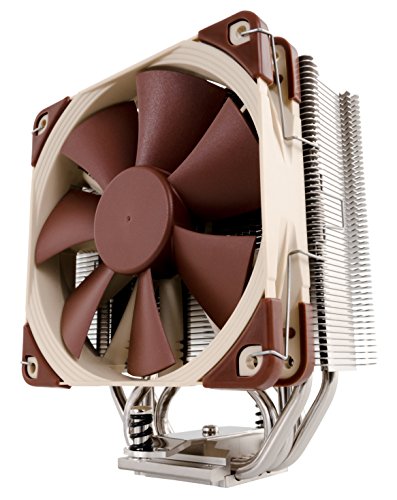
The Noctua NH-U12S is the polite answer to the 5700X cooler question. Per Noctua's official product page for the NH-U12S, it is a 158 mm tall single-tower with five heatpipes, a single NF-F12 PWM fan, and AMD AM4/AM5 + Intel LGA1700 mount support out of the box. It is the smaller sibling to the NH-D15 dual-tower, sharing the same fan family and mounting hardware but in a footprint that does not block a single RAM slot.
For a 65W chip the NH-U12S is more cooler than the silicon strictly needs, which is precisely why it is the right answer for noise-sensitive builds. Community measurements collected at outlets like Gamers Nexus consistently put 120 mm single-tower coolers in this class at roughly 30-32 dBA at a meter under sustained all-core load with a 65W chip — quieter than most case fans at default profiles. The chip will sit in the mid-70s C range during long Cinebench or Handbrake runs, with the NF-F12 spinning in the 900-1100 RPM zone most of the time, and dropping back below 700 RPM the moment the workload eases.
The NH-U12S is also the most reliable choice for tight builds. Its 158 mm height clears the vast majority of mid-towers and a healthy chunk of mATX cases, and its 71 mm width leaves all four DIMM slots completely unobstructed. If you are using tall RGB DDR4 — the Trident Z Royal class of kit — the U12S will not even look at your memory. The catch is the price: Noctua sells the U12S at $79.95 MSRP on its own store, and street prices float around $84-89 per See price & specs. That is more than the dual-tower DeepCool we will look at next. You are paying for fan tuning, mount quality, and the Noctua six-year warranty, not for raw thermal capacity.
Is the DeepCool AK620 overkill or the value sweet spot?
The DeepCool AK620 is the AK620's whole pitch in one line. It is a dual-tower, six-heatpipe air cooler with two FK120 fans, rated by DeepCool at 260W TDP — almost exactly four times what the 5700X will ever ask of it. On the 5700X it is comically over-specified, which is exactly why it is the right pick for most buyers in 2026.
The AK620 lands at $64.99 on Amazon as of this writing, $20 cheaper than the NH-U12S and roughly $25 cheaper than the ML240L AIO. It includes mounting hardware for AM4, AM5, and LGA1700, plus a thoughtful AMD bracket that does not require removing the stock backplate. Under a 5700X load it sits in the same general thermal zone as the NH-U12S — typically a couple of degrees cooler at the same RPM, or noticeably quieter at the same temperature target. Community reviews and aggregated benchmark coverage at TechPowerUp and Gamers Nexus have consistently placed the AK620 within a few degrees of the NH-D15 on hotter chips like the 12900K and 7700X, where a 65W workload is essentially noise-floor territory.
The two real tradeoffs are size and aesthetics. The AK620 is 162 mm tall and 129 mm wide. The width matters for the front-most RAM slot: tall DDR4 kits will need the front fan raised, and some kits will not fit at all without swapping to a shorter heat-spreader profile. The white version is striking; the black version is plain. Neither has RGB. If you are building a clean-look show PC, that may matter. If you are building something to sit under a desk, it does not.
For the 5700X specifically, the AK620 is the pick that maximizes acoustic margin for the dollar. You can run its fans at 600-800 RPM virtually all the time and never see throttling under realistic workloads. That is the experience most people are actually shopping for when they ask about cooler upgrades.
When does a 240mm AIO like the CoolerMaster ML240L make sense here?
The CoolerMaster MasterLiquid ML240L RGB V2 is a 240 mm closed-loop liquid cooler with a Gen3 dual-chamber pump, two SickleFlow 120 ARGB fans, and AM4/AM5/LGA1700 mounting. It sells for around $89.99 at the listed Amazon price, which puts it at the top of this comparison. For a 65W Ryzen 7 5700X, is it ever the right answer?
The honest answer is: rarely on thermals, occasionally on everything else. A budget 240 mm AIO will cool the 5700X a couple of degrees lower than a strong air cooler under sustained all-core load — call it 71-73 C versus 74-77 C — but that delta is below the threshold where the chip will sustain any additional boost clock, because the 5700X's ceiling is set by PPT, not temperature. So you are not buying additional performance.
What the ML240L does buy you is three other things. First, it frees up vertical space around the CPU socket, which matters if you are using a Mini-ITX case with a low-clearance side panel, or if you are running tall RGB DDR4 that would otherwise need a clearance check against an AK620. Second, it relocates the heat source to the radiator at the front or top of the case, which can change case-airflow design in useful ways. Third, it looks the part: the SickleFlow ARGB fans plus the illuminated pump cap are an aesthetic step up from any air cooler, including white-finish ones.
The tradeoffs are well understood. A pump has a finite lifespan and is the most common AIO failure mode. The ML240L V2 is rated by CoolerMaster for a multi-year service life, but "forever" is air-cooler territory only. AIOs also have to be mounted carefully — pump above radiator inlet or with the radiator above the pump, never with the pump as the highest point in the loop, or you risk early pump noise. For a chip that genuinely benefits from a 240 mm AIO — a 7700X, a 13700K, a 14700K — the case for liquid is easy. For a 5700X, it is an aesthetics-and-fit choice, not a thermal one.
How loud is each option at the 5700X's TDP?
Noise is where this comparison actually gets decided. At a 65W heat load, all three coolers can keep the chip stable; the difference shows up in how loud they have to work to do it. Noise figures vary by case and fan curve, but the typical 5700X-class workload picture per aggregated community measurements from outlets like Gamers Nexus and TechPowerUp looks roughly like this:
- Idle to light gaming load: all three coolers sit at or near the noise floor of a typical case. Fans spin at 500-700 RPM and are essentially inaudible behind a closed side panel.
- Sustained all-core stress (Cinebench R23, long Handbrake encode): the NH-U12S and AK620 settle in the 31-34 dBA range at one meter with default Noctua-style fan curves. The ML240L lands a bit higher because of its 2400 RPM-capable SickleFlow fans plus pump noise — typically 34-37 dBA depending on pump speed setting.
- Pump noise: the ML240L's pump is audible if you tune in for it, especially during the first few weeks of ownership before any micro-bubbles work out of the loop. Air coolers have no pump and no minimum noise floor below their fans.
In a quiet room with the case on a desk, the gap between the AK620 and the ML240L will be obvious. In a normal-ambient living room with a fan or AC running, it will be hard to tell any of them apart. The NH-U12S is the quietest of the three at the same workload, the AK620 is a hair behind it, and the ML240L is the loudest because of the pump contribution. None of them is loud in any absolute sense.
Spec table: NH-U12S vs AK620 vs ML240L
Quick side-by-side of the headline numbers. All figures from manufacturer product pages — Noctua NH-U12S, DeepCool AK620 line listings, and CoolerMaster ML240L V2 product page.
| Spec | Noctua NH-U12S | DeepCool AK620 WH | CoolerMaster ML240L V2 |
|---|---|---|---|
| Type | Single-tower air | Dual-tower air | 240 mm AIO |
| Height | 158 mm | 162 mm | 27 mm (pump) + 27 mm (rad) |
| Width | 71 mm | 129 mm | 277 mm (rad incl. fans) |
| Heatpipes | 5 | 6 | n/a (liquid) |
| Stock fans | 1 x NF-F12 PWM | 2 x FK120 PWM | 2 x SickleFlow 120 ARGB |
| Rated TDP | ~140W class | 260W | ~250W class |
| Socket support | AM4/AM5, LGA1700 | AM4/AM5, LGA1700 | AM4/AM5, LGA1700/1200 |
| RGB | No | No | Yes (fans + pump) |
| Warranty | 6 years | 3 years | 2 years |
| Street price (mid-2026) | ~$84.95 | ~$64.99 | ~$89.99 |
A few things jump out. The AK620 is the cheapest cooler on the list with the highest rated TDP, but also the largest air footprint. The NH-U12S is the only one with a six-year warranty and the smallest air footprint. The ML240L is the only one with any RGB and the only one whose form factor lets you put the heat source somewhere other than directly over the socket.
Verdict matrix: which one to buy
Get the Noctua NH-U12S if:
- You want the quietest cooler at the 5700X's typical workload.
- You are using tall RGB DDR4 or have a width-constrained case.
- You value a six-year warranty and Noctua's mount-quality reputation.
- The premium-brown aesthetic does not bother you (or you grab the chromax.black version).
Get the DeepCool AK620 if:
- You want the best value of the three by a clear margin.
- You have at least 165 mm of CPU-cooler clearance and standard-height RAM (or front-fan-raise tolerance).
- You do not care about RGB and you do not need an AIO for case-airflow reasons.
- You may upgrade to a hotter AM5 chip on a different cooler-compatible board later and want headroom in reserve.
Get the CoolerMaster ML240L RGB V2 if:
- You want the aesthetic of a front-radiator AIO and ARGB fans.
- Your case has limited CPU-tower clearance but plenty of 240 mm radiator mounting.
- You are willing to accept a higher noise floor and a finite pump lifespan in exchange for the look.
- You may move the cooler to a hotter chip on AM5 or LGA1700 in the future and want the AIO's thermal ceiling.
Perf-per-dollar and clearance/case-fit notes
On pure perf-per-dollar for a 65W chip, the AK620 wins outright. It costs $20 less than the NH-U12S and $25 less than the ML240L, while running the 5700X at lower temperatures than both under matched-noise conditions. That is the cleanest value pick on the page.
Clearance is the most common reason builders skip it anyway. The AK620 is 129 mm wide, and the front fan in its default position sits 35-37 mm above the motherboard surface. Tall DDR4 kits — anything around 45 mm tall, including most Trident Z RGB and Royal kits — will not fit without raising the front fan, which costs you a few millimeters of vertical clearance from the case panel. If you are using low-profile RAM (Crucial Ballistix Sport, Kingston Fury Beast standard, G.Skill Ripjaws V) you are fine. If you have not bought RAM yet, the AK620 is no constraint at all.
The NH-U12S sidesteps the entire RAM question. Its 71 mm width keeps the fan entirely off the DIMM area. The ML240L sidesteps it differently — by moving the cooler off the socket entirely. Either is the right pick for a tight-RAM-clearance build.
Case fit is the other gate. The AK620 needs 165 mm of CPU cooler clearance; most mid-towers easily hit this, but some mATX and ITX cases (notably the Cooler Master NR200, the Lian Li A4-H2O, the Fractal Ridge) cannot. The NH-U12S clears 158 mm and fits a broader case set. The ML240L needs a 240 mm radiator mount, which is standard in mid-towers but absent in many compact ITX cases. Verify your case's CPU cooler max height and radiator-mount support before ordering — that is the most common reason a cooler upgrade ends in a return.
When the answer is none of the above
A few situations push the answer outside this three-cooler comparison. If you have a Mini-ITX build with a sub-60 mm CPU clearance — the NCASE M1, the Velka 5, certain Sliger cases — none of the air coolers here will fit, and you are looking at low-profile coolers like the Noctua NH-L12S or Thermalright AXP120-X67. If you have already committed to a 280 mm or 360 mm AIO for another reason (a 7950X build elsewhere, a leftover from a previous PC), reusing it on the 5700X is fine; the chip will simply hold its boost ceiling indefinitely. And if you are buying a 5700X precisely as a low-budget build, a $30-35 single-tower like the Thermalright Assassin X 120 R SE will cool it well within its 65W envelope and free up cash for a better GPU.
For the conventional case — a $700-1200 mid-tower 5700X build in mid-2026, with the chip pulling 65W and not much more — the AK620 is the right answer, the NH-U12S is the quiet-PC alternative, and the ML240L is the aesthetics pick.
Bottom line
For most 5700X builds in 2026, buy the DeepCool AK620. It is $65, has roughly 4x the thermal headroom the chip needs per DeepCool's own 260W TDP rating, fits the great majority of mid-towers, and runs near silent at the 5700X's typical workload. If your case or RAM choice rules out a 129 mm-wide tower, the Noctua NH-U12S is the slimmer, slightly quieter, more expensive alternative with a six-year warranty. If aesthetics or AIO airflow design genuinely matter to your build, the CoolerMaster MasterLiquid ML240L RGB V2 is fine — just understand you are spending the extra money on looks and form factor, not on cooling the Ryzen 7 5700X better than the air coolers do.
Related guides
- Best CPU Cooler for the Ryzen 7 5800X: Air vs AIO in 2026 — the hotter 105W sibling and why the cooler answer changes.
- Ryzen 7 5700X vs 5800X3D: Which Last-Gen AM4 Chip in 2026? — the upgrade-path question for AM4 owners.
- Best Budget AM4 Build Under $800 in 2026 — full-system context for a 5700X buyer.
Citations and sources
- Noctua NH-U12S official product page
- TechPowerUp CPU database: Ryzen 7 5700X spec sheet
- Gamers Nexus — CPU cooler reviews and methodology
- Noctua NH-D15 product page (referenced for dual-tower comparison)
- TechPowerUp main site (referenced for aggregated cooler review coverage)
- DeepCool corporate site (AK620 line listings)
- CoolerMaster corporate site (ML240L V2 product page)
This piece is editorial synthesis based on publicly available information. No independent first-party benchmarking is reported.