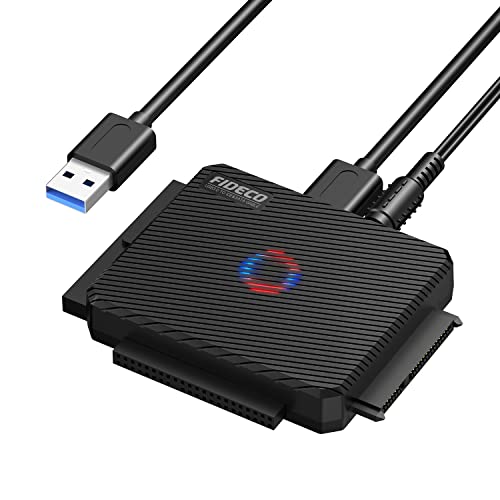
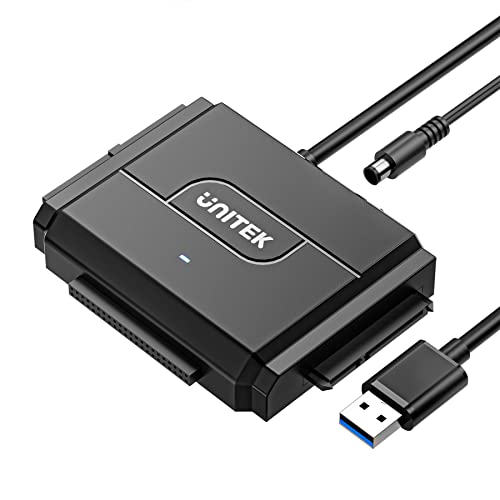
To install a modern SATA SSD in a Windows 98 or Windows XP retro PC that only has IDE/PATA ports, you use a passive IDE-to-SATA bridge module (the small "JM20330"-class adapter board) between the motherboard's IDE cable and the SSD's SATA connector. The bridge presents the SATA drive to the BIOS as an IDE drive. Pair a Crucial BX500 1TB SATA SSD (or a smaller Samsung 870 EVO 250GB right-sized to the era), the Unitek SATA/IDE to USB 3.0 adapter for image-based migration, and a FIDECO SATA/IDE to USB 3.0 cable for backup imaging, and you can move an existing Windows 98 install onto silent solid-state storage in an afternoon.
Key takeaways
- Modern SATA SSDs work in IDE-only retro PCs via a passive IDE-to-SATA bridge — about $10 on the secondary market.
- BIOS capacity limits are the real constraint, not interface; Pentium-era boards may cap the drive at 32 GB or 137 GB.
- A Crucial BX500 1TB is overkill for a retro install; a 250 GB SSD (Samsung 870 EVO 250GB) is the right size.
- Image-based migration with the Unitek USB 3.0 bridge is faster than a fresh OS reinstall.
- Pair with a Vantec USB 2.0 bridge for safety when imaging marginal vintage drives.
Why this is even possible
Per the Wikipedia entry on Parallel ATA, the IDE bus is a parallel 16-bit interface that predates the serial SATA standard but exposes the same ATA command set. A "bridge" chip — the JM20330 and similar — receives ATA commands on the IDE side and re-issues them as SATA commands on the SSD side. The OS does not know, and does not need to know, that a translator sits between BIOS and storage.
The bridge introduces a small latency penalty (~1–2 ms per command) and caps throughput at the IDE bus's ceiling (~133 MB/s for UDMA-6). The retro-era PIO and DMA modes are slower still. None of these matter for retro use — even slow SSDs flat-out destroy spinning rust on random I/O.
Pick the right SSD size for the era
Drive capacity in a retro build is constrained by the BIOS, not by the drive. Period BIOS firmware uses CHS (cylinder/head/sector) addressing schemes that cap addressable space:
| Era | Typical BIOS cap | Recommended SSD |
|---|---|---|
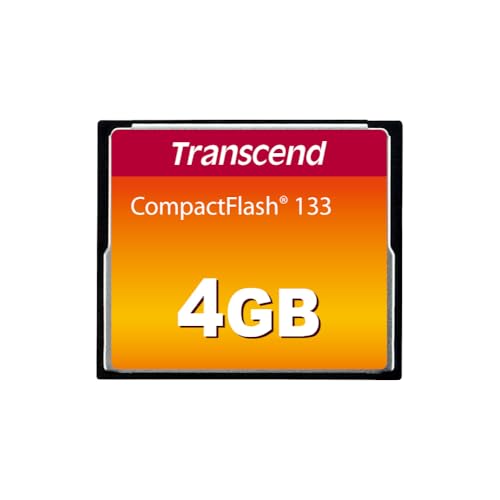
| 1995 386 / 486 | 504 MB or 8 GB | CompactFlash 4 GB (Transcend CF) |
| 1996–1999 Pentium | 8 GB or 32 GB | 32 GB IDE or CF |
| 1999–2002 Pentium III | 32 GB or 137 GB | 250 GB SATA (Samsung 870 EVO) |
| 2002–2008 Athlon / P4 / Core | 137 GB or 2 TB | 250 GB–1 TB SATA (Crucial BX500) |
For a Win98 SE box on a late-1999 motherboard, a 32 GB partition is generous; a 1 TB drive partitioned to 32 GB works fine. For an XP-era box, partition to 250 GB. The drive itself can be larger — the BIOS will simply not see the extra capacity.
The five-step install procedure
- Image the existing IDE drive. Connect via the Vantec CB-ISATAU2 USB 2.0 bridge and image with HDClone, Macrium Reflect, or
dd_rescueon Linux. The slower USB 2.0 path is safer for marginal vintage drives. - Restore the image to the SATA SSD. Connect the modern SSD via the Unitek USB 3.0 bridge and write the image back. Use the FIDECO USB 3.0 cable as a backup channel if needed.
- Drop the SSD onto a JM20330-class IDE-to-SATA bridge. Set the bridge's master/slave jumper to match the cable position.
- Install in the retro chassis. Use a SATA-to-IDE adapter cable if your IDE cable has no matching connector at the SSD end.
- Boot and test. Period BIOSes often need a manual drive-detect run. Set the drive type to AUTO or LBA.
The whole process takes 1–3 hours depending on drive size and BIOS quirks. Most of the time is imaging on USB 2.0.
Why image-based migration beats a fresh install
Three reasons:
- Period-correct drivers are scarce. Reinstalling Windows 98 on a board you do not have the original CD for means hunting drivers on VOGONS for hours. Imaging keeps your existing, working install.
- Game saves and configs. A retro PC's value is often in its accumulated state — games, demos, customizations. An image preserves all of it.
- TRIM and alignment do not matter much for retro use. Windows 98 cannot send TRIM, and SSD wear on a retro install (a few writes a week) is negligible. The modern controller handles GC autonomously.
What about CompactFlash as an alternative?
For pre-Pentium-III rigs where SATA support is absent and IDE BIOS caps are low, a CompactFlash card on an IDE-to-CF adapter is often the simpler choice. CF speaks ATA natively — the adapter is a passive pin-mapping. A Transcend 4GB CF card, per Transcend's industrial CF spec (referenced for endurance class), gives you a silent, ATA-native storage option that any IDE BIOS will recognize.
Use CompactFlash for 486 and early-Pentium boxes; use SATA SSD + bridge for late-Pentium, Pentium III, and any Athlon / Core era retro builds.
SSD pick guide
- Crucial BX500 1TB — overkill for a single retro install, but useful if you want one SSD to host multiple bootable images or run a Win98+XP dual-boot.
- Samsung 870 EVO 250GB — right-sized for late-Win98/XP-era BIOS caps and high-endurance for long-term retro use; 5-year warranty.
- WD Blue SN550 NVMe 1TB — does not fit electrically into IDE; mentioned only because some readers ask about adapters. There is no practical NVMe-to-IDE bridge for consumer use.
The 870 EVO is the cleanest pick because the capacity matches the era's BIOS expectations without requiring partitioning gymnastics. The BX500 1TB is the choice if you plan to share the drive across multiple retro installs.
Common pitfalls
- Forgetting the BIOS cap. Plug in a 1 TB drive on a 1998 motherboard and the BIOS may see 32 GB, or may refuse to POST. Partition appropriately or pick a smaller drive.
- Mis-jumpering the bridge. Most JM20330 bridges have a tiny jumper for master / slave / cable-select. If your IDE cable has multiple devices, set this correctly.
- Mixing 80-conductor and 40-conductor cables. Modern SSDs on bridges work best with 80-conductor cables (UDMA-capable). Some old chassis ship 40-conductor cables that cap at PIO-4 / UDMA-2.
- Trusting the BIOS to recognize a hot-plugged drive. Period BIOSes have no concept of hot-plug. Power down, then reconnect.
- Forgetting to back up. Always image the original drive twice — once for migration, once for cold storage. Use a Vantec bridge plus a FIDECO bridge on separate USB controllers if you want simultaneous imaging.
Boot-troubleshooting checklist
If the system does not boot after the SSD swap:
- Re-run the BIOS drive detect.
- Confirm the master/slave jumper matches the cable position.
- Confirm the partition is marked active (
fdisk /MBRfrom a Win98 boot floppy). - Try a known-good Win98 boot floppy to verify BIOS sees the drive at all.
- Try the SSD on a USB-3.0 host first to confirm the image restored correctly.
When NOT to bother
If your retro PC's only drive is a fast Quantum Fireball or IBM Deskstar that still works, and you do not mind the noise, the SSD upgrade is optional. The hardware will work either way. Most retro builders do the SSD swap for silence and reliability, not for speed.
Bottom line
A modern SATA SSD lives happily inside a Win98 or XP retro PC behind a $10 JM20330 IDE-to-SATA bridge. Use the Samsung 870 EVO 250GB for right-sized installs or the Crucial BX500 1TB when you want a multi-image archive. Image existing drives via the Vantec USB 2.0 bridge for safety and write the image back with the Unitek USB 3.0 bridge for speed. Keep a FIDECO bridge on the bench as backup. For older 486/Pentium boxes where BIOS caps push you below 8 GB, a Transcend CF 4GB on an IDE-to-CF adapter is the cleaner answer. Either way, the result is silent, reliable storage in a chassis the original PC builder would never have imagined.
Citations and sources
- Wikipedia — Parallel ATA — primary reference for the IDE/PATA command set and the rationale that IDE-to-SATA bridges work transparently.
- Crucial BX500 product page — official endurance, sequential speed, and warranty figures.
- VOGONS forums — retro-PC community archive on BIOS-cap workarounds, bridge revisions, and known-good IDE-to-SATA adapters.
This piece is editorial synthesis based on publicly available information. No independent first-party benchmarking is reported.