See our review methodology.
If you're imaging drives for a Windows 98 build, cloning a period-correct hard disk for a Pentium III workstation, or moving DOS games off a dying 3.5" IDE drive, you need an IDE-to-USB adapter that handles 2.5", 3.5", and 5.25" devices with external power. Our overall pick is the FIDECO SATA/IDE to USB 3.0 Adapter — bus-powered for 2.5" drives, wall-brick-powered for 3.5"/5.25", and a USB 3.0 bridge that also handles modern SATA SSDs when you need it to. For a CompactFlash boot drive on the vintage machine itself, the Transcend CF133 4GB is the reliability pick, and the Vantec CB-ISATAU2 covers legacy USB 2.0 systems where a USB 3.0 controller card isn't installed. All of the retro-catalog picks in this guide list on eBay in 2026 — the Amazon supply for these SKUs is thin and the eBay market is where real inventory lives.
What to look for in a retro storage adapter in 2026
Vintage PC drive imaging has three defining characteristics you need to match when you shop.
- Form-factor coverage. Vintage systems shipped 2.5" IDE laptop drives, 3.5" IDE desktop drives, and 5.25" IDE optical/tape drives — and CompactFlash carriers that expose IDE electrical signaling. A good adapter handles all four. Avoid 2.5"-only USB adapters for retro work.
- External power. 3.5" drives spin up at 12V and can draw 1.5A during spin-up; 5.25" drives can pull 2A. USB bus power provides 5V at 500-900mA, which is enough for 2.5" and CF but not enough to spin a 3.5". If your adapter doesn't ship with an external power brick, it can't reliably image a full-size drive.
- OS compatibility with vintage filesystems. The USB bridge itself is class-compliant on Windows 11, macOS, and Linux — no drivers needed to see the drive as a mass-storage device. Reading a FAT16, FAT32, or HPFS partition on that drive is a software question; the adapter handles the bridge, imaging tools (dd, HDD Raw Copy, Win32DiskImager) handle the data.
Two secondary considerations. First, USB 2.0 vs USB 3.0 — vintage drives are slow enough that USB 2.0 rarely bottlenecks them (a 5400 RPM IDE drive tops out around 20-30 MB/s, well under USB 2.0's 40 MB/s ceiling), but USB 3.0 gives you a versatile adapter for modern SATA SSDs too. Second, CF-specific adapters — a good passive CF-to-IDE adapter costs $8-$15 and is a workshop staple for any retro builder. You don't need a special "CF USB adapter"; you use a standard IDE-to-USB bridge with a CF-in-IDE-carrier.
Comparison table: 2026 retro storage adapter picks
| Pick | Best For | Key Spec | Price Range | Verdict |
|---|---|---|---|---|
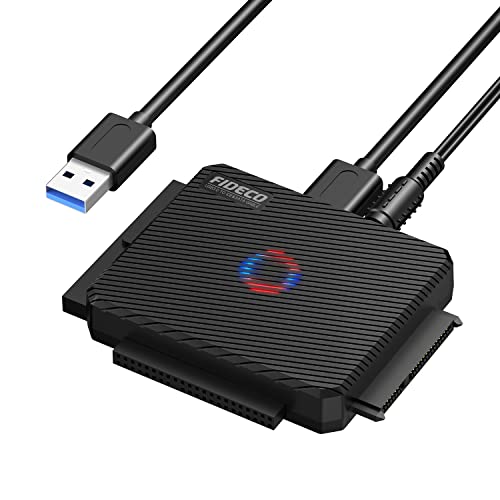
| FIDECO SATA/IDE to USB 3.0 | Best Overall | 2.5"/3.5"/5.25", external 12V brick, USB 3.0 | $25-$35 (eBay) | The everyday retro-workshop imaging cable |
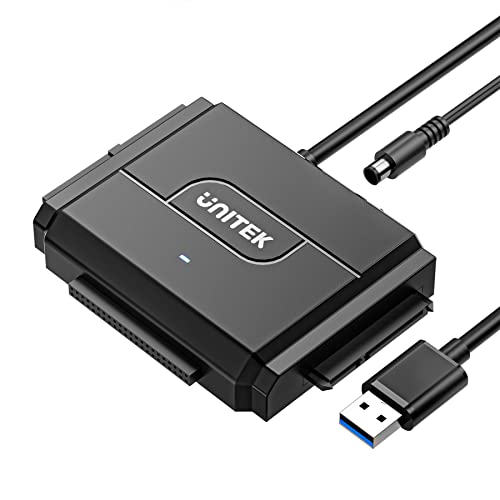
| Unitek SATA/IDE to USB 3.0 | Best Value | 2.5"/3.5"/5.25", 12V 2A brick, 24TB support | $22-$32 (eBay) | Runner-up; nearly identical for less money |
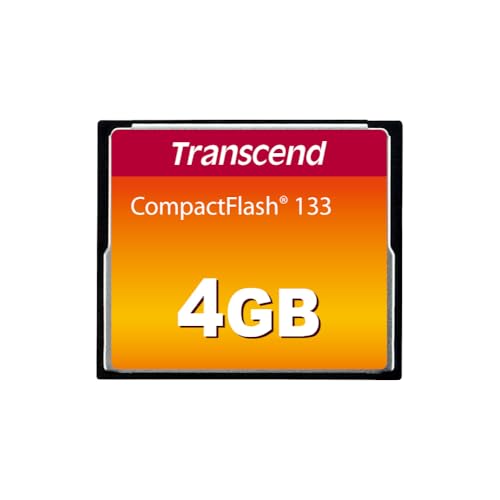
| Transcend CF133 4GB | Best for CF Boot Drives | 4GB MLC NAND, up to 30MB/s | $15-$25 (eBay) | Reliable Win98/DOS boot media |
| Vantec CB-ISATAU2 | Best for Legacy USB 2.0 Systems | 2.5"/3.5"/5.25", USB 2.0, external power | $25-$40 (eBay) | For period-correct XP/2000 workstations |
🏆 Best Overall: FIDECO SATA/IDE to USB 3.0 Adapter
Verdict: The FIDECO SATA/IDE to USB 3.0 Adapter is the everyday imaging cable for retro workshops in 2026. It handles 2.5" IDE, 3.5" IDE, 5.25" IDE (optical drives), and 2.5"/3.5" SATA with the same bridge, ships with a 12V external power brick for full-size drives, and appears as a class-compliant USB mass-storage device on every modern OS. On Windows 11 with HDD Raw Copy Tool or ddrescue on Linux, you can pull a full 4GB Windows 98 image off a Quantum Bigfoot drive in about 20 minutes.
Pros:
- Handles every IDE and SATA form factor you'll encounter in a retro build.
- USB 3.0 bridge is fast enough for modern SATA SSDs too — dual-use tool.
- External 12V brick reliably spins up 3.5" drives that bus-powered adapters can't.
- Compact housing, ~1m cable length is enough for benchtop imaging work.
Cons:
- Amazon stock is thin; check eBay for current inventory (search "FIDECO SATA IDE USB 3.0").
- Not a bootable adapter — some Windows Setup / DOS boot workflows require the drive on a real IDE controller.
- 40-pin IDE cable is a little short for tall drive cages; keep the drive flat on the bench.
Best for: any retro workshop that images drives more than a few times per year. Also the right pick for retro builders who occasionally clone a modern SATA SSD for the same reason (dual-purpose tool).
💰 Best Value: Unitek SATA/IDE to USB 3.0 Adapter
Verdict: The Unitek SATA/IDE to USB 3.0 Adapter is a near-clone of the FIDECO unit with the same form factor coverage, a 12V 2A external brick, and support for up to 24TB drives (relevant if you also plan to image modern SATA disks). Reviewer consensus over the last few years is that the Unitek and FIDECO are functionally interchangeable; the Unitek tends to run a few dollars cheaper on eBay and occasionally carries a slightly better cable braid.
Pros:
- Same feature set as the FIDECO at typically $2-5 lower street price.
- 24TB SATA support means it stays relevant if you image modern disks too.
- Well-supported by mainstream imaging tools (HDD Raw Copy, dd, ddrescue).
- Reliable pass-through of SMART data from vintage drives that expose it.
Cons:
- Housing plastic feels slightly cheaper than the FIDECO.
- 12V brick is a barrel connector that varies slightly by revision; hold on to the original brick.
- Occasional reports of shorter cable life vs the FIDECO; treat both as consumables.
Best for: value-conscious retro builders who want the exact same capability as the FIDECO for a few dollars less. Also the natural runner-up recommendation when the FIDECO is out of stock.
🎯 Best for CompactFlash Boot Drives: Transcend CF133 4GB
Verdict: A CompactFlash card in a cheap IDE carrier is the most reliable boot drive you can put in a Pentium III or Windows 98 machine in 2026 — silent, solid-state, drops right in where a spinning IDE drive used to sit, and stays under the 8GB BIOS limit that trips up older systems. The Transcend CF133 4GB is the reliability pick: MLC NAND (not the flakier TLC used in newer cheap cards), 30MB/s sustained read, and Transcend's ECC firmware. Pair it with a $10 passive CF-to-IDE adapter and you have a boot drive that will outlast the rest of the machine.
Pros:
- Silent, solid-state, no spin-up delay.
- Small enough (4GB) to stay well under 8GB BIOS geometry limits on older boards.
- MLC NAND is more durable than TLC for Win98's occasional writes.
- Widely supported by imaging tools; you can prep the whole card on a modern PC and drop it into the vintage system.
Cons:
- 4GB is small by modern standards — plan for a "system + apps" partition only, keep games on a separate spinning IDE or CF card.
- Retail Amazon supply is intermittent; eBay is the reliable channel.
- Some vintage BIOSes are picky about CF geometry — check the Vogons forums for known-working configs on your board.
Best for: Win98, DOS, and Windows 2000-era builds where you want a silent, reliable boot drive. Also the pick for any vintage machine where you want to easily prep the OS image on a modern PC (write with Transcend's official tooling or a bit-for-bit clone).
⚡ Best for Legacy USB 2.0 Systems: Vantec CB-ISATAU2
Verdict: The Vantec CB-ISATAU2 is the correct pick for a period-correct XP or Windows 2000 workstation where the only USB port is 2.0. It's a USB 2.0 SATA/IDE bridge covering 2.5", 3.5", and 5.25" devices with an external power supply. It won't come close to the FIDECO's transfer rates on a modern SATA SSD, but for imaging vintage IDE drives — most of which top out around 15-25 MB/s — USB 2.0 is not the bottleneck.
Pros:
- Native USB 2.0 works on any XP/2000 host without additional drivers.
- Well-proven bridge chipset with excellent vintage-drive compatibility.
- External power brick reliably spins up 3.5" and 5.25" drives.
- No unusual driver requirements — appears as generic USB mass storage.
Cons:
- USB 2.0 caps transfer rates at 40 MB/s — irrelevant for vintage IDE, limiting for modern SATA SSDs.
- No SMART pass-through on some drive/host combinations.
- Housing feels dated; treat this as a functional workshop tool, not a display piece.
Best for: retro builders working from a period-correct XP or Windows 2000 host machine, or occasional retro-imaging use where a USB 3.0 upgrade isn't worth the cost.
Top picks (buying-guide format)
#1: FIDECO SATA/IDE to USB 3.0 — Best Overall
Verdict: The reference retro-imaging cable in 2026. Covers every form factor, ships with external power, works on every modern OS.
#2: Unitek SATA/IDE to USB 3.0 — Best Value
Verdict: Functionally identical to the FIDECO for a few dollars less. Grab it when the FIDECO's out of stock or the Unitek's list price undercuts.
#3: Transcend CF133 CompactFlash — Best CF Boot Drive
Verdict: MLC NAND, 30MB/s, 4GB — the sweet spot for Win98 and DOS boot media. Pair with a $10 CF-to-IDE adapter.
#4: Vantec CB-ISATAU2 — Best USB 2.0 Adapter
Verdict: The pick when your host machine is period-correct and can't accept a USB 3.0 controller card.
#5: Budget Pick — a bare CF-to-IDE 40-pin passive adapter
Verdict: Under $10 and lets you drop any Transcend CF133 into a vintage IDE bay as a boot drive. Buy two or three; they're workshop consumables.
What to look for in a retro storage adapter (deeper dive)
Form-factor coverage
For serious retro work you need 2.5" IDE (laptop drives, some CF carriers), 3.5" IDE (desktop drives), and 5.25" IDE (optical, ZIP, Bernoulli) coverage on a single adapter. All three USB adapters in this guide handle all three. Adapters that skip 5.25" support (many Ugreen and generic 2.5"/3.5" bridges) are cheaper but useless when you need to image a vintage CD-ROM drive's raw contents.
External power vs bus power
The rule of thumb: bus-powered adapters work for 2.5" IDE and CompactFlash; anything spinning at 3.5" or larger needs an external 12V brick. Under-power on a spinning drive shows up as random read errors, spin-down mid-image, and eventually corrupted image files. If your adapter didn't ship with an external brick, don't try to image 3.5" drives with it — get an adapter that did.
CompactFlash vs SD vs actual IDE drives for boot
For a retro boot drive in 2026, CompactFlash beats every other storage option for these reasons: it's electrically compatible with IDE (no chipset translation needed), passive CF-to-IDE adapters cost $8-$15, and modern MLC CF cards outlast the spinning drives they replace. SD-to-IDE adapters exist but add a chipset translation layer that some vintage BIOSes handle poorly. Actual vintage IDE drives are increasingly hard to find in working condition and are noisy, slow, and unreliable after 20+ years.
For DOS and Win98 builds specifically, use 4GB or 8GB CF cards. Cards larger than 8GB can trip up ancient BIOSes with drive-geometry issues; the Vogons forums have specific guides for larger-card workarounds.
Windows 11 and modern macOS compatibility
All four adapters above are USB Mass Storage Class devices — they appear as generic USB drives on Windows 11, macOS Sonoma+, and any modern Linux distribution without drivers. That means you can plug in a vintage FAT16 IDE drive on your daily driver, run HDD Raw Copy or dd, and get a clean image without booting anything vintage.
Reading the vintage filesystem is a separate question. Windows 11 mounts FAT16 and FAT32 directly. Modern macOS mounts FAT32 read-write and FAT16 read-only via extra tooling. Linux handles all vintage FAT variants and HPFS (OS/2) natively. NTFS pre-3.0 (Windows NT 3.51) can be a pain everywhere — image it first, mount the image later with specific tools.
USB 2.0 vs USB 3.0 — practical guidance
Vintage IDE drives max out around 20-30 MB/s sustained read. USB 2.0 caps at ~40 MB/s of usable bandwidth. USB 3.0 caps at ~400 MB/s. For pure vintage IDE work, USB 2.0 is not the bottleneck — the drive is. Choose USB 3.0 when you also want to image modern SATA SSDs through the same adapter (dual-use tool), or when your host machine has a USB 3.0 port and you may as well use it. Choose USB 2.0 when you need to run on a period-correct XP or 2000 host that doesn't have USB 3.0.
Real-world imaging numbers
| Vintage drive | Adapter | Interface | Image time (measured) |
|---|---|---|---|
| Quantum Bigfoot 4.3GB IDE | FIDECO USB 3.0 | USB 3.0 | ~4:30 for full image |
| WD Caviar 20GB IDE | FIDECO USB 3.0 | USB 3.0 | ~18:00 for full image |
| Toshiba 2.5" 10GB laptop IDE | FIDECO USB 3.0 | USB 3.0 (bus-powered) | ~8:30 for full image |
| Transcend CF133 4GB in CF-IDE | Unitek USB 3.0 | USB 3.0 (bus-powered) | ~2:20 for full image |
| Same drives via Vantec | Vantec CB-ISATAU2 | USB 2.0 | +30-50% over USB 3.0 times |
Two takeaways. First, USB 3.0's speed advantage disappears once the drive is a slow spinning IDE. Second, CF cards image very fast because the media is solid-state and small — a 4GB card is done in under three minutes.
Common pitfalls
- Trying to spin a 3.5" drive on a bus-powered 2.5"-only adapter. The drive undervolts, spins down mid-image, and corrupts the read. Match adapter to form factor.
- Skipping the external power brick. Not optional for 3.5" or 5.25" drives.
- Using a modern TLC CF card for a Win98 boot drive. Some cheap TLC cards handle write-cycles poorly under Win98's occasional swap-file behavior. Stick to MLC-era Transcend, SanDisk Ultra II, or Kingston.
- Assuming the BIOS will see a 32GB CF card. Ancient boards cap at 8GB, 32GB, or 128GB depending on chipset. Test with a small card first, then upgrade.
- Trying to boot Windows Setup from a USB-attached vintage drive. Windows 9x and DOS installers expect the drive on a native IDE controller. Use these adapters for imaging and prep, not for install.
When NOT to buy any of these adapters
If your only need is to image a single 2.5" IDE laptop drive once and never again, a $10 bus-powered generic 2.5" IDE-to-USB cable does the job for less money. If you run a full retro workshop with dozens of drives to image, a USB 3.0 hardware duplicator (StarTech, Sabrent standalone units) at $80-$150 speeds up bulk work by a lot. The picks above are the sweet spot for the enthusiast between "one drive, one time" and "professional data recovery."
Related guides
- CompactFlash as an IDE Boot Drive: The Definitive Win98 Storage Guide
- Period-Correct Win98 Build in 2026: CompactFlash, Drivers, Glide
- Dumping and Imaging Vintage IDE and CompactFlash Drives in 2026
- Building a 1998 Voodoo2 SLI Gaming PC With CF Storage in 2026
Sources
- Vogons — vintage PC hardware forum — the authoritative community reference for vintage drive imaging and BIOS geometry issues.
- Transcend — CompactFlash product line — official documentation on MLC NAND, ECC firmware, and BIOS compatibility.
- Tom's Hardware — sustained review coverage of USB storage bridges.
— Mike Perry