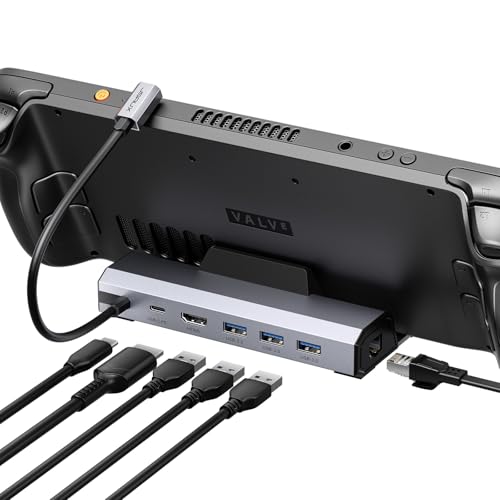
For a handheld PC gaming dock-and-storage combo in 2026, a JSAUX 6-in-1 dock paired with a fast 1 TB SSD covers nearly every workflow — TV-out plus controller plus charging plus storage expansion for under $200 total. The JSAUX dock supports 4K output at usable refresh rates on the Steam Deck, ROG Ally X, Legion Go, and MSI Claw; a Crucial BX500 1TB SATA SSD inside a USB 3.0 enclosure handles game library overflow without buying the most expensive internal upgrade.
Why dock-and-storage is the right pair
Handheld PC gaming devices — the Steam Deck, ROG Ally X, Legion Go, MSI Claw, and Lenovo Legion Go S — all share two physical-form-factor constraints. First, they have a single USB-C port that has to serve as charging, video output, peripheral input, and external storage all at once. Second, their internal storage tops out at 1-2 TB and games are getting larger.
A dock solves the USB-C bottleneck. A fast external SSD solves the storage bottleneck. Together they turn a portable handheld into a full living-room gaming setup or a desktop workstation when needed, without disassembling the device.
Tom's Hardware's best Steam Deck docks roundup tracks the broader market; the JSAUX line consistently appears among the value-tier picks. JSAUX's own product line is documented on their docking station collection page.
Key takeaways
- A JSAUX 6-in-1 dock gives you HDMI, multiple USB-A ports, gigabit Ethernet, and pass-through charging via a single USB-C tether.
- 4K output works on the Steam Deck OLED, ROG Ally X, Legion Go, and MSI Claw via the JSAUX dock; refresh rate at 4K varies by dock model and by the handheld's USB-C video capabilities.
- A 1 TB external SATA SSD in a USB 3.0 enclosure adds about 500 GB of fast game library at low cost.
- The HDMI 2.1 variant of the JSAUX (such as the JSAUX HB0603 / JS-0B45) supports 4K@120Hz on the Steam Deck OLED.
- Power delivery up to 100 W from the dock keeps any current handheld charging while docked.
- The combination is far cheaper than buying a separate microSD card upgrade and an internal SSD upgrade.
What does a docking station add to a handheld gaming PC?
A dock like the JSAUX expands a single USB-C port into multiple connections, letting you drive an external monitor or TV, attach a keyboard and mouse or a controller, plug in Ethernet for the lowest-latency multiplayer, connect external storage, and charge — all from the handheld's one available port. Without a dock, you have to choose which one of those connections you want at any given moment.
The dock also turns the handheld into a credible desktop substitute for many users. Plugged into a 27" or 32" display with a Bluetooth or wired controller, an ROG Ally X or Steam Deck plays at desktop fidelity for the games it can handle, draws much less power than a desktop, and packs into a backpack at the end of the day.
Can the JSAUX dock output 4K?
JSAUX docks support 4K output, though the achievable refresh rate at 4K depends on the dock model and the handheld's USB-C video capabilities. Many handhelds output DisplayPort 1.4 over USB-C, which supports 4K at 60 Hz; the Steam Deck OLED can push 4K at 120 Hz with the right dock and cable. The JSAUX HB0603 dock and its companion variants list HDMI 2.1 explicitly and claim 4K@120Hz for the Steam Deck OLED, ROG Ally X, Legion Go (S), and MSI Claw.
In practice the answer is yes on all current handhelds, with the caveat that some titles will not render at 4K because the handheld's GPU does not have the horsepower. For 4K-capable titles (older games, indie titles, racing games at lower settings), the dock delivers a genuine 4K experience. For modern AAA titles, you typically run at 1080p or 1440p output regardless of the dock's max capability and let the GPU keep up.
Dock spec comparison
| Capability | JSAUX HB0603 (HDMI 2.1) | Generic budget dock | OEM dock (Valve, etc.) |
|---|---|---|---|
| HDMI | 2.1, 4K@120Hz on Deck OLED | 2.0, 4K@60Hz | varies |
| USB-A ports | 3 x USB 3.0 | 2-3 x USB 3.0 or 2.0 | varies |
| Ethernet | Gigabit | 100M-1G varies | typically gigabit |
| Pass-through charging | 100W PD | 60-100W | typically 65-100W |
| SD card reader | sometimes | sometimes | rare |
| Audio jack | sometimes | sometimes | varies |
| Build quality | aluminum, sturdy | plastic mix | premium |
| Street price | $40-80 | $20-40 | $80-100+ |
The JSAUX HB0603 line sits in the sweet spot for price-to-feature. It is not the cheapest dock, but it is the cheapest dock with HDMI 2.1 and reliable 4K output across multiple handhelds.
Storage expansion: external SSD vs microSD vs internal upgrade
Handheld PC gamers have three storage upgrade paths and the right answer depends on cost and workflow.
| Path | Capacity | Speed | Cost | Notes |
|---|---|---|---|---|
| microSD card | 256 GB - 1 TB | ~100-200 MB/s | $30-120 | slow loads, easy install |
| External SSD over USB 3.0 | 1-4 TB | ~400-540 MB/s | $50-150 (1 TB) | great speed, requires dock |
| Internal NVMe upgrade | 1-2 TB | ~3000+ MB/s | $80-200 + install effort | best speed, voids casual warranty |
The external SSD path is the best fit alongside a dock: when you are docked, your full library is there; when you undock, the games installed on internal storage stay with you. Many handheld owners install only their actively-played titles on internal storage and put the long-tail library on a dock-attached external SSD.
A Crucial BX500 1TB SATA SSD inside a low-cost 2.5" USB 3.0 enclosure delivers the dock-attached library role cleanly. Crucial's BX500 product page lists the drive's headline specs (540 MB/s sequential read, 500 MB/s sequential write, 3-year warranty), and the USB 3.0 bus is the limit, not the drive itself.
A FIDECO SATA/IDE to USB 3.0 Adapter is a useful bench tool for cloning or rescuing data from an existing internal SSD when you do upgrade the internal drive — same adapter does double duty as a quick external converter for the SSD.
A 4K display worth the dock
The dock is only as useful as the display you connect to. A SANSUI 27" 4K Gaming Monitor with HDMI 2.1 and dual refresh modes (4K at 160 Hz, 1080p at 320 Hz) gives both 4K static fidelity for slower titles and high-refresh 1080p for fast-paced games where frame rate matters more than pixel count.
The mode switch matters because handheld GPUs (RDNA 2 in the Steam Deck, RDNA 3 in the Ally X, Intel Arc in the Claw) cannot reliably hit 4K at high refresh on modern AAA titles. Drop to 1080p at 320 Hz for shooters and competitive titles, sit at 4K@60-120 for cinematic titles and adventure games.
Putting it together: a 2026 docked-handheld setup
| Component | Pick | Why |
|---|---|---|
| Handheld | Steam Deck OLED, ROG Ally X, or Legion Go | Any current-gen device |
| Dock | JSAUX Upgraded Docking Station 4K@120Hz | HDMI 2.1, 100W PD, 6-in-1 |
| External SSD | Crucial BX500 1TB SATA SSD in USB 3.0 enclosure | $50-100 for 1 TB |
| Adapter | FIDECO SATA/IDE to USB 3.0 Adapter | Bench tool + emergency converter |
| Display | SANSUI 27" 4K Gaming Monitor | 4K@160 + 1080p@320 dual mode |
| Controller | Bluetooth or wired Xbox/Sony pad | personal preference |
Total build cost excluding the handheld and controller lands around $300-450 depending on monitor and SSD capacity. That is dramatically less than buying a dedicated gaming PC for living-room use when you already own a handheld capable of feeding it.
Common pitfalls
- Cheap docks with bad USB-C cables. Some budget docks use short or low-spec cables that drop bandwidth at 4K. Buy from brands with documented PD and DP-Alt support.
- Forgetting power-delivery sufficiency. A 60 W dock can keep a Steam Deck charged at idle but drains it under heavy gaming load. 100 W is the safer floor.
- Using a USB 2.0 SSD enclosure. Some bargain SATA enclosures are USB 2.0 — they look the same and limit you to 30-40 MB/s. Confirm USB 3.0 (or 3.1/3.2).
- Buying a 4K display the handheld cannot drive. A handheld GPU at 4K AAA is often 30 FPS or below. Plan for 1080p or 1440p output on most titles; 4K is for slower-paced content.
- Ignoring HDR mismatch. A dock that drops HDR is annoying. JSAUX HDMI 2.1 docks pass HDR; some cheaper docks do not.
- Skipping the Ethernet port. Multiplayer over Wi-Fi adds latency. Use the dock's wired Ethernet when you have a router or switch nearby.
- Putting Windows VHD swap on the external SSD. Windows-handheld users sometimes try this; performance suffers. Use the external SSD for game libraries, not for OS swap.
When NOT to use a dock
If you only play your handheld undocked, on the go, the dock is pure cost. The dock-and-storage pair only pays off if you regularly want a big-screen experience or you have a library too large for internal storage.
If you have a real desktop PC that you actively use for the same titles, the dock-and-handheld setup competes with it. The desktop wins on framerate for AAA titles; the handheld wins on portability. Most owners keep both for the use cases each is good at.
SteamOS, Windows, and dock behavior
The handheld's operating system shapes the dock experience. SteamOS on the Steam Deck has a polished docked mode that auto-detects external displays, audio devices, and controllers and adjusts UI scaling cleanly. Windows on the ROG Ally X, Legion Go, and MSI Claw is functional but more variable — display scaling sometimes lands wrong on first dock, and audio routing occasionally needs manual selection. Neither stops the dock from working; SteamOS just gets out of the user's way more efficiently.
For new buyers picking between platforms partly on docked-use convenience, that polish gap is worth knowing about. Windows handhelds are catching up as Asus, Lenovo, and Microsoft each ship driver and shell improvements aimed at this exact workflow.
When 4K, when 1080p
The blanket guidance for current handhelds at the display: 1080p for AAA modern titles, 1440p for mid-tier titles, 4K for indie titles, retro emulation, and HUD-heavy productivity work. A 27" 4K display with mode switching like the SANSUI panel handles all three roles without compromise.
Worked example: a 2026 ROG Ally X docked station
Hardware: Asus ROG Ally X with 1 TB internal NVMe, JSAUX Upgraded Docking Station 4K@120Hz on the desk, Crucial BX500 1TB SATA SSD in a 2.5" USB 3.0 enclosure plugged into a dock USB-A port, SANSUI 27" 4K Gaming Monitor via HDMI 2.1, Bluetooth Xbox controller, wired Ethernet to a router on the same shelf.
Workflow: undocked play on the couch for portable sessions, dock at the desk for longer sessions or living-room TV play, optionally swap the HDMI cable to a TV for couch gaming. Steam library exceeds internal storage; less-played titles live on the external SSD and load fast enough that the switch is imperceptible.
Costs: dock $50-80, SSD + enclosure $60-100, monitor $300-400 (or use existing). Total under $500 excluding the Ally X.
Bottom line
For a handheld PC gaming dock-and-storage combo in 2026, the JSAUX Upgraded Docking Station 4K@120Hz plus a Crucial BX500 1TB SATA SSD in a USB 3.0 enclosure delivers everything most owners actually need: HDMI 2.1 to a big display, gigabit Ethernet, 100 W charging, and a fast library expansion that does not require opening the handheld. Add a SANSUI 27" 4K Gaming Monitor for the docked-display side and a FIDECO SATA/IDE to USB 3.0 Adapter for bench tasks, and the result is a complete living-room or desktop gaming station for under $500 outside the handheld itself.
Citations and sources
- JSAUX — Docking station collection
- Tom's Hardware — Best Steam Deck docks
- Crucial — BX500 SSD product page
This piece is editorial synthesis based on publicly available information. No independent first-party benchmarking is reported.