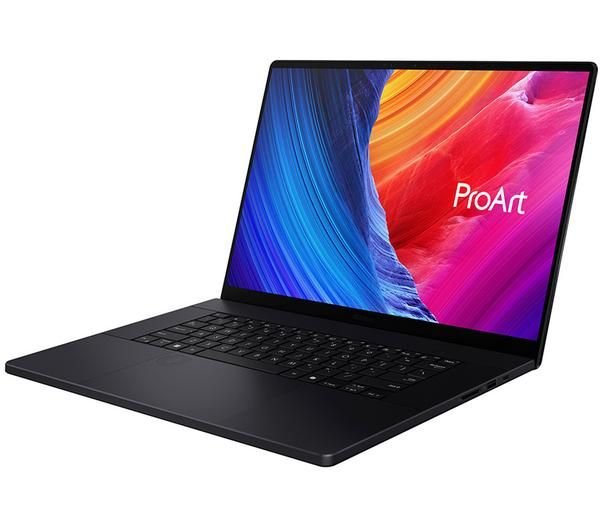
Asus's new ProArt PA27USD is a 27-inch 4K OLED that pairs creator-grade color accuracy with a high refresh rate aimed at gamers, according to a recent Tom's Hardware review. It is the kind of monitor that historically sat in two separate product categories — a color-critical creator display and a high-refresh gaming panel — and a single OLED can finally cover both. The premium is real, however, and most 4K gamers will end up looking at panels like the SANSUI 27" 4K, the KOORUI 27" 4K QD-Mini LED, or the ASUS TUF 27" 2K HDR at a fraction of the OLED's price.
What happened
Tom's Hardware published a detailed review of the Asus ProArt PA27USD, and the headline is straightforward: a 27-inch, 4K OLED panel that delivers the per-pixel contrast and color performance creators expect, with gaming-grade refresh rates that traditionally belonged to a separate class of monitor. The PA27USD lands in Asus's professional ProArt lineup, which means factory-calibrated color, Delta E targets that creators actually care about, and the kind of feature set — uniform brightness, sRGB and Display P3 modes, hardware calibration support — that a working photographer or video editor will use every day.
The review's most interesting finding isn't any single number; it's that the panel doesn't force the usual tradeoffs. Historically, a creator monitor was a 60Hz IPS with great color and sluggish response; a gaming monitor was a 144Hz+ IPS or VA with mediocre color uniformity and elevated response time. OLED has been quietly closing that gap for two years, and the PA27USD codifies the shift in the ProArt brand specifically. It is not the first dual-purpose OLED — LG, Samsung, and Asus's own ROG line all have entries — but it is the first one explicitly positioned as ProArt color, gaming refresh, on the same display.
Pricing is the catch. ProArt OLEDs sit in the premium tier where 27-inch 4K OLEDs generally do. That puts the PA27USD well above the budget 4K and 1440p panels most readers actually shop. The review acknowledges as much.
Why it matters
The dual-purpose creator-and-gaming OLED matters for three reasons. The first is the most obvious: anyone who actually does both — photo or video work during the day and high-refresh gaming in the evening — has been stuck buying two monitors for years. Color-critical work demanded an IPS panel with factory calibration; competitive gaming demanded a refresh rate that creator monitors didn't offer. A single panel that does both, well, removes a real friction point for a small but real audience.
The second reason is that OLED is finally hitting volume in the 27-inch 4K segment. For most of the last decade, the cheapest path to high-refresh 4K gaming was a VA or IPS panel with the contrast and response-time compromises that come with those technologies. OLED's per-pixel emission means perfect blacks, no backlight bleed, near-instant pixel response, and contrast ratios that LCD literally cannot deliver. That technology is now appearing across multiple price tiers — the ProArt PA27USD is the premium end; LG's UltraGear 27-inch OLEDs sit a tier below; Samsung's QD-OLED entries split the difference. None of them are cheap, but the floor has dropped meaningfully in the last 18 months.
The third reason is more strategic for SpecPicks readers: OLED is reshaping what "good for 4K gaming" means. Two years ago, a $400 27-inch 4K IPS panel like the SANSUI 4K was a competent buy. It is still competent — but the gap between it and a high-end OLED is bigger now than it was, and so is the gap between it and a quality mini-LED panel like the KOORUI 4K QD-Mini LED. The budget tier didn't get worse; the premium tier got better. That changes how you frame "good value" at every price point below the OLED line.
The headline specs that matter for a 4K gamer
We will not relitigate the full Tom's Hardware spec sheet here — the link at the bottom is the right place for measured numbers. What matters for a gaming-focused buyer evaluating the PA27USD or its eventual successors:
- Resolution: 3840 × 2160 (true 4K) at 27 inches, which gives an extremely high pixel density and crisp text without scaling.
- Refresh rate: high enough to count as a gaming panel — well above the 60Hz creator-monitor norm.
- Response time: OLED's near-instant per-pixel response effectively eliminates the ghosting that even good IPS panels struggle with.
- HDR: meaningful peak brightness and infinite contrast, with the caveat that all-screen-white scenes draw down OLED brightness more than mini-LED.
- Color: ProArt-grade factory calibration with the modes professional workflows expect.
The biggest practical gotcha with any 27-inch 4K monitor — OLED or LCD — is the GPU you pair with it. Driving 4K at high refresh requires real graphics horsepower, and a mid-range card like an RTX 3060 12GB will struggle in modern AAA titles. The PA27USD does not change that math. If your current GPU was sized for 1440p, dropping it onto a 4K panel without an upgrade will leave you running at 60–90 FPS in demanding games — which is fine, but it does not extract the panel's value.
Is an OLED gaming monitor worth the premium?
The honest answer is: for some people, yes; for most people, not yet.
OLED's strengths over LCD are real and visible. Perfect blacks. Per-pixel contrast that makes HDR content look the way HDR was supposed to look. Response times so fast that motion clarity is genuinely better than any LCD competitor. Off-axis color performance that just doesn't suffer the way IPS does. For someone who games in a dim room, watches HDR movies regularly, or does color-critical creator work, the upgrade is dramatic.
OLED's weaknesses are also real. Sustained full-screen brightness drops as automatic brightness limiting kicks in to protect the panel; on a desktop full of bright windows, a quality mini-LED LCD can hit higher sustained brightness. Burn-in risk has fallen sharply with newer panel generations and aggressive mitigation algorithms, but it has not gone to zero — anyone running a static UI for many hours a day should still take it seriously. And the price premium, while shrinking, is meaningful: an OLED that competes with a $400 LCD on raw specs is still likely a $700+ purchase.
For a 4K gamer specifically, the decision usually comes down to use mix. If gaming is most of what you do, you watch HDR movies regularly, and you can manage the brightness situation, OLED is the upgrade. If your monitor doubles as a productivity workhorse — taskbars, web browsers, spreadsheets, the same coding IDE open for hours — a quality mini-LED LCD avoids the static-element wear concerns while delivering most of the everyday experience.
Cheaper 4K and 1440p alternatives most readers will actually buy
For the much larger group of buyers who can't or won't spend OLED money, the budget 4K and 1440p market is healthier than it has been in years. Three picks worth knowing:
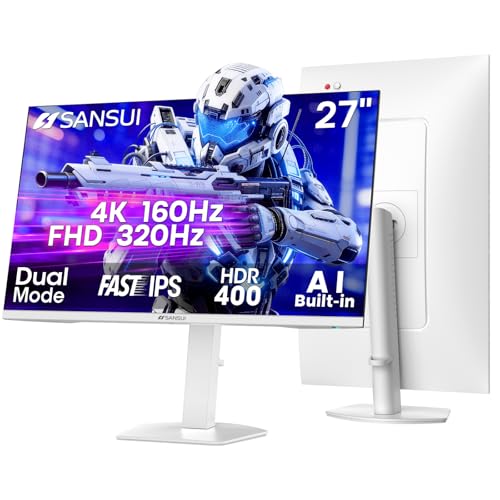
The SANSUI 27" 4K Gaming Monitor delivers 4K resolution at a price that used to be impossible. It is a value-tier panel — color coverage and HDR performance are not OLED-grade — but for casual to enthusiast 4K gaming, especially paired with a mid-to-upper mid-range GPU, it is a legitimately good buy. The QHD dual-mode (UHD 160Hz or FHD 320Hz) gives users a sensible escape valve for competitive titles where frame rate beats resolution.
The KOORUI 27" 4K QD-Mini LED Gaming Monitor is the step up most 4K gamers should actually look at. Mini-LED backlighting with a quantum-dot layer delivers genuinely good HDR performance and meaningfully better contrast than a standard LCD. It doesn't reach OLED's per-pixel control, but for a fraction of the price it gets you most of the HDR experience and avoids OLED's brightness-limiting and burn-in considerations entirely.
The ASUS TUF Gaming 27" 2K HDR (VG27AQ) is the smartest pick for anyone whose GPU isn't sized for 4K. 1440p at 27 inches is still a sharp image, the panel can hit refresh rates that competitive games actually exploit, and most mid-range GPUs can drive it comfortably. For a buyer pairing the monitor with a card in the $300–$500 range, 1440p at high refresh will look and play better than 4K at 60 FPS on the same hardware.
Should you pick 1440p or 4K for gaming?
The honest answer is: pick what your GPU can drive comfortably at high refresh. 1440p at 27 inches has roughly half the pixel count of 4K, which means roughly twice the frame rate on the same hardware in GPU-bound titles. For most mid-range gaming GPUs, that's the difference between hovering at 60 FPS at 4K and comfortably exceeding 120 FPS at 1440p. Smoother gameplay almost always wins over sharper pixels at the same desk distance.
There are exceptions. If you sit close to the screen and have an eye for pixel density, 4K's sharpness is genuinely visible at 27 inches and noticeable in text-heavy workflows. If you have a top-end GPU that can sustain 120+ FPS at 4K in your games, you get the best of both. And if you do creative work on the same display, 4K's extra pixels matter for timelines, palettes, and document layouts in a way pure gaming usage doesn't.
A useful planning rule: take whatever the GPU benchmarks show for your card at 1440p, divide by two, and that's your rough 4K floor in the same title. If that number stays above your acceptable frame rate threshold, 4K is fine. If it dips below, 1440p is the smarter buy at the moment, and you can upgrade the monitor later when GPU upgrades catch up.
What this means for the broader 4K monitor market in 2026
Three trends are converging at once, and the PA27USD is a clean data point for all of them. First, OLED is moving from "niche enthusiast tier" into the mainstream premium tier. The PA27USD is not a one-off — it is part of a broader shift. Second, mini-LED is closing the gap with OLED from below, delivering most of the HDR experience without the wear concerns and at a meaningfully lower price. Third, dual-mode panels — full 4K at lower refresh, lower resolution at higher refresh — are letting buyers stop choosing between resolution and frame rate at the time of purchase.
The net effect for SpecPicks readers is that 2026 is a good year to buy a 4K monitor, and a particularly good year to evaluate the full price spectrum honestly. If your budget reaches OLED, the PA27USD-class panels deliver an experience that simply did not exist five years ago. If your budget is in the $300–$500 zone, the mini-LED and value-tier 4K panels are better than the equivalent price tier has ever been. And if your GPU isn't quite ready for 4K, the 1440p tier is mature and excellent.
Bottom line: who should buy what
Buy a ProArt PA27USD or peer-tier OLED if you do color-critical creative work and high-refresh gaming on the same machine, you've planned the GPU upgrade that the panel demands, and you can take OLED's brightness and static-content limitations in stride. The experience justifies the premium for the right person.
Buy a mini-LED panel like the KOORUI 27" 4K QD-Mini LED if you want a clear HDR upgrade over a standard LCD without OLED's wear concerns or premium pricing. It is the smart middle-tier pick for most 4K-curious gamers.
Buy the SANSUI 27" 4K if your budget is tight and you want 4K resolution above all else. It is the cheapest credible path to 4K gaming today.
Buy the ASUS TUF 27" 2K HDR if your GPU isn't sized for 4K. 1440p high refresh on a quality IPS panel will look and play better than 4K on the same hardware in nearly every modern title.
The PA27USD is a great display. Most readers will not buy one. The right question to ask in 2026 is "what is the best 27-inch panel I can pair with the GPU I actually own?" — and for most readers, the answer is somewhere on the mini-LED or 1440p tier.
The source
Tom's Hardware published the detailed PA27USD review covering measured color coverage, brightness, response time, and gaming performance. We link it at the end of this brief so you can see the measured numbers directly rather than relying on our summary, which is the responsible way to evaluate any color-critical or high-refresh display claim. For any color-accurate monitor purchase, also cross-reference RTINGS' independent measurements once they post their own review — their methodology is the most consistent published source for monitor data.
Related guides
- Best 4K Monitor for Console Gaming on a PS4 Pro in 2026
- Ryzen 5 5600G vs Ryzen 7 5700X for a Budget Homelab and Virtualization
- Best Budget Gaming CPU: Ryzen 5 5600G vs 5700X vs i7-9700K
- Best Sim-Racing Wheel and Shifter Setup for Beginners in 2026