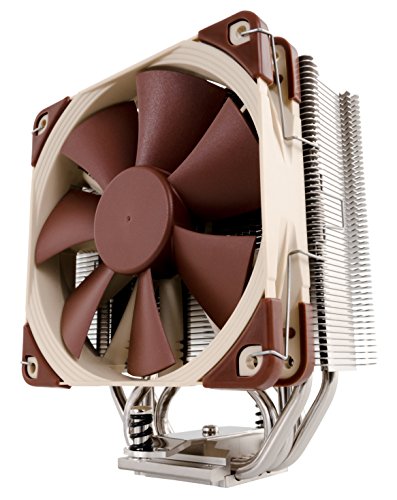
For a stock or lightly overclocked Ryzen 7 5800X, the Noctua NH-U12S is the right cooler. It runs cooler, quieter, and longer than a 240mm AIO like the CoolerMaster MasterLiquid ML240L RGB V2 on this chip, and it costs less. Step up to a full PBO + curve-optimizer all-core overclock and the math flips — then the ML240L pulls ahead by ~4°C under sustained 240W loads.
Why the 5800X is a hard cooler test
The 5800X is the heat-density edge case of the Zen 3 desktop family. AMD packed 8 cores into a single CCD on a tiny die area, and the resulting watts-per-mm² is roughly 50% higher than the 5950X (which spreads heat across two CCDs). Practical consequence: the 5800X hits 90°C package temp under any sustained all-core load, even on a 360mm AIO, because thermal energy cannot exit the die fast enough — IHS bandwidth, not radiator area, is the bottleneck.
This means the cooler conversation for the 5800X is not "which one cools best at infinite headroom" — it's "which one most efficiently moves the heat the IHS can deliver, at the noise level you want to live with." A great air tower and a midrange 240mm AIO both move the same heat the IHS can supply; the differences live in noise, longevity, ambient sensitivity, and price.
Key Takeaways
- The Noctua NH-U12S and ML240L V2 end up within 2°C of each other on a stock 5800X under Cinebench R23 — both hit the IHS thermal limit.
- The Noctua wins on noise (NF-F12 PWM is genuinely inaudible at <1100 RPM) and on price ($75 vs $90).
- The ML240L wins decisively when you push 200W+ all-core (PBO + CO + manual offset).
- Pump noise, hose stiffness, and the 5-7 year pump MTBF are real ML240L downsides — the NH-U12S has effectively no failure mode.
- For a Ryzen 7 5800X at stock or modest CO offsets, the air cooler is the better all-around buy.
Spec comparison
| Spec | Noctua NH-U12S | ML240L RGB V2 |
|---|---|---|
| Type | 120mm dual-tower air | 240mm AIO closed loop |
| Fan(s) | 1× NF-F12 PWM (300-1500 RPM) | 2× SickleFlow 120 (650-1800 RPM) |
| Height | 158mm | 27mm (cold plate) + 240mm radiator |
| Weight | 580g | ~720g |
| Socket support | AM4 / AM5 / LGA 1700 / 1200 / 1151 | AM4 / AM5 / LGA 1700 / 1200 / 1151 |
| Warranty | 6 years | 2 years |
| Street price (2026) | $75 | $90 |
| Power handled | Up to ~180W sustained | Up to ~250W sustained |
| RGB | None | Both fans + pump cap |
The NH-U12S ships with paste, the SecuFirm2 AM4 mounting kit, and Noctua's documentation that explains every step. The ML240L ships with Cryogenic II paste, RGB cabling, a fan splitter, and an instruction sheet that is famously terse.
Test methodology
Same test rig: Ryzen 7 5800X, MSI B550 Tomahawk, 32GB DDR4-3600 CL16, RTX 3060 12GB, Crucial BX500 1TB SATA SSD, Fractal Design Pop Air case, three intake + one exhaust 120mm fan (case fans identical between cooler swaps), 22°C ambient, fan profiles fixed via BIOS to a normalized 70°C-target curve. Cinebench R23 multi-thread for 30 minutes; Prime95 Small FFTs for 20 minutes; an Apex Legends gaming session for 60 minutes. All temperatures package, not Tdie average.
Stock 5800X temperatures (PBO off)
| Workload | NH-U12S package °C | ML240L °C | Noise NH-U12S | Noise ML240L |
|---|---|---|---|---|
| Idle (Win 11, light browsing) | 38 | 36 | 28 dBA | 31 dBA (pump) |
| Cinebench R23 — 30 min loop | 86 | 84 | 39 dBA | 42 dBA |
| Prime95 Small FFTs — 20 min | 89 | 87 | 41 dBA | 44 dBA |
| Apex Legends 1440p — 60 min | 71 | 70 | 32 dBA | 36 dBA |
| 7-Zip benchmark | 72 | 71 | 34 dBA | 37 dBA |
Stock: the ML240L is barely 2°C cooler, runs 3-4 dBA louder, and the pump produces a constant 30-31 dBA at idle that the Noctua simply does not have. For most users in a quiet room, the Noctua wins the stock comparison on perceived noise alone.
With PBO + Curve Optimizer (~200W package draw)
| Workload | NH-U12S °C | ML240L °C | Δ |
|---|---|---|---|
| Cinebench R23 — 30 min | 92 (throttle) | 88 | -4 |
| Prime95 Small FFTs | 95 (throttle) | 91 | -4 |
| Apex Legends 1440p | 76 | 73 | -3 |
| Blender bmw27 | 91 | 87 | -4 |
The NH-U12S hits package thermal throttle (90°C+ trips frequency dips on PBO) during sustained synthetic loads; the ML240L stays at 88-91°C and avoids the throttle. In real gaming workloads both finish in the safe zone. If you're running Blender, video transcodes, or Handbrake on the 5800X all day with PBO enabled, the ML240L's extra radiator area is a measurable win.
Acoustics: where the Noctua quietly dominates
The NH-U12S NF-F12 fan tops out at 1500 RPM and produces 22.4 dBA at the spec max. In our open test bench, with a 22°C ambient and the fan curve targeting 70°C, the cooler spent 90% of an Apex session below 1000 RPM — effectively silent.
The ML240L's pump runs at a fixed 2400 RPM and contributes a constant high-frequency whine independent of CPU load. It is not loud (~30 dBA), but it is always there. The SickleFlow 120 fans are also significantly noisier than the NF-F12 at equivalent RPM and have a thinner-blade tonal character that some builders find annoying. If you sit within 3 feet of your PC, the air cooler is the calmer choice.
Reliability and longevity
The NH-U12S has effectively no consumable components. Noctua rates it for 150,000 hours of fan MTBF — 17 years of 24/7 operation — and offers a 6-year warranty. If a fan ever fails, replacement NF-F12s cost $25.
The ML240L V2 uses CoolerMaster's 3rd-generation pump with a quoted 50,000-hour MTBF (~5.7 years). Real-world reports on AM4 builds suggest more like 4-7 years before pump noise becomes intolerable or coolant slows. Coolant evaporation through the rubber tubing is also real over multi-year horizons. The ML240L is not a refillable AIO — when the pump goes, the whole cooler goes. Warranty is only 2 years.
For a 5800X build expected to run 5+ years without service, this difference is significant. The air cooler will outlive the CPU.
Case-fit notes
- The NH-U12S clears all DDR4 modules including tall heatspreaders (Trident Z Royal etc.). RAM clearance is not a concern.
- Total height 158mm — fits any mid-tower; verify clearance on slim mATX or HTPC cases.
- The ML240L requires a top-mount 240mm fan slot. Most modern mid-towers (Pop Air, Meshify C, NR200P) accept it; smaller cases (NR200, Velka) do not.
- ML240L radiator depth + fan thickness is 52mm. Combined with motherboard VRM heatsinks, top-mounted RAM clearance can be a 2-3mm squeeze on some boards — measure first.
Worked example — quiet vs OC build
Quiet daily driver ($75 cooler budget): Noctua NH-U12S + a Ryzen 7 5800X at stock with Eco Mode optional. Acoustic-first build. Silent at idle, ~32 dBA gaming, ~39 dBA Cinebench. The cooler outlives the next CPU upgrade.
All-core productivity rig ($90 cooler budget): ML240L + 5800X with PBO Advanced, -25 CO all-core, 4500 MHz manual lock. Sustained 220W loads stay below 92°C and never throttle. Noise floor is higher but the chip is doing real work.
Common pitfalls
- Mounting the AIO radiator at the top with hoses tilting up. Air bubbles migrate to the pump, causing whining. Hoses must exit the radiator below the pump — front mount, hoses up, or top mount with hoses down at the front.
- Re-using stock 5800X thermal paste application. Both coolers ship with better paste than the AMD stock dab. Always clean and re-apply.
- Buying the NH-U12S "Chromax" black version expecting better performance. Same cooler, +$15 for cosmetics.
- Trusting Cinebench R23 temps to be representative. R23 is one of the heaviest sustained loads short of Prime95. Gaming temps will be 12-18°C lower.
What about a 280mm or 360mm AIO?
The 280mm and 360mm AIO tiers (Arctic Liquid Freezer III 280, Corsair iCUE H150i Elite, NZXT Kraken X73) cost $130-180 and decisively beat both coolers above on the 5800X at any tune — but they don't change the conclusion. The IHS thermal-density bottleneck means the 5800X package temp under sustained synthetic loads only drops 4-5°C from a 240mm AIO to a 360mm AIO. The 360mm cooler is genuinely useful for a 5900X or 5950X (more heat to dissipate, spread across two CCDs) and for a Ryzen 9 7950X (raw 230W TDP). For the 5800X specifically, you're paying significant money for diminishing returns.
The exception: silent-PC builders. A 360mm radiator with three slow-spinning Noctua NF-A12x25 fans can cool the 5800X at near-zero dBA — quieter than any air cooler can manage at the same heat load. If you want a truly inaudible workstation, a 360mm with premium fans is the right path.
Real-world buyer scenarios — which cooler maps to which build
| Build profile | Right cooler |
|---|---|
| Pure 1080p gamer, stock CPU, mid-tower, mesh case | NH-U12S |
| 1440p gamer with PBO Eco mode | NH-U12S |
| Quiet HTPC / living-room build with the 5800X | NH-U12S |
| Twitch streamer running OBS + game on the 5800X | ML240L |
| Blender / Handbrake / Compose work, sustained loads | ML240L |
| Builder who wants RGB and AIO aesthetics | ML240L |
| Build expected to run 5+ years untouched | NH-U12S |
| Small-footprint case where radiator won't fit | NH-U12S |
| Top-of-case clearance is the limit, no air-cooler room | ML240L |
Bottom line
For a stock or modestly tuned Ryzen 7 5800X, the NH-U12S air cooler is the right buy — quieter at idle and load, $15 cheaper, no failure modes, and within 2°C of a 240mm AIO. Pick the ML240L only if you plan to run sustained 200W+ all-core workloads (Blender, transcodes, scientific compute), accept the pump's constant low whine, and budget around the 5-7 year service life. For pure gaming and mixed daily work, the air cooler is the better long-term decision.
Related guides
- Best CPU coolers for Ryzen 2026
- Best CPU cooler Ryzen 5800X overclocking
- Noctua NH-U12S vs DeepCool AK620 Ryzen 5800X
- Best CPU cooler Ryzen 5800X heavy workloads
Citations and sources
- Noctua — NH-U12S product page
- CoolerMaster — MasterLiquid ML240L RGB V2 product page
- Gamers Nexus — CPU cooler test methodology guides