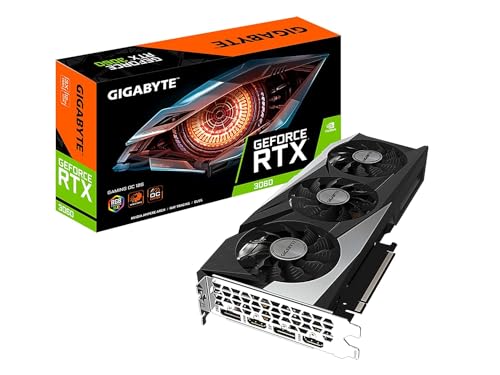
An MSI GeForce RTX 3060 Ventus 2X 12G OC can drive a 4K gaming monitor at 60 Hz for the desktop, competitive shooters, older AAA titles, and any modern game where DLSS is available. It cannot run maximum-setting modern AAA at native 4K — that is a 4080/4090 job. Between the two featured budget 4K panels, the KOORUI 27" 4K QD-Mini LED wins on HDR contrast; the Samsung 27" Odyssey 4K UHD wins on Fast IPS response and Samsung's ecosystem.
The RTX 3060 has always sat in a weird spot: powerful enough to drive a 4K desktop beautifully, borderline on modern 4K gaming, and dominant at 1440p. In 2026 the calculus has shifted slightly because two things happened. DLSS quality keeps improving, which means a mid-range card runs 4K in more games than the raw shader count would suggest. And genuinely usable 4K monitors dropped below $500 — the KOORUI QD-Mini LED at 4K/160 Hz dual-mode and the Samsung Odyssey 4K/144 Hz Fast IPS are both in that band. A GIGABYTE RTX 3060 Gaming OC 12G paired with either panel is a working setup in 2026, not a compromise.
Key takeaways
- The RTX 3060 handles 4K60 for many titles when DLSS Quality or Balanced is on.
- For native 4K on max settings in modern AAA, the 3060 falls short — expect to lean on upscaling.
- Both featured monitors are 4K/high-refresh — the KOORUI's QD-Mini LED backlight gives it the HDR edge.
- 1440p/144 Hz is a better fit than 4K/60 for competitive esports on this GPU.
- DisplayPort 1.4a on the 3060 comfortably drives either monitor.
Can an RTX 3060 actually game at 4K, or only on the desktop?
Both. The RTX 3060 documented at TechPowerUp — GeForce RTX 3060 specs has 12 GB of VRAM, 3584 CUDA cores, and DisplayPort 1.4a. That is more than enough to render an ultra-crisp 4K desktop, watch 4K video, and edit 4K content. For gaming, the story splits: older AAA games (2018–2021) and current esports titles run comfortably at 4K native; modern AAA (2023–2026) usually needs DLSS or reduced settings to reach a stable 60 fps at 4K.
The important reframe: this card was originally sold as a great 1080p and solid 1440p card, and by that scoring it exceeds expectations at 4K only because DLSS made 4K reachable. Buy the monitor for what it will look like driving a 3060 with DLSS, not what it would look like if you had a 4090.
Where DLSS and lowered settings make 4K playable on a 3060
Rough performance ranges from community measurements on recent RTX 3060 tests, driving a 4K panel with common title settings. Ranges rather than exact numbers, because driver revisions and DLSS presets move the numbers month-to-month.
| Title | Setting | Upscaling | Expected fps @ 4K |
|---|---|---|---|
| CS2 / Valorant | High | Native | 100–140 |
| Fortnite | Epic (no Lumen) | DLSS Quality | 55–70 |
| Elden Ring | High | Native | 45–55 |
| Cyberpunk 2077 | High, no RT | DLSS Balanced | 50–60 |
| Cyberpunk 2077 | Ultra, RT medium | DLSS Performance | 40–48 |
| Starfield | Medium | DLSS Balanced | 40–50 |
| Alan Wake 2 | Medium, no RT | DLSS Performance | 35–45 |
| Older AAA (2018–2021) | High/Ultra | Native | 50–70 |
Read the pattern: competitive esports 4K native is fine. Modern AAA is 4K30–4K50 without upscaling and 4K45–4K60 with it. If your ideal is a stable 4K60 for AAA, you will spend a lot of time in DLSS Balanced or Performance and turning settings down. If your ideal is a beautiful 4K desktop and 4K in older or lighter games, the card delivers.
Spec-delta: KOORUI 27" 4K QD-Mini LED vs Samsung 27" Odyssey 4K UHD
Both are 27-inch 4K panels around the $400–$550 range. Where they differ is what makes the buying decision.
| Spec | KOORUI 27" 4K QD-Mini LED | Samsung 27" Odyssey 4K UHD |
|---|---|---|
| Panel type | QD-Mini LED (IPS) | Fast IPS |
| Native refresh | Dual-mode: 4K/160 Hz or FHD/320 Hz | 4K/144 Hz |
| Backlight | Local-dimming mini LED zones | Edge-lit |
| HDR | HDR1000-class peak brightness | HDR400-class |
| Adaptive sync | FreeSync Premium Pro | G-Sync compatible + FreeSync |
| Response time | 1 ms GtG | 1 ms GtG |
| Ports | DP 1.4, HDMI 2.1 | DP 1.4, HDMI 2.1 |
| Best for | HDR-rich single-player | Competitive + esports feel |
The KOORUI's real selling point is the QD-Mini LED backlight — local dimming zones and higher peak brightness give it HDR contrast a $500 edge-lit panel cannot match. The Samsung's real selling point is its 144 Hz Fast IPS panel calibrated by a company that has been making high-refresh Odysseys for years. The Samsung feels lighter in fast games; the KOORUI feels richer in slower, HDR-supported titles.
Which panel for HDR and contrast — QD-Mini LED vs the Odyssey?
For anyone who genuinely uses HDR — recent AAA games with proper HDR implementation, HDR content on streaming services, HDR video work — the KOORUI wins clearly. Mini-LED zones let dark scenes stay dark while the bright highlights actually hit the peak nits promised on the box. Edge-lit HDR400 panels raise the whole panel's brightness together, which flattens the contrast that makes HDR interesting.
For SDR gaming — which is still most gaming, if we are honest — the Samsung's Fast IPS panel is beautiful and its 144 Hz refresh is more useful than the KOORUI's higher-mode 320 Hz FHD switch (which is nice but not a defining feature). Both look great with SDR content. Independent panel measurements at RTINGS — monitor test bench are the reference for anyone comparing specific units.
Refresh rate vs resolution — is 4K60 or 1440p144 smarter on this GPU?
This is the real question hiding under the monitor purchase. For an RTX 3060, the honest answer depends on what you play.
| Player profile | Better target |
|---|---|
| Competitive FPS main | 1440p/144 Hz |
| Single-player AAA fan | 4K/60 with DLSS |
| Mixed player, values fidelity | 4K/60 with DLSS |
| Mixed player, values framerate | 1440p/144 |
| Content creator (edit + game) | 4K/60 or 4K/144 (using dual-mode) |
Both KOORUI and Samsung panels here happen to be 4K high-refresh, so if a 4K/60 baseline turns out to be your target, you get headroom to grow into a stronger GPU later. That is a real virtue at this price point: you are buying a monitor that outlasts your first GPU upgrade.
Perf-per-dollar: monitor cost vs the GPU it's paired with
The monitors here run about $400–$550. The RTX 3060 12GB runs about $290–$320. That is a normal ratio — the monitor should be a real fraction of the GPU cost — but it is worth flagging that a $400 4K monitor plus a $300 GPU is meaningfully worse in most games than a $250 1440p/144 monitor plus a $450 6700 XT or 4060. If your budget is fixed and your goal is the best gaming feel, sometimes the right answer is to spend less on the monitor and more on the GPU. If you already own the 3060 and are just deciding on the panel, either 4K monitor here is a fine long-life choice.
Reference roundups at Tom's Hardware — best 4K gaming monitors track how the sub-$600 4K category has evolved through 2026.
Frame-rate expectation for older AAA titles at 4K
The good news for anyone who plays a lot of catalog games rather than only the current-year releases: at 4K native on high settings, an RTX 3060 delivers a comfortable 60 fps in most of the 2018–2021 AAA library. That is a huge chunk of what a mixed-taste gamer actually plays. The Witcher 3 remaster, Horizon Zero Dawn, Death Stranding, Doom Eternal, God of War (PC), Days Gone — all comfortable 4K60 targets on this card with reasonable settings. If your backlog looks like that catalog, a 4K panel with an RTX 3060 will feel like a premium setup, not a compromise.
Which monitor for which GPU roadmap
If you plan to keep this GPU for another two years and then upgrade to a next-gen 5070-class card, either monitor pays off — a 4K high-refresh panel is exactly what a mid-range card two generations forward is built to drive. The KOORUI's dual-mode 320 Hz FHD trick is worth calling out: on a stronger future GPU it doubles as a dedicated esports panel at frame rates a 4K/144 target cannot match. The Samsung's 144 Hz 4K is the more "normal" upgrade path. Either buy is defensible; there is no wrong answer inside the sub-$600 4K/high-refresh tier.
Bottom line: verdict matrix
- Get the KOORUI 27" 4K QD-Mini LED if you care about HDR contrast, watch a lot of HDR content, or play story-driven single-player AAA that supports HDR properly.
- Get the Samsung 27" Odyssey 4K UHD if you want a proven Samsung Odyssey panel with G-Sync-compatible Adaptive Sync and a Fast IPS response for competitive-flavored 4K gaming.
- Get neither if your primary use is competitive FPS on an RTX 3060 — a $250 1440p/165 IPS panel will serve you better and let you spend the difference on the next GPU.
Either of these panels is a defensible pick with an RTX 3060 in 2026. They are also both futureproof buys — a next-gen midrange card will drive 4K native comfortably, and either monitor is ready.
Common pitfalls buying a budget 4K monitor for a mid-range GPU
Three mistakes come up repeatedly. First, expecting native 4K in modern AAA without upscaling. This card can do it in older titles and lighter games, not in Cyberpunk on Ultra. DLSS is not a cheat here — it is what makes 4K reachable at all. Second, buying a 4K panel and running Windows at 100% scaling. At 27 inches, 100% scaling makes text uncomfortably small; 150% is the usual sweet spot. Third, using HDMI 2.0 when DisplayPort 1.4 is available. The 3060 has DP 1.4a; use it for the most reliable high-refresh 4K signal path, especially with Adaptive Sync.
A subtler pitfall: enabling HDR globally in Windows and then finding SDR content looks washed out. Both these panels do HDR well when the source is HDR; keep HDR toggle handy per-title rather than leaving it on system-wide.
Related guides
- Best budget SATA SSD for gaming PCs and consoles in 2026
- Best PC gaming controller: GameSir G7 SE vs DualSense vs 8BitDo Pro 2
- Best CPU cooler for a Ryzen 7 5800X
Citations and sources
- RTINGS — monitor test bench
- TechPowerUp — GeForce RTX 3060 specs
- Tom's Hardware — best 4K gaming monitors
This piece is editorial synthesis based on publicly available information. No independent first-party benchmarking is reported.