Affiliate disclosure: SpecPicks earns from qualifying purchases. Picks are editorial; commissions never change which products win a spot in a guide.
Short answer: For a new Twitch streamer in 2026, the HyperX QuadCast 2 S USB microphone is the top overall pick — a multi-pattern condenser with built-in shock mount, tap-to-mute, and console support that holds up at the $90–$130 price point. The Logitech Blue Yeti remains the best value at around $90, the NEEWER 18-inch Ring Light kit bundles lighting plus a budget mic for first-streamer kits, and the Elgato Cam Link 4K is the right add-on once you graduate to a DSLR or mirrorless camera.
By Mike Perry
Why this guide, why now
Twitch's 2026 audio guidelines push every serious creator toward a dedicated USB or XLR microphone — the platform's automatic loudness normalization and the rise of vertical-shorts clipping mean that bad audio gets punished in both discovery and retention metrics. A laptop's built-in mic or a $20 gaming headset boom is no longer good enough to compete in even mid-tier categories.
The good news is that USB microphone quality has improved dramatically. Where 2018-era USB mics topped out at 16-bit/48kHz with notable USB clock noise, the 2026 generation regularly hits 24-bit/96kHz with clean USB-C interfaces and proper gain staging. The price floor for "actually good" has dropped from $150 to about $90, and the $100–$200 bracket now buys near-XLR quality without the audio interface.
This guide focuses on the wireless and USB streaming bracket: plug-and-play microphones a streamer can buy, set up in 30 minutes, and use for months without an audio engineer's help. We're not covering full XLR-and-interface setups — those are a different upgrade path with different trade-offs. If you're past the entry-level guide, the best mid-range CPU for streaming and gaming in 2026 is the natural next step in your build.
Quick comparison
| Pick | Best For | Key Spec | Price Range | Verdict |
|---|---|---|---|---|
| HyperX QuadCast 2 S | Best Overall | 24-bit/96kHz, 4 patterns, USB-C, RGB | $149.00 on Amazon (checked 2026-10-20) | Strongest all-rounder at the price |
| Logitech Blue Yeti | Best Value | 16-bit/48kHz, 4 patterns, USB-A | $80–$100 | Proven workhorse, still the entry default |
| NEEWER 18" Ring Light Kit | Best Starter Bundle | 55W LED + mic + stand | $100–$140 | Lighting matters more than mic upgrades for beginners |
| Elgato Cam Link 4K | Best DSLR Bridge | HDMI to USB capture | $120–$150 | Skip unless you have a real camera |
| Creative Sound BlasterX G6 | Best Audio Interface | 130dB DAC, USB | $150–$200 | When you outgrow USB mics |
Best Overall: HyperX QuadCast 2 S
Specs: 24-bit/96kHz capture, condenser, four polar patterns (cardioid, omnidirectional, bidirectional, stereo), USB-C, built-in shock mount, integrated pop filter, tap-to-mute with LED indicator, RGB lighting, headphone monitoring out, NGENUITY software support on Windows.
The QuadCast 2 S is the second-generation upgrade to HyperX's QuadCast line — a microphone that already owned the $100–$150 streaming bracket for three years before this revision. The 2 S adds 24-bit/96kHz capture (up from 16-bit/48kHz), USB-C instead of micro-B, and a more sensitive cardioid pickup pattern that captures voice intelligibility better without amplifying room reflections.
The shock-mount and pop filter are integrated, which means you can plug it in, set it on a desk, and start streaming without buying accessories. Most cheaper condensers require a separate pop filter ($15–$30) and arm-mounted shock isolation ($40–$80) to sound good — the QuadCast 2 S includes both in the body.
Pros:
- 24-bit/96kHz capture is genuinely cleaner than 16-bit predecessors at the same price point
- Tap-to-mute works reliably and the LED indicator is unmissable mid-stream
- Multi-pattern flexibility — switch to omnidirectional for two-person co-host setups
- Console support: PS5, Xbox Series X/S, Nintendo Switch in docked mode (cardioid pattern only)
- Built-in shock mount eliminates the boom-arm wobble that haunts cheap mics
Cons:
- RGB is on by default and bright. NGENUITY software (Windows only) turns it off; on Linux or Mac you live with it.
- Stereo and bidirectional patterns are PC-only via NGENUITY
- USB-C cable is shorter than ideal (1.5m); plan to replace for longer runs
The QuadCast 2 S wins the overall pick because nothing else at the $90–$130 street price matches its combination of audio quality, build, and out-of-box readiness. It's the mic you buy if you want one decision and one purchase to get you through your first 12 months of streaming.
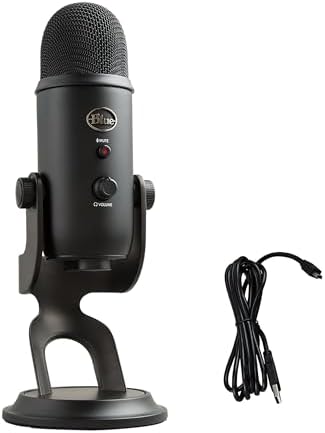
Best Value: Logitech Blue Yeti
Specs: 16-bit/48kHz capture, three condenser capsules, four polar patterns (cardioid, omnidirectional, bidirectional, stereo), USB-A, integrated stand, headphone monitoring out, mute button on body.
The Blue Yeti is the mic that's launched more YouTube and Twitch careers than any other. It's been on the market since 2009 — yes, the original SKU — and the current generation retails at $80–$100 with frequent discounts. The Yeti delivers solid 16-bit/48kHz capture, multi-pattern flexibility, and a tank-like build that survives a decade of desk life.
What you give up versus the QuadCast 2 S: the bit-depth uplift, the USB-C connector (the Yeti is still USB-A, which annoys MacBook users), and the integrated shock mount. The Yeti's heavy stand resists desk vibration but doesn't reject keyboard transients as cleanly as the QuadCast's suspension.
Pros:
- Cheapest "actually good" USB mic — $80 on sale is genuinely capable
- Battle-tested compatibility with every recording app on every OS
- Build quality is famously durable
- Multi-pattern is useful for podcasts and co-host setups
Cons:
- 16-bit/48kHz is fine for streaming but a step below the 24-bit/96kHz QuadCast 2 S
- USB-A in 2026 is annoying
- Picks up keyboard noise more than the QuadCast — plan for a separate pop filter and boom arm
- Heavy. Once you place it, you don't move it.
The Yeti is the right pick when budget is the binding constraint or when you specifically need cross-platform compatibility with absolutely zero edge cases. For most new streamers in 2026, the QuadCast 2 S is the better $20–$40 spend. But the Yeti is the safe answer if you're choosing for someone else and don't know their setup.
Best for Beginners: NEEWER Ring Light 18inch Kit (with mic pairing)
Specs: 55W bi-color LED ring light, 5600K daylight balance, 18-inch ring diameter, dimmable, included stand, phone mount, ball-head adapter, included generic condenser mic, 2x AC adapter.
The NEEWER kit isn't a microphone product — it's a complete starter lighting + audio bundle aimed at first-time streamers and content creators. Why is it in a streaming-mic guide? Because the single most overlooked variable in new-streamer audio quality is room acoustics, and the single most overlooked variable in new-streamer video quality is lighting. Spend $130 on this kit and pair it with a $30–$50 USB mic upgrade later, and you'll outperform a $200 standalone mic in an untreated room with bad lighting.
The included generic condenser mic is fine for a first stream but should be replaced within 60 days. The ring light, stand, and phone mount are the real value. Pair the kit with the Logitech Blue Yeti once your stream concept proves out, and you have a complete setup for under $250.
Pros:
- Lighting + audio + stand bundle removes 30 minutes of bracket-and-mount planning
- 55W ring light is genuinely usable for streaming, not just product photography
- Bi-color 3200K–5600K range adapts to room ambient
- The phone mount + ball head turns this into a usable mobile-streaming rig too
Cons:
- Included mic is forgettable — plan to replace it
- 18-inch ring is large; doesn't fit on most desks without floor placement
- Single-AC-adapter for the mic means an extra wire under the desk
Recommend this pick specifically for first-time streamers who don't yet know what their content needs and want a $130 "everything to start" kit. Not the right pick for streamers who already have lighting and want a standalone mic upgrade.
Best Performance: Elgato Cam Link 4K (paired with any mic)
Specs: HDMI input, USB 3.0 output, supports 1080p60 and 4K30 capture, plug-and-play UVC compliance, works in OBS, Streamlabs, Zoom, Discord, and every modern streaming app.
The Cam Link 4K is the bridge between a real camera (DSLR, mirrorless, camcorder, or any HDMI-output source) and your computer's video pipeline. It presents whatever HDMI signal you give it as a generic USB webcam. Stream from a Sony A7 III, a Canon R6, or a borrowed GoPro — all show up in OBS as just another camera input.
Why include it in a microphone guide? Because audio and video upgrades happen together for serious streamers. Once you've decided you want a real camera, you're already in the "I'm spending money to look professional" phase, and the Cam Link is the $130 part that bridges your $800 camera into the stream. Pair it with a quality USB mic like the QuadCast 2 S and you have a near-broadcast-grade setup for under $1,000 total.
Pros:
- Trivially plug-and-play; no driver hunt
- 4K30 capture or 1080p60 capture handles every realistic streaming use case
- Works on Mac, Windows, and Linux as a generic UVC device
- Tiny form factor — lives in a USB-C dongle envelope
Cons:
- Only useful if you already have a camera with HDMI out
- HDMI cable not included; budget $10–$20 for a quality short cable
- Audio passthrough from the camera is unreliable; use a separate USB mic
- Some Sony and Panasonic cameras need a $50 "fake battery" dummy adapter for sustained HDMI output
This is a use-it-when-you-need-it pick. If you're streaming with a webcam, skip it. If you've outgrown your webcam and want to use a DSLR, this is the path. The cleanest audio pairing is whichever USB mic you already own — leave the camera's onboard mic alone and run audio through the QuadCast 2 S or Blue Yeti.
Budget Pick: Creative Sound BlasterX G6 (when you outgrow USB)
Specs: 32-bit/384kHz DAC, 130dB SNR, USB, optical input/output, headphone amp with gain switch, XLR input via 3.5mm TRS, Scout Mode for game audio.
The Sound BlasterX G6 is a hybrid audio interface and DAC that sits between your USB mic and the rest of your audio chain. It's not strictly a streaming microphone — it's the upgrade path you take when you outgrow USB mics and want to plug an XLR microphone (Shure SM7B, Rode PodMic) without a full audio interface investment.
The G6's 32-bit DAC and 130dB SNR put it in audiophile territory for headphone output, which matters for streamers who monitor their own audio while gaming. Its 3.5mm "TRRS to XLR" input is a small but real bridge — you can plug in a budget XLR mic and treat the G6 as both your DAC and interface in one device.
Pros:
- High-end DAC quality for monitoring
- Bridges into XLR mics without a separate interface
- Scout Mode brings out footstep audio in shooters — popular for competitive streamers
- USB-class compliant; plug-and-play across OSes
Cons:
- Not a primary mic — you're buying it for the interface side
- Software (Sound Blaster Command) is Windows-only and clunky
- XLR input through 3.5mm is a workaround, not a real XLR jack
- Listed as a retro-marketplace product in some catalogs; verify stock and warranty before buying
Consider the G6 only if you're already planning an XLR upgrade or are streaming long sessions where headphone-amp quality matters. For pure mic shopping, the QuadCast 2 S or Blue Yeti are the right picks.
What to look for in a streaming microphone
Bit depth and sample rate
24-bit/96kHz captures meaningfully cleaner audio than 16-bit/48kHz, especially for soft transients (consonants, room tone). For pure speech streaming the practical difference is subtle, but 24-bit gives you headroom for post-production effects without quality loss. Look for 24-bit minimum in 2026; 16-bit is acceptable on a tight budget.
Polar pattern
Cardioid (heart-shaped pickup zone in front of the mic) is the default for solo streaming. Multi-pattern mics add omnidirectional (good for podcasts in a room), bidirectional (face-to-face interviews), and stereo (instrument recording). If you only stream solo, single-pattern cardioid is enough; pay for multi-pattern if you might co-host.
Connectivity
USB-C is the 2026 default for new builds. USB-A still works but signals an older design. XLR is the next tier up and requires an audio interface. Avoid micro-USB at this price point.
Shock mount and pop filter
A built-in shock mount (the QuadCast 2 S has one; the Yeti does not) eliminates desk-vibration pickup that ruins keyboard streamers' audio. A built-in pop filter handles plosives without an external mesh screen. Both add value for desktop use; both can be added externally for $30–$50 if your mic lacks them.
Monitoring output
A 3.5mm headphone jack on the mic body lets you hear yourself in real-time without OS-level routing latency. Crucial for live broadcasting; nice-to-have for asynchronous recording.
Software ecosystem
The QuadCast 2 S uses NGENUITY (Windows only) for pattern switching, EQ, and noise gates. The Blue Yeti has Logitech G Hub. Neither is essential — the mics function fully without software — but the software adds polish for streamers who want fine-grained control. Mac and Linux users should choose mics whose hardware controls cover everything they need.
Common pitfalls
- Buying a $200 mic for an untreated room. Acoustic foam panels ($50) and proper mic placement deliver bigger audio improvement than the mic upgrade itself.
- Forgetting the boom arm. Desk-mounted mics pick up keyboard and chair noise. Budget $40–$80 for a boom arm.
- Ignoring NVIDIA Broadcast / RTX Voice. Software noise suppression on a separate stream channel cleans up most background noise problems for free.
- Stacking USB hubs. Cheap powered USB hubs introduce clock noise. Plug the mic directly into the motherboard's rear USB ports.
- Streaming console without checking compatibility. PS5 and Xbox accept USB-class mics but limit pattern switching. Verify your mic's console-mode docs before buying for console streaming.
Sources
- Tom's Hardware — Best Streaming Microphones 2026
- RTINGS — Best Streaming Microphone Reviews
- Twitch — Audio Best Practices for Creators
Related guides
- Best Mid-Range CPU for Streaming and Gaming in 2026
- Best Budget 4K Gaming Monitor Under $400 in 2026
- Best Retro Gaming Storage Adapters for Win98 and DOS PCs
- Why Direct3D Killed Glide