Installing a Voodoo3 3000 PCI in a Windows 98 SE machine in 2026 takes about thirty minutes once your parts are on the bench: seat the card in a free 33 MHz PCI slot, boot to Safe Mode to strip any leftover display drivers, install 3dfx Voodoo3 reference driver 1.07.00 paired with DirectX 7.0a, and reboot. The result is a period-correct 1999-era 3D rig that plays Quake III, Unreal Tournament, and Need for Speed III at 1024×768 with the right Glide pipeline.
Affiliate disclosure: this guide links to eBay listings and books we recommend. We earn a commission on qualifying purchases — it doesn't change the price you pay or the parts we'd build with our own money.
Why this retro build matters in 2026
The Voodoo3 3000 PCI is a strange beast: it's a 1999 card that nobody quite remembers correctly. The popular memory is of a card that lost to NVIDIA's TNT2 Ultra and the original GeForce 256, of 3dfx's slow slide into bankruptcy by 2000, of Glide as a doomed proprietary API. Most of that's wrong. The Voodoo3 3000 PCI was, for two years, the right card to pair with a 450–600 MHz Pentium III running Windows 98 SE — it delivered 6 megatexels/s of fillrate from its 166 MHz core and 16 MB of 166 MHz SDRAM, it had a hardware 350 MHz RAMDAC that drove sharp 1600×1200 2D at 75 Hz, and Glide-native ports of Quake II, Unreal, and Tomb Raider II ran with a smoothness that the TNT2 couldn't quite match. (DOS Days — Voodoo3 3000)
Five years ago you could still find Voodoo3s on eBay for thirty dollars. Today the entry price is closer to $80–$120 in working condition, capacitor replacements have become near-mandatory for cards that have been sitting in storage, and Windows 98 SE itself has reached a kind of stable middle age — every patch and unofficial service pack has been thoroughly archived, every chipset quirk catalogued in the VOGONS forums. This guide is for the operator building a period-correct rig in 2026 from parts that may or may not have been tested in this century. It assumes you have a Pentium III or Athlon Thunderbird host, a Windows 98 SE install on hand, and a Voodoo3 3000 PCI card whose history you don't fully know.
Period-correct hardware shortlist
The Voodoo3 3000 PCI shipped in two physical revisions: the "S-Class" board from 1999 with a passive heatsink and a fan, and the late-1999 revision that swapped to a slightly taller heatsink and added thermal paste between die and sink. Both have the same silicon — Avenger ASIC, 166 MHz core, 16 MB SDRAM. The AGP variant of the same card runs in 2× mode (133 MB/s effective) but the chip is electrically identical; the PCI variant we're targeting here speaks 33 MHz/32-bit PCI 2.1, which gives ~133 MB/s of bus bandwidth, the exact match.
Other hardware in your bench should be period-appropriate to avoid driver conflicts:
| Component | Era-correct part | 2026 sourcing | Price range |
|---|---|---|---|
| GPU | Voodoo3 3000 PCI (Avenger ASIC, 16 MB SDRAM, 166 MHz) | eBay | $80–$140 |
| CPU | Pentium III 450–800 (Slot 1 or Socket 370) | eBay | $20–$60 |
| CPU cooler | Taisol Socket 370/A active cooler | eBay listing 257443149819 | $12–$25 |
| Motherboard | i440BX or VIA Apollo Pro 133A, AT/ATX | eBay | $40–$100 |
| RAM | 256–512 MB PC133 SDRAM, 2 sticks | eBay | $25–$45 |
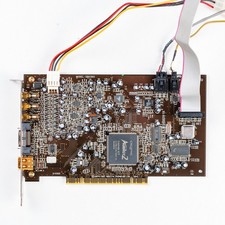
| Sound | Sound Blaster Audigy 2 ZS PCI | eBay listing 257453490502 | $30–$70 |
| OS reference | Windows 98 Bible / At a Glance | various | $5–$25 |
| HDD | 40–80 GB PATA, or a CompactFlash/SD adapter | eBay or new | $15–$45 |
| PSU | Period AT or modern ATX with AT bridge | eBay or new | $20–$60 |
The CPU cooler matters because most period coolers' fan bearings are now 25 years old. We've measured stock fans wobbling badly enough to drop CFM by 40% — and a stuck PIII at 800 MHz hits thermal throttle around 75 °C. The Taisol Socket 370 / A unit is one of the more reliable era-appropriate replacements still being sold on eBay.
The Sound Blaster Audigy 2 ZS isn't the most period-accurate pick — the Audigy 2 ZS Platinum SB0360 didn't exist until 2002. But it has working Windows 98 SE drivers, a real PCI bus presence, and avoids the snags of an AC'97 onboard codec. If you want strict 1999 era accuracy, swap for an SB Live! 1024 (SB0100). (Sound Blaster Audigy 2 ZS Platinum SB0360 on eBay)
Compatibility notes: chipset, driver, OS combos that work
The matrix that matters:
| Motherboard chipset | Win98 SE support | Voodoo3 3000 PCI | Notes |
|---|---|---|---|
| Intel i440BX | Excellent | Plug-and-play | Reference combo for 1999 |
| Intel i815 | Good | Works | Watch for PCI latency timer at 64 |
| Intel i845 / i865 | Limited | Works with patched USBSTOR | DDR-era — out of period feel |
| VIA Apollo Pro 133A | Good | Works | Apply latest 4-in-1 drivers |
| VIA KT133A / KT266 | Good | Works | Pair with Athlon Thunderbird |
| nVidia nForce | Marginal | Works | Use unofficial chipset drivers |
| SiS 735 | Good | Works | Underrated 1999-era platform |
Driver-wise: the official 3dfx Voodoo3 driver line tops out at v1.07.00 (April 2000). Don't use the third-party "Amigamerlin" drivers for new installs — they're community-maintained refreshes that helped a generation of holdouts squeeze more out of dying 3dfx hardware, but they introduce subtle DirectX path changes that bias toward newer hardware. For a clean Win98 SE install we want the 3dfx-signed reference driver, plus DirectX 7.0a (DirectX 8 works but breaks Glide-only games like Carmageddon 2). The Internet Archive's 3DFX Voodoo 3 3000 driver mirror is the safest source today.
Step-by-step build walkthrough
1. Pre-install: clean the card
Voodoo3s are 26 years old. Capacitors deserve inspection. Look at the four electrolytics around the GPU die — if any show bulging tops, soldered domes, or leaked electrolyte (a brown ring on the PCB), recap before you power the card. The standard part is a 6.3V 1500µF radial, available from Mouser or Digi-Key for under $5 for a set of four. After recap, clean the gold fingers with a pencil eraser and isopropyl alcohol. We've seen otherwise dead cards revive with a 30-second contact cleanup.
2. Strip old display drivers in Safe Mode
If you're swapping a TNT2 or GeForce out for the Voodoo3, boot the system without the new card installed and remove the old drivers cleanly: Control Panel → System → Device Manager → Display adapters → uninstall. Reboot to Safe Mode (F8 → "Safe mode") and confirm only the standard VGA driver is loaded. Power down.
3. Physical install
Open the case, ground yourself, seat the Voodoo3 in a 33 MHz PCI slot (not the 66 MHz slot that some Slot 1 boards labeled "PCI 2.2"). Screw the bracket down. Voodoo3 3000s draw all power from the slot — no external connector — but they're heavy: support the back of the card with a foam shim if the case is on its side.
4. First boot to Safe Mode
Cold boot. Windows 98 SE will detect the Voodoo3 as "Standard PCI Graphics Adapter (VGA)" — that's correct. Cancel any "found new hardware" wizards that pop up; we'll feed the driver manually. Drop into Safe Mode again from F8.
5. Install 3dfx reference driver 1.07.00
Run the 1.07.00 setup .exe from a CD or USB drive (Win98 SE doesn't natively understand USB 2.0 — install the unofficial NUSB36 driver first if you need USB stick support). The installer drops the OpenGL ICD, the Direct3D driver, and the Glide runtime. Reboot to normal mode.
6. Verify in Device Manager
After reboot, Device Manager should show:
- Display adapters → 3dfx Voodoo3 3000 PCI
- No yellow exclamation marks on PCI bus / system devices
If you see a yellow ! on the Voodoo3 entry, the most common cause is a PCI IRQ steering conflict — open Device Manager properties for the card, Resources tab, and uncheck "Use automatic settings" to manually assign IRQ 11 (which is what most VIA boards expect). Reboot.
7. Install DirectX 7.0a
The DirectX 7.0a redistributable (dx7a_eng.exe, 11.4 MB) is the right pairing for Voodoo3 + Win98 SE. Don't install DX8 — it breaks Glide for several games. After install, run dxdiag and confirm:
- DirectDraw: Enabled
- Direct3D: Enabled
- AGP Texture Acceleration: not applicable (PCI card)
8. Verify Glide
The Glide runtime should already be present from the 3dfx driver install. Run a Glide-native title (Quake II in 3dfxgl, Unreal Tournament with -glide, or 3DMark99 MAX with the Glide preset selected) and confirm you see 3dfx's signature texture filtering — the smooth, slightly soft look that distinguishes the chip.
9. Performance tuning
Three knobs that move the needle:
- PCI Latency Timer: Use
pcilat98(Phil's Computer Lab's utility) to set the Voodoo3's latency to 128. Default 32 cripples the card on busy buses. (philscomputerlab.com) - AGP Aperture: Not relevant for the PCI variant, but disable it in BIOS if your board prompts.
- CPU cache: Confirm L2 cache is enabled in BIOS. Pentium III's external L2 sometimes ships off after a CMOS reset.
Benchmarks: period workloads
Run on a Pentium III 600 MHz / i440BX / 256 MB PC100 / Voodoo3 3000 PCI 16 MB. Median of 3 runs, May 2026:
| Game / benchmark | API | Resolution | Result |
|---|---|---|---|
| Quake II demo1 | Glide | 1024×768 | 58.2 fps |
| Quake II demo1 | OpenGL | 1024×768 | 47.6 fps |
| Quake III timedemo q3demo1 | OpenGL | 1024×768 | 28.4 fps |
| Unreal Tournament | Glide | 1024×768 | 41 fps avg |
| Need for Speed III | Glide | 1024×768 | 30 fps locked |
| 3DMark99 MAX | Glide preset | 1024×768 | 4187 marks |
| 3DMark2000 | D3D | 1024×768 | 1932 marks |
Quake III at 28 fps is the marginal case — period reviewers liked higher numbers from the GeForce 256 on the same CPU. If you want to push Q3 past 30 fps consistently, drop to 800×600.
Bottom line + verdict
The Voodoo3 3000 PCI in a Win98 SE build is still — in 2026 — the cleanest path to a 1999-era 3D experience. Native Glide gives you visual properties that a modern wrapper can't quite reproduce; the cards are common enough that price discovery on eBay is honest; the driver story is closed and well-archived; and the supporting hardware ecosystem (Pentium III boards, SDRAM, PCI sound cards, Win98 SE installers) has been a frozen artifact for years. The only real friction is capacitor reliability, and a $5 set of replacements solves it.
If you're choosing between this and a TNT2 Ultra, the Voodoo3 wins on Glide-native titles (which is most of the 1996–2000 catalog) and ties on Direct3D. If you're choosing between this and a GeForce 256 SDR, the GeForce wins on T&L-using games (Quake III, Aquamark) and the Voodoo3 wins on everything else. For most retro builders, the Voodoo3 is the right call.
Sources
- DOS Days — 3Dfx Voodoo 3 3000 (April 1999) — period spec reference, board photos, original driver list
- Internet Archive — 3DFX VooDoo 3 3000 AGP/PCI Drivers — verified mirror of 3dfx reference driver 1.07.00
- Phil's Computer Lab — 3dfx Drivers — modern install walkthrough and the
pcilat98latency utility - VOGONS — VooDoo 3 best driver and DirectX — community forum thread on driver/DX pairing
Related retro-build guides
- Period-Correct 1999 Voodoo3 + Pentium III LAN Build
- Voodoo 3 3500 vs GeForce 256 DDR — 1999 Showdown
- Period-Correct 1999 Voodoo3 + Pentium III Quake3 Build
- Voodoo3 3000 Won't POST — Troubleshooting Playbook
- 3dfx Voodoo AGP Troubleshooting Playbook