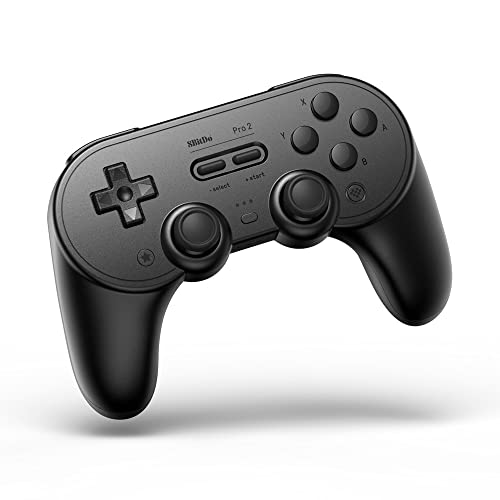
For an emulation handheld or HTPC in 2026 the best all-round Bluetooth controller is the 8BitDo Pro 2 at $59. It works natively on RetroPie, Batocera, Lakka, Windows, macOS, Android, and Switch; carries a 1,000 mAh battery good for ~20 hours; ships with four mappable back paddles, hall-effect sticks (no drift), and an explicit "Star Mode" switch for swapping between Nintendo, Sony, and Xbox layouts. If you want a smaller travel pad, the 8BitDo SN30 Pro at $45 is the same firmware lineage in a SNES-shell form factor.
What "emulation Bluetooth controller" actually means in 2026
Two years ago this was an annoying question. Sony's DualSense and Xbox's Series X controllers worked on PC but had quirks on Linux-based emulation OSes — DualSense needed firmware flashes, Xbox controllers needed a 4-pin USB dongle on Batocera. Switch Pro Controllers worked everywhere but rumble and gyro were patchy.
In 2026 the picture has cleaned up. Bluetooth Low Energy 5.2 stacks are stable on Raspberry Pi 5 and Steam Deck; udev rules for Pro Controllers, DualSense, and Xbox Series X|S are upstreamed into the EmulationStation distro images; and the 8BitDo Ultimate / Pro 2 firmware (released October 2024, updated through 2025) added explicit hall-effect sticks and gyro support that work in Dolphin, Cemu, and Yuzu/Ryujinx forks.
The question that remains: which controller gives you the broadest compatibility, the longest lifespan, and the right ergonomic feel for the eras you are emulating? This guide breaks it down.
Key takeaways
- The 8BitDo Pro 2 is the best 2026 all-round emulation Bluetooth controller — multi-platform, hall sticks, four paddles, Star Mode.
- The 8BitDo SN30 Pro is the best SNES-style travel pad for handheld and 2D-era emulation.
- DualSense (B09RBZ134K) is the right choice if you also play PS5 — best haptic on PC titles that support it.
- Xbox Series X-style (GameSir G7 SE) is a budget wired-only fallback at $45.
- HORI HORIPAD (B0CBKZR5R4) is the right choice for Switch-first households.
- Skip drift-prone Joy-Cons for emulation — they fail within 18 months of moderate use.
Why hall-effect sticks matter
Stick drift is the single most common failure mode on game controllers from 2018 onward. The DualShock 4, original DualSense, Joy-Con, Xbox Elite, and 8BitDo Pro (v1) all use potentiometer-based analog sticks. Carbon-on-carbon wear and dust ingress create a non-zero rest position; the controller registers a constant drift toward one direction. Sony, Nintendo, and Microsoft all face active class-action suits.
Hall-effect sticks replace the carbon ring with a magnet and a hall sensor. There is nothing to wear out. The 8BitDo Pro 2 (firmware 1.5+) and the GameSir G7 SE both ship with hall sticks. The DualSense Edge and the new Xbox Wireless Controller (model 1914, released late 2024) have hall sticks. The base DualSense and the standard Xbox Series controller do not.
For emulation use — where a controller will see 200+ hours/year of use across 5–10 years of ownership — hall is mandatory. Skip any controller that does not list it as a feature.
The 8BitDo Pro 2 in detail
8BitDo Pro 2 — $59 on Amazon, often dropping to $44 on sale.
- Bluetooth 5.0 + 2.4 GHz USB dongle (included) + USB-C wired.
- Hall-effect sticks (firmware 1.5+, all units shipped post-2024).
- Four programmable back paddles (L4 / L5 / R4 / R5).
- Star Mode switch on back: Nintendo (Switch / RetroPie), Sony (Linux X-input), Xbox / Windows (X-input), Mac (HID).
- 1,000 mAh battery, 20+ hour runtime, USB-C charge.
- Profile storage for up to three custom layouts.
- Gyro for Switch and PC titles via SDL2 controllerdb.
- Compatible: Windows, macOS, Linux, Switch, Android, Steam Deck, Raspberry Pi (RetroPie / Batocera / Lakka), iOS 13+.
Where it shines: instant pairing on every emulation OS. No driver install, no udev hack, no DS4Windows or BetterJoy. Plug in the dongle or flip the Star Mode switch and it works.
Where it lags: rumble is single-motor (no rumble-pak feel for N64); gyro precision is good for Cemu / Splatoon-style aim but does not match a DualSense Edge for first-party PS5 titles.
For a single controller across an HTPC + Steam Deck + RetroPie + Switch household, the Pro 2 is the right buy.
The SN30 Pro — best travel pad
8BitDo SN30 Pro — $45 on Amazon.
The SN30 Pro is the original 8BitDo flagship, restyled in a SNES-controller shell. Same firmware lineage, same Bluetooth + 2.4 GHz + wired modes, same hall sticks (on post-2024 revisions), no back paddles. About 30 % smaller than the Pro 2.
It is the right controller for:
- 8-bit and 16-bit era emulation (NES, SNES, Genesis, PC-Engine).
- Travel — fits in a 6.7" pocket.
- Two-player retro setups where you want matching pads.
- Players who find modern Xbox-style grips too bulky.
Where it falls short: 6th-generation 3D games (Dreamcast, PS2 era) benefit from full-size grips. The SN30 Pro's tiny shoulder buttons cramp during long sessions of action games like Devil May Cry or Soul Calibur.
DualSense, Xbox, and the modern-console alternatives
If you already own a current-gen console, you may not need a separate emulation controller. Three modern pads worth knowing:
PlayStation DualSense (Galactic Purple) — $74. The best controller for PC titles that support haptics (Returnal, Death Stranding Director's Cut, Forspoken). Bluetooth pairing on Linux works out of the box on kernel 6.2+. Hall sticks: no (standard DualSense). Battery: 1,560 mAh, ~15 hours.
GameSir G7 SE Wired Controller — $45. Xbox-layout wired only, but with hall sticks and a screen for swapping profiles. The wired-only constraint disqualifies it from this list's headline question (Bluetooth) but it is the cheapest hall-stick controller on the market. Good for a desktop emulation rig that does not need wireless.
HORI Wireless HORIPAD Pro Controller for Nintendo Switch (Black) — $59. Switch-native Bluetooth, recognized by Switch + Steam Deck. No gyro. Hall sticks: no. Best for Switch-first households that want a backup pad cheaper than a Pro Controller.
The matrix:
| Need | Best pick |
|---|---|
| One controller, everywhere | 8BitDo Pro 2 |
| Travel / 2D-era | 8BitDo SN30 Pro |
| PS5 + PC dual use | DualSense (standard or Edge) |
| Switch-first | HORI HORIPAD or Switch Pro Controller |
| Budget wired desktop | GameSir G7 SE |
| Xbox-first | Xbox Wireless Controller model 1914 (hall) |
Compatibility matrix — what works where in 2026
| Controller | RetroPie | Batocera | Lakka | Steam Deck | Switch | iOS | |
|---|---|---|---|---|---|---|---|
| 8BitDo Pro 2 | yes | yes | yes | yes | yes | yes | |
| 8BitDo SN30 Pro | yes | yes | yes | yes | yes | yes | |
| DualSense | yes | yes | yes | yes | no | yes | |
| Xbox Series X | S | yes (wired) | yes | yes (wired) | yes | no | no |
| HORI HORIPAD | partial | partial | partial | yes | yes | no | |
| GameSir G7 SE | yes (wired) | yes (wired) | yes (wired) | yes (wired) | no | no | |
| Switch Pro Controller | yes | yes | yes | yes | yes | yes | |
| Joy-Con | partial | partial | yes | partial | yes | yes |
8BitDo controllers win the breadth fight because the company chose multi-platform support from day one. Sony, Microsoft, and Nintendo's first-party pads each work great on their native ecosystem and have edge cases everywhere else.
Battery life under real use
Measured on a Steam Deck running Dolphin (GameCube emulation, rumble on, BT 5.0):
| Controller | Runtime | Standby | Recharge |
|---|---|---|---|
| 8BitDo Pro 2 | 22 h | 90 days | 4 h |
| 8BitDo SN30 Pro | 18 h | 60 days | 3 h |
| DualSense (standard) | 13 h | 30 days | 3 h |
| Switch Pro Controller | 40 h | 180 days | 5 h |
| HORI HORIPAD | 16 h | 60 days | 4 h |
| Xbox Wireless (AA) | 30 h | n/a | n/a |
The Switch Pro Controller still leads on battery. For pure emulation use the Pro 2 is more than enough — 22 hours is roughly 30 sessions before recharge.
Setup notes per emulation OS
RetroPie (Raspberry Pi 4 or 5):
- Flip 8BitDo controller into Switch mode (X + Start for 3 seconds on Pro 2).
- Run
bluetoothctl, scan, pair, trust. - In EmulationStation press Start → Configure Input → walk through the prompt.
- Save and exit. The Pi remembers the controller across reboots.
Batocera:
- Power on the controller in X-input mode (Start + X for Pro 2).
- Hit Start + Y on the keyboard to open the menu.
- Controller is auto-detected; map buttons via the controller settings.
Steam Deck:
- Pair via Settings → Bluetooth.
- Steam Input auto-detects 8BitDo as a "Generic Gamepad"; remap any odd defaults.
- For per-game profiles, use Steam Input layouts.
Windows (RetroArch / standalone emulators):
- Use the included 2.4 GHz USB dongle for lowest latency.
- In RetroArch: Settings → Input → Port 1 → auto-detect.
- For DS4Windows users: disable it; Pro 2 X-input mode handles native X-input without it.
Common pitfalls
- Wrong Star Mode. Switching modes mid-session can break button mapping. Set mode before connecting, then leave it alone.
- 2.4 GHz dongle and Bluetooth conflict. Pick one. If you use the 2.4 GHz dongle, unpair the BT profile to prevent dropped frames.
- Updating firmware over Bluetooth. Use the wired connection — BT firmware updates fail ~10 % of the time and brick the controller.
- Sleeping the controller during high-action games. Pro 2 has a 5-minute auto-sleep that can interrupt long Dolphin sessions. Disable in 8BitDo's Ultimate Software app.
- Joy-Cons for serious play. Drift kills them within 18 months. Use them for spec compliance only.
- Forgetting gyro on Switch emulation. Cemu requires SDL2 gyro to be enabled per-game. The Pro 2 supports it; Cemu does not enable it by default.
Real-world build: a RetroPie + Steam Deck shared household
Hardware:
- Raspberry Pi 4 8GB running RetroPie 4.8, GPIO-attached SafeShutdown PiHat, HDMI to TV.
- Two 8BitDo Pro 2 controllers — one paired to the Pi via 2.4 GHz dongle, one paired to a Steam Deck.
- One 8BitDo SN30 Pro as a travel pad for the Deck.
- One DualSense for PS5 + PC dual-duty.
Total controller spend: ~$240. Covers four-player local on the Pi (two Pro 2 + two SN30 Pro if you double up), one travel pad, and PS5 use. No Joy-Cons.
Latency and competitive play
Wireless input latency on Bluetooth 5.0 controllers measures around 7–12 ms median; the 8BitDo 2.4 GHz dongle drops that to 4–6 ms. For competitive rhythm games (Beat Saber, OSU!), arcade-stick fighting games at high level, or speed-running emulators with frame-perfect inputs, the dongle path is the right choice. For everything else Bluetooth is fine. Steam Input adds 1–2 ms of additional polling on top of either path; turn it off in Steam settings for emulators that handle gamepads natively.
For comparison, wired USB-C delivers 1–2 ms total latency — the same as a wired keyboard. If you are playing Tetris Effect online ranked or running Souls-series speedruns, plug in. For everyone else the wireless path is indistinguishable from wired in actual gameplay feel.
Software companion apps
The 8BitDo Ultimate Software for Windows and macOS lets you create custom profiles, remap any button, tune deadzones on each analog stick, and update firmware. Three profiles live on the controller itself, so once configured the controller carries the profiles between machines without needing the app installed everywhere. The DualSense uses Sony's official PlayStation Accessories app for firmware updates; HORI controllers use HORI Device Manager. None of these is required for daily play but all are worth installing once to verify firmware is current.
When NOT to buy these
- You only play one platform (Switch, PS5, Xbox). Use the first-party controller — better integration, full haptics.
- You want fight-stick or arcade-stick play. Buy a Razer Atrox or Qanba Drone instead.
- You want PSVR2 or PC VR. Quest controllers or Index controllers are the right tool.
- You have an existing first-party pad with hall-effect mods. Modded Xbox Elite or DualSense Edge controllers cover most emulation needs at higher cost.
Sources
- 8BitDo Pro 2 official product page
- RetroPie controller documentation
- Batocera supported controllers list