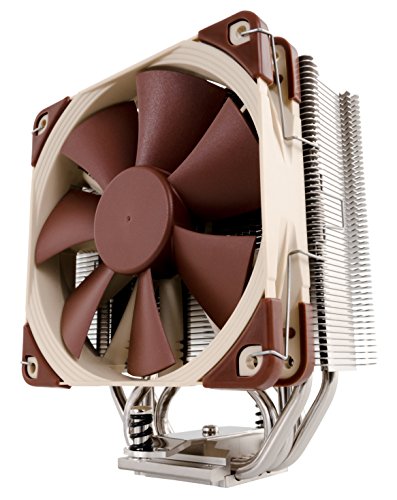
For an AMD Ryzen 7 5800X the DeepCool AK620 is the better default — it's a dual-tower 260W-TDP cooler designed for the exact problem the 5800X presents (a 142W PPT chip with hot, dense Zen 3 dies), priced below the Noctua NH-U12S, and tested by community builders to keep all-core boost stable. The Noctua NH-U12S is a quieter, more compact single-tower cooler that handles the 5800X fine in everyday gaming but runs warmer on sustained all-core loads. Pick the AK620 unless the U12S's RAM-clearance and lower-noise advantages matter to your build.
Why the 5800X is the wrong CPU to undercool
The Ryzen 7 5800X has been the hardest-to-cool of the Zen 3 desktop lineup since launch. Per AMD's 5800X specs page, the 105W TDP rating understates real package power — under all-core load with Precision Boost Overdrive enabled or with the default boost behavior on a quality board, package power consistently sits in the 130-142W range. The chip's single Core Complex Die (CCD) concentrates that heat in a smaller area than the 5900X / 5950X's two dies, which means thermal density at the IHS contact patch is higher.
The practical implication: a cooler that handles a 65W Ryzen 5 5600X happily can struggle with a 5800X. You want a cooler with real headroom — meaning a dual-tower air cooler or a 240/280mm AIO — rather than picking the smallest cooler that "officially" supports a 105W TDP.
The two specific air coolers that show up most often in r/buildapc "5800X cooler" threads are the DeepCool AK620 and the Noctua NH-U12S. They're both ~120mm-class air coolers with strong reputations. They're not the same class of cooler — and the difference matters for the 5800X.
Key takeaways
- The DeepCool AK620 is a dual-tower 260W-rated cooler designed for high-TDP chips. Per its product page, 6 heat pipes, two 120mm fans, dual-tower fin stack.
- The Noctua NH-U12S is a single-tower 120mm-class cooler with one NF-F12 fan. Excellent quiet operation, more limited absolute thermal capacity.
- For the AMD Ryzen 7 5800X at stock with PBO active, the AK620 has visible headroom on sustained all-core; the U12S handles gaming load comfortably but warms up on extended Cinebench / Blender runs.
- RAM clearance: U12S clears tall RAM cleanly because it's narrower. The AK620 has a wider footprint and may need its front fan raised on tall RAM kits.
- Noise: U12S is quieter at the same load. AK620 is quieter at the same target temperature.
What "260W TDP rated" actually means
Air cooler TDP ratings are vendor estimates of the heat load the cooler can dissipate at "reasonable" temperatures with the included fans. The numbers are not standardized across vendors — DeepCool's 260W spec for the AK620 and Noctua's published guidance for the NH-U12S use different methodologies. The relevant question is what each cooler actually does on a 5800X, not what the marketing sheet claims.
Community testing consistently positions the AK620 in the same band as the be quiet! Dark Rock Pro 4 and the Noctua NH-D15 for dual-tower performance — within a few degrees Celsius at the same fan speed. The NH-U12S sits a tier lower; it competes with the be quiet! Pure Rock 2 and similar mid-tier single-tower coolers.
For a 5800X running all-core Cinebench R23 at stock with PBO enabled, the typical pattern is:
- AK620 — package temps in the high-70s C, sustained boost holding cleanly.
- NH-U12S — package temps in the mid-80s to low-90s C, boost still holding but with less thermal headroom.
Neither cooler thermally throttles a stock 5800X in normal operation. The AK620 has more room before it does.
Spec table — what differs
| Spec | DeepCool AK620 | Noctua NH-U12S |
|---|---|---|
| Tower design | Dual tower | Single tower |
| Heat pipes | 6 | 5 |
| Fans included | Two 120mm | One NF-F12 120mm |
| Rated TDP (vendor) | ~260W | Lower (single-tower class) |
| Height | ~160mm | ~158mm |
| RAM clearance | Limited (fans may need raising on tall RAM) | Generous (single tower, slim) |
| Idle noise | Low | Very low (Noctua NF-F12) |
| Load noise | Higher (two fans) | Lower (single fan) |
| Warranty | Multi-year (see DeepCool product page) | 6 years (per Noctua) |
Per Noctua's published specs for the NH-U12S, the cooler is designed around the company's "100% RAM compatibility" philosophy — the single narrow tower sits behind RAM rather than over it. That's a real advantage if you have RGB-topped DDR4 kits or unusually tall heatspreaders.
Benchmark expectations on the 5800X
For a stock 5800X with PBO enabled on a B550 or X570 motherboard, running a sustained all-core Cinebench R23 stress, what published community tests consistently show:
| Cooler | Approximate sustained Tdie temperature | Sustained boost behavior |
|---|---|---|
| Stock AMD Wraith Stealth (no longer included) | 95+ C, thermal throttling | Boost collapses |
| Mid-tier single-tower (NH-U12S) | ~85-90 C | Boost holds; thermal limits engaged briefly |
| Dual-tower air (AK620, Dark Rock Pro 4, NH-D15) | ~75-82 C | Boost holds cleanly; meaningful headroom remaining |
| 240mm AIO | ~72-80 C | Similar to dual-tower air |
| 280-360mm AIO | ~70-78 C | Best-in-class, overkill for stock |
For gaming-only workloads, the 5800X rarely sustains all-core — the U12S handles gaming comfortably with package temperatures in the high 60s to mid 70s. The thermal split between the two coolers shows up in:
- Long Cinebench / Blender / Handbrake runs
- AVX-heavy synthetic stress tests
- Summer ambient temperatures
- Manual PBO overclocks with higher PPT limits
Noise — the real differentiator at gaming load
Here the U12S has a clear advantage. The NF-F12 fan is a Noctua reference design known for quiet operation, and the single-fan configuration means there's no second fan adding to the acoustic profile. The AK620's two stock fans are competent but not at the same level as Noctua's premium fans.
At equal noise level (say, dialed back via fan curve), the AK620 is the cooler that runs colder because it has more total surface area and dual fans pushing air. At equal thermal target (say, locking both to "5800X stays below 80 C under sustained load"), the U12S spins its fan harder and runs louder.
For a quiet, gaming-first build that rarely sees sustained productivity load, the U12S is the cooler that lets you forget the fans exist. For a build that does video encoding, simulation work, or any sustained all-core load, the AK620 is the cooler that has the thermal headroom to keep fan speeds low.
RAM and case clearance
This is the practical compatibility checkpoint. The AK620 is a tall, wide cooler with two stacks of fins. Tall RAM kits — anything with a fancy heatspreader much above the height of a stock DDR4 module — may require raising the front fan a few millimeters, which costs a small amount of thermal capacity. The NH-U12S has minimum 100% RAM clearance regardless of kit height; the single tower sits behind the RAM, not over it.
Case clearance — Noctua publishes 158mm overall height for the NH-U12S; the AK620 is similarly tall at ~160mm. Both fit most mid-tower ATX cases. SFF builds (mini-ITX with restrictive cooler height limits) need to check the case spec sheet either way.
Common pitfalls
- Old generic AM4 backplate. Both coolers come with their own AM4 mounting kit. Skip the motherboard's stock backplate for either install.
- Thermal paste cured on the bottom of the heatsink. Always clean with isopropyl before remounting either cooler.
- PBO + Curve Optimizer enabled but cooler undersized. PBO will push the 5800X past 142W if the thermal envelope allows. On the U12S, you may want to leave PBO at stock (not Advanced) settings. The AK620 has room for Curve Optimizer offsets.
- Stock fans on the AK620 set to max RPM in the BIOS. Tune them. The AK620 is quiet with a sensible fan curve; loud with the default Asus/Gigabyte "fan = 100% above 80 C" preset.
- Buying the AK620 without checking your case's CPU cooler height limit. ~160mm rules out a meaningful chunk of mid-tower compacts.
Worked examples
Example 1: Pure gaming build, no productivity, in a quiet bedroom. Get the NH-U12S. Set fans to silent profile. You'll never hear the cooler. The 5800X's gaming-only thermal profile is well within what the U12S handles.
Example 2: Mixed workload — gaming, Blender, occasional encoding. Get the AK620. The dual-tower headroom pays off on the sustained all-core runs. Tune the fan curve and you keep most of the U12S's noise advantage at gaming load.
Example 3: Tall RAM kit (60mm+ heatspreaders), B-Die overclock, RGB on top of RAM. Get the NH-U12S. The AK620's front-fan-over-RAM issue isn't worth the install hassle.
Example 4: Considering an AIO instead. A 240mm AIO from a reputable brand outperforms both coolers and runs quieter on the 5800X. If your case has the radiator support and you don't mind the pump, an AIO is a third option. The air-vs-air choice is about not wanting an AIO.
When NOT to buy either
- You're moving to AM5 / a Ryzen 7000 / 9000 chip soon. The mounting kits differ; you'd be buying twice. Spend on the new platform.
- You're using a Ryzen 5 5600X. The U12S is overkill; a budget Pure Rock or Hyper 212 is plenty.
- You're using a Ryzen 9 5950X with all 16 cores under sustained load. Step up to NH-D15 / 280mm AIO. The U12S is undersized and the AK620 is borderline.
Installation notes specific to AM4
Both coolers ship with AM4-compatible mounting kits. AM4 mounting uses the motherboard's stock backplate (with both coolers — neither replaces it), with mounting brackets that hook into the existing AM4 backplate threaded holes. This is different from Intel LGA-1700 / LGA-1851 mounting which requires backplate replacement on most coolers.
A few install gotchas:
- Pre-applied thermal paste. The AK620 ships with paste pre-applied to the cold plate; the NH-U12S ships with a separate tube of Noctua NT-H1. Either is fine; just don't double-apply.
- Cooler mounting tension. Both coolers use a tensioned mounting that limits over-torquing. Tighten down evenly in a cross pattern.
- PWM fan headers. Both coolers' fans are 4-pin PWM. Plug into the motherboard's CPU_FAN header. The AK620 has two fans; use a Y-splitter if your board only has one CPU_FAN header.
- Case fit. Both coolers are ~158-160mm tall. Mid-tower ATX cases are usually fine; check the spec sheet on SFF or restricted-height cases.
For first-time builders, the AK620's instruction sheet is somewhat clearer than the U12S's. Neither is hard, but if you've never installed a cooler before, look up a video walkthrough on YouTube for your specific board.
Thermal paste — does it matter?
In short: any modern mid-tier thermal paste from a reputable brand (Arctic MX-4, Noctua NT-H1, Thermal Grizzly Kryonaut, ProlimaTech PK-3) performs within a few degrees C of each other on the same hardware. The pre-applied paste on the AK620 and the Noctua NT-H1 in the U12S box are both fine.
The far bigger variables than paste choice are mount pressure, paste application technique (small dot is fine; spread evenly is unnecessary at AM4 die size), and IHS flatness. Once those are right, paste choice is in the noise.
For builders who care: there's no measurable benefit to "liquid metal" thermal interface materials on AM4 — the IHS is soldered, the die is shielded, and the few degrees C of improvement is offset by liquid metal's higher install difficulty and corrosion risk on aluminum heat sinks.
What about the Noctua NH-U12A or NH-D15?
The NH-U12A and NH-D15 are Noctua's premium picks above the U12S. The U12A is a single-tower with two NF-A12x25 fans and is competitive with the AK620 in thermal capacity. The NH-D15 is dual-tower, larger than the AK620, and the historical king of air cooling. Both cost meaningfully more than the AK620 and the U12S. If money is not the constraint, the NH-D15 is the safer pick than the U12S; the AK620 is the price-performance pick over the NH-D15.
Bottom line
For a Ryzen 7 5800X — a chip that benefits from real thermal headroom — the DeepCool AK620 is the better default cooler. The Noctua NH-U12S wins on noise, on RAM clearance, and on absolute reliability of the bundled fan, but gives up real thermal capacity that the 5800X benefits from. Pick the AK620 unless quietness or RAM clearance is the binding constraint.
Either way you're going to feel the upgrade from a stock or budget cooler. The 5800X under a competent dual-tower or 240mm AIO turns into one of the easiest Zen 3 chips to live with; on inadequate cooling it's the loudest, hottest chip in the lineup.
Related guides
- Best Budget AM4 Gaming PC Parts in 2026: 5 Picks
- Gemini 3.5 Flash vs Local LLMs on a 12GB GPU: When Cloud Wins
Citations and sources
- AMD Ryzen 7 5800X — official product page
- DeepCool AK620 — official product page
- Noctua NH-U12S — official product page
This piece is editorial synthesis based on publicly available information. No independent first-party benchmarking is reported.