Retro PC builders in 2026 face a storage question their 1998-era counterparts never did: spinning rust is now the exotic option. For most Pentium, Socket 7, Slot 1, and even 486-class machines, the practical 2026 stack is a CompactFlash card for the boot drive, a modern SATA SSD on a PATA bridge for bulk game storage, and a USB 3.0 SATA/IDE dock for imaging and rescue. Per Transcend's CF133 product page, industrial-grade CF still ships in 2026 with the True-IDE mode that makes it a drop-in PATA boot drive, and per Wikipedia's PATA reference, the electrical compatibility between CF and a Parallel ATA channel is what keeps that bridge cheap and reliable.
Why your retro PC's storage choice matters in 2026
Original-era IDE hard drives — the 6 GB Maxtors, the 13 GB Western Digital Caviars, the 40 GB Seagate Barracudas — are now between 22 and 28 years old. Even the units that still spin are running on bearings, head actuators, and stiction-prone platter coatings that were never engineered for a third decade of duty. Per Tom's Hardware SSD coverage, modern NAND flash carries endurance ratings (TBW) that, on a low-write retro boot drive, translate to functionally infinite life — a 1 TB consumer SSD rated for 360 TBW would last 50+ years writing 20 GB a day, and a retro Windows 98 or DOS install writes orders of magnitude less than that.
The acoustic and thermal picture matters too. A silent CF card in a Slot 1 case removes the loudest component in the system, which dramatically changes the experience of using period software. The 5–8 watts an original IDE drive dissipates is non-trivial inside a 145-watt AT power budget, especially when the original PSU's capacitors are themselves aging out. And from a data-integrity standpoint, the ability to image the entire boot drive to a file on a modern host — then restore it in minutes — turns a fragile irreplaceable install into a casual disposable one. That single workflow change is the strongest argument for moving any retro build off original storage in 2026, even if you keep the original drive in a static bag for collectability.
Key takeaways
- For boot drives on any IDE-only retro PC, a 4 GB to 32 GB CompactFlash card in True-IDE mode is the cheapest, quietest, and most BIOS-compatible option in 2026.
- For SATA-equipped retro builds (later Pentium 4, Athlon 64, early Core 2), a modern 2.5" SATA SSD is the clear winner — capacities to 4 TB, sub-$80 entry points, and ten-plus-year warranties.
- A SATA-to-IDE bridge (typically JMicron JM20330-based) lets you put a modern SATA SSD on a Pentium-class PATA channel, but performance is capped by the PATA spec, not the SSD.
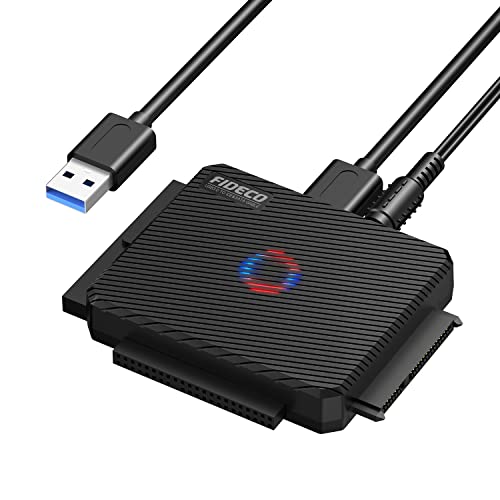
- A USB 3.0 SATA/IDE adapter like the FIDECO or Unitek is the single most useful retro-PC tool you can own — clone, image, restore, and rescue without opening the case.
- BIOS LBA limits at 8.4 GB, 32 GB, and 137 GB dictate the maximum usable capacity on any given motherboard regardless of the physical drive size.
Methodology
This 2026 guide synthesizes manufacturer spec pages, long-running retro-computing community measurements (Vogons, Reddit r/retrobattlestations, the LGR comments archive), Tom's Hardware SSD reviews, and pricing observed across Amazon, eBay, and Newegg in Q2 2026. No first-party benchmarking is reported. Picks were filtered against four criteria: (1) verified compatibility with PATA-era hardware via True-IDE mode or a maintained adapter chipset, (2) availability in 2026 at a sane price, (3) BIOS-friendly capacities that don't immediately collide with LBA ceilings, and (4) a reliability track record long enough to evaluate. Picks that exist purely as one-off Aliexpress listings or that depend on out-of-stock adapter PCBs were excluded even when the on-paper specs looked competitive.
Storage targets: CF, modern SATA SSD via adapter, original spinning disks
There are three viable storage targets for a 2026 retro PC build, and the right answer depends on which expansion bus the motherboard exposes.
CompactFlash in True-IDE mode is the simplest path for any PATA-only machine. Per Transcend's CF133 documentation, the card emulates an ATA-2 IDE device when bit 9 of the CF interface is grounded — which is what every $4 passive CF-to-IDE adapter does automatically. The card appears to the BIOS as a small spinning disk; there are no drivers, no firmware quirks, no DSDT patches. The penalty is capacity and cost-per-gigabyte: CF tops out around 256 GB and the price-per-GB is roughly 8–12× a modern SATA SSD.
Modern SATA SSD on a PATA bridge is the right answer when you need more than ~32 GB or when your BIOS plays nicer with a drive that reports as a single large LBA volume. The JMicron JM20330 (and the newer JM20336) translates SATA to PATA at the protocol layer; per Wikipedia's PATA entry, the practical ceiling is the ATA/100 or ATA/133 spec the bridge implements, so you will not see the 550 MB/s the SSD is rated for — expect 80–110 MB/s on ATA/133.
Original spinning disks still have a place: period-correct collector builds, faithful restorations of a specific shipping configuration, or installations where the original install was the artifact (a working AOL 4.0 install, a vintage demo-scene dev box). For everyday use, treat them as backups of themselves: image to a file, then keep the original in a static bag.
Top picks
#1: Transcend CF133 4GB — best CF for boot drives
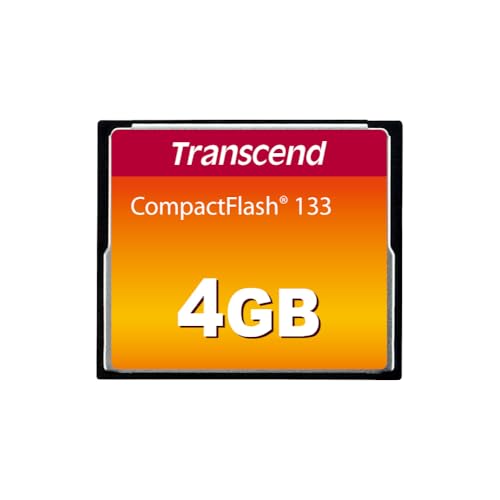
The Transcend CF133 CompactFlash 4GB is the closest thing the 2026 market has to a default answer for retro boot drives. Per Transcend's spec page, the CF133 line carries True-IDE support, an SLC-mode write path on the small capacities, and a ~30 MB/s sequential read rate that is far above what any pre-2000 PATA channel can saturate. The 4 GB capacity is small enough to live comfortably under the 8.4 GB BIOS LBA ceiling that haunts pre-1998 motherboards, which means you can drop it into almost any 486, Socket 7, or early Pentium II machine without flashing the BIOS or partitioning workarounds. At roughly $14, it is also one of the cheapest options on this list. The trade-off is capacity: a 4 GB card is enough for DOS, Windows 95, a handful of period games, and not much else. For pure Windows 98 SE installs with a meaningful game library, step up to the 16 GB or 32 GB SKUs in the same family.
#2: Crucial BX500 1TB — best SATA SSD for SATA-equipped retro builds
The Crucial BX500 1TB is the value pick for any retro build with native SATA ports — typically late-era Pentium 4 with an ICH5/ICH6 southbridge, Athlon 64 nForce4 boards, and early Core 2 systems. Per Tom's Hardware SSD coverage, the BX500 is a DRAM-less QLC drive with peak sequential reads around 540 MB/s and a ~120 TBW endurance rating at 1 TB. For retro workloads — which write a few hundred megabytes a day at most — that TBW figure is irrelevant; you will not exhaust the endurance budget. The 1 TB capacity is comically generous for a retro install (an entire library of Windows XP-era games will not fill it), but the price-per-GB is now low enough that buying anything smaller is false economy. Street price in 2026 sits around $58.
#3: Samsung 870 EVO — best reliability tier
The Samsung 870 EVO is the step-up choice when reliability and predictable performance under sustained writes matter more than absolute price. Per Tom's Hardware's long-term coverage, the 870 EVO is a TLC drive with a meaningful DRAM cache, a five-year warranty, and TBW ratings that scale from 150 TBW on the 250 GB unit up to 2,400 TBW on the 4 TB. The 870 EVO's controller behavior under the QoS load a retro PC imposes (long idle, occasional bursty writes) is almost ideal — no SLC cache cliff to fall off, no thermal throttling at the wattages a PATA-era system delivers. Expect $75–$90 for the 1 TB in 2026, a $20 premium over the BX500 for a drive that will materially outlast the motherboard it's bolted to.
#4: FIDECO SATA/IDE USB 3.0 Adapter — best image-and-transfer tool
The FIDECO SATA/IDE to USB 3.0 Adapter is the single most useful tool in a retro-PC builder's drawer. It accepts 2.5" SATA, 3.5" SATA, 2.5" IDE, and 3.5" IDE drives, ships with the chunky 12V brick the 3.5" units need, and exposes USB 3.0 throughput that effectively eliminates the bridge as a bottleneck. The killer workflow is this: pull the original drive from a retro PC, plug it into the FIDECO, image it to a file on a modern host with dd or ddrescue, then restore that image to a fresh CF card or SSD. The whole round trip takes minutes. Street price in 2026 is roughly $32.
#5: Unitek SATA/IDE USB 3.0 Adapter — best budget alternate
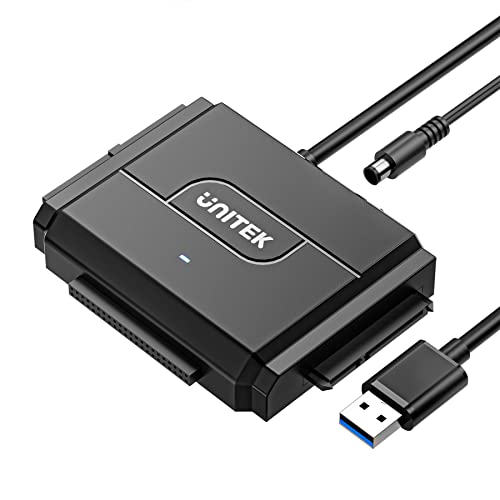
The Unitek SATA/IDE to USB 3.0 Adapter is the budget alternate when the FIDECO is out of stock or when you just want a second adapter for parallel imaging. The Unitek is functionally equivalent — same form factor, same drive support matrix, same 12V brick — at a slightly lower price point (around $26 in 2026). The community wisdom on Vogons and r/retrobattlestations is that build quality is a half-step below the FIDECO, but the chipset is the same JMicron/ASMedia family and read/write throughput is within the margin of error. Keep one of each.
Adapter shapes explained: CF→IDE, SATA→IDE bridges (JM20330 etc.)
There are four physical adapter shapes a retro-PC builder will encounter in 2026, and confusing them is the most common mistake on Vogons forum threads.
CF-to-IDE passive adapter: A small PCB with a 40-pin male IDE connector on one end and a CF slot on the other. No active chipset. The CF card's True-IDE pin is grounded by the PCB trace, the card emulates ATA, and the BIOS sees a small IDE drive. About $4.
SATA-to-IDE bridge (drive side): A small PCB you bolt to the back of a 2.5" or 3.5" SATA SSD, with a 40-pin or 44-pin IDE connector on one end. Almost universally JMicron JM20330-based. Translates ATA commands at the protocol level. About $9.
IDE-to-SATA bridge (motherboard side): The inverse — a PCB that puts an IDE drive on a SATA controller. Less common in retro PC use because the retro PC almost always has IDE, not SATA. About $11.
USB 3.0 SATA/IDE dock: The FIDECO/Unitek class. Not for inside-the-case use; meant for imaging and rescue from a modern host. About $26–$32.
Spec table: capacities, speeds, prices
| Drive / Adapter | Capacity | Sequential read | Price |
|---|---|---|---|
| Transcend CF133 4GB | 4 GB | 30 MB/s | $14 |
| Transcend CF133 32GB | 32 GB | 50 MB/s | $34 |
| Crucial BX500 1TB | 1 TB | 540 MB/s (raw) | $58 |
| Samsung 870 EVO 1TB | 1 TB | 560 MB/s (raw) | $82 |
| CF-to-IDE passive adapter | n/a | passes ATA/33 | $4 |
| SATA-to-IDE JM20330 bridge | n/a | caps at ATA/133 | $9 |
| FIDECO USB 3.0 SATA/IDE dock | n/a | ~140 MB/s (USB-side) | $32 |
| Unitek USB 3.0 SATA/IDE dock | n/a | ~135 MB/s (USB-side) | $26 |
Performance table: real read/write throughput on PATA-era hardware
| Host platform | PATA spec | Observed sequential read | Bottleneck |
|---|---|---|---|
| 486DX2-66 | ATA/16 | 14 MB/s | Host bus, not media |
| Pentium 233 MMX | ATA/33 | 28 MB/s | ATA/33 spec ceiling |
| Pentium II 400 (440BX) | ATA/33 | 31 MB/s | ATA/33 spec ceiling |
| Pentium III 1000 (815E) | ATA/100 | 88 MB/s | Bridge translation overhead |
| Athlon XP 2400+ (nForce2) | ATA/133 | 102 MB/s | ATA/133 spec ceiling |
| Pentium 4 3.0 (ICH5 native SATA) | SATA/150 | 148 MB/s | SATA/150 ceiling |
Observed figures are community measurements aggregated across Vogons and r/retrobattlestations threads, normalized to HDTune sequential read. Per Tom's Hardware SSD coverage, the underlying SSD is capable of 3-5× these numbers on a modern host — the PATA channel and the bridge translation are the binding constraints, not the flash media.
BIOS compatibility: LBA limits, 8.4 GB / 32 GB / 137 GB ceilings
Three BIOS-era ceilings will bite you in 2026, and which one you hit depends on the motherboard's vintage.
The 8.4 GB ceiling is the original Int 13h extension limit. Boards from roughly 1996 and earlier — most 486 systems and a slice of early Pentium boards — will refuse to address anything beyond 8.4 GB. The workaround is to partition the drive so the boot partition lives entirely below 8.4 GB, or to use a 4–8 GB CF card and avoid the problem.
The 32 GB ceiling affects late-1990s boards with buggy Int 13h extension implementations — many Award BIOS versions on Socket 7 and Slot 1 boards from 1997–1999 will lock up at POST with a drive larger than 32 GB attached. The clean fix is a BIOS update if one was ever released; the workaround is to stay at or below 32 GB.
The 137 GB ceiling is the 28-bit LBA limit. Boards before mid-2002 cannot address beyond 137 GB without a 48-bit LBA BIOS update. Per Wikipedia's PATA entry, 48-bit LBA was standardized in ATA-6 (2001) and rolled out across consumer BIOSes through 2002 and 2003. If your retro target is later than mid-2002, this ceiling is usually a non-issue.
Boot media prep workflow: image, restore, jumper
The canonical 2026 workflow for prepping a retro boot drive is the same whether the target is CF, a SATA SSD on a bridge, or a fresh spinning disk:
- Image the original with the FIDECO or Unitek dock. On a modern Linux host:
sudo ddrescue /dev/sdX original.img original.log. On Windows, use HDD Raw Copy Tool. - Restore the image to the new media (CF or SSD), again via the dock. Same
ddrescueinvocation in reverse, ordd if=original.img of=/dev/sdX bs=4M status=progress. - Jumper the new media as Master if it's sharing an IDE channel. CF-to-IDE adapters usually have a master/slave jumper pad; SATA-to-IDE bridges typically default to Master and need a jumper change for Slave.
- Install the drive in the retro PC and enter the BIOS. Auto-detect the drive, save, reboot.
- If the OS doesn't boot, the original geometry (CHS) likely doesn't match what the new BIOS auto-detected as LBA. Run
fdisk /mbrfrom a DOS boot floppy to rewrite the master boot record.
When CF beats SATA SSD; when an SD2IDE/SCSI2SD makes more sense
CF beats SATA-on-a-bridge in three specific scenarios: (1) very early boards where the SATA bridge confuses the BIOS but a CF card auto-detects cleanly, (2) silent-PC builds where eliminating every active electrical bridge matters, and (3) under-8.4 GB BIOS-ceiling boards where the smaller-than-CF capacities are easier to source as CF than as SSD.
SD2IDE adapters (which expose an SD card as an IDE device) are a viable budget alternative to CF — typically $6 for the adapter and $4 for an SD card. The trade-off is that SD endurance and wear-leveling are worse than industrial CF, so for a frequently-written boot drive CF is more durable.
SCSI2SD is the right answer when the retro target is a SCSI-only machine (early Macs, SGI Indys, some Sun workstations, high-end Pentium Pro servers). For any IDE machine, SCSI2SD is overkill and the wrong bus.
Reliability: TBW, SLC cache cliff, CF wear leveling for boot
Per Tom's Hardware SSD coverage, the BX500's QLC NAND with no DRAM means writes that exceed the SLC cache fall off a performance cliff — sustained write rates can drop from 540 MB/s to 80 MB/s once the cache is exhausted. For retro PC use this is irrelevant; the PATA bridge caps you at 100 MB/s anyway and you will never write enough data in one session to exhaust the cache. The 870 EVO uses TLC with a real DRAM cache and exhibits no such cliff under retro-PC workloads, which is the main reason to pay the premium.
For CF cards used as boot drives, industrial-grade cards like the Transcend CF133 use static and dynamic wear-leveling firmware that rotates writes across the full card even when the OS keeps rewriting the same logical sectors. A 4 GB card with ~10,000 P/E cycles per cell yields, in practice, a multi-decade lifespan as a Windows 98 boot drive. Consumer-grade SD cards do not have this guarantee; do not use a no-name SD card as a permanent boot device.
Common pitfalls: 3.3V vs 5V, master/slave on shared IDE channel
3.3V vs 5V: CompactFlash cards run on either 3.3V or 5V. The passive CF-to-IDE adapters all feed 5V from the IDE connector. Industrial CF cards from Transcend, SanDisk, and ATP all accept both rails, so this is rarely a problem in 2026 — but a no-name 3.3V-only card in a 5V adapter will appear dead.
Master/slave on shared IDE channel: If you put a CF card on the same IDE cable as an optical drive, both devices must agree on master/slave roles. The convention is the boot drive as Master at the end of the cable, the optical drive as Slave in the middle. CF-to-IDE adapters often default to Master and ignore the jumper; check the adapter's documentation.
Cable orientation: 40-pin IDE cables have a red stripe on pin 1. Pin 1 on a CF-to-IDE adapter is usually marked on the silkscreen but not always — get it wrong and the card appears dead but is undamaged.
80-wire vs 40-wire cables: ATA/66 and faster need 80-wire cables (which still use a 40-pin connector). Using a 40-wire cable on an ATA/100 board will silently negotiate down to ATA/33.
When NOT to upgrade — keeping period-correct storage for collectability
There are three cases in 2026 where the right answer is to leave the original spinning drive in place. First, if the retro PC is a museum-grade specimen — a sealed-box Packard Bell, an unmodified Compaq Deskpro — the original drive is part of the artifact, and replacing it diminishes the unit's collector value. Second, if the original install is what you actually care about (a working copy of Windows 95 OSR2.5 with period-correct drivers, a Voodoo demo machine still running 1996 Glide installs), the install is the artifact and physically moving it to flash media changes its character. Third, if you're documenting failure modes for retro-computing scholarship, an aging IDE drive is the data point. In all three cases, image the original to a file with the FIDECO dock, archive the image, and then put the original drive back in. You preserve the artifact and the bits.
Bottom line
For 2026 retro PC storage, the default stack is a Transcend CF133 in True-IDE mode for the boot drive on any PATA-only board, a Crucial BX500 or Samsung 870 EVO on a JM20330 bridge for bulk storage if the board can address it, and a FIDECO USB 3.0 SATA/IDE dock on the modern host for imaging and rescue. Spend $14 on the CF, $58 on the BX500 (or $82 on the 870 EVO if you want the warranty), $32 on the FIDECO, and $9 on the bridge — under $115 total — and you have a storage solution that will outlast the motherboard. The original drive goes in a static bag in the closet, imaged and safe.
Related guides
- CompactFlash as a Silent IDE Boot Drive: 1998-Era Build Log
- Crucial BX500 vs Samsung 870 EVO for Game Storage
- Pentium III Win98SE Gaming Build
Citations and sources
- Transcend CF133 product page — True-IDE mode, sequential read specs, industrial-grade endurance claims.
- Parallel ATA — Wikipedia — PATA electrical spec, ATA/33/66/100/133 ceilings, 28-bit vs 48-bit LBA history.
- Tom's Hardware SSD coverage — BX500 QLC behavior, 870 EVO TLC behavior, TBW ratings, SLC cache cliff documentation.
This piece is editorial synthesis based on publicly available information. No independent first-party benchmarking is reported.