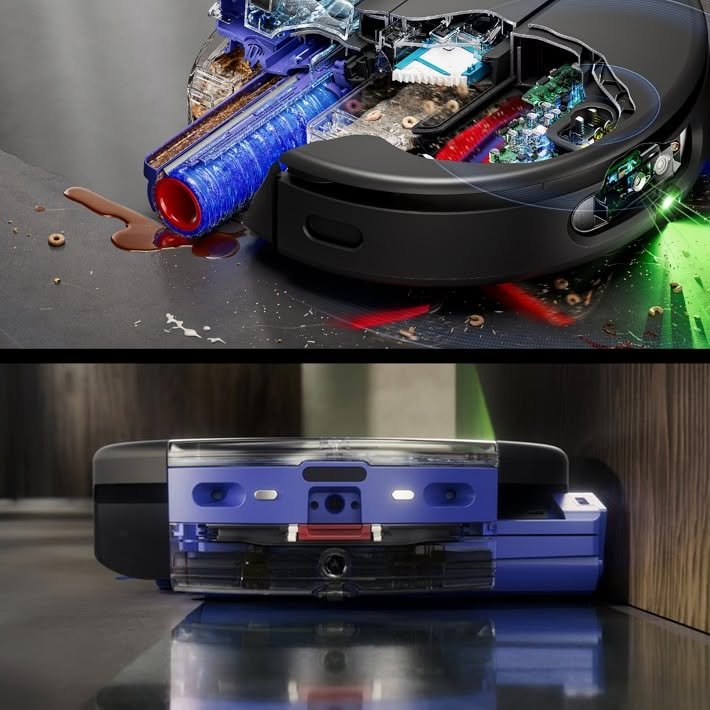
In brief — 2026 · Oomwoo is a new open-source robot vacuum whose chassis, brush mounts, and structural parts are 3D-printable at home and whose navigation stack runs locally rather than in a vendor cloud. It targets the growing niche of makers who want cloud-free floor cleaning — and its natural compute brain is a Raspberry Pi 4 8 GB.
The Oomwoo project — covered by Tom's Hardware's maker desk — sidesteps the two biggest concerns hobbyists have with commercial robot vacuums: cloud dependency and long-term support. Instead of streaming floor maps and telemetry to a vendor server, an open-source printable design keeps everything local. And instead of throwing the whole robot away when the manufacturer discontinues a model, the printable parts mean you reprint the broken bracket and keep going.
For the SpecPicks audience, the interesting question is what this actually looks like as a build. This is a short news brief on Oomwoo itself, followed by the practical context — which single-board computer runs a printable robot vacuum, what LiDAR mapping demands from a Pi, and where the design choices leave a builder.
What happened
Oomwoo is an open-source robot vacuum whose distinguishing feature is that the mechanical hardware is designed to be printable from common filament, and the navigation software is designed to run entirely on-device. Coverage from Tom's Hardware's maker desk framed it as a direct response to a long-running problem in consumer robotics: robot vacuums are cheap to buy and expensive to trust, because they hoover up floor plans and camera data to vendor servers with variable security records.
The Oomwoo design decouples the mechanical build (printable, repairable, forkable) from the compute build (a single-board computer running local mapping). That is a familiar pattern in the maker community — it's how open printers work, how retro handhelds are approached, and how a growing class of home-robotics projects (ROS-based navigation, Home Assistant integrations) are being packaged for hobbyist reproduction.
Why it matters
Commercial robot vacuums have been in the security-headline rotation for years. Vacuum-cloud breaches have exposed floor maps, camera streams, and household-schedule data. Even absent a breach, the cloud dependency creates a support cliff — if the vendor shuts down its servers, an expensive appliance turns into an oversized brick with a rotating brush.
An open-source, on-device navigation stack solves both problems. Nothing leaves the device. The manufacturer cannot revoke your access. If a bracket cracks, you reprint it. If a sensor board fails, you swap in an alternate that the community has already tested.
The compute brain is where those tradeoffs become concrete. A robot vacuum with local LiDAR SLAM needs enough RAM to hold the current map plus the moving occupancy grid, enough USB or GPIO bandwidth to talk to the sensor array in real time, and enough sustained CPU to close the control loop without missing frames. A Raspberry Pi 4 8 GB is the mainstream choice for exactly this envelope in 2026 — it clears the RAM and I/O bar for cost-effective, low-power always-on operation.
The source
The reporting SpecPicks is synthesizing is from Tom's Hardware's coverage of maker projects — see the Tom's Hardware maker section for the ongoing beat on printable and open-source robotics. Additional community context comes from Hackaday's robot vacuum tag archive and the official Raspberry Pi 4 Model B product page that details the SBC most Pi-based robots run.
What Pi hosts a printable robot vacuum well?
The reason the Pi 4 8 GB has become the default in this class of project is not any single spec. It is the combination of adequate RAM, four USB ports (two USB 3.0 for LiDAR and camera bandwidth), and native ROS 2 support that has been debugged in a hundred hobbyist projects. The Pi Zero W is at the other end of the spectrum — cheap enough to be a sensor node or a wireless bridge for a secondary board, but not fast enough to be the main mapping brain for anything more than a differential-drive toy.
Rough resource envelope for a Pi-hosted mapping stack on Oomwoo-style hardware:
| Component | Pi 4 8 GB usage | Pi Zero W usage | Notes |
|---|---|---|---|
| Base OS (Raspberry Pi OS Lite) | ~200 MB RAM | ~150 MB RAM | Similar footprint on both |
| ROS 2 core | ~400-600 MB RAM | not recommended | ROS 2 assumes 64-bit; Zero W is 32-bit |
| SLAM / LiDAR mapping | 800 MB - 2 GB RAM | not viable | Depends on map resolution |
| Motor control loop | ~50 MB RAM, low CPU | ~50 MB RAM, low CPU | Fine on either |
| Web dashboard | ~200 MB RAM | ~150 MB RAM | Fine on either |
The Pi 4 8 GB handles a serious mapping stack comfortably; the Zero W is happier as an auxiliary sensor node or a Wi-Fi bridge to a nearby Pi 4.
What "3D-printable robot vacuum" actually means
The distinction between "printable" and "buildable-from-parts" matters. On an open-source printable vacuum, roughly this fraction of the bill of materials is printable versus off-the-shelf:
- Printable at home — chassis shells, brush housings, bumper covers, dust-bin lid, wiring channels, sensor mounts. Anywhere the mechanical part is structural or aesthetic but does not need precise metallurgy.
- Off-the-shelf — motors, wheels with tires, LiDAR module or ToF sensor array, battery, single-board computer, motor driver board, power management circuitry, brush bristles.
The specific mix depends on how ambitious the design is. Fully printable brushes and gearboxes are possible but harder; most designs stop at "housings and brackets are printed, moving mechanical parts are sourced." The appeal is repair economics, not full self-sufficiency — a broken bracket is a two-hour reprint, not a proprietary spare-parts order that may not exist anymore.
Realistic timeline and cost for a beginner
A beginner attempting an Oomwoo-class build in 2026 should expect the print time itself to run 30-50 hours of active printer time depending on the number of parts. Sourcing the electronics and sensor modules is a few days of shopping. Assembly, wiring, and firmware calibration typically runs a weekend of hands-on time before the vacuum will roam meaningfully, and another week or two of iterative calibration before it maps and cleans a whole apartment reliably.
Rough cost breakdown:
- Raspberry Pi 4 Model B 8 GB — $150-200 depending on channel.
- Filament for the chassis — $30-50 in PLA or PETG.
- LiDAR or ToF sensor — $100-250 depending on capability.
- Motors, drivers, battery, dust-bin hardware — $80-150 combined.
- Secondary Raspberry Pi Zero W for auxiliary sensor nodes (optional) — ~$50.
Total for a functional single-Pi build lands in the $400-600 range in 2026, comparable to a mid-tier commercial robot vacuum but without the cloud dependency and with full source access.
Why local mapping is a meaningful privacy win
The specific data an on-device vacuum generates — a detailed floor plan, a record of which rooms are used at which times, sometimes camera streams — is unusually sensitive because it doubles as a physical model of your home. Commercial vendors have had breaches that exposed exactly this. Even absent a breach, the terms of service often permit sharing map data with partners.
An on-device stack means the map lives on the SD card and (if you choose) a local backup. Nothing goes to a third party by default. Home Assistant, MQTT, and similar local integration points let you build automations without ever routing through a vendor cloud. For anyone who cares about physical-location privacy — and there is a growing constituency — that is a meaningful upgrade.
Where this fits in the broader maker landscape
Oomwoo is part of a longer trend of hobbyist takes on appliance categories that have quietly become cloud-dependent: robot mowers, security cameras, video doorbells, thermostats. Each of these has a growing open-source alternative built around one of a few common SBCs, and the Raspberry Pi 4 tends to be the default because of its price, availability, and community depth.
The trade — you build it yourself and it works forever, versus you buy it in five minutes and it might stop working when the vendor rolls a firmware update — is a real one, and it is the same trade that drives the retro-PC community's insistence on physical media and offline repair paths.
What the sensor stack actually needs from the Pi
A local-mapping robot vacuum typically pairs a 360° LiDAR (or a 2D depth-camera equivalent) with one or more short-range obstacle sensors (ToF, infrared, or ultrasound) and cliff sensors under the chassis. The Pi 4's two USB 3.0 ports comfortably handle the LiDAR spin-encoder stream plus a USB webcam if the design includes one. The GPIO header covers the smaller sensors and the motor driver board.
Sustained CPU load on a well-tuned mapping stack sits at 40-70% across the four Cortex-A72 cores of the Pi 4, with occasional spikes when a new frame triggers loop closure in SLAM. Under sustained load the Pi 4 needs active cooling — a small heatsink and fan are the difference between "works for an hour then throttles" and "works forever."
What breaks in practice
Community post-mortems on Pi-hosted robot vacuums converge on a small list of failure modes:
- SD-card wear. Rewriting a floor map to the SD card several times a session eats a cheap card in months. Move logs and map state to a USB SSD or accept regular card replacement.
- Under-torqued motors. Printed brackets flex more than injection-molded ones, so cheap motors can slip under load or misalign wheels over time. Overspec the motors by roughly 30-50%.
- LiDAR glass cover. If the LiDAR sits under a printed dome, the printed material's optical properties matter — some filaments produce a fringing pattern that degrades scans.
- Battery management. A single 18650 pack is fine for a few hours of runtime but needs proper charge/protect circuitry — this is one of the few places where "off-the-shelf" beats "roll your own."
Each of these is solvable with roughly a weekend of debugging, but new builders should expect to hit at least two of them.
When NOT to build one
If you need a robot vacuum that works reliably on delivery and never needs your attention, buy a commercial unit and accept the cloud dependency — the maker route rewards tinkerers, not people who want an appliance. If you rent and cannot leave a running project on the floor of your unit, the build is impractical. And if the appeal is "cheaper than commercial," recalibrate — the cost is comparable but the time investment is not.
The right builder for this project is someone who wants control over the map data, is comfortable iterating on firmware, and enjoys the physical build. Everyone else is better served by a commercial unit whose cloud terms they've read.
Bottom line
Oomwoo's real contribution is not the vacuum itself. It is another proof-point that a class of consumer-electronics device long thought to require a cloud can be reproduced locally on a $150 SBC. The engineering is genuinely accessible in 2026 — a printer, a Pi 4 8 GB, a LiDAR module, and a weekend get you a working robot that does not phone home. That is the story worth watching, and Oomwoo is where a new builder should start. Expect to spend more time calibrating navigation than building the chassis, and expect the project to end up on your shelf as a working appliance rather than a completed experiment.
Related guides
- Raspberry Pi AI Module in 2026: Can a Pi + Hailo Run Local LLMs?
- On-Device AI Keyboards: What a Sub-2GB LLM Needs to Run Local
- Rescue a Dying Retro PC: Image Your IDE Drive to CompactFlash First
Citations and sources
- Tom's Hardware — Maker section
- Raspberry Pi — Raspberry Pi 4 Model B product page
- Hackaday — robot vacuum tag archive
This piece is editorial synthesis based on publicly available information. No independent first-party benchmarking is reported.


