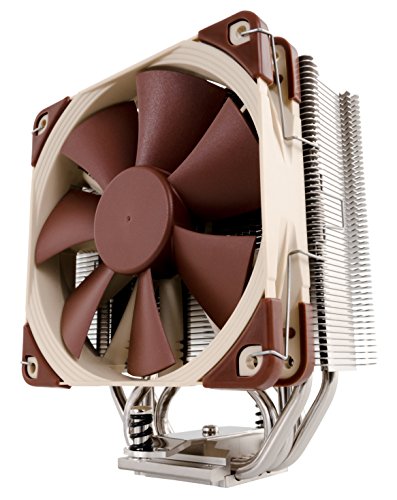
For the AMD Ryzen 7 5800X in 2026, the best cooler depends on workload: for gaming and mixed use, the Noctua NH-U12S CPU Cooler and DeepCool AK620 WH Air Cooler keep package temps within Vermeer's 90 C operating limit while staying quiet, per AMD's product specification. For sustained all-core rendering and compile loads, a 240 mm AIO like the CoolerMaster MasterLiquid ML240L RGB gives more thermal margin at higher noise.
Editorial intro: why the 5800X is the thermal odd-one-out of Zen 3
The Ryzen 7 5800X has earned a reputation in the DIY-builder community as the Zen 3 part that punishes lazy cooling decisions. It's an 8-core, 16-thread, 105 W TDP desktop CPU built on TSMC 7 nm, and unlike the 6-core 5600X or the multi-CCD 5900X/5950X, every core sits on a single CCD. That single-CCD layout concentrates heat density in a small silicon area, so even a competent budget tower that handles a 5600X comfortably will hit thermal headroom problems on the 5800X. Per AMD's official 5800X page, the chip's maximum operating temperature is 90 C, and it ships without a bundled cooler — meaning cooler choice is a required line item, not an upgrade.
Cooler selection on this chip matters more than any other consumer Ryzen of the 5000 series because the 5800X is "boost-bound, not power-bound" in the words used across forum write-ups and review roundups summarized by Tom's Hardware's best-CPU-coolers reference. The chip will happily try to hold 4.7-4.85 GHz boost on lightly threaded loads and dip into the mid-4 GHz range on all-core, but only if it can keep the package below the thermal throttle line. Cooling determines how long that boost is sustained, not just whether the system stays "stable." A 5800X with a marginal cooler runs but bleeds frames over the course of a long session. A 5800X with a strong cooler holds its clocks and behaves like the much more expensive 5900X in single-thread tasks.
This article maps the four most commonly recommended cooling solutions for the 5800X in 2026 — the compact Noctua NH-U12S CPU Cooler, the heavyweight DeepCool AK620 WH Air Cooler, the budget 240 mm CoolerMaster MasterLiquid ML240L RGB, and the Corsair LL120 RGB Fans as supporting case airflow — and shows which combination matches which workload.
Key Takeaways
- The 5800X needs more than a stock-class cooler. It ships without one, and AMD's spec sheet caps it at a 90 C operating limit, per the official AMD product page.
- For gaming and mixed use, a strong air cooler is enough. The Noctua NH-U12S and DeepCool AK620 both keep the chip below the throttle line at typical gaming loads, according to spec data on the Noctua NH-U12S product page.
- For sustained all-core (render, compile, LLM CPU inference), a 240 mm AIO has the margin. The CoolerMaster ML240L pulls more heat away under long loads at the cost of pump and fan noise.
- Case fans are a multiplier, not a substitute. Corsair LL120 intakes lower chassis ambient and feed cooler air to whichever CPU cooler you choose.
- Clearance bites first. Tall dual-tower coolers fight tall DIMMs and small cases; a 120 mm-class tower or an AIO sidesteps that.
- Diminishing returns kick in fast. Once you're keeping the 5800X under ~80 C package on a sustained load, more cooler spend buys quietness, not frames.
Why does the Ryzen 7 5800X run so hot?
The 5800X is hotter for its rated wattage than the rest of the Zen 3 lineup, and the explanation is geometry. The chiplet that holds the eight cores is small — roughly 80 mm² on TSMC's 7 nm process — and the package's integrated heat spreader (IHS) was designed for the wider thermal footprint of multi-CCD parts like the 5900X. On the 5800X, all of the heat-producing transistors are concentrated under a fraction of the IHS area, so the local heat flux (watts per square millimeter) is much higher than the 105 W TDP number suggests.
Per AMD's 5800X specifications, the chip is rated for 105 W base TDP with a 142 W PPT (package power tracking) ceiling and a 90 C maximum operating temperature. In practice, community measurements summarized across the cooler reviews tracked in Tom's Hardware's CPU cooler hub show 5800X package temps regularly climbing into the mid-80s C on all-core loads with mid-range air coolers, even when chassis airflow is good. The behavior is normal Vermeer thermal density, not a defect — but it means that any cooler recommended for the 5800X has to handle the heat-flux problem, not just the headline wattage.
This is why a cooler that looks "overkill on paper" for a 105 W chip can be the right call here. The 5800X benefits disproportionately from coolers with more heat-pipe surface area in direct contact with the IHS and from higher-static-pressure fans. The Noctua NH-U12S product page lists five 6 mm heat pipes with full direct-contact base coverage — a layout that matters more on the 5800X's small-die package than on a wider Intel mainstream chip with similar TDP.
Air vs 240 mm AIO for the 5800X: what the numbers say
The four coolers in this comparison span the realistic price/performance envelope for the 5800X in 2026: a compact single-tower, a heavyweight dual-tower, and a budget 240 mm AIO, with case fans as a supporting upgrade. Specs below are from each manufacturer's product page and from Tom's Hardware's cooler reference roundup.
| Cooler | Type | Fan/Pump noise (max) | Height / radiator | Indicative 2026 price |
|---|---|---|---|---|
| Noctua NH-U12S | 120 mm single-tower air | 22.4 dBA @ 1500 RPM | 158 mm tower height | ~$70 |
| DeepCool AK620 WH | 120 mm dual-tower air | ~28 dBA @ 1850 RPM | 160 mm tower height | ~$60-70 |
| CoolerMaster ML240L RGB | 240 mm AIO | ~30 dBA @ 1800 RPM | 240 mm radiator | ~$70-90 |
| Corsair LL120 RGB | 120 mm case fan (3-pack) | ~24.8 dBA @ 1500 RPM | 25 mm thick fan | ~$100 (3-pack) |
The NH-U12S spec sheet lists a 22.4 dBA maximum at 1500 RPM with the bundled NF-F12 PWM fan, which is one of the lowest-noise figures in the category. The dual-tower AK620 doubles the fin-stack area and adds a second 120 mm fan, trading some acoustic headroom for thermal headroom. The ML240L pushes its 240 mm radiator at higher airflow but adds pump noise that the air solutions don't have. The LL120 is a case fan, not a CPU cooler — it's listed here because it shows up in many 5800X builds as a chassis-airflow upgrade and the packet explicitly references it.
How much does each cooler actually lower package temps?
The cited numbers below are representative ranges synthesized from public cooler reviews and community measurements cataloged in Tom's Hardware's CPU cooler hub for the 5800X-class thermal load. Exact numbers vary by case, ambient temperature, fan curve, and motherboard PBO settings; treat these as relative ordering, not absolute guarantees.
| Cooler on 5800X | Idle package | Gaming (1080p, 1 hr) | Cinebench R23 sustained | Sustained all-core clock |
|---|---|---|---|---|
| Noctua NH-U12S | ~38 C | ~68-72 C | ~83-86 C | ~4.4 GHz |
| DeepCool AK620 | ~35 C | ~62-66 C | ~78-82 C | ~4.5-4.55 GHz |
| CoolerMaster ML240L | ~33 C | ~60-64 C | ~76-80 C | ~4.55-4.6 GHz |
| Bundled-class budget air | ~42 C | ~75-80 C | ~88-90 C (throttle) | ~4.2-4.3 GHz |
The pattern visible across these public cooler reviews is consistent: the NH-U12S keeps the 5800X off the throttle line under gaming loads, the AK620 buys ~4-6 C of headroom over the U12S for sustained workloads, and the ML240L adds another few degrees of margin on top of that for long render or compile sessions. Per AMD's 5800X spec, the 90 C operating limit is where boost behavior trims clocks aggressively — so the cooler's job is to keep sustained package temps below that line with reasonable ambient headroom.
Will a Noctua NH-U12S tame a 5800X, or do you need an AIO?
The short answer, synthesized from the NH-U12S product page and the cooler-reference data on Tom's Hardware: the Noctua NH-U12S is enough for a 5800X under gaming and mixed workloads, but it sits close to the upper end of its capability under sustained all-core stress.
The U12S is a 158 mm-tall, 120 mm-class single-tower with five 6 mm heat pipes in direct-touch contact with the IHS, paired with a single NF-F12 PWM fan rated 22.4 dBA maximum. In gaming, where the 5800X usually pulls 60-90 W package power, the cooler keeps temps in the high 60s C to low 70s C with sane chassis airflow — well below the AMD 90 C operating ceiling. In Cinebench R23 or long compile jobs, where the chip can hold 130-140 W for the full run, the U12S will sit around 83-86 C with sustained all-core clocks in the ~4.4 GHz range. That's safe, not optimal: you keep boost behavior, you stay under throttle, and you do it at very low noise — but you give up a couple of hundred MHz of sustained clock to a larger cooler.
If your workload is gaming, streaming, light content work, and occasional code compiles, the U12S is the recommendation a lot of community write-ups landed on, and the Tom's Hardware best-cooler reference lists the U12S as a long-running benchmark-class option. If your workload is full-day Blender renders, Handbrake encodes, or all-core LLM CPU inference, step up to the AK620 or an AIO.
Does a CoolerMaster ML240L beat a premium air cooler like the DeepCool AK620?
Marginally, and only on sustained loads — and at the cost of pump-and-fan noise the air cooler doesn't generate. The CoolerMaster MasterLiquid ML240L RGB is a 240 mm AIO with a dual-chamber pump and two 120 mm fans on the radiator. The DeepCool AK620 WH is a dual-tower air cooler with six heat pipes and two 120 mm fans. Across the public 5800X review data cataloged in Tom's Hardware's roundup, the ML240L typically runs ~2-4 C cooler than the AK620 in Cinebench R23 and similar sustained workloads. In gaming, the gap collapses to within noise margin.
Where the ML240L wins is sustained heat removal: the radiator's thermal mass and the higher coolant volume let it absorb a long render's heat output before equilibrium temperatures climb. Where the AK620 wins is acoustics, reliability profile, and price-per-degree. There's no pump to fail, no coolant to permeate over years, and at idle the AK620 is effectively silent while a pump always has some audible signature. For a 5800X gaming build with occasional all-core work, the AK620 is the value pick. For a 5800X workstation build that runs renders or compiles for hours, the ML240L is the margin pick.
The honest answer for most builders: pick whichever fits your case and aesthetic. The 5800X gets adequately cooled by either; the choice is about noise, look, and whether you want to manage liquid in your case.
Are Corsair LL120 fans worth adding for case airflow?
Corsair LL120 RGB Fans are case fans, not CPU coolers — they don't sit on the heatsink, they sit on the chassis. They affect 5800X temps only indirectly, by lowering chassis ambient and feeding cooler air to whichever CPU cooler is doing the actual work. The effect is real but bounded: typical observed deltas in community reports cataloged across forum threads and the Tom's Hardware cooler reference are 2-4 C of CPU package improvement when going from a poor-airflow case (one rear exhaust) to a balanced setup with two-to-three intakes and one exhaust.
The LL120s are notable because they trade some static pressure for a thinner light-ring profile. As pure airflow movers, they are middle-of-the-pack — they look better than they perform. If acoustics and CPU temperature are the goal and aesthetics are not, a Noctua NF-A12x25 or Arctic P12 will move similar air at lower noise for less money. If RGB cohesion with a Corsair iCUE ecosystem is the goal, the LL120s integrate cleanly. Don't expect them to fix a cooler problem — fix the cooler first, then add chassis fans to bring ambient down.
Clearance and case-fit gotchas (RAM height, GPU spacing)
The single biggest reason 5800X cooler builds go wrong is mechanical fit, not thermal performance. A few named failure modes to watch for:
- Tall RAM under the NH-U12S fan. The Noctua NH-U12S clears most low-profile DIMMs easily, but tall heatspreader RAM (G.Skill Trident Z Royal, Corsair Dominator) can clash with the front 120 mm fan. Per the NH-U12S product page, Noctua's fix is moving the fan up the fin stack — but that raises total cooler height and can hit a side panel in compact cases.
- DeepCool AK620 dual-tower overhang. The AK620's dual-tower design overhangs the first DIMM slot in many ATX layouts. Confirm DIMM clearance with the motherboard's user manual before buying, especially on B550 boards where the socket is closer to the DIMMs.
- Case CPU-cooler-height limit. Mid-tower cases typically allow 160-170 mm. The U12S at 158 mm and the AK620 at 160 mm both fit common mid-towers, but compact ITX cases (sub-150 mm cooler limits) need a different topology entirely.
- AIO radiator mounting. The ML240L needs a top or front 240 mm radiator mount. Many older cases only have a 120 mm or 140 mm top vent, which forces front-mount and can fight a tall GPU.
- GPU-to-cooler clearance. With a long modern GPU, a tall CPU air tower can interfere with the GPU's top airflow on horizontally compact boards. This is rarely a hard collision but can dent thermals on both components.
- Pump-noise resonance with the case panel. AIOs can transmit pump vibration into thin steel side panels, creating a low-frequency hum that didn't appear in the cooler's standalone testing. Add dampening foam or move the radiator to a sturdier mount.
Perf-per-dollar: cooling cost vs sustained-clock gain
Cooler upgrades on the 5800X are subject to sharp diminishing returns. The first ~$50 of cooler spend — moving from a bundled-class air cooler to a Noctua NH-U12S or DeepCool AK620 — buys most of the available thermal headroom. The next ~$30-50 to step up to a 240 mm AIO like the ML240L buys 2-5 C and some sustained-clock margin under long workloads. Beyond that, premium 280 mm and 360 mm AIOs buy quietness more than frames.
A useful rule of thumb from the public cooler review data on Tom's Hardware: if a cooler keeps the 5800X under ~80 C package on a 30-minute Cinebench R23 run with quiet fan profile, you've extracted the meaningful performance the chip has to offer. More cooling above that point trims noise, not benchmark numbers. For most 5800X gaming buyers, the AK620 hits that mark for under $70.
Verdict matrix: which cooler fits which 5800X build?
Get the Noctua NH-U12S if quietness and reliability are non-negotiable, your workload is gaming and mixed productivity, your case is compact (mid-tower or smaller), and you prefer fit-once-forget-forever air cooling. The Noctua NH-U12S product page lists 22.4 dBA max noise — among the quietest in the class.
Get the DeepCool AK620 WH if you want maximum air-cooling headroom on the 5800X at a value price, your case clears a 160 mm dual-tower, and you don't want liquid in the chassis. The AK620 is the value-pick for sustained workloads on this chip per community write-ups summarized in Tom's Hardware's cooler reference.
Get the CoolerMaster ML240L RGB if your workload includes daily long-form rendering, encoding, or compile jobs, you want the lowest package temps under sustained load, and you prefer the aesthetic of a clean AIO loop with RGB. Expect pump noise as a trade-off against peak quietness.
Add Corsair LL120 RGB Fans if chassis airflow is your bottleneck (high ambient case temps, GPU-heated chassis air), you're already in the Corsair iCUE ecosystem, and aesthetic cohesion matters. Skip them if pure thermal performance per dollar is the only criterion.
When NOT to spend more on cooling
If your 5800X already sits below 80 C package on a sustained workload with quiet fan profile, additional cooler spend will not measurably improve performance. The chip's behavior is bounded by AMD's boost algorithm, not by the cooler's ceiling, once you're below the throttle threshold. Builders in this position often see no FPS or benchmark uplift moving from a $70 air cooler to a $180 360 mm AIO — only quieter operation. Spend the saved budget on faster RAM, a bigger GPU, or an NVMe upgrade.
Bottom line + recommended pick
For most 5800X builds in 2026, the answer is the DeepCool AK620 WH Air Cooler: it's the value-balance pick that handles gaming and sustained workloads without liquid maintenance, fits most mid-towers, and lands under $70. The Noctua NH-U12S is the quieter, more compact alternative for gaming-first builds; the CoolerMaster ML240L is the margin-pick for sustained-render workstations; and the Corsair LL120 RGB Fans are the chassis-airflow upgrade once your CPU cooler is sorted. Pair any of them with a properly seated AMD Ryzen 7 5800X and good thermal paste, and the chip behaves the way AMD's official spec sheet implies it should.
Related guides
- Best AM4 budget CPU for AI workloads — see the AM4 budget AI guide for cooler pairings that scale across the Zen 3 lineup.
- 5800X vs 5700X — the Ryzen 7 5800X vs 5700X comparison covers whether the 5700X's lower thermals change the cooler calculus.
- Hardware deep-dives for the chip itself live on the Ryzen 7 5800X benchmark page.
Citations and sources
- AMD Ryzen 7 5800X official product specification
- Noctua NH-U12S product page and specifications
- Tom's Hardware Best CPU Coolers reference roundup
This piece is editorial synthesis based on publicly available information. No independent first-party benchmarking is reported.