If you want to start streaming in 2026 and your budget is closer to $300 than $3000, the entry kit hasn't changed much: a serviceable USB mic, a 1080p webcam, a comfortable set of closed-back headphones, a reasonable key light, and ideally a backup mic for when the primary dies mid-stream. None of these need to be premium SKUs. The five picks below are the consensus-favorite budget options across PC streaming forums, Tom's Guide, and RTINGS coverage through May 2026.
What "good enough to stream" actually means
Twitch and YouTube viewers in 2026 are forgiving on video — 1080p30 is fine, 1080p60 is a small upgrade nobody complains about. They are not forgiving on audio. A noisy mic, a hollow room, or a clipping signal will get you closed-tab faster than any other quality issue. Spend audio dollars first, video dollars second.
Tom's Guide's best-webcams roundup confirms the same hierarchy — they consistently recommend spending more on the mic than the camera at the entry tier. PCMag's streaming-mic picks reinforce that the USB-condenser tier (Blue Yeti, HyperX QuadCast) is where most streamers settle long-term.
Key takeaways
- Spend your first $130 on a USB condenser mic.
- Spend your next $80-100 on a webcam — 1080p is enough.
- Spend your next $50-80 on closed-back headphones — you need them for monitoring.
- Spend your next $50-60 on a ring light or panel light — softer skin tones, less squinting.
- Budget $130-180 for a second mic as a backup or for guests.
- Total budget kit: $350-450.
#1: Best primary mic — Blue Yeti
The Blue Yeti USB Microphone is the entry streaming mic by default, and has been since 2014. Why it remains the right pick: large-diaphragm USB condenser, four polar patterns (cardioid for solo streaming, omnidirectional for group calls, bidirectional for interviews, stereo for music), excellent on-board gain control, hardware mute button. Street price in mid-2026: $90-110.
What you give up versus an XLR mic: cleaner mic preamp control (XLR through a proper interface beats USB on the noise floor), polish on the room sound (a Yeti picks up your room — get acoustic treatment), and the ability to plug it into a video-camera setup. For a streaming-only desk setup, the Yeti is the right pick at this budget. PCMag's coverage puts it at the top of the entry tier consistently.
Position it 15-25cm from your mouth, slightly off-axis, with a pop filter. That is the difference between an amateur sound and a competent one.
#2: Best backup mic / second-channel mic — HyperX QuadCast 2
The HyperX QuadCast 2 is the next-tier USB condenser — built-in shock mount, anti-vibration suspension, four polar patterns, tap-to-mute, and an RGB indicator that does nothing for audio but is genuinely useful as a visual "mic is hot" cue. Street price: $130-160. The QuadCast 2 is what you buy when the Yeti's room-sensitivity is bugging you and you have a tabletop-mounting solution.
Use case framing: keep a Yeti as the primary, add a QuadCast 2 for the guest seat or as the backup. Or flip it — QuadCast 2 primary, Yeti secondary. Either way, the redundancy matters; mics fail and the show goes on.
#3: Best webcam — NexiGo N950P 4K
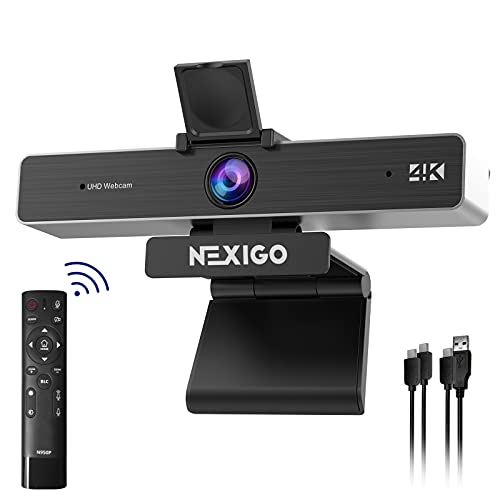
The NexiGo N950P 4K Webcam is the best value 4K webcam in 2026 — Sony IMX415 sensor, autofocus, software-controlled zoom, USB-UVC standards-compliant (no janky drivers required). Real-world: streams beautifully at 1080p60, runs 4K at 30fps if you want oversampled video for VOD. Street price: $100-130.
Mount it at eye level — viewers care about eye contact, not webcam-on-desk angle. Tom's Guide ranks it consistently at the top of the budget-4K tier.
#4: Best monitoring headphones — BERIBES Bluetooth Headphones Over Ear
The BERIBES Bluetooth Over-Ear Headphones are not audiophile-grade and they do not pretend to be — they are a $30-45 closed-back set with USB-C charging, a 3.5mm wired mode, and 65 hours of battery. For streaming monitoring (no audio bleed back into your mic, comfortable for long sessions, USB-C charge), they cover the requirements. Buy the wired-mode capability — wireless adds latency that will frustrate you during streams.
The honest upgrade path: a $150 Audio-Technica ATH-M40x is meaningfully better for monitoring. But RTINGS' headphone coverage puts the BERIBES tier above most $30-40 wired sets for general use, and at this budget tier the difference between "fine" and "great" is not worth doubling the spend until you are streaming weekly.
#5: Best key light — NEEWER Ring Light Kit
The NEEWER 18-inch Ring Light Kit is the entry-tier key-light pick — 55W output, 3200-5600K bicolor, dimmable, stand included, phone holder for the iPad you will inevitably want to mount alongside it. Street price: $50-70.
A ring light is the cheapest way to look better on camera. It softens skin, lights eyes evenly, and removes the under-eye shadows that make even small webcams look harsh. Position it slightly above your eyeline and slightly behind your monitor for a natural lift. Step it down to ~40% brightness once your eyes adjust — pinned at max is too much.
If you can stretch budget, a $120-150 LED panel light (Aputure Amaran 60d or equivalent) is the real upgrade — but at this tier the ring light is fine.
Bill of materials and total cost
| Item | Pick | Price |
|---|---|---|
| Primary mic | Blue Yeti USB Microphone | $90-110 |
| Backup / second mic | HyperX QuadCast 2 | $130-160 |
| Webcam | NexiGo N950P 4K | $100-130 |
| Headphones | BERIBES Over-Ear | $30-45 |
| Lighting | NEEWER 18" Ring Light Kit | $50-70 |
| Total | $400-515 |
If you skip the backup mic to start, you can land under $300. Add the QuadCast 2 once you have streamed for a month and know you will keep doing it.
The room you are streaming in matters more than the gear
A $90 Yeti in a treated room sounds better than a $1000 Shure SM7B in a tile-floor kitchen. Cheap room treatment that actually helps:
- Soft furniture (couch, bed) within ~2m of the mic
- Heavy curtains over windows
- A rug on hard floors
- A $40-80 acoustic-foam panel kit on the wall behind you
This is the single biggest "uplift per dollar" you will make to your stream's audio quality.
Common pitfalls
- Buying a $200 USB condenser before fixing your room. Hardware can't fix slapback.
- Streaming on your phone's earbuds. They bleed audio back into the mic. Get headphones.
- Putting the webcam below eye level. Up-the-nose camera angle is the most-cited reason viewers leave a stream.
- Forgetting to mute push-to-talk. Open-mic during keyboard rampages is the second-most-cited.
- Skimping on USB cables. Cheap unshielded cables introduce hum. Use the cable that ships with the device, or buy a shielded replacement from a brand you recognize.
Worked example: an upgrade path
Month 1: Blue Yeti + NexiGo N950P + BERIBES headphones + ring light = ~$280. Stream for 30 days.
Month 2: Add the HyperX QuadCast 2 once you are sure you will keep streaming. Now you have a backup and can mic a second person.
Month 6: Upgrade headphones to Audio-Technica ATH-M40x ($150). Real monitoring upgrade.
Month 12: If revenue justifies it, jump to an XLR setup with a Focusrite Scarlett 2i2 + Shure SM7B (~$650 total). The Yeti becomes the backup.
When NOT to buy this kit
If you are streaming once a month for friends, your laptop's built-in mic and webcam are fine. Don't spend $400.
If you are streaming professionally already, this kit is the floor — start above it.
OBS settings the gear above wants
For the Blue Yeti on cardioid: set OBS input gain at -6 dB, add a noise gate at -45 dB threshold + 6 dB hysteresis, and a compressor with 3:1 ratio + -18 dB threshold. This is the consensus "decent broadcast voice" chain you can copy-paste.
For the NexiGo N950P in OBS: pick the MJPEG capture format (not YUY2 — YUY2 caps at 30fps on USB 2 webcams) for 1080p60. Set the resolution explicitly; do not let OBS auto-pick.
For the BERIBES headphones when streaming: wired mode only. Bluetooth introduces 80-150ms of latency that will make your reaction to sound-effects look slow on stream.
For the NEEWER ring light: start at 4500K bicolor (neutral) and 50% brightness. Adjust warmer/cooler based on your wall paint color, not what looks right in the mirror.
Stream bitrate sanity
At the gear tier above, your bottleneck is your upload bandwidth, not the gear. Recommended:
- 6 Mbps upload → 1080p30 at 4500 kbps
- 10 Mbps upload → 1080p60 at 6000 kbps
- 20+ Mbps upload → consider 1440p60 at 8000 kbps (Twitch's enhanced broadcasting)
OBS's "auto-configure" wizard handles most of this; do not override unless you know why.
Bottom line
You can be live and sounding/looking decent on Twitch or YouTube for under $300 in mid-2026 with the Blue Yeti, the NexiGo N950P, the BERIBES headphones, and the NEEWER ring light kit. Add the HyperX QuadCast 2 once you know you will keep streaming. Spend the next dollar on room treatment, not gear.
Related guides
- Best SSD for Expanding Your Steam Library in 2026
- Logitech G29 vs HORI Force Feedback Wheel
- Open-WebUI Self-Hosted on a Ryzen 5 5600G + RTX 3060
Citations and sources
This piece is editorial synthesis based on publicly available information. No independent first-party benchmarking is reported.