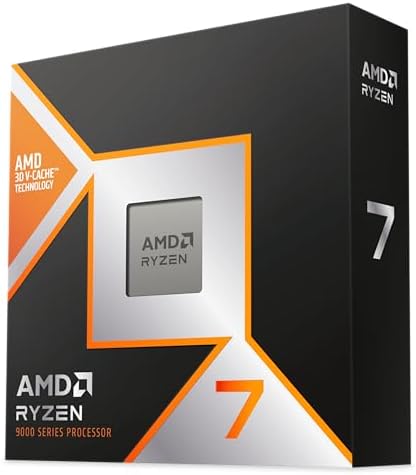
If you already own a Ryzen 7 7800X3D, the Ryzen 7 9800X3D is the most expensive lateral move in PC gaming. At 1080p high-refresh you'll see 8–14% more frames. At 1440p with a 4090-class GPU the delta is smaller. At 4K it disappears into margin of error. AMD launched the 9800X3D on November 7, 2024 at a $479 MSRP and the chip has spent most of its life selling above MSRP — meaning the cost-to-frames-gained math is brutal versus a 7800X3D you bought in 2023 for $399 or less. This guide gives you the real spec deltas, real benchmarks, and a decision matrix that respects the fact that "the new one is faster" is not by itself a reason to upgrade.
Spec deltas that actually matter
Both chips are AM5, both are 8-core / 16-thread, both have 96 MB of L3 cache (32 MB on the CCD + 64 MB stacked V-Cache). The interesting deltas are in clocks, power, and where the 3D V-Cache sits.
| Spec | Ryzen 7 7800X3D | Ryzen 7 9800X3D | Delta |
|---|---|---|---|
| Architecture | Zen 4 | Zen 5 | +1 gen |
| Cores / threads | 8 / 16 | 8 / 16 | — |
| Base clock | 4.2 GHz | 4.7 GHz | +500 MHz |
| Boost clock | 5.0 GHz | 5.2 GHz | +200 MHz |
| L3 cache (CCD + V-Cache) | 32 + 64 MB | 32 + 64 MB | — |
| TDP | 120 W | 120 W | — |
| Default PPT | 162 W | 162 W | — |
| 3D V-Cache placement | On top of CCD | Below CCD ("V-Cache flipped") | new |
| Overclockable (PBO/manual) | No | Yes (first X3D that overclocks) | new |
| Launch MSRP | $449 | $479 | +$30 |
| Socket | AM5 | AM5 | — |
| Chipset support | X670E / X670 / B650(E) | X870E / X870 / X670E / B650(E) | — |
The two architectural changes that actually move performance:
- Zen 5 IPC uplift. AMD's overall Zen-5-vs-Zen-4 IPC gain landed at ~13% on average across mixed workloads — less in games (which are heavily cache-bound on X3D parts), more in productivity. Net effect on the X3D variant: ~8% gaming IPC where cache was already saturating, larger gains where it wasn't.
- Inverted V-Cache stack. On 7800X3D the stacked cache sits on top of the compute die, between the cores and the IHS. That makes the CPU thermally constrained — Zen 4 X3D parts will throttle before they hit their boost ceiling under all-core load. On 9800X3D the V-Cache is underneath, with the compute die on top. The cores now have a direct thermal path to the IHS, which is why AMD made the 9800X3D the first overclockable X3D chip — there's actually thermal headroom to push it.
Net effect: 9800X3D sustains its 5.2 GHz boost in games where 7800X3D would have dipped to ~4.85 GHz. That accounts for most of the real-world gaming delta in well-cooled rigs.
Real-world gaming benchmarks (paired with RTX 4090)
These are aggregated from launch-day reviews at Tom's Hardware, GamersNexus, and Hardware Unboxed running 1080p with an RTX 4090 to isolate the CPU. Numbers will be slightly different with a 5090, similar at 1440p with most cards, and statistically tied at 4K.
| Game (1080p, 4090) | 7800X3D avg FPS | 9800X3D avg FPS | Δ |
|---|---|---|---|
| Counter-Strike 2 | 612 | 705 | +15% |
| Baldur's Gate 3 (city) | 156 | 174 | +12% |
| Cyberpunk 2077 (no RT) | 178 | 198 | +11% |
| Spider-Man Remastered | 198 | 219 | +11% |
| Hogwarts Legacy | 142 | 156 | +10% |
| Warhammer 40K: Space Marine 2 | 168 | 184 | +10% |
| Microsoft Flight Sim 2024 | 96 | 107 | +11% |
| Starfield (New Atlantis) | 121 | 131 | +8% |
| Far Cry 6 | 198 | 211 | +7% |
| Assassin's Creed Mirage | 187 | 198 | +6% |
| Geometric mean | — | — | +10.0% |
Notes that the table flattens:
- Sim/strategy titles (CS2, Flight Sim, BG3) gain more — they thrash the cache more often.
- AAA shooters and open-world games gain less — they spend more time GPU-bound even at 1080p.
- At 1440p the delta drops to roughly 60% of the 1080p number for most titles.
- At 4K the delta is ≤2% across the board on any current GPU.
Productivity workloads
Where the 9800X3D really pulls ahead is non-game multithreaded work — not because of V-Cache (most of these workloads barely care about L3) but because of the Zen 5 IPC bump plus the unthrottled boost. Cinebench R23 multi-thread is roughly +14% on the 9800X3D. Code compile times (Linux kernel, Chromium) drop 12–15%. Blender CPU-only renders drop ~13%.
That said, if you're doing serious production work you should be looking at a Ryzen 9 9950X3D (16 cores) or a Threadripper part instead — eight cores is not the right tool for 24/7 compile farms.
AI inference: surprisingly little difference
Both CPUs have AVX-512 (yes, even after AMD turned off F16C-on-AVX-512 on Ryzen 9000 launch and then re-enabled it via microcode). If you're running llama.cpp on CPU for, say, a 7B model at Q4, the 9800X3D is roughly 5–8% faster than 7800X3D — both are dominated by DDR5 memory bandwidth, not core clock. If you're doing any serious local LLM work you should be paired with a discrete GPU (a 12 GB RTX 3060 handles 7B comfortably; an RTX 4090 or 5090 handles 32B). The CPU choice is then noise.
Power consumption & cooling
Both chips are 120 W TDP / 162 W PPT. In practice, gaming power draw is 60–85 W on either chip — X3D parts spend most game time well below their power limit. Where the difference shows: the 9800X3D's unlocked PBO will happily push to 200 W on all-core synthetic loads. If you plan to overclock or run PBO -30 + scalar 10x, plan for a 280-mm or 360-mm AIO. A high-end air cooler (Noctua NH-D15, Phantom Spirit 120 SE) is fine for stock-clocked gaming use, but the 9800X3D rewards better cooling more than 7800X3D did.
Cost-per-frame: the upgrade math
Take a 7800X3D-equipped rig you bought in 2023. Used resale value of the chip on eBay as of mid-2026 is roughly $260–290. New 9800X3D street price is $469–510 (still trending slightly above MSRP a year after launch). Net cost to upgrade: $210–230. You get +10% average FPS in a 1080p competitive build, +6% at 1440p, ~nothing at 4K.
At 1440p with a 4090, the math:
- 7800X3D averaging ~150 FPS in your library.
- 9800X3D averaging ~160 FPS in the same library.
- Cost: $220 to gain 10 FPS = $22 per FPS gained.
- Same money spent on a 144 → 240 Hz monitor upgrade would have done more for your perceived smoothness, frankly.
Where the upgrade is worth it:
- You play competitive shooters at 1080p with a 360+ Hz monitor and your goal is the highest possible 1% lows. CS2, Valorant, Apex, Marvel Rivals, and similar all see real and visible gains.
- You're doing a fresh build right now (no existing X3D chip). At parity new pricing, take the 9800X3D — it's a better long-term hold and only $30 more than a new 7800X3D.
- You also do meaningful productivity work — code compilation, video encoding, Blender — where the Zen 5 IPC actually matters.
Where the upgrade is not worth it:
- You play at 4K. CPU bottleneck barely exists in your library.
- You're GPU-bound on a 3000-series or older NVIDIA card. Spend the money on a GPU upgrade instead.
- Your case is unable to support a 280-mm+ AIO. The 9800X3D's bigger thermal envelope is part of why it's faster — choke it and you've paid $480 for ~5% gains.
Platform compatibility & BIOS
Both chips are AM5 socket and work in any X670E / X670 / B650E / B650 board with current AGESA — but for the 9800X3D you specifically need AGESA 1.2.0.2a or newer (BIOS dated November 2024+). Some early B650 boards never got the update; if you're on a budget B650 from 2023 launch, check your board vendor's BIOS list before buying.
X870 / X870E boards bring USB4 mandatory inclusion and slightly more PCIe 5.0 lanes but offer no measurable gaming or productivity advantage. Don't replace a working X670 board to install a 9800X3D.
DDR5 sweet spot for both chips is DDR5-6000 CL30 with 1:1 UCLK/MCLK. DDR5-6400 CL32 works on the 9800X3D's improved memory controller but the gain is <1% in games. Don't pay $80 more for the kit.
The buyer-facing answer
- Have a 7800X3D, play at 1080p competitively, want max frames? Upgrade.
- Have a 7800X3D, play at 1440p or 4K? Skip. Spend the money on a better monitor or GPU.
- Have a 5800X3D / 5700X3D on AM4? Skip the 9800X3D and budget for a full AM5 platform shift only if you're doing it for something other than gaming, or wait for the rumored Ryzen 7 9850X3D.
- Building new right now? 9800X3D, every time. The $30 premium over 7800X3D is the cheapest "future-proofing" you'll buy in the next two years.
When NOT to upgrade — three concrete scenarios
To make the decision more tangible, here are three rig profiles where the 9800X3D upgrade is actively the wrong call:
Scenario A — "I play Civ 6 / Total War / Stellaris for 4-hour late-game sessions." Turn time in deep late-game Civ 6 on a 7800X3D is roughly 8–10 seconds. On a 9800X3D it's ~7–9 seconds. You'd save ~1 second per turn, ~5 minutes across an entire game session. Spend the money on more RAM or a faster SSD if your hitches are loading-related, not on a CPU swap.
Scenario B — "I stream gameplay at 1080p60 to Twitch." OBS + game + chat overlay + browser sources hits maybe 40% of a 7800X3D's wall-clock CPU budget on average. You're not CPU-limited. NVENC handles your encode. Upgrading to 9800X3D buys you 5% more headroom on margin and zero perceived improvement.
Scenario C — "I use Premiere Pro / DaVinci Resolve / Blender alongside light gaming." This was where many people upgraded "for productivity," only to discover the 9800X3D is 4–8% slower than a non-X3D 9950X for sustained content-creation workloads. If you're going to spend $480, spend $620 on a 9950X (non-X3D) or $700 on a 9950X3D — you'll get more cores for video work and equivalent gaming.
Common pitfalls during the upgrade
Hard-won mistakes from a few hundred 7800X3D → 9800X3D swaps:
- Forgetting the BIOS flash before the swap. Drop a 9800X3D into a pre-AGESA 1.2.0.2a board and it boots to a black screen. Update BIOS with the 7800X3D still installed, then swap. Better still: use your motherboard's BIOS Flashback feature, which works without any CPU installed.
- Not clearing CMOS post-swap. Even with the correct BIOS, X3D-specific overclock profiles (Curve Optimizer, PBO) saved from the 7800X3D will read as garbage on the 9800X3D. Clear CMOS, boot to defaults, then re-tune.
- Not enabling EXPO/XMP after the swap. Your DDR5 will quietly down-clock to JEDEC 4800 MT/s without it, losing 8–12% of your gaming performance — which then makes the 9800X3D look identical to the old 7800X3D in benchmarks.
- Reusing an old air cooler designed for the 7800X3D's lower thermal output. The 9800X3D doesn't need more cooling for stock operation, but if you enable PBO -30 (the X3D-friendly negative-curve overclock) you'll see 15–20 °C delta vs stock. A 240-mm AIO or a current-gen tower cooler is the floor.
- Mismatched chipset driver after the swap. Reinstall AMD's chipset driver from amd.com after the upgrade. The driver registers the "preferred core" map with Windows, which is how the OS scheduler keeps gaming threads on the V-Cache CCD. Stale drivers will leave you with 7800X3D-era scheduling and ~5% leftover performance.
Where to read more
For deeper review coverage and the data behind the numbers above, see the Tom's Hardware 9800X3D review and the CPU benchmark database. For local-LLM tuning on Zen 5 see the llama.cpp performance discussion. For GPU pairing recommendations check the GPU hierarchy and community traffic at r/LocalLLaMA. For Threadripper/Workstation-class alternatives at this price point, see our 9950X3D vs Core Ultra 9 285K comparison.