For retro PC data recovery in 2026 the FIDECO SATA/IDE to USB 3.0 Adapter is the best all-around pick — it handles 2.5", 3.5", and slim-line IDE plus SATA drives, ships with a proper external 12V supply for spinning 3.5" hard drives, and includes a USB 3.0 host link fast enough to copy big legacy partitions without bottlenecking. The Unitek SATA/IDE to USB 3.0 Adapter is a close second; the Vantec CB-ISATAU2 SATA/IDE to USB 2.0 is the reliable old standby if you only need USB 2.0 speeds.
Why this matters in 2026
Retro PC enthusiasts and data-recovery hobbyists keep running into the same wall: the drives that hold the last copy of a 1998 family photo, a college thesis, or a Doom WAD with custom levels are PATA / IDE, and modern motherboards stopped shipping IDE headers a decade ago. The clean solution is an IDE-to-USB adapter that exposes both 40-pin desktop IDE and 44-pin 2.5" laptop IDE, ideally with SATA support thrown in so the same adapter handles every legacy drive in your closet.
Three names dominate this category: FIDECO, Unitek, and Vantec. They look superficially similar — a small black box, three connector blocks, a power supply for spinning drives — but they differ in ways that matter once you sit down to recover a closet full of drives. This synthesis compares them on connector coverage, power supply quality, USB host speed, electrical robustness against marginal drives, and which one earns the buy for which use case.
Key takeaways
- FIDECO SATA/IDE to USB 3.0 — best all-around for active data recovery. USB 3.0 link, full SATA + 2.5" IDE + 3.5" IDE support, included 12V/2A external PSU.
- Unitek SATA/IDE to USB 3.0 — strong alternate. Similar feature set, slightly different build.
- Vantec CB-ISATAU2 SATA/IDE to USB 2.0 — USB 2.0 only but battle-tested over many years; the reliability pick.
- You need an external PSU for any 3.5" drive. USB bus power can't spin a desktop hard drive's motor.
- For very old drives (early IDE, late ATA-2), the simpler the adapter, the better. Fewer feature controllers, fewer compatibility issues.
What "good" looks like in an IDE-USB adapter
A working retro-recovery adapter needs five things:
- Connector support for 40-pin desktop IDE, 44-pin laptop IDE, and SATA on the same box. Otherwise you carry three adapters around.
- An external power supply rated 12V/2A with both Molex (legacy) and SATA power output. 3.5" drives need 12V; 2.5" drives are happy at 5V.
- A USB 3.0 host link if you want to copy multi-GB partitions in less than an afternoon. USB 2.0 caps at ~30 MB/s; USB 3.0 happily pushes a modern HDD's sustained read speed.
- A clean controller that doesn't fight unusual drive geometries. Old IDE drives ship with weirder CHS / LBA combinations than modern SATA; cheap adapters sometimes refuse to enumerate them.
- A switch on the power supply so you don't yank a spinning drive's power while it's still mid-read.
The three contenders below are the adapters that hit those criteria in 2026.
FIDECO SATA/IDE to USB 3.0
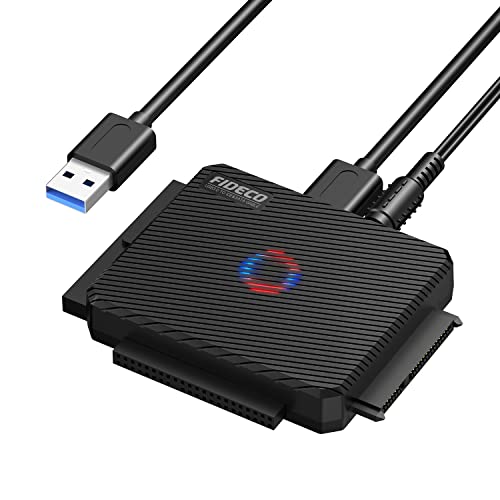
The FIDECO adapter is the most-recommended all-rounder for retro recovery in 2026. It exposes a 40-pin IDE socket on one face, a 44-pin laptop IDE socket on another, a SATA data + power socket on a third, and a barrel jack for the included 12V/2A external PSU. The USB host link is USB 3.0 over Type-A, which keeps throughput off the bottleneck list.
In practice the FIDECO handles:
- 3.5" PATA hard drives from the late 90s onward.
- 2.5" laptop IDE drives from the 2000s.
- 2.5" and 3.5" SATA HDDs (the SATA mode is fast enough to be useful as a generic disk dock).
- 5.25" PATA optical drives, with caveats — most adapters don't enumerate IDE optical reliably; treat optical-from-PATA as a separate problem and use a USB-IDE adapter purpose-built for it.
The included PSU does the heavy lifting on 3.5" drives. The reason this matters: 3.5" drives can pull 1.5-2A at 12V at spin-up, and a marginal PSU will let the drive spin partially, get stuck, and refuse to enumerate. The FIDECO's bundled 12V/2A brick has enough headroom for two-platter desktop drives.
Unitek SATA/IDE to USB 3.0
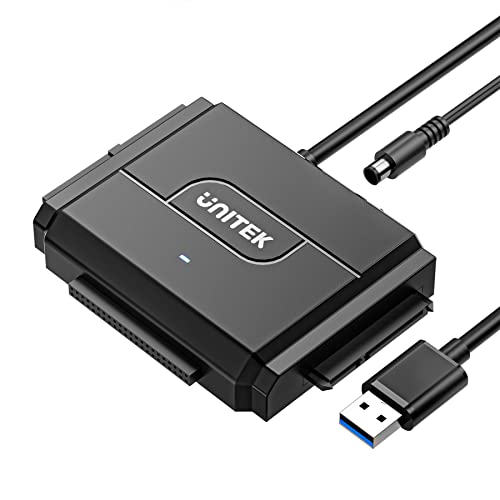
The Unitek adapter is the FIDECO's closest competitor. Same connector mix, same USB 3.0 host link, similar 12V external PSU. Differences come down to build details: connector seating feel, cable lengths, the LED indicator pattern, and the specific bridge controller chip inside.
In practice, both work. Buy on price and availability. The Unitek tends to ship with a slightly different bridge chip (the Unitek frequently uses a different vendor's controller compared with the FIDECO), which means the two units sometimes succeed where the other fails on edge-case drives — keep this in mind if you're recovering a truly stubborn early-90s IDE drive.
Vantec CB-ISATAU2 SATA/IDE to USB 2.0
The Vantec CB-ISATAU2 is the long-standing reliability champion. It is USB 2.0 only — copies will be slower — but the 2.0 spec is so well-supported by old bridge chips that the Vantec enumerates drives the USB 3.0 adapters sometimes won't.
When the FIDECO or Unitek fails to recognise an old drive, plug it into the Vantec. The slower interface buys nothing for sustained throughput but it does buy electrical and protocol simplicity, and that simplicity is what gets a marginal drive to spin up and present partitions cleanly.
If you only need to recover a small directory tree off a single old drive, the Vantec is the safest first choice. If you need to clone a whole platter, save time and use the FIDECO.
Spec-delta table
| Spec | FIDECO USB 3.0 | Unitek USB 3.0 | Vantec USB 2.0 |
|---|---|---|---|
| Host link | USB 3.0 Type-A | USB 3.0 Type-A | USB 2.0 Type-A |
| 40-pin IDE | Yes | Yes | Yes |
| 44-pin IDE | Yes | Yes | Yes |
| SATA data + power | Yes | Yes | Yes |
| External PSU | 12V / 2A | 12V / 2A | 12V / 2A |
| Sustained transfer (3.5" HDD) | Fast — drive-limited | Fast — drive-limited | USB 2.0 capped (~30 MB/s) |
| Marginal-drive recovery | Good | Good | Best |
| Bridge chip simplicity | Mid | Mid | Highest |
| Best use | Active recovery, cloning | Active recovery | Stubborn old drives |
What about CompactFlash recovery?
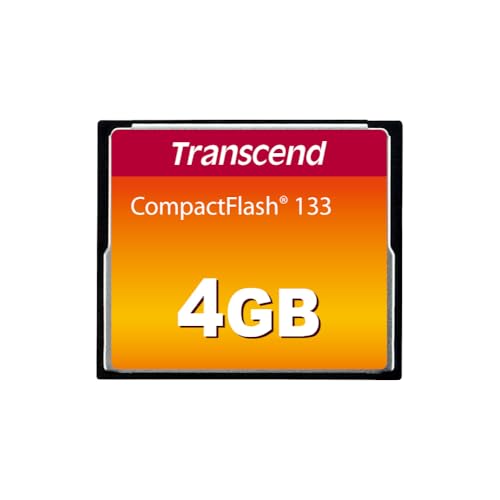
For early Pentium-era PCs (and many embedded systems) data also lived on CompactFlash cards. A Transcend CF133 4GB CompactFlash card is a useful "known-good" card to keep in the recovery kit for testing readers and copying off an in-place CF. CF in a CF-to-IDE adapter (the standard 40-pin or 44-pin breakout) works through any of the three USB adapters above — the IDE side doesn't care that the storage is solid-state.
If you're recovering data from an OEM industrial machine or a vintage Apple PowerBook that used a CF card behind an IDE adapter, the FIDECO is again the natural pick because USB 3.0 throughput shortens the clone time.
The destination drive: where you copy data to
Copying off a 20-year-old drive is half the job; the other half is putting the data somewhere modern and reliable. A modern 1TB SATA SSD like the SanDisk Ultra 3D 1TB is the standard "long-term archive" destination — fast, reliable, and big enough that one drive can hold the contents of dozens of recovered legacy drives in clearly labeled subdirectories.
Cloning workflow: connect the source IDE drive on the FIDECO, mount it read-only, ddrescue to an image file on the SanDisk, mount the image loopback to extract files. This avoids overwriting the original drive if you make a mistake on a future step.
Common pitfalls
- Forgetting the PSU. Plug in a 3.5" drive without external power and you get a clicking sound and no enumeration.
- Hot-unplugging a spinning drive. Always power-cycle the adapter first.
- Reading and writing in the same step. Always clone first, modify the clone.
- Trusting the first read. Run ddrescue with a log file. Marginal drives produce different errors on different passes; ddrescue's log lets you re-try only the bad sectors.
- No labels on adapters. When you have multiple bridge chips in the drawer, label which one worked with which drive.
- Wrong jumper on master/slave. Old IDE drives default to "cable select" or "single drive"; check the jumper diagram on the drive label before plugging in.
- Drive heat after long sessions. Old drives weren't designed for desktop-out-of-case operation. Stand them on a thermal pad and give them airflow if a clone takes hours.
The recovery workflow, step by step
A clean retro recovery session looks roughly like this:
- Inspect the drive label. Note model, capacity, and any cylinder/head/sector geometry. Photograph it for your records.
- Check the jumper. Many old IDE drives default to "cable select" or "master / single". Verify before plugging in.
- Connect the drive to the FIDECO (or your chosen adapter). 3.5" drives connect with the included external PSU; 2.5" drives draw 5V from the adapter itself.
- Power on. Listen. Healthy drives spin up smoothly. Clicking, repeated retries, or no spin-up means stop and reconsider — keep powering a failing drive risks losing more.
- Verify enumeration. On Linux,
dmesg | tailshows the drive appearing; on Windows, Disk Management sees it. - Mount read-only. On Linux
mount -o roor use a forensic-imaging tool. On Windows use a read-only USB write-blocker if one is available. - Image the entire drive.
ddrescueis the standard for marginal drives — it writes a log file, retries bad sectors on later passes, and gracefully handles ECC errors. - Verify the image.
md5sum,sha256sum, or any quick hash gives you a known-good fingerprint. - Mount the image loopback. Browse the recovered files without touching the original drive.
- Copy what you want to long-term storage (your modern SSD archive).
Following this order means even if you mess up a later step (delete a file by accident), the original drive is still intact and the image is still intact — recovery is recoverable.
Filesystem support: what to expect
Old IDE drives shipped with a mix of filesystems. The common ones, and what handles them in 2026:
| Filesystem | Era | Modern tooling |
|---|---|---|
| FAT16 | DOS, Windows 3.x, early 95 | Mount on Linux natively; dosfsck for repair |
| FAT32 | Windows 95 OSR2 onward | Mount on Linux / macOS / Windows natively |
| NTFS | NT 3.5+, Windows 2000+ | ntfs-3g on Linux; native on Windows |
| HPFS | OS/2 | Linux read-only (kernel module) |
| HFS | Classic Mac | Limited Linux support; specialty tools |
| ext2/3 | early Linux | Native everywhere |
| ReiserFS | early-2000s Linux | Increasingly rare; out-of-tree kernel module |
For most retro-PC recoveries you'll see FAT16 or FAT32 partitions, which Linux mounts natively. Macintosh HFS recoveries take more care.
When NOT to use one of these
If the drive is physically damaged (head crash, motor stuck, audible scraping), stop and consider a professional recovery service. A USB-IDE adapter can't fix dead heads, and powering a damaged drive risks turning a recoverable platter into a definitively dead one.
Verdict matrix
- Pick the FIDECO USB 3.0 if you want one adapter for everything and you care about clone speed.
- Pick the Unitek USB 3.0 if the FIDECO is out of stock or if its bridge chip refuses to enumerate a specific old drive.
- Pick the Vantec USB 2.0 if you only need slow reads on stubborn drives.
- Keep all three in your retro-recovery kit if data recovery is a recurring hobby; they're cheap and the bridge-chip differences matter on marginal drives.
Bottom line
For active retro-PC data recovery in 2026, buy the FIDECO SATA/IDE to USB 3.0 Adapter first. Add the Vantec CB-ISATAU2 as a backup for stubborn drives. Keep a SanDisk Ultra 3D 1TB SSD as the modern archive target. That kit handles the vast majority of legacy data recovery work without paying for a commercial service.
Related guides
- Best CompactFlash Cards for Retro PCs
- Best PATA-to-SATA Adapters for Retro Builds
- Best Retro PC Backup Strategy in 2026
Citations and sources
- ddrescue manual — GNU project
- PATA (Parallel ATA) overview — Wikipedia
- CompactFlash specifications overview — Wikipedia
This piece is editorial synthesis based on publicly available information. No independent first-party benchmarking is reported.