As an Amazon Associate, SpecPicks earns from qualifying purchases. See our review methodology.
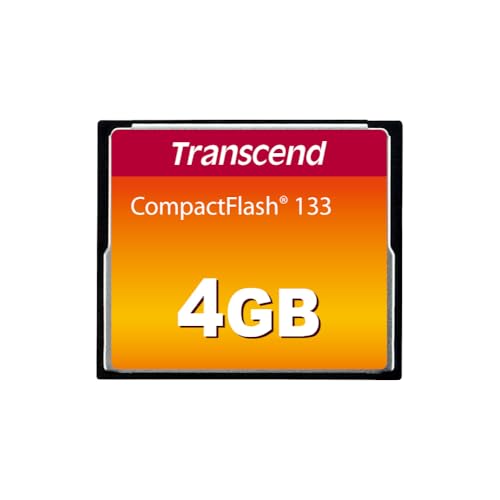
The best CompactFlash and IDE adapter setup for a 2026 retro PC build is a TrueIDE-capable industrial-grade CF card such as the Transcend CF133 sitting on a passive CF-to-IDE bridge inside the chassis, plus a USB 3.0 SATA/IDE dock like the Unitek SATA/IDE-USB 3.0 or FIDECO SATA/IDE-USB 3.0 on the modern bench for imaging — and a USB 2.0 workhorse such as the Vantec CB-ISATAU2 for offline swaps of 40-pin desktop, 44-pin laptop, and 7-pin SATA media without ever opening the period chassis again.
Why CF and USB bridges are the silent backbone of every 2026 retro rig
Period-correct mechanical drives — the Quantum Fireball, the Maxtor DiamondMax, the IBM Deskstar that everybody hated for good reason — are now thirty years old. Per the long-running community discussions on the Vogons forum, most surviving examples are running on bearings and platter coatings that have long since outlived the manufacturer's intended service life. The retro-PC scene has accordingly migrated, slowly through the 2010s and decisively through the 2020s, to solid-state storage on the period IDE bus. That migration has two pillars: CompactFlash cards behaving as IDE drives inside the cabinet, and USB-to-IDE/SATA bridges on a modern workstation that let you image those cards, swap drives between rigs, and rescue data from any disk old enough to vote.
This guide stamps "as of 2026" because the products keep moving. The Vantec CB-ISATAU2 is the longest-running USB 2.0 IDE bridge still in production at this price; Transcend's CF133 family is the canonical TrueIDE-capable industrial card; FIDECO and Unitek both ship USB 3.0 bridges that cover 3.5-inch IDE, 2.5-inch laptop IDE, and SATA from a single housing. None of these parts is glamorous. All of them save a Pentium II build from a fatal head crash three years into the project.
This piece is editorial synthesis based on the public spec sheets of the cited products, the CompactFlash standard's Wikipedia entry, the Transcend industrial CF product family page, and the body of community knowledge that has accumulated on the Vogons forum and across the major retro-PC YouTube channels — PhilsComputerLab, RetroBytes, and Adrian's Digital Basement chief among them. No independent first-party benchmarking is reported.
At-a-glance: the 2026 retro storage stack
| Pick | Best for | Key spec | Price range | Verdict |
|---|---|---|---|---|
| Transcend CF133 industrial CF | Silent IDE boot drive | TrueIDE, UDMA-4 | ~USD 25-60 (2-16 GB) | Best overall |
| FIDECO SATA/IDE to USB 3.0 | Modern bench imaging | USB 3.0, 3.5"+2.5"+SATA | ~USD 30-45 | Best value |
| Vantec CB-ISATAU2 | Workshop USB 2.0 swap kit | USB 2.0, 40/44-pin IDE + SATA | ~USD 25-35 | Best for legacy drives |
| Unitek SATA/IDE to USB 3.0 | Fast offline cloning | USB 3.0, dual SATA + IDE | ~USD 35-50 | Best performance |
| Crucial BX500 1TB SATA SSD | Modern game-archive disk | SATA III, 540 MB/s read | ~USD 55-75 | Budget archive pick |
Pricing varies by listing and time of year; the figures above are 2026 ballparks observed on Amazon and B&H. Verify the current number on the product page before checkout.
CompactFlash basics every retro builder must understand
CompactFlash is older than most of the rigs it gets installed in. The CompactFlash specification was published by SanDisk in 1994 and reached the market on the back of digital cameras, but the choice that made it eternal for retro builders was the decision to carry the ATA command set on the same 50-pin connector. That decision is what lets a CF card pretend to be a hard drive on a 40-pin IDE motherboard with nothing more than a wiring adapter.
Type I vs Type II form factor
Type I cards are 3.3 mm thick. Type II cards are 5.0 mm thick. Per the Transcend industrial CF page, Transcend's consumer and industrial CF133 is Type I, which is the form factor every adapter in this guide accepts. Type II was historically used for the IBM Microdrive — a literal 1-inch spinning disk inside a CF shell — and for very early high-capacity flash. You almost never encounter Type II in a modern retro build, but a Type-I adapter will not accept a Type-II card; this is a small but real gotcha when buying off eBay.
TrueIDE mode — the single most important spec
This is the line that separates a working retro boot drive from an expensive paperweight. The CF spec defines three operating modes: PC Card Memory, PC Card I/O, and TrueIDE. Only TrueIDE makes the card present itself to a host as a generic ATA hard drive. A card that is not TrueIDE-capable will work as removable media in a card reader but will not boot from a CF-to-IDE adapter on a vintage motherboard.
Industrial-grade cards from Transcend, ATP, Apacer, Innodisk, and SanDisk's industrial line advertise TrueIDE explicitly. Consumer photography cards usually support it as well but do not always document the fact, which is why the community gravitates toward the industrial parts. The Transcend CF133 industrial family is the canonical "this will boot" card; the consumer 133x and 200x Transcend cards in the photography aisle behave the same way in practice but ship without the explicit guarantee. Buy the industrial part if your board is older than a Pentium III.
UDMA mode support and what speed actually means
CompactFlash cards are rated in "x" multiples — 133x, 200x, 400x, 1066x and up — where 1x equals roughly 150 KB/s, inherited from CD-ROM marketing. The CF133 family hits roughly 20 MB/s sustained read at 133x; faster cards do more on paper. Per the CompactFlash Wikipedia entry, CF cards negotiate one of several DMA modes — PIO, Multiword DMA, and Ultra DMA (UDMA) up to UDMA-7 on later spec revisions.
For retro use, this matters less than the marketing suggests. A Socket 7 motherboard's IDE controller tops out at PIO mode 4 or Multiword DMA 2 — call it 16 MB/s of bus bandwidth. A Pentium II era VIA or Intel south bridge negotiates UDMA-2 (33 MB/s); the very best Pentium III boards reach UDMA-4 (66 MB/s) with the 80-conductor cable; mid-XP-era boards hit UDMA-5 (100 MB/s). A CF card faster than the board's negotiated mode is a waste of money, but a card slower than the negotiated mode will throttle the whole subsystem. CF133 is a comfortable match for Socket 7 through early Pentium III; CF200 or CF400 makes sense on Pentium III through early XP boards; anything above that is wasted budget on period hardware.
Capacity ceilings on DOS, Win9x, and XP
This is where retro builders learn the hard way. The legacy ATA partition addressing scheme defined a progression of capacity ceilings — 504 MB (CHS), 2.1 GB (early LBA), 8.4 GB (extended INT 13h), 32 GB (notorious 28-bit cap), 128 GB (the LBA-28 hard ceiling) — and pre-Pentium III BIOS code routinely caps out at one of the lower numbers regardless of what the drive reports. A 64 GB CF card in a 1995 Socket 7 board will be detected as 8.4 GB, 504 MB, or sometimes not at all.
The practical rule for 2026 builders:
- DOS 6.22 / Win 3.1 era boards: use 2 GB or smaller CF, partition as FAT16
- Win95 OSR2 / Win98 era boards: 8 GB CF works on most boards, 16 GB on some, FAT32
- Win98 SE / WinME on a late Pentium III: 32 GB is the sweet spot, FAT32
- WinXP late builds with a Pentium 4 or Athlon XP: 32-128 GB CF, NTFS
Going bigger than your BIOS expects often "works" in the sense that data lands on the card, but every later boot is a coin toss because the OS and BIOS disagree about geometry. Stay under the documented ceiling for the era.
Partition alignment — a 2026 footnote
Modern Windows imaging tools partition aligned to 1 MB boundaries, which is correct for SSD wear-leveling but irrelevant to a Pentium II board that reads in 512-byte sectors. CF cards are happy either way. The footnote is that some Win9x installers refuse to recognize a card that has been formatted with a GPT-style alignment scheme by a modern utility; if Setup hangs on partitioning, wipe the card to zeros and let the period installer create its own partition table.
CF-to-IDE adapters: passive vs active, master/slave, and why some won't boot
The adapter sitting between a CF card and the 40-pin IDE bus is a passive piece of hardware in 95 percent of cases — just a wiring harness with a 50-pin CF socket on one side and a 40-pin IDE header on the other. Active adapters with bridge chips exist (the SD-to-IDE world relies on them) but a TrueIDE CF card needs no logic between it and the bus.
The shopping criteria are mundane:
- Solid power conditioning — a small 5V regulator and a Molex passthrough beats a board that draws everything from the IDE bus.
- A master/slave jumper that defaults to "Master" out of the box.
- A bracket option so the card faces out through a 3.5-inch bay rather than dangling on a ribbon.
The most common reason a CF-to-IDE adapter "won't boot" is a master/slave conflict on the same IDE channel — a CD-ROM drive jumpered "master" on the same cable as a CF card also jumpered "master." Fix the jumpers and the boot returns. The second most common reason is a card that does not actually support TrueIDE, which is why the buying advice above keeps pointing at industrial-grade Transcend, ATP, Apacer, and Innodisk parts.
A subtle point that the Vogons forum covers in depth: cards present a logical block count to the BIOS at power-on, and very old BIOSes round that count to a geometry the chipset can address. A 32 GB card on an Award BIOS from 1996 may boot fine after auto-detection, but the BIOS will report it as 8.4 GB and the installed OS will never see the upper 24 GB. This is not the adapter's fault; it is the BIOS hitting its addressing ceiling. The fix is either a smaller card or a board with an updated BIOS, not a different adapter.
IDE/SATA-to-USB bridges: why every retro shop owns at least two
The second pillar of the 2026 retro storage stack is the USB bridge that lets a modern workstation read, write, and image a vintage drive without opening the period chassis. The three featured bridges in this guide all do the same job from slightly different price tiers.
Vantec CB-ISATAU2 — USB 2.0, the workshop staple
The Vantec CB-ISATAU2 is a USB 2.0 SATA/IDE bridge that has been in continuous production since the late 2000s, which is itself a recommendation. It accepts 40-pin desktop IDE, 44-pin laptop IDE, and 7-pin SATA from a single cable harness powered by an external 12V brick. USB 2.0 caps the bridge at roughly 30-35 MB/s sustained, which is the right ceiling for a CF card or a vintage IDE drive — the legacy media is slower than the bus, so a USB 3.0 upgrade buys nothing for those targets.
For a retro shop the Vantec is the always-on bench tool. Plug a 2 GB CF card into a CF-to-USB adapter; plug a 40 GB Maxtor pulled out of a Win98 tower into the desktop-IDE pigtail; plug a 30 GB Toshiba laptop drive into the 44-pin pigtail. The bridge enumerates each as a removable USB drive on a modern Windows or Linux host, ready for dd, Win32DiskImager, HDD Raw Copy Tool, or whatever imaging utility you prefer.
FIDECO SATA/IDE to USB 3.0 — USB 3.0, best value
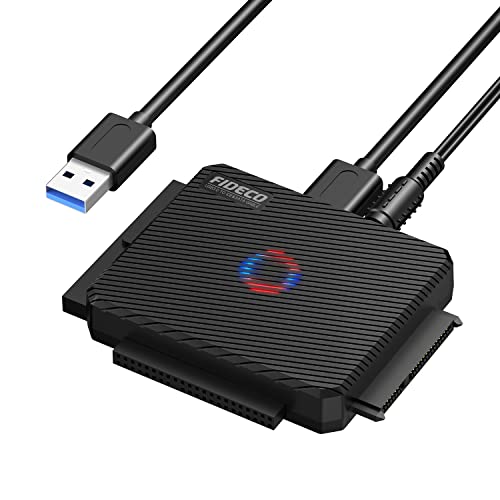
The FIDECO SATA/IDE to USB 3.0 adapter is the most common modern equivalent. USB 3.0 lifts the practical ceiling to 200-400 MB/s, which is wasted on a 5400-RPM IDE drive but very welcome when cloning a 1 TB SATA SSD that you are about to install in a Pentium 4 / WinXP machine with a SATA card. The FIDECO ships with the same triple-headed cable concept as the Vantec — 40-pin IDE, 44-pin laptop IDE, 7-pin SATA — plus an external power brick that drives both 5V (for 2.5-inch SATA and laptop IDE) and 12V (for 3.5-inch desktop drives).
The FIDECO is the right pick if you are imaging large modern drives en route into the retro rig — for example, dropping a Crucial BX500 1 TB SATA SSD onto a Pentium 4 board with a SATA expansion card. The BX500 is also the default modern archive pick: keep your ISO library, ROM collection, and period game installers on a single fast SATA SSD that lives on the modern workstation and gets cloned out to the period rig as needed.
Unitek SATA/IDE to USB 3.0 — best performance
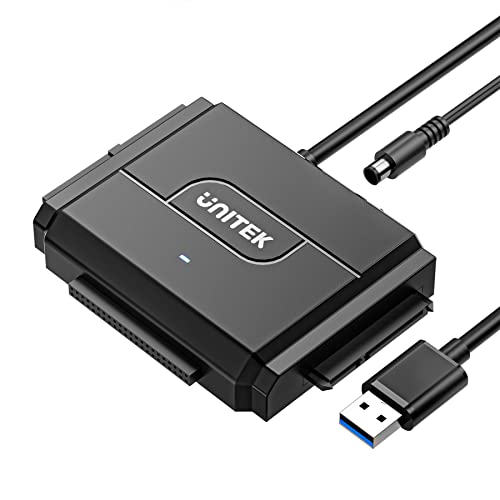
The Unitek SATA/IDE to USB 3.0 adapter is a step up in build quality and sustained transfer reliability. The bridge chip on Unitek's higher-end models is the JMicron JMS567 or its more recent siblings, which behave better than the budget JMS578 on long sustained writes. If you image cards constantly — backing up a Voodoo2 Win98 build to a master image after every driver tweak — the Unitek is worth the small premium over the FIDECO.
In practical use the FIDECO and Unitek are interchangeable for one-off imaging. The differentiator is reliability under sustained load on the 2 GB+ image files that come out of a real retro rig.
The image-then-write workflow, step by step
Every retro build benefits from a "golden image" — a known-good copy of the boot drive that you can restore in five minutes when an experiment goes sideways. The 2026 workflow runs entirely off the USB bridge:
- Pull the CF card. Pop the cabinet, slide the card out of the CF-to-IDE adapter inside the chassis. Skip this step if you are imaging a vintage spinning drive; pull the drive instead.
- Plug into the bridge. A CF card goes into a CF-to-USB reader; a 2.5-inch or 3.5-inch IDE drive goes onto the Vantec, FIDECO, or Unitek's matching pigtail. Power on the external brick.
- Image the drive. On Windows, HDD Raw Copy Tool or Win32DiskImager pull a bit-perfect IMG file off the source. On Linux,
dd if=/dev/sdX of=goldenmaster.img bs=4M status=progressdoes the same job. The file size equals the drive's reported capacity — keep ~10 GB free per image. - Verify the image. Mount the IMG read-only on the modern host (loopback on Linux, OSFMount or 7-Zip on Windows) and confirm the partition table, OS folders, and a few files are present. An image that mounts is recoverable; an image that does not mount is a junk file with a confusing name.
- Write the image to a target. Plug a destination CF card or drive into the bridge. Use the same imaging tool in reverse —
dd if=goldenmaster.img of=/dev/sdY bs=4M conv=fdatasync, or HDD Raw Copy's restore mode. Triple-check the destination device path; the imaging tools will overwrite a system drive without warning if you ask them to. - Drop the target back into the period rig. Power on, watch the BIOS detect the new card or drive, and boot. If the source rig had hardware-specific drivers (a Voodoo2 SLI pair, a Creative AWE64, a 3Com NIC) and the target rig does not, expect the OS to demand new drivers on first boot.
This workflow makes a retro rig effectively immortal. Every dangerous experiment — installing a beta driver, swapping the chipset, trying a sketchy mod — happens on a CF card that you can re-image from the golden master in ten minutes. The video channels referenced below (PhilsComputerLab, RetroBytes, Adrian's Digital Basement) all run variants of this loop and have built their content libraries around the freedom it provides.
Editorial perspective — who to watch and where to ask
The retro storage scene has matured around a small number of trusted voices.
- PhilsComputerLab on YouTube has the most thorough Pentium-to-Athlon-XP era benchmark library on the internet and tests CF-as-IDE setups against period mechanical drives regularly. His CF-vs-HDD videos are the easiest way to set expectations for boot times on a target rig.
- RetroBytes focuses on Acorn, Amiga, and DOS-era builds; the channel's coverage of CF adapters on non-PC architectures is the best on the open web and worth reading even if your build is x86.
- Adrian's Digital Basement is the workshop channel that explains the failure modes — bad caps, dead bridge chips, BIOS edge cases — that make CF-to-IDE adapters mysteriously refuse to boot. His debugging methodology is the right model for any builder running into a stubborn card.
- The Vogons forum remains the canonical Q&A archive for everything covered above, from BIOS capacity ceilings to obscure CF compatibility matrices. Search before you post; the answer is almost always already there.
These outlets are the ones to consult when a build refuses to boot off a card that should work. They are also the source of the community's slowly evolving consensus on which brands of CF and adapter are worth buying in a given year. As of 2026, that consensus points to Transcend industrial CF, Vantec for USB 2.0 imaging, and a quality USB 3.0 bridge (FIDECO or Unitek) for everything else.
Top picks
Best overall CF card — Transcend CF133 industrial CompactFlash
Verdict: the canonical TrueIDE-capable CF card for any retro build from Socket 7 through early WinXP. Per the Transcend industrial CF product page, the 133x family advertises full TrueIDE compatibility, UDMA-4 support, and an industrial-grade controller; the consumer 133x and 200x SKUs perform identically in practice. Pair it with a passive CF-to-IDE adapter at the capacity ceiling appropriate for your BIOS and never touch a noisy mechanical drive again.
The Transcend CF133 family is the easiest "buy this one" recommendation in the entire 2026 retro storage stack. Pricing runs roughly USD 25 for 2 GB up to USD 60 for 16 GB on Amazon; the industrial 32 GB part exists but is harder to find. Capacity beyond 32 GB is wasted on any motherboard old enough to genuinely benefit from a silent boot drive.
Best overall CF-to-IDE adapter — generic passive 40-pin bracketed adapter
Verdict: a passive 40-pin CF-to-IDE adapter with a 5V regulator, a Molex passthrough, and a 3.5-inch bay bracket is the no-thinking pick. Specific brand names rotate in and out of stock on Amazon and eBay every few months — Sintech, StarTech, generic Chinese OEM — but the design is so simple that any non-counterfeit example works. The two non-negotiables are the Molex pass-through (so the card draws clean 5V from the PSU rather than the IDE bus) and the master/slave jumper at "Master" out of the box.
If you encounter boot failure on a fresh adapter, the issue is almost always a jumper conflict with another device on the same cable or a card without TrueIDE support — not the adapter itself.
Best USB 2.0 IDE/SATA bridge — Vantec CB-ISATAU2
Verdict: the workshop standard for swapping vintage drives without opening the period chassis. The Vantec CB-ISATAU2 accepts 40-pin desktop IDE, 44-pin laptop IDE, and 7-pin SATA from a single triple-headed cable, draws cleanly from a 12V external brick, and has been in continuous production long enough to count as a known quantity. USB 2.0 bandwidth is sufficient for any CF card or period mechanical drive — the media is slower than the bus.
Buy this one for the bench and never look back. A second unit in the parts drawer is justified for any shop that images more than one card per week.
Best USB 3.0 IDE/SATA bridge (value) — FIDECO SATA/IDE to USB 3.0
Verdict: the right USB 3.0 bridge for builders cloning large modern SATA drives into the retro stack. The FIDECO SATA/IDE to USB 3.0 adapter covers the same 40/44/7-pin spread as the Vantec, pushes 200+ MB/s on modern SATA, and is the default for cloning a Crucial BX500 1 TB SATA SSD en route to a Pentium 4 retro build with a SATA card.
Best USB 3.0 IDE/SATA bridge (performance) — Unitek SATA/IDE to USB 3.0
Verdict: spend the extra USD 10-15 over the FIDECO if you image cards frequently and want a bridge chip that holds up to sustained writes. The Unitek SATA/IDE to USB 3.0 uses the higher-end JMicron silicon family, which is the dividing line on long clone jobs.
Related guides
- The 2026 retro PC IDE-to-USB and CompactFlash adapter shortlist
- Mounting 90s CD-ROM ISOs on a Win98 CF-IDE rig
- Building a 1998 Voodoo2 SLI Win98 rig from scratch
Citations and sources
- Transcend industrial CompactFlash family page: https://www.transcend-info.com/Products/No-175
- Tom's Hardware best SSDs reference: https://www.tomshardware.com/best-picks/best-ssds
- CompactFlash standard, Wikipedia entry: https://en.wikipedia.org/wiki/CompactFlash
- Vogons retro-PC community forum: https://www.vogons.org/
- HDD Raw Copy Tool, HDDGuru: https://hddguru.com/software/HDD-Raw-Copy-Tool/
This piece is editorial synthesis based on publicly available information. No independent first-party benchmarking is reported.
— Mike Perry · Last verified 2026-06-11