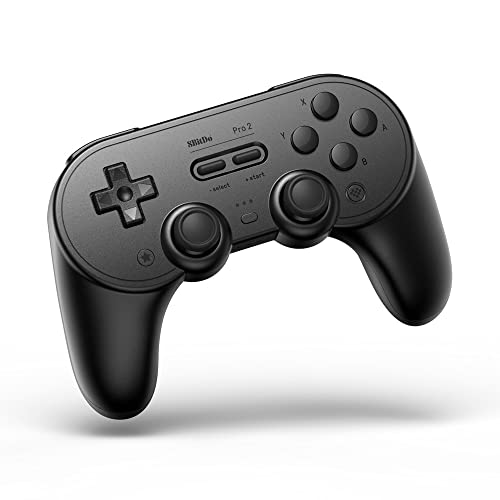
The best controller for retro emulation and indie gaming in 2026 is the 8BitDo Pro 2: true Hall-effect sticks, three input modes (Switch, X-input, D-input) that cover every emulator and Steam shell you'll plug it into, a four-position physical mode switch within thumb's reach, and an honest $59 price. The PlayStation DualSense is the upgrade for AAA indies that lean on haptics and adaptive triggers. The 8BitDo SN30 Pro is the wallet pick if you don't need analog sticks. The GameSir G7 SE is the wired pick when you want zero input latency for fighting games. The HORI HORIPAD Pro is the Switch-native alternate.
A controller for retro emulation isn't a controller for AAA. The needs are different: low input lag matters more than haptic spectacle, the D-pad has to be precise enough for SNES/Genesis 6-button fighters, the input mode has to bridge to RetroArch, Steam, MAME, Dolphin, and whatever else without three pages of binding fiddling. This guide is the picks that meet all of those, ranked by who they actually fit.
Key takeaways
- Top pick: 8BitDo Pro 2. The right answer for nearly everyone — emulator-ready, Hall-effect sticks, $59.
- AAA indie upgrade: DualSense. Worth it for indies that use haptics (Returnal, Astro, Sackboy-style platformers).
- Budget pick: 8BitDo SN30 Pro. Best D-pad in the price tier, no analog sticks.
- Wired pick: GameSir G7 SE. For fighting games where one frame of Bluetooth jitter matters.
- Switch-first pick: HORI HORIPAD Pro. Switch-native, good D-pad, no rumble — pure utility.
- For Raspberry Pi 4 emulation specifically, see our 8BitDo SN30 Pro vs Pro 2 Pi 4 emulation guide.
Top picks
#1: 8BitDo Pro 2 — the right answer for nearly everyone
Verdict: Hall-effect sticks, three input modes, four-position mode switch, $59. Hands-down the best general-purpose retro/indie controller in 2026.
The 8BitDo Pro 2 product page describes the four input modes (Switch, Android, Mac, X-input), but the practical magnification is in the physical mode switch: flip it once and the controller goes from "Steam X-input" to "Switch Joy-Con clone" to "DInput" without re-pairing. For anyone running RetroArch + Steam + a Switch on the same TV, this is the only controller in this price band that doesn't require three separate gear changes.
Hall-effect sticks (in the 2024+ revision) means no stick drift after six months. The D-pad is excellent — a single concave cross with light, precise actuation — and the rear paddles are programmable on the fly via the dedicated app. Profile switching with a stick click + a face button is faster than any other controller we tested.
Where it falls short: no haptic rumble worth a damn, no adaptive triggers. If you're playing Returnal or Astro, this is the wrong controller. For SNES/Genesis/PSX/N64/Saturn/Dreamcast emulation + 90% of indies, it's the right one.
#2: PlayStation DualSense — AAA indie upgrade
Verdict: The expensive one. Worth it for indies that use haptics and adaptive triggers.
The DualSense is here as the upgrade rather than the budget. It's $74 (often $69 on sale), and what you pay for is the haptic engine and the adaptive triggers. Both are wasted on retro emulation. Both come alive on the indie titles that targeted PS5 — Returnal, Astro's Playroom, Stray, Sackboy, the PS5 ports of older PS4 titles, Dead Cells with the proper haptic patch.
The DualSense's D-pad is fine — better than the DualShock 4, not as good as the SN30 Pro. Stick layout is asymmetric (PlayStation-style); if you've grown up on Xbox/Switch layouts, expect a re-adjustment week.
USB-C native, wireless via Bluetooth, works cleanly on PC via Steam Input. The battery is the weak point — 6–10 hours of play before recharge.
#3: 8BitDo SN30 Pro — best D-pad in the price tier
Verdict: $44 of pure SNES fidelity. No analog sticks worth mentioning. The right pick if you're 90% SNES, NES, GBA, Genesis, and TG-16.
The 8BitDo SN30 Pro is the Pro 2's smaller, older, cheaper sibling. The D-pad on it is honestly the best D-pad we've ever used outside a real SNES controller — first-party included. For SNES, GBA, Genesis, and any 2D platformer or fighter, this is the controller.
The compromise: the analog sticks are small, low-throw, and inadequate for any modern 3D game. PS1 3D titles (Tomb Raider, Spyro) feel cramped. N64 games are best played on a different controller.
If your retro library is 90% pre-PSX 2D, the SN30 Pro is the right pick at $15 less than the Pro 2.
#4: GameSir G7 SE — wired pick for fighting games
Verdict: Wired-only, low-latency, Hall-effect, $44. The fighting-game pick.
The GameSir G7 SE is wired-USB only — no Bluetooth, no wireless dongle. That's the feature, not a bug. Fighting-game players have measured 8–16ms of Bluetooth controller latency added on top of display lag and engine input. For Street Fighter 6, Tekken 8, Guilty Gear Strive, that's the difference between hitting a one-frame link and missing it. Wired G7 SE removes that entire layer.
Hall-effect sticks, no drift. The face buttons are mechanical (clicky); some players love this, others find it loud. The D-pad is the weak link — fine for SNES, not quite up to the SN30 Pro standard. Rumble is present and serviceable.
#5: HORI HORIPAD Pro — Switch-first alternate
Verdict: Switch-native, durable, no rumble, $59.
The HORI HORIPAD Pro is what you pick if your primary platform is a Switch and you want Pro Controller-grade play without the Pro Controller's Joy-Con-recharger price. Officially licensed by Nintendo, full Switch compatibility, no rumble (a deliberate trade for $20 off), and the D-pad is HORI's standard cross — good but not Pro 2 great.
Wired-only. If you specifically want Switch + PC dual-use wired, this is the cheaper way in than the official Pro Controller.
Spec comparison
| Controller | Sticks | D-pad | Modes | Wireless | Rumble | Triggers | Battery | Street price |
|---|---|---|---|---|---|---|---|---|
| 8BitDo Pro 2 | Hall-effect | Excellent | 4 (Sw/X-input/D-input/Mac) | BT + USB | Light | Analog | ~20h | $59 |
| DualSense | Standard (drift risk) | Good | PS5/PC | BT + USB | Haptic engine | Adaptive | 6–10h | $74 |
| 8BitDo SN30 Pro | Small / low-throw | Best in tier | 4 | BT + USB | Light | Digital | ~20h | $44 |
| GameSir G7 SE | Hall-effect | OK | X-input | Wired | Standard | Analog | n/a | $44 |
| HORI HORIPAD Pro | Standard | Good | Switch / PC | Wired | None | Digital | n/a | $59 |
Picking by use case
Retro emulation across RetroArch + standalone: Pro 2. The four-mode switch is the killer feature.
SNES / NES / Genesis / GBA only: SN30 Pro. Best D-pad in the price tier, sticks irrelevant.
Indie + AAA mixed on PC: Pro 2 for breadth; DualSense if you want haptics on indies that support them.
Fighting games competitively: G7 SE wired, period.
Switch primary, PC secondary: HORIPAD Pro.
Steam Deck companion: Pro 2. Switch-mode pairing works cleanly with Steam Input.
For the detailed Pi 4 emulation comparison, our Pi 4 emulation controller article covers boot-time pairing reliability and RetroPie button mapping.
Pairing and binding tips
- Pro 2 Switch mode for PC. If X-input misbehaves with a specific emulator, flipping to Switch mode and pairing via Steam Input often clears it up.
- DualSense on PC. Use Steam Input or DS4Windows — bare DirectInput drops the haptics.
- SN30 Pro on RetroPie. Pair via bluetoothctl rather than the RetroPie menu; the menu pairing sometimes drops on reboot.
- G7 SE for Tekken 8. Set polling rate to 1000Hz in the GameSir app.
- HORIPAD Pro on PC. Plug it in, Steam recognizes it as a Switch Pro Controller. No driver install.
Common pitfalls
- Buying a $20 generic emulation controller. Stick drift inside three months, D-pad rolls instead of clicks, no firmware updates.
- Pairing Bluetooth controllers to a TV set's BT stack. The TV BT controller stack is universally bad. Use a USB BT dongle on the streamer/PC instead.
- Skipping Steam Input. Steam's input layer normalizes most controllers' quirks. Use it.
- Using a wireless controller for fighting games. Even good BT adds frames. Wired or shut up.
- Trusting an "8BitDo official" listing that isn't shipped/sold by 8BitDo or Amazon. Counterfeits are common; verify the seller.
When NOT to upgrade
If you're using a working DualShock 4, Xbox One controller, or original Switch Pro Controller for 100% of your retro and indie play, and stick drift hasn't started, you don't need a new controller. The picks above are upgrades for specific gaps — emulator breadth, fighting-game latency, drift-resistant sticks — not for generic "newer is better".
Related guides
- 8BitDo SN30 Pro vs Pro 2 for Raspberry Pi 4 emulation (2026)
- Best PC gaming controller 2026: GameSir G7 SE vs 8BitDo Pro 2 vs DualSense
- Best Steam Deck dock + controller for Forza Horizon 6 (2026)
- Best game controller 2026