You need a low-latency USB microphone with strong echo rejection, a full-duplex USB audio interface (any modern USB-C mic qualifies), and either a wired headset or a good pair of noise-isolating headphones so the model doesn't hear its own voice through your speakers. A HyperX QuadCast 2 or Blue Yeti plus a decent pair of over-ear cans covers it.
Why the hardware suddenly matters
OpenAI shipped a "full-duplex" ChatGPT voice mode in 2026 — announced on their product blog — where the model listens and speaks at the same time. Practically, this means you can interrupt it, it can interrupt you, and the pause between your last word and its first word drops from ~800ms to under 300ms. It feels startlingly close to a real conversation.
The catch: your microphone and your speaker path suddenly matter more than they did with old push-to-talk voice. A cheap headset with a rattly USB DAC introduces echo, and the model starts talking over itself when it hears its own audio bleed back through your speakers. Half of the "voice mode feels broken" posts in the days after launch trace back to a hardware setup that was fine for one-way voice and terrible for duplex. This piece covers what to actually buy.
Who this is for
You want to use ChatGPT's new voice mode as a real work tool — dictation, brainstorming, walking-around coding pair — not as a novelty. You are willing to spend $80-200 on the mic + headphone setup to make it usable. You do not need broadcast-studio quality; you need conversation-latency reliability.
Key takeaways
- Full-duplex voice raises the bar on your mic + monitoring path. Cheap laptop mics push echo back into the model and cause interrupt loops.
- USB-C condenser mics with a built-in DAC (QuadCast 2, Yeti X) are the easiest fix; they present a stable full-duplex device to the OS.
- Wear headphones or a wired earpiece — do not run voice mode on speakers unless you tune echo cancellation carefully.
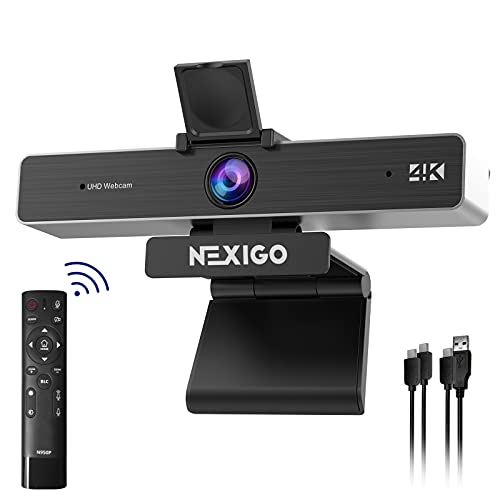
- A NexiGo N950P 4K webcam with its built-in beamforming mic is a workable "one device on the desk" setup for casual use.
- Latency floors: on a good USB-C mic + wired headphones over broadband, you should see 200-300ms round-trip; anything past 400ms indicates a hardware or software bottleneck.
What "full-duplex" actually means for your desk
A traditional half-duplex voice UX (old ChatGPT voice, most car-Bluetooth assistants) captures your speech, sends it up when you stop, generates a response, plays it back, then re-arms the mic. Two turns per exchange, hundreds of milliseconds between them.
Full duplex captures continuously, transcribes on-the-fly, and starts generating a response mid-utterance if the model has enough signal. The playback path is also continuous — the model can cut in when your voice pauses, and you can cut in over its playback. This only feels natural if:
- Your mic samples cleanly and doesn't drop packets under sustained streaming.
- Your speaker path does not bleed back into the mic (or your echo cancellation is very good).
- Your USB stack presents a stable full-duplex audio device — most modern USB-C mics do; older USB-A gear sometimes doesn't.
Miss any of those and you get one of two failure modes: the model starts saying "sorry, sorry, sorry" as it hears its own voice back and thinks you're interrupting, or it never seems to hear you and you find yourself repeating.
The mic recommendations
HyperX QuadCast 2 — $140. USB-C, tap-to-mute, four polar patterns, built-in shock mount. The one to buy for a permanent desk setup; the built-in DAC presents cleanly and the cardioid pattern rejects room echo well.
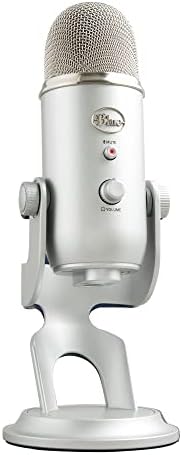
Blue Yeti (Logitech Creators) — $100. The 2010s desktop-podcast standard, still current. Bigger footprint than the QuadCast, slightly warmer sound, same reliable USB profile. The safe pick if you already have desk space.
NexiGo N950P 4K webcam — $70. Its beamforming stereo mic is not as clean as a dedicated USB mic but it is more than adequate for casual voice mode and it removes an item from your desk. Best if you also want the video path for meetings.
Any of these three will get you to the "just works" ceiling for full-duplex. Below them there is a jump in echo bleed and dropped packets that is not worth chasing for savings.
The headphone side
The most common voice-mode failure is running audio through your laptop speakers. The model hears its own playback, decides you're interrupting, apologizes, restarts. The fix is trivial: wear headphones.
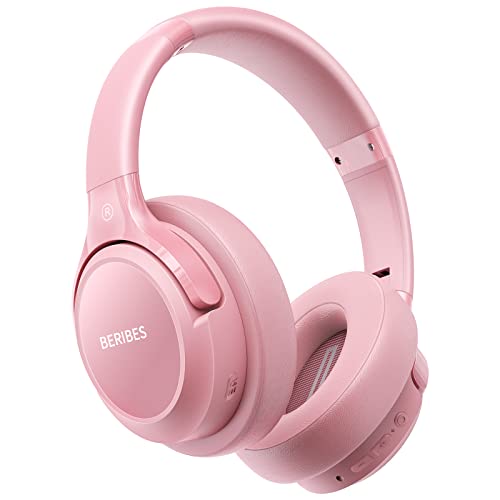
A wired pair is best because Bluetooth adds another 100-200ms of latency; BERIBES Bluetooth over-ear headphones work fine if you accept that ceiling. For a permanent setup a $30-60 pair of wired over-ear cans (any decent studio-monitor style) is the cheapest way to eliminate the echo path.
If you insist on running voice mode on speakers, use a directional mic aimed away from the speakers, keep the speaker volume as low as you can, and enable your OS-level acoustic echo cancellation. It will still not feel as good as headphones. This is a hardware constraint, not a model problem.
Setup recipe
- Plug the USB-C mic in directly to the machine (not through a hub with mixed devices).
- Set it as the default input in the OS and confirm the sample rate is 48kHz.
- Set your headphones as default output. Confirm mute-when-headphones-unplugged is off.
- Open ChatGPT voice mode. Speak. If it responds within 300ms, you're done.
- If not: try a different USB port (some laptops have a USB-3-only port that fixes it), close every other audio-using app, and check the browser/app is granted mic permission for the correct device.
Comparison table
| Setup | Round-trip latency | Echo behavior | Cost |
|---|---|---|---|
| Laptop mic + speakers | 400-800ms | Very bad | $0 |
| Laptop mic + wired headphones | 300-500ms | OK | $30 |
| USB-C mic + wired headphones | 200-300ms | Good | $130+ |
| USB-C mic + wireless earbuds | 350-500ms | Good | $180+ |
| USB-C mic + wired studio cans | 200-300ms | Excellent | $170+ |
Common pitfalls
- USB-C hub in the middle. A hub with mixed high-bandwidth peripherals can introduce jitter that shows up as audio dropouts. Plug the mic directly.
- Wrong sample rate. If your OS is set to 44.1kHz and the mic to 48kHz you may see periodic pops or dropouts. Match both to 48kHz.
- Bluetooth headphones for anything serious. The added latency wrecks the "interrupt me naturally" feel. Wired is the pattern.
- Echo cancellation disabled at OS level. On Windows this is per-device; check the mic's Enhancements tab. On macOS it is generally on by default but a couple of app-level flags can disable it.
- Muted app-level input. ChatGPT's voice mode has its own mic-mute state independent of the OS mute. Unmute both.
When not to bother
Full-duplex voice is genuinely useful for brainstorming, dictation, and "walk around and talk through a problem" work. It is worse than typing for anything that requires precise punctuation, code, URLs, or file paths. It is worse than a phone call for anyone who does not want to be overheard. If your workflow does not include one of the first three cases, keep using push-to-talk and skip the mic upgrade.
Bottom line
Full-duplex voice is a meaningful UX jump, and it exposes any weakness in your audio path. Spend $130-170 on a USB-C mic and wired headphones and you will get the "startlingly close to a real conversation" experience the launch promised. Skip either and you'll get the same "the model apologizes constantly" feel that clogged the launch-week posts.
Related guides
- Grok 4.5 Ranks #4 on GDPval: Cloud-vs-Local Math for 2026 — the cloud-vs-local math for the model side of the equation.
- Gemini API Adds MCP + Background Execution: Build a Local Agent Host — hosting agentic voice workflows.
- News: ChatGPT Now Listens and Talks at Once — the launch news brief.
Citations and sources
- OpenAI — product blog with the ChatGPT voice mode announcement
- HyperX — QuadCast 2 product page and specifications
- Logitech — Blue Yeti product page
This piece is editorial synthesis based on publicly available information. No independent first-party benchmarking is reported.