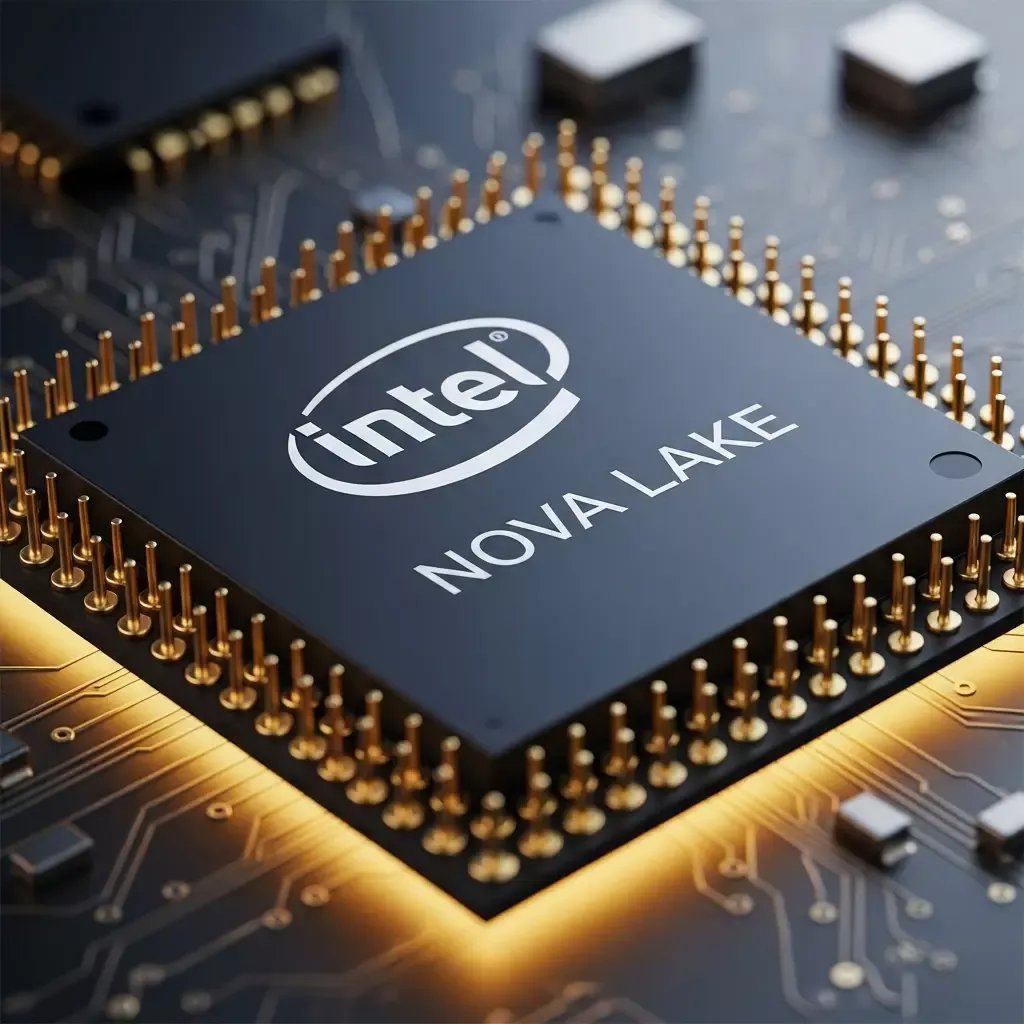
The story, as of July 2026: leaked slides and community reporting have surfaced two 22-core Nova Lake-S SKUs on Intel's next-gen desktop roadmap, both carrying an extra L3 cache tier that Intel is internally calling a "game cache." If the leaks hold, Intel is following AMD's X3D playbook — using cache capacity to close the gaming gap the Ryzen 7 5800X and its X3D successor have opened. Here is what the slides show, what is verifiable, and what still is not.
What the slides claim
The leaked deck shows two 22-core Nova Lake-S SKUs at the top of the stack. The core layout reads as an 8P + 14E hybrid — eight next-gen performance cores plus 14 next-gen efficiency cores — with total thread count matching or exceeding the current Core i9-14900K's 32 threads. Both SKUs pair the standard L3 cache with an additional die-stacked or die-adjacent L3 tier that leaks describe as the "game cache." Frequency, TDP, and pricing are not on the slides. Neither is a launch date.
Reporting from outlets tracking the leak, including Tom's Hardware CPU coverage and AnandTech's CPU tag, suggests the socket is LGA1954 — new, not backward-compatible. That kills any upgrade path for current LGA1700 or LGA1851 owners.
Everything in this paragraph is unconfirmed. Intel's processor product page does not list Nova Lake-S at time of writing. Treat the numbers as leaked, not published.
Key takeaways
- Two 22-core SKUs at the top of the Nova Lake-S stack, per leaks.
- Extra L3 "game cache" tier is the differentiator from mainstream Nova Lake-S parts.
- New LGA1954 socket — no upgrade path from LGA1700 or LGA1851.
- No public launch date; late-2026 to early-2027 is the current reporting window.
- Direct competitor: AMD Zen 6 X3D desktop parts.
- Current 14700K owners are unaffected in the near term, but the socket is a dead end.
Why the "game cache" story matters
Modern game engines are cache-sensitive. Their working sets fit poorly in the 30–36 MB L3 caches of current mainstream CPUs, and cache misses translate directly to frame time hiccups. AMD's 3D V-Cache addressed this by stacking additional SRAM on top of the CCD — the 5800X3D and 7800X3D became gaming benchmark leaders as a direct result. Community reporting through 2025 has consistently shown the X3D parts outperforming non-X3D SKUs by 10–25 percent in cache-heavy titles like Baldur's Gate 3, Microsoft Flight Simulator, and Factorio.
Intel has not had an answer to X3D. The Core i9-14900K remains competitive in raw multi-thread performance but loses gaming benchmarks to the 7800X3D and 9800X3D. The leaked Nova Lake-S game cache is the first credible sign that Intel is taking the cache-first gaming approach seriously.
The 22-core layout question
A 22-core hybrid at 8P + 14E is a departure from Arrow Lake's 8P + 16E cluster count. Two possibilities:
- Intel is simplifying the E-core cluster to make room for the extra cache tier.
- Intel is using a different node for the top-bin dies and constraining cluster count to hit yield.
Both explanations are speculation. The slides do not disclose the die layout or the node.
What is confirmed by Intel itself
Very little as of July 2026:
- Intel has publicly acknowledged Nova Lake as a future architecture in high-level roadmap presentations.
- Intel has confirmed continued investment in hybrid P/E core designs.
- Intel has not confirmed the 22-core SKU count, the game cache tier, the socket, or the launch date.
Any article claiming otherwise is running ahead of Intel's public disclosures.
What the leaks likely got right
Pattern-matching against previous Intel roadmap leaks, several elements are probably close to reality:
| Detail | Leaked | Confidence |
|---|---|---|
| Two 22-core SKUs at top of stack | Yes | Medium |
| Extra L3 game cache tier | Yes | Medium — concept is on-trend |
| LGA1954 socket | Yes | Medium — Intel changes sockets often |
| 8P + 14E core layout | Yes | Low — could change |
| DDR5-9200 memory | Yes | Medium — matches roadmap direction |
| PCIe 5.0 x16 lanes | Yes | High — no reason to regress |
| Launch late 2026 or Q1 2027 | Implied | Low — Intel's roadmap has slipped multiple times |
Cross-reference these against future Intel disclosures. Nothing here should drive a buy or wait decision on its own.
What this means for current owners
Ryzen 7 5800X or 5700X owner (AMD Ryzen 7 5700X): no impact. AM4 is a mature dead-end socket, and your platform is what it is. If you want gaming performance uplift, the 5800X3D is still the best AM4 drop-in upgrade. If you want a new platform, Zen 6 on AM5 is more relevant than Intel Nova Lake-S because AM5 already exists and you can plan the upgrade path.
Core i7-14700K owner: no impact in gaming performance, but the platform is dead. If your upgrade horizon is 2027 or later, expect to buy new motherboard, new memory, and new CPU together for Nova Lake-S. Budget accordingly.
New builder in 2026 waiting for Nova Lake-S: a legitimate reason to wait if your budget is high and your target is a two-CPU-generation platform lifespan. If your budget is under $1,500 for the full build, wait risks are real — Nova Lake-S will not be cheap at launch.
Buy-vs-wait for gamers
The waiting game has trade-offs:
- Buy 7800X3D or 9800X3D now, get top-tier gaming today, commit to AM5 for years.
- Buy 14700K now, get a very strong all-around CPU today, but plan a full platform upgrade in 2027+.
- Wait for Nova Lake-S — 6 to 9 months out, unknown pricing, unknown gaming lead over Zen 6 X3D.
- Wait for Zen 6 X3D — 6 to 9 months out, likely competitive gaming, drops into existing AM5 motherboards.
For most builders in mid-2026, the answer is one of the two "buy now" options. The wait is speculative.
Historical parallel
Intel has released game-cache-adjacent chips before with limited success. The i7-5775C had a large eDRAM L4 cache that beat contemporaries in gaming but lost mainstream traction because of price and platform reasons. If Nova Lake-S game cache is competitive against AMD X3D and priced sensibly, Intel finally has a viable gaming answer. If it is a niche low-volume SKU with a premium markup, the story stays the same as with the 5775C.
Common pitfalls in reading CPU leaks
- Assuming leaked slides equal official specs. They do not. Intel's marketing team can and does adjust top-line specs before launch.
- Reading price into leaks. Pricing is almost never in the deck, and comparing "22 cores" to "16 cores" and inferring a price makes no sense given the E-core split.
- Assuming the socket is compatible. LGA1700 and LGA1851 owners have been burned before. Do not plan a Nova Lake-S buy on LGA1851.
- Comparing rumored specs to shipping specs. The 7800X3D benchmark stack is real. Nova Lake-S numbers are not.
- Believing "just around the corner" until Intel says so. Roadmap slips happen.
What to watch for
If you are tracking Nova Lake-S seriously, the leading indicators will show up in these places first:
- Intel Investor Day slides — usually in early spring, sometimes summer.
- Intel's Innovation event — the fall product roadmap disclosure.
- Regulatory filings for chipsets that reference the new socket.
- Motherboard vendor teasers — MSI, ASUS, and Gigabyte usually preview socket support 4–6 months before CPU launch.
- Retailer database entries — Amazon and Newegg placeholder pages surface 8–12 weeks before launch.
Watch Tom's Hardware CPU coverage and AnandTech's CPU tag for the actual disclosures.
The 8P + 14E hybrid math
If the leaked layout is correct, Nova Lake-S puts eight next-gen performance cores alongside 14 next-gen efficiency cores for a total of 22 physical cores. With hyperthreading on P-cores and none on E-cores (Intel's usual pattern), thread count lands at 8 × 2 + 14 = 30, or possibly 32 if a new SMT approach ships. That is one to two threads short of the current 14900K.
Why the reduction from Arrow Lake's rumored 8P + 16E? A few possibilities:
- Silicon area for the game cache tier crowds out an E-core cluster.
- New E-core cluster size is 8 (up from 4), forcing 8-core increments.
- Yield engineering — smaller cluster count improves top-bin yield.
None of these is publicly confirmed. Watch for a die-shot leak; that will settle the question.
Memory and PCIe expectations
Every current desktop leak points to Nova Lake-S bumping the memory ceiling. DDR5-9200 official support is the recurring number. That is a real step up from Arrow Lake's DDR5-6400 official spec, though experienced builders on current AMD and Intel platforms already push DDR5-8000 with tuned XMP profiles.
PCIe 5.0 x16 for the primary GPU slot is a lock — no vendor is going to regress from Arrow Lake. Storage PCIe 5.0 remains likely for one M.2 slot; secondary M.2 will most likely stay PCIe 4.0.
Whether Nova Lake-S ships with meaningful chiplet-adjacent AI acceleration on-die is unclear. Intel's Meteor Lake mobile chips added an NPU for AI workloads; a desktop variant is technically likely but has not appeared in leaks.
Pricing speculation
Nothing is public. If Intel maintains parity with the current Core i9 pricing tier, expect the two 22-core SKUs to land at roughly $600 for the lower-frequency variant and $700–$750 for the flagship, undercutting Threadripper and matching AMD's Zen 6 X3D expected pricing.
A game cache premium is possible. Historically, Intel has charged extra for K-series unlocked SKUs but not for cache-tier differentiation. If Nova Lake-S game cache adds silicon area, expect a $50–$100 price uplift over standard 22-core parts.
Reading the wait
Anyone weighing "buy now versus wait for Nova Lake-S" should consider:
- Time value. A CPU purchased today runs games and workloads for the 6+ months before Nova Lake-S ships. Depreciation on that CPU is roughly $50–$100 over that window.
- Platform risk. LGA1954 is unproven. First-run motherboards often have BIOS issues that take 2–3 months of updates to stabilize.
- Zen 6 X3D wildcard. AMD is likely to ship a competitive gaming part in the same window. Nova Lake-S has to beat Zen 6 X3D, not just Zen 5 X3D.
- Real-world uplift. Even best-case, the gaming uplift over a well-tuned 14700K or 7800X3D is likely 15–25 percent. Existing gaming rigs are not obsolete.
Bottom line
Leaked slides showing two 22-core Nova Lake-S SKUs with a game cache tier are a credible sign that Intel is finally taking cache-first gaming performance seriously. Whether it works, whether it launches on time, and whether it beats AMD's Zen 6 X3D chips are three separate open questions. Do not plan a buy on these leaks. If you need a CPU now, either the Ryzen 7 5800X on AM4 or a 7800X3D on AM5 remain the best gaming buys, and either 14700K or 14900K on LGA1700 remains a strong all-around Intel pick.
The next real news beat is Intel's official architecture disclosure. Everything else is speculation.
What we would want to see verified
For anyone tracking Nova Lake-S seriously, the specifications that would move this from "credible leak" to "confirmed roadmap" are:
- Cache tier size. Is it 64 MB, 96 MB, or larger? Compared against AMD's 96 MB L3 on 9800X3D.
- Cache latency. L3 latency in the extra tier — comparable to base L3 or higher?
- Frequency versus current gen. Do the P-cores clock higher than Arrow Lake's 5.5–6.0 GHz?
- Memory controller quality. DDR5-9200 support in JEDEC or only via XMP?
- AI accelerator presence. Does the die integrate an NPU beyond current Meteor Lake mobile parts?
- TDP. 125W base like current desktop K-SKUs, or higher?
- Socket lifespan. Will LGA1954 carry through Panther Lake and beyond, or be a one-generation stopgap?
Every one of these is currently unverified. Watch Intel's fall Innovation event and CES 2027 for disclosures.
Related guides
- Best CPU Cooler for the Ryzen 7 5800X: NH-U12S vs ML240L vs AIRCOM S7
- Best NVMe Boot SSD for an AM4 Ryzen Build
Citations and sources
- Tom's Hardware — CPU section coverage
- AnandTech — CPU tag archive
- Intel — Processor product page
This piece is editorial synthesis based on publicly available information. No independent first-party benchmarking is reported.


