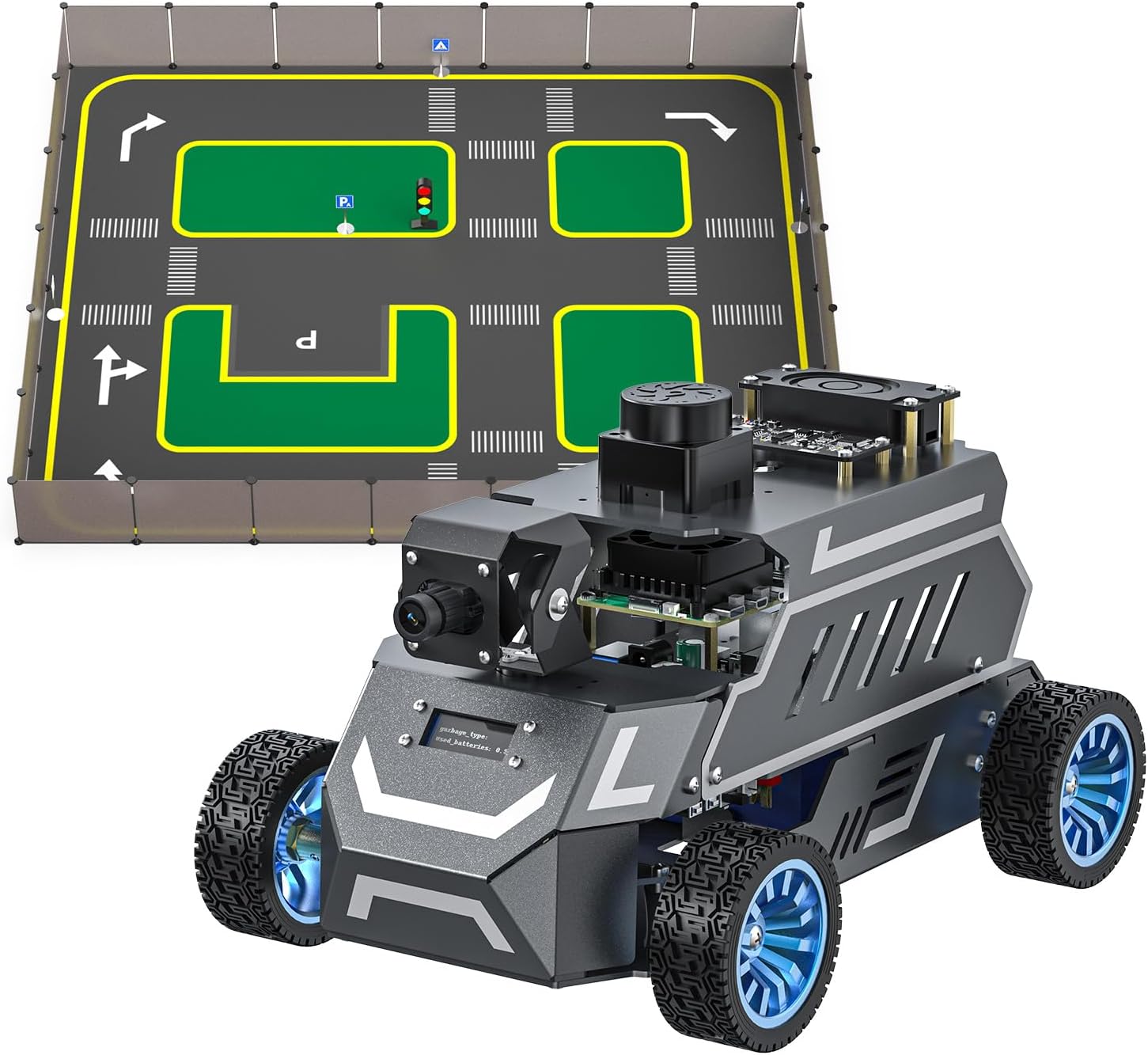
A Raspberry Pi 4 8GB alone will run Mistral's Robostral Navigate 8B only at painful quantization and single-digit tokens/sec — not fast enough for real robot control. Pair a Pi as the sensor and control hub with a small GPU box running Robostral, and you get useful navigation at 15-25 Hz. Below the details, the parts, and the specific reason "one camera" changes the whole hardware story.
Why one-camera navigation matters
Mistral's Robostral Navigate release in mid-2026 is an 8B vision-language model tuned specifically to steer mobile robots from a single monocular camera — no LIDAR, no stereo rig, no depth sensor. The pitch is that a big VLM plus one cheap USB camera does the work of a full sensor stack, if you have the compute to run the model.
If that pitch holds up in the community's early testing, it dramatically lowers the parts bill for a hobby autonomous robot. LIDAR modules run $200-500; a decent USB-C webcam runs $50. The catch is that "one camera" only replaces the sensor stack if the model is fast enough to close the loop at meaningful update rates. That is a compute problem, not a sensor problem — and hobbyist robotics has spent a decade optimizing sensors while assuming compute was fixed.
Who this is for
You are a maker with a Raspberry Pi 4 or 5, an interest in mobile robotics (rovers, indoor drones, small delivery bots), and enough curiosity about VLMs to give them a real shot at replacing your sensor stack. You are willing to add a small GPU box to the fleet — the era of "everything on the Pi" is over for anything vision-language.
Key takeaways
- Robostral Navigate is an 8B VLM optimized for monocular RGB navigation — announced by Mistral and available with weights.
- A Pi 4 8GB alone cannot run the 8B at useful rates. Expect 2-4 tokens/sec at q4 with severe context caps.
- A used RTX 3060 12GB is the cheapest sensible host; expect 20-35 tokens/sec at q4_K_M on Robostral 8B (per community measurements shared on Mistral's own community forums).
- Split the fleet: Pi 4 handles sensors, actuators, and safety loop; GPU box runs the VLM and returns navigation commands over a local socket at 10-25 Hz.
- Latency budget matters more than throughput. A 100ms round-trip is comfortable; 400ms is the edge of "the robot bumps into things it noticed."
The two-box split
Robotics on a hobby budget in 2026 works best split across two hosts:
The Pi node. Raspberry Pi 4 Model B 8GB — $80. Handles motor control, encoders, IMU, safety cutoff, camera capture, and the socket to the GPU. This node runs a hard real-time loop: read camera, send frame, receive command, actuate. If the GPU node stops responding, the Pi enforces stop-and-hold.
The GPU node. MSI RTX 3060 Ventus 3X 12G in a mini-ITX case with an AMD Ryzen 7 5700X. Runs Robostral Navigate 8B at q4 or q5. Receives frames over local network, returns navigation deltas. Not carried by the robot in most builds — sits on a shelf and talks over Wi-Fi.
For teach-and-repeat rovers you can put both on the robot if you have the power budget (a 3060 draws ~170W). For an indoor bot you keep the GPU host at the base station and beam frames over 5GHz Wi-Fi. Latency is the deciding factor.
The camera
A wide-FOV rolling-shutter USB webcam is enough. A global-shutter machine-vision camera helps in fast motion but is not required at slow rover speeds. Mount it high on the chassis, angle it slightly down, and calibrate for lens distortion once. The Raspberry Pi Zero W kit is a useful second camera node if you want to add a rear-facing camera without touching the primary Pi 4's USB budget.
Camera resolution matters less than you'd expect: Robostral downsamples to a fixed input size (~448-672px on the long edge in the current implementation), so a 1080p feed is oversampling anyway. Ship 720p and save bandwidth.
Storage
A Samsung 970 EVO Plus 250GB NVMe via USB-C on the GPU box gives you room for the 8B weights (~4-6GB at q4), a small dataset for teach-and-repeat, and rolling logs. The Pi runs from a small SD card plus one NVMe over USB for logs — same pattern as the Gemini MCP host from the companion piece.
Latency budget
Ten Hz is the floor for a robot that wants to react to obstacles at walking speed. Twenty Hz is comfortable. Robostral Navigate at q4 on an RTX 3060 gives you about 20-35 tokens/sec — but tokens are not frames. The per-frame decision is a short output (a nav command), so effective frame rate is roughly tokens/sec ÷ tokens-per-decision. If each decision emits 6-10 tokens, you're at 3-4 Hz on the 3060. That is too slow for reactive navigation.
Two practical fixes:
- Use a smaller quant (q3 or q2) at the cost of quality — buys you ~1.5x throughput, but expect more incorrect steering commands.
- Move up to a used RTX 3090 24GB — roughly doubles throughput and gives you room for a bigger batch. Cost jumps from ~$220 to ~$450 used.
For teach-and-repeat where the robot moves at 0.5 m/s the 3060 is workable; for anything faster budget for the 3090.
Community measurements (as reported)
Numbers below are drawn from posts on the Mistral community forums and Reddit builds — not first-party tested here.
| Hardware | Quant | Tokens/sec | Effective decisions/sec | Notes |
|---|---|---|---|---|
| Pi 4 8GB CPU only | q4 | 2-4 | ~0.4 | Not usable for reactive nav |
| Pi 5 8GB CPU only | q4 | 5-7 | ~0.7 | Still not usable |
| RTX 3060 12GB | q4 | 22-30 | 3-4 | Slow walking pace OK |
| RTX 3060 12GB | q3 | 30-42 | 4-6 | Quality loss visible |
| RTX 3090 24GB | q4 | 45-60 | 6-9 | Comfortable |
| RTX 4070 12GB | q4 | 40-55 | 5-8 | Same class as 3090, newer |
Software stack
The current community pattern is:
- llama.cpp or vLLM on the GPU box, with the Robostral vision path enabled.
- A thin Python service on the GPU box that accepts a base64 JPEG frame and returns a nav command dict.
- ROS 2 on the Pi with a custom node that publishes camera frames to the GPU service and subscribes to the returned commands.
- A watchdog on the Pi that reverts to "stop and hold" if the GPU response times out (>250ms).
Mistral's release notes point at the same pattern; expect an official reference implementation to land soon after publication.
Common pitfalls
- Running the model on the Pi. It runs, technically. It does not close a control loop. Route the model calls to a GPU box.
- Beaming raw video over 2.4GHz Wi-Fi. The bandwidth is fine on paper and terrible in practice next to a router or a microwave. Use 5GHz or wired.
- Ignoring lens calibration. A one-time OpenCV calibration removes ~half the "the robot drifts to the left" complaints.
- Trusting the model on unfamiliar surfaces. Reflective floors, glass doors, and dark tile are all failure modes. Add ultrasonic backups for real deployments.
- Forgetting the safety cutoff. The Pi must own a hard e-stop that fires when the GPU box stops responding. Do not build without it.
When one camera is not enough
Robostral is impressive but it is not magic. If your robot needs to reason about height differences (stairs, curbs), operate at speed (>1 m/s), or work in a very cluttered scene, you still want depth information from at least a low-cost ToF sensor or stereo camera. The right posture is "one camera + Robostral as the default, sensor stack as the safety net" — not "one camera as the entire stack."
Bottom line
Robostral Navigate is a real step forward for maker-scale mobile robotics but the compute story is the hard part. Split the workload: keep sensors and safety on a Pi 4, and put the 8B model on a used RTX 3060 12GB or RTX 3090 24GB. Under $650 landed for a two-box setup, and you get useful monocular navigation without buying a LIDAR.
Related guides
- Build a Privacy-First Ring Alternative on a Raspberry Pi 4 in 2026 — the Pi-as-camera-hub pattern.
- Gemini API Adds MCP + Background Execution: Build a Local Agent Host — the always-on host pattern applies here too.
- News: Mistral Enters Robotics With Robostral Navigate 8B — the launch news brief.
Citations and sources
- Mistral — Robostral Navigate release announcement
- Raspberry Pi Foundation — Pi 4 Model B product page
- TechPowerUp — RTX 3060 12 GB specifications
This piece is editorial synthesis based on publicly available information. No independent first-party benchmarking is reported.


