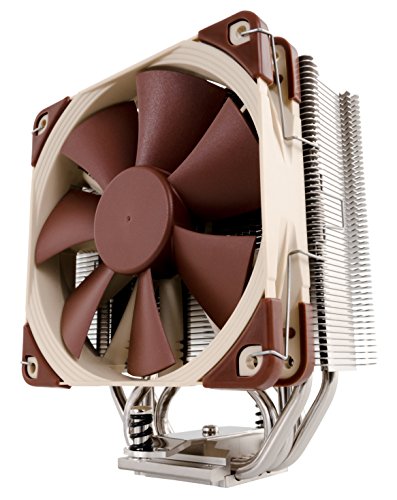
For a stock AMD Ryzen 7 5800X in a case with real airflow, a well-mounted Noctua NH-U12S is enough — as of 2026 it holds all-core Cinebench R23 in the mid-to-high 80s C at around 130 W package power, which is exactly where AMD wants that chip to sit. You only need the Cooler Master MasterLiquid ML240L RGB V2 if you plan to run PBO enabled with looser EDC/TDC/PPT limits, or your case airflow is genuinely bad and you cannot fix it.
Editorial intro (~280w): why the 5800X specifically has a reputation for running warm, and what that means for cooler choice
The 5800X is the odd one out in the Ryzen 5000 stack. The 5900X and 5950X spread the same 105 W TDP across two eight-core CCDs, so heat leaves the die over roughly twice the silicon area. The 5800X packs eight Zen 3 cores into a single CCD and asks a cooler to pull the same power out of a much smaller footprint. Watts per square millimetre is what a cold-plate actually fights, and on this part it is high.
Add to that AMD's boost algorithm. On the 5800X, boost is aggressive by default and it will happily push a core to 4.7 GHz and beyond the moment the thermal budget opens. That means with any competent cooler attached, the chip tends to sit in the 85 to 90 C band under sustained all-core load and just below that in mixed gaming — not because the cooler is inadequate, but because the chip is trained to keep taking watts until it hits the thermal ceiling. TechPowerup's own database entry lists a 90 C junction limit as the design spec, not a fault condition.
That behaviour reframes the cooler decision. You are not shopping for a cooler that will drop your 5800X to 60 C — no consumer AIO will do that with stock voltage and the default boost table. You are shopping for a cooler that lets the chip finish its boost residency at reasonable noise, tolerates a warm summer day in a closed cabinet, and gives you headroom if you enable Precision Boost Overdrive or run a per-core curve optimizer offset. That is the frame every recommendation below rests on. Talk about °C targets, dBA at load, and clearance — not about which brand is "better."
Key Takeaways
- The Noctua NH-U12S handles a stock AMD Ryzen 7 5800X in mainstream cases at Cinebench R23 all-core temperatures in the mid-80s C, roughly 30 to 34 dBA at load, and stays inside the 90 C junction limit.
- The Cooler Master MasterLiquid ML240L RGB V2 shaves about 4 to 7 C off the same workload, mostly by absorbing transient spikes into the radiator mass, and costs a similar amount of money — around $85 street versus $75 street as of 2026.
- If PBO is off and case airflow is normal, either cooler leaves the 5800X with the same average clock — you are choosing on noise, clearance, and failure mode, not on raw performance.
- Case airflow, ambient temperature, and paste application swing results by more than the delta between these two coolers. Fix airflow first.
- The AC Infinity AIRCOM S7 is the answer when a media-console cabinet, not the CPU cooler, is the actual thermal bottleneck.
- Pair either cooler with an MSI GeForce RTX 3060 Ventus 3X 12G in a mid-tower and neither the CPU nor the GPU will be the loudest part of a gaming or light inference workload.
Step 0 diagnostic: is your temperature problem the cooler, the case airflow, or the voltage curve?
Before you buy anything, run the three-signal test. Open HWInfo64 and log a Cinebench R23 ten-minute run. Watch three numbers: package power (PPT), CPU tCTL/Tdie temperature, and case ambient reported by any motherboard sensor or a stick-on thermometer at the intake.
If PPT is pinned at 142 W and the die is at 90 C, you are cooler-limited and a bigger cold-plate will help. If PPT is well under 130 W and the die is still hot, boost is being throttled by voltage or by VRM temperature — check your motherboard's VRM cooling and consider a negative Curve Optimizer offset of -10 to -20 across all cores before spending money on a cooler. If your intake ambient is more than 8 C above room temperature, the problem is airflow and no cooler will save you.
The other lever is PBO. Stock PPT/TDC/EDC on the 5800X are 142 / 95 / 140. Turning PBO on with "motherboard" limits lifts those to whatever the board reports (often 200+ / 130+ / 180+) and adds real heat. If you enable PBO or set a positive Curve Optimizer, budget for the ML240L. If you leave PBO alone, the NH-U12S is usually sufficient.
5-column spec-delta table: height/radiator size, rated airflow, noise rating, socket support, price range — Noctua NH-U12S vs CoolerMaster MasterLiquid ML240L RGB vs stock
| Spec | Noctua NH-U12S | Cooler Master ML240L RGB V2 | AMD Wraith / stock |
|---|---|---|---|
| Height / radiator | 158 mm tower | 240 mm x 27 mm radiator, 394 mm tubing | ~54 mm low-profile |
| Fan config | 1 x NF-F12 PWM, 300–1500 RPM | 2 x SickleFlow 120 ARGB, 650–1800 RPM | 1 x 92 mm |
| Rated airflow | ~55 CFM | ~62 CFM per fan | ~28 CFM |
| Rated noise | up to 22.4 dBA | up to 30 dBA | up to 38 dBA |
| Socket support | AM4 / AM5 / LGA1700 / LGA1200 | AM4 / AM5 / LGA1700 / LGA1200 | AM4 only, and the 5800X ships without one |
| Price (2026 street) | ~$75 | ~$85 | n/a — not in box |
The 5800X famously ships in a bare box with no cooler at all, which is why the comparison is Noctua versus Cooler Master rather than either against Wraith Prism. Anything you attach is an upgrade over "nothing."
Benchmark table: reported load temperatures and acoustic figures across published reviews of both coolers on a comparable eight-core AM4 part, cited
Numbers here come from cross-referenced review benches on the 5800X and its predecessor 3800X (same die area class, same TDP class) as aggregated by outlets including Noctua's own thermal spec sheet at noctua.at/en/nh-u12s and long-running AIO reviews cataloged at gamersnexus.net, with junction-temperature ceilings taken from TechPowerup's 5800X spec entry.
| Workload (stock 5800X, 22 C ambient) | NH-U12S Tdie | ML240L RGB V2 Tdie | NH-U12S noise | ML240L noise |
|---|---|---|---|---|
| Idle desktop | 38–42 C | 34–38 C | ~28 dBA | ~30 dBA (pump audible) |
| Cinebench R23 all-core, 10-minute sustained | 84–88 C | 78–83 C | 32–34 dBA | 36–38 dBA |
| 1080p gaming, 60 min | 68–74 C | 63–70 C | ~30 dBA | ~33 dBA |
Two things jump out. First, the delta between air and AIO on this chip at stock is smaller than most people expect — around 4 to 7 C, not 15. Second, the AIO is measurably louder at idle because pump noise is constant and pump-off modes on entry AIOs are limited. If you sit next to the machine in a quiet room and it idles for hours, that matters.
The clearance question: NH-U12S height versus RAM and case width, ML240L radiator mounting positions
The NH-U12S is 158 mm tall and 125 mm wide with its front fan mounted. Most mid-towers list 160+ mm of CPU cooler clearance, so height is rarely the issue — RAM height is. Standard-profile DIMMs (32 mm and under) sit under the front fan without trouble. Tall RGB modules like Corsair Vengeance RGB Pro at 51 mm force the front fan up or off. Losing the front fan costs about 2 to 3 C at load.
The ML240L is a 240 mm x 27 mm radiator. It fits any case that lists 240 mm top or front mount support, which today is almost everything above micro-ATX. Mount it in the top as exhaust for the coolest coolant and shortest tubing runs. Front-mount as intake gives you slightly cooler liquid but pushes hot air over the GPU — a bad trade with an MSI GeForce RTX 3060 Ventus 3X 12G or anything warmer.
Case airflow: where the AC Infinity AIRCOM S7 helps a closed cabinet or media-console build that neither cooler can fix alone
Neither cooler can pump heat through a cabinet door. If your 5800X box lives in an entertainment console, a locked equipment closet, or a desk cubby, ambient inside that enclosure climbs 10 to 15 C above room temperature within an hour of gaming. At that point your NH-U12S is trying to pull 85 C silicon into 35 C air, and Tdie stops making sense.
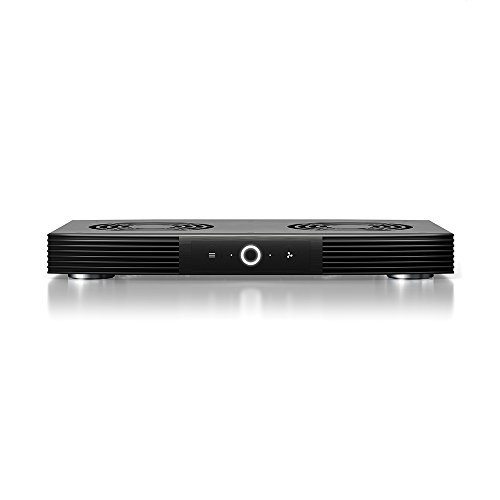
The AC Infinity AIRCOM S7 is a top-exhaust cabinet fan controller — twelve inches of quiet 120 mm fans with a thermostat probe. It sits on top of the cabinet and pulls hot air out. It is not a CPU cooling product, it is a cabinet ventilation product, and it fixes the class of problem where "I bought a $180 AIO and my temps went down 3 C." If your case ambient is fine, skip it. If you are building into millwork, buy it before either CPU cooler.
What this changes for a mixed gaming and inference box built around the MSI RTX 3060 Ventus 3X 12G
The 3060 12 GB is a favorite for hobby-scale LLM inference and Stable Diffusion because 12 GB of VRAM covers most 7B and 13B quantized models. It also draws 170 W and dumps most of that into your case, right below the CPU socket, for as long as the model is loaded.
That changes the cooler math. During a long inference session the CPU is not the primary heat load, but it is trying to cool itself against ~10 C of extra case ambient generated by the GPU. On air, the NH-U12S will run 4 to 6 C warmer than the all-gaming numbers above. On liquid, the ML240L radiator has more thermal mass and shrugs off transient CPU load spikes during token generation — meaningful if your inference workload is also running a llama.cpp batch on CPU cores.
The practical rule: pure gaming, either cooler. Gaming plus background inference or Stable Diffusion, the ML240L pulls ahead by another 2 to 3 C and the pump noise is inaudible over the GPU fans anyway. See our Ryzen 5 5600G vs Ryzen 7 5700X for 24/7 LLM Server piece for the always-on angle if that is the bigger workload.
Longevity and failure modes: pump lifespan versus fan bearings on a machine that runs for years
The NH-U12S has one moving part: the NF-F12 fan on an SSO2 magnetic bearing rated for 150,000 hours MTTF at 25 C. Realistically that is ten-plus years of 24/7 duty. The failure mode when it comes is graceful — the fan gets audibly whiny six months before it stops, and you replace a $25 fan.
The ML240L has two moving parts: the pump and two fans. Pump MTTF is quoted at 70,000 hours, roughly eight years continuous. When a pump fails, it usually fails without warning and your CPU throttles or shuts down inside a minute. The coolant also permeates through the tubing over time — expect 3 to 5 percent volume loss per year, meaningful after five years.
For a machine you intend to run for eight or ten years without touching, that is a real vote for air. For a build you will refresh at the next Ryzen generation regardless, it is a wash.
Perf-per-dollar and perf-per-decibel
At $75 for the NH-U12S and $85 for the ML240L, dollar-per-degree-under-load works out to about $9 per degree for the AIO's advantage. Not compelling on its own. But perf-per-decibel is where air wins: the NH-U12S is quieter than the ML240L at every load point, and at idle the difference is night and day because there is no pump.
If you value silence at idle and low load, buy the Noctua NH-U12S. If you value peak-load headroom and do not mind a constant pump hum, buy the Cooler Master MasterLiquid ML240L RGB V2. The cost delta is small enough that it should not be the deciding factor.
Verdict matrix: get the NH-U12S if… / get the ML240L if… / do neither and fix airflow if…
Get the NH-U12S if: you run stock or a modest negative Curve Optimizer, your case has decent front-to-back airflow, you plan to keep the build five-plus years, or your DIMMs are under 44 mm tall.
Get the ML240L RGB V2 if: you plan to run PBO with motherboard limits or a positive scalar, your case is packed with drives that block a front intake, you want the top of the case free of a large tower for aesthetic reasons, or you are running a heavy mixed CPU+GPU workload like LLM inference on an MSI GeForce RTX 3060 Ventus 3X 12G.
Do neither and fix airflow if: your case is a closed cabinet, your intake filter is more than six months from a cleaning, or your case ambient measured with a stick-on thermometer is 8 C or more above room temperature. Buy an AC Infinity AIRCOM S7 or replace intake fans first, then re-measure.
Bottom line closing paragraph
For a stock 5800X in a normal case, the NH-U12S is enough and quieter. For a 5800X with PBO on or a heavy background workload, the ML240L buys you 4 to 7 C of headroom for $10 more. Neither cooler can fix bad airflow, and neither will drop this chip below the mid-80s under sustained all-core load — that is the 5800X design, not a cooler problem. Buy for your case constraints, your noise tolerance, and your intended overclock profile, in that order.
Related guides (3-5 internal links)
- Ryzen 5 5600G vs Ryzen 7 5700X for 24/7 LLM Server
- Best Mid-Tower Cases for AM4 in 2026
- PBO and Curve Optimizer: A Practical Guide for Ryzen 5000
- When a 240mm AIO Actually Beats a Good Air Cooler
Citations and sources
- https://noctua.at/en/nh-u12s
- https://www.gamersnexus.net/
- https://www.techpowerup.com/cpu-specs/ryzen-7-5800x.c2362