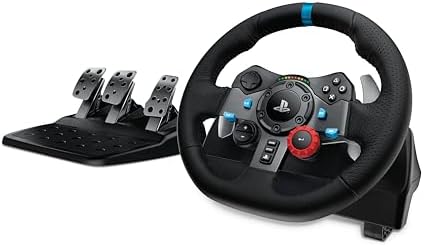
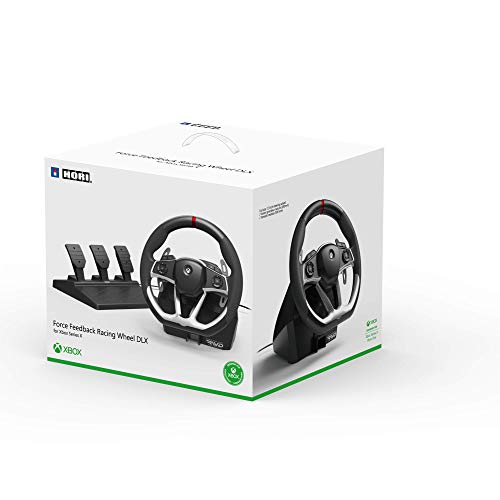
For a new sim racer building a first setup in 2026, the Logitech G29 Driving Force is the safer default — huge game-compatibility footprint, a proven helical-gear force-feedback design, and a three-pedal set at the entry price point. The HORI Force Feedback Racing Wheel DLX is the better pick if you play mostly on Xbox Series X|S and want a modern belt-driven feel. Neither is a direct-drive wheel; expect a step up in cost and immersion to reach that tier.
Who this is for
You are choosing your first force-feedback wheel. Your budget is somewhere between $200 and $300, you play racing sims on PC or console (or both), and you have read enough forum posts to know that "any wheel is better than a controller" is not quite true — some wheels are wobbly toys, and some are legitimate learning tools. The two wheels in this article are both in the second category.
The Logitech G29 has anchored the beginner sim-racing market for eight-plus years and works with a huge library of games across PlayStation, PC, and Xbox variants. The HORI Force Feedback Racing Wheel DLX is the newer, Xbox-focused challenger with an updated FFB design and a licensing story that keeps it certified for Xbox Series X|S.
Key takeaways
- The Logitech G29 has the broadest game compatibility and a proven helical-gear FFB, but it is a PS4/PS5/PC wheel — not native to Xbox.
- The HORI Force Feedback Racing Wheel DLX is officially licensed for Xbox Series X|S and delivers a smoother belt-driven feel.
- Neither is direct-drive. Direct-drive wheels start around $700 for the wheel base alone.
- Paddle shifters cover most modern cars; a Thrustmaster TH8A shifter is an add-on for H-pattern immersion.
- Verify platform compatibility before you buy — Xbox-locked HORI variants will not work on PlayStation, and vice versa.
Step 0: figure out your platform and desk mount before you buy
Compatibility across console generations is inconsistent. The Logitech G29 targets PlayStation 4 and 5, plus PC. The Logitech G920 is the Xbox-and-PC sibling with the same hardware. The HORI Force Feedback Racing Wheel DLX is designed and licensed for Xbox Series X|S — check exactly what version you are ordering, because HORI ships different racing wheels for different platforms.
Desk mount is the other pre-purchase question. Both wheels use table clamps to fix to a desk edge. If your desk is thinner than about 30mm, has a glass top, or is wall-mounted, you need a dedicated wheel stand — feedback wheels tug hard enough to slide or flex a light table. A wheel that wobbles as it corrects transmits noise into the rim and makes learning trail-braking harder than it needs to be.
How does the Logitech G29 compare to the HORI Force Feedback wheel?
Per Logitech G's product page, the G29 uses a helical-gear force-feedback system with dual motors, a 900-degree rotation range, a stainless-steel-and-leather-wrapped 27 cm rim, and a three-pedal set with a load-cell-style clutch pedal (though the pedals are not true load-cell — they are potentiometer-based). The G29 has been on the market long enough that the driver support is mature across Windows, macOS, and both PlayStation consoles.
Per HORI's product family, the Force Feedback Racing Wheel DLX for Xbox Series X|S uses a belt-driven FFB system with a similar 270-degree usable rotation, a lighter 25 cm rim, and a two-pedal set out of the box (throttle and brake — clutch and shifter are optional accessories on this model). The belt drive is quieter and smoother than the G29's gears at the cost of somewhat weaker peak torque.
For a beginner learning car control, both are usable. The G29's gear-driven feedback has a slight notchiness on very small steering corrections that experienced sim racers can feel; new drivers rarely notice it. The HORI's belt-drive feels smoother across the same corrections, but the peak torque is lower, so big FFB moments (over-a-curb, tank-slapper) feel muted.
Spec-delta table
| Spec | Logitech G29 | HORI Force Feedback Racing Wheel DLX | |
|---|---|---|---|
| FFB drive | Helical gear (dual motor) | Belt-driven | |
| Rotation range | 900° | 270° usable (up to 900° depending on game) | |
| Rim material | Stainless + leather wrap | Reinforced plastic + rubber | |
| Pedals | 3 (throttle, brake, clutch) | 2 (throttle, brake) | |
| Platform | PS4, PS5, PC | Xbox Series X | S, Xbox One, PC |
| Typical street price | $230–$280 | $200–$240 |
Which wheel feels better for beginners learning trail-braking?
Trail-braking is the technique of continuing to brake while turning into a corner — it requires precise brake pressure feedback and a smooth FFB response as weight transfers. Both wheels can teach it, but they teach it differently.
The G29's pedal set has three pedals including a stiffer brake pedal with a rubber insert that mimics a load cell. The FFB during trail-braking is textured — you can feel understeer developing through the wheel as the front tires wash out. The gear-driven design transmits micro-corrections well enough that a new driver can iterate on their braking pressure over a lap.
The HORI's belt-driven FFB is smoother during steady-state corners but is less textured on the transitions. The brake pedal is softer and less progressive than the G29's, which makes precise pressure control harder. For learning trail-braking specifically, the G29's stiffer brake wins.
For steady-state corners and long high-speed sweepers, the HORI's smoother feedback is more pleasant. Different tools for different techniques.
Do you want to add a dedicated shifter?
Paddle shifters on both wheels cover every modern car in Assetto Corsa, Gran Turismo 7, Forza Motorsport, iRacing, and F1 24. If you are racing modern GT3 cars, F1 cars, or LMP prototypes, paddles are enough — you will not touch an H-pattern shifter.
If you race classic cars, rally, or truck-simulation titles, an H-pattern shifter like the Thrustmaster TH8A adds real immersion. It plugs into either wheel via USB, supports both H-pattern and sequential modes, and works with every major sim. Budget an extra $200 for the shifter — it is worth it if you race manual cars, and not worth it if you do not.
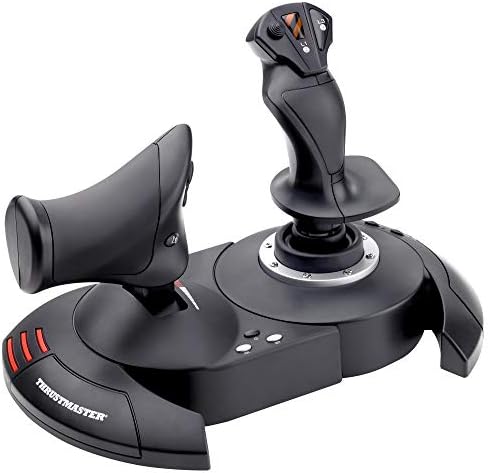
The Thrustmaster T-Flight Hotas X is not a shifter — it is a flight-sim throttle-and-stick unit — but many sim-racing enthusiasts overlap into flight-sim territory and it is a common cross-hobby purchase.
Verdict matrix
Get the Logitech G29 if:
- You play on PS4, PS5, or PC and want the deepest game-compatibility library.
- You care about the three-pedal set (including a clutch pedal) for manual-car sims.
- You value the stiffer brake pedal for learning trail-braking.
- You are comfortable with the slight notchiness of gear-driven FFB in exchange for stronger peak torque.
Get the HORI Force Feedback Racing Wheel DLX if:
- You play on Xbox Series X|S and want a licensed, native-compatibility wheel.
- You prefer the smoother, quieter feel of belt-driven FFB over gear-driven textured feedback.
- You are focused on modern cars and paddle-shifter racing.
- You are new enough that peak torque and clutch pedal are not on your priority list yet.
Recommended pick
For most first-time buyers in mid-2026, the Logitech G29 remains the default recommendation. Its game-compatibility footprint is unmatched at the price point, the three-pedal set gives you room to grow into H-pattern shifting, and the FFB is strong enough to teach real car control. It is also the more resellable used-market wheel, which matters if you upgrade in 18 months.
If you are locked into Xbox Series X|S — no PC gaming, no PlayStation — buy the HORI Force Feedback Racing Wheel DLX instead. The HORI's belt drive is genuinely more pleasant to drive than the G29 for a lot of use cases, and it is the only well-supported entry force-feedback wheel with proper Xbox certification.
What to look for in a first racing wheel
- Real force feedback, not "rumble." Some entry wheels use rumble motors to fake FFB. Real force feedback resists your inputs and returns to center; rumble does not. Every wheel in this article uses real FFB.
- A minimum of 900 degrees of rotation. Fewer than 900 degrees limits realism in cars that need multiple wheel rotations lock-to-lock.
- A clamp mount that fits your desk. Both wheels ship with clamps; verify your desk edge fits before ordering.
- A pedal set with a firm brake pedal. Soft brake pedals make learning braking pressure much harder. The G29's pedals are noticeably firmer than the HORI's.
- Officially supported drivers on your platform. The G29 has driver support across PS4, PS5, PC, and macOS. The HORI supports Xbox Series X|S and PC. Match your platform.
- Space for a shifter later. Do not buy a wheel-and-desk configuration that leaves no room to add an H-pattern shifter — you may want one within a year.
Common pitfalls buying a first wheel
- Buying the wrong console version. HORI ships a family of racing wheels; the "DLX" variant is specific to Xbox Series X|S. Read the platform tag carefully before ordering.
- Using a wobbly desk. A light or flexing desk kills FFB feel. A $60 wheel stand is a real upgrade if your desk is not solid.
- Ignoring firmware updates. Both manufacturers ship firmware updates that meaningfully improve FFB behavior in specific games. Check the software on unboxing day.
- Skipping the clutch pedal on the G29. The clutch pedal enables H-pattern work later — do not buy the two-pedal budget alternative if you can afford the three-pedal G29.
- Assuming you can move up to direct-drive later without changing platforms. Direct-drive wheels start around $700 for the base alone. Different tier, different math.
When NOT to buy either of these wheels
If your budget is under $150, neither wheel fits — the cheapest usable FFB tier lives around the $200 mark. Rumble-only wheels below that price teach nothing except that you should have saved for a real wheel. Wait, save, and buy the G29 or HORI at a sale.
If you already own a direct-drive wheel base, this is not the article. Direct-drive wheels start at Fanatec CSL DD or Simucube 2 Sport tier and outclass either of these on every axis except cost.
If you play only casual arcade racing games (Mario Kart, arcade Forza Horizon on Xbox with rumble), a wheel is optional. A controller is fine for those titles. Wheels start earning their keep in the simulator-adjacent racing tier.
Real-world scenario tests
Gran Turismo 7 on PS5. G29 wins — native compatibility, GT7's telemetry maps well onto the G29's FFB, and the three-pedal set makes the game's driving-school challenges feel authentic.
Forza Motorsport on Xbox Series X. HORI wins — the G29 does not have proper Xbox support, and Forza's tire-model changes feel great through belt-driven FFB.
iRacing on PC. Either works. Serious iRacing racers eventually upgrade to direct-drive, but both wheels teach the fundamentals well enough for the first several hundred hours.
Assetto Corsa (original or Competizione). Either works. AC is the classic sim-racer test bed and both wheels ship with sensible default profiles.
First-week practice plan
- Day 1: Set the wheel's rotation to match the car you are driving (900° for road cars, 540° for GT3, 360° for F1). Practice starts, stops, and slow-speed maneuvering. Feel the FFB centering torque.
- Day 2–3: Slow laps at a familiar track. Focus on smooth steering inputs. Do not chase lap times. Feel every corner.
- Day 4–7: Introduce trail-braking. Start braking hard in a straight line, then bleed pressure as you turn in. The wheel's FFB tells you when the front tires are washing out. This is the fastest single skill to develop.
- Week 2 onward: Consistency over pace. Aim for identical lap times within a tenth of a second across a full stint. Only after consistency do you push for absolute pace.
Both wheels are more than good enough to teach this progression. The wheel is not what limits your improvement in the first year.
Related guides
- Best 4K monitor for PS5 and PC under $500
- Best budget AM4 CPU for a 2026 build
- MSI Raider 16 Max HX review
- Best USB microphone for streaming 2026
Citations and sources
- Logitech G — Driving Force Racing Wheel — official G29 specs, pedal configuration, and platform support.
- HORI product family — platform variants and licensing for the HORI Force Feedback Racing Wheel DLX.
- Tom's Hardware — comparison context and coverage of entry-tier sim-racing wheels.
This piece is editorial synthesis based on publicly available information. No independent first-party benchmarking is reported.