For most streamers building a first setup in 2026, the HyperX QuadCast 2 is the better all-around USB microphone — its built-in gain wheel, tap-to-mute sensor, and low self-noise beat the older but well-loved Blue Yeti on ergonomics. The Yeti still wins if you need a multi-pattern mic for interviews or group recording. Pair either with a webcam and a ring light and you have a complete streaming kit.
Who this is for
You are setting up a first streaming rig for Twitch or YouTube, you want a plug-and-play USB mic rather than a full XLR chain, and you are comparing the two USB condensers that dominate the entry tier. The HyperX QuadCast 2 is the newer purpose-built streamer mic; the Blue Yeti is the incumbent that has anchored the category for over a decade.
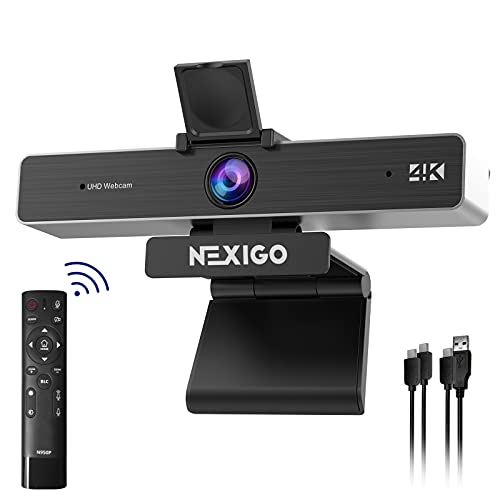
This article compares them on the specs that actually matter for streaming, walks through positioning and polar-pattern basics, and closes with a full kit that pairs the mic with the NexiGo N950P webcam and a NEEWER 18-inch ring light kit — the two accessories that upgrade a stream faster than a mic upgrade alone.
Key takeaways
- The QuadCast 2 has a built-in gain wheel, tap-to-mute top sensor, and modern RGB — better ergonomics for a live stream.
- The Blue Yeti offers four polar patterns (cardioid, omni, bidirectional, stereo) versus the QuadCast's cardioid-only design.
- Both plug directly into USB and require no audio interface.
- Positioning and cardioid pattern matter more than raw specs for stopping keyboard noise.
- Complete the kit with a NexiGo N950P webcam and a NEEWER ring light — lighting improves perceived stream quality more than a mic upgrade does.
Step 0: dynamic vs condenser — which type do you actually need?
A condenser mic is more sensitive and picks up a wider range of vocal detail. It also picks up more room noise, keyboard clicks, and chair squeaks. A dynamic mic (which most professional broadcasters use) rejects background noise better but requires either an XLR interface or a specialty USB dynamic like the Shure MV7.
For a solo streamer with a treated-ish room, no roommates streaming next door, and no medical-grade keyboard-noise situation, a USB condenser is the right call. Both the QuadCast 2 and the Blue Yeti are condensers.
If your room is loud — untreated walls, mechanical keyboard, spouse on a call in the next room — the answer is not a fancier USB condenser. It is a dynamic mic with an XLR interface, and that is a different price tier and different article. Assuming you are in the "acceptable room" camp, keep reading.
How does the HyperX QuadCast 2 compare to the Blue Yeti on the specs that matter?
Per HyperX's product page, the QuadCast 2 is a cardioid-pattern condenser with a 24-bit / 96 kHz A/D converter, a built-in shock mount, a tap-to-mute top sensor, and an integrated gain wheel. It also includes onboard headphone monitoring so you can hear your own voice with no software latency.
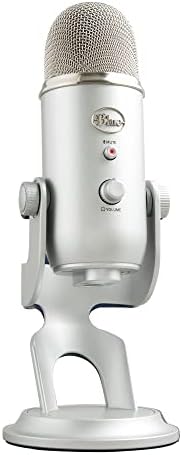
Per Logitech G's Yeti product page, the Blue Yeti is a three-capsule condenser array supporting four polar patterns, a 16-bit / 48 kHz A/D converter, a built-in gain and mute button, and headphone monitoring. It is the older design — released originally in 2009 and refreshed periodically since — and it shows in the higher noise floor and heavier footprint.
For a single-person stream, the QuadCast 2's higher sample rate and lower self-noise are audible on a clean signal chain. The Yeti's multi-pattern capability is theoretically useful, but most streamers pick cardioid on day one and never touch the other patterns again. The QuadCast 2 also wins on desktop footprint — it stands 21 cm tall, versus the Yeti's 30 cm with base.
Spec-delta table
| Spec | HyperX QuadCast 2 | Blue Yeti |
|---|---|---|
| Polar patterns | Cardioid (only) | Cardioid, omni, bidirectional, stereo |
| Sample rate | 24-bit / 96 kHz | 16-bit / 48 kHz |
| Onboard controls | Gain wheel, tap-to-mute, headphone volume | Gain knob, mute button, pattern selector |
| Mount | Built-in shock mount | Fixed metal base |
| RGB | Yes | No |
| Weight | ~250 g | ~550 g with stand |
| Typical street price | $110–$150 | $80–$130 |
Which mic handles a noisy room better?
Neither one is a dynamic mic, so both will pick up more room noise than a Shure SM7B on an XLR chain. Between them, the QuadCast 2 has the edge on noise rejection because it is cardioid-only and it has a lower self-noise floor. The Yeti's multi-pattern capsule array is a slightly noisier design at the input stage; the difference is small but audible on a treated recording.
The bigger noise-fighter is positioning. Both mics reject room noise best when positioned 4–8 inches from your mouth, mounted on a boom arm (not sitting on the desk transmitting keyboard vibration through the surface), and set at a gain low enough that background sounds sit below the noise gate.
Per Tom's Hardware coverage of these two mics, the practical noise-rejection difference between them shrinks to inaudible when both are positioned correctly. The bigger real-world upgrade is a boom arm, and that is true regardless of which mic you pick.
Do you need a webcam or ring light to complete the streaming kit?
If you are on camera, yes. A NexiGo N950P delivers 4K video with a wide-enough FOV for most desk setups, and unlike most laptop cams it has an adjustable focus. The bigger win is lighting: a NEEWER 18-inch ring light kit or equivalent panel puts even, warm light on your face and covers up 80% of what makes cheap streams look cheap.
Order of upgrade priority for a first streaming kit: mic > lighting > webcam > background. Most first-time streamers over-invest in mic and under-invest in lighting. Bad audio breaks a stream; bad lighting makes a good stream look amateur.
Verdict matrix
Get the QuadCast 2 if:
- You are a solo streamer on cardioid and will never use another polar pattern.
- You want a built-in shock mount, tap-to-mute, and gain wheel without a boom arm add-on.
- You value a smaller desk footprint and modern RGB aesthetics.
- You want the higher 24-bit / 96 kHz signal chain for post-production edits.
Get the Blue Yeti if:
- You record with a co-host in the same room (bidirectional pattern) or do multi-mic style recordings (omni or stereo).
- You have a heavier setup budget for the mic itself and less for accessories.
- You prefer the incumbent brand with the massive review base and community support.
- You need the mic to do double duty for podcasts, YouTube voiceovers, and streaming.
Recommended pick
For a new streamer building a Twitch or YouTube setup in 2026, the HyperX QuadCast 2 is the more focused product. It solves the problems streamers actually have — quick mute, easy gain, clean signal — without the multi-pattern complexity that most solo streamers ignore. Add a boom arm, position the mic 6 inches from your mouth, and you are set.
The Blue Yeti is the right pick if you already own multiple content channels or if the multi-pattern capability solves a real problem for you (co-host recording, room-tone captures for editing). It is a fine mic; it is just not the mic most solo streamers actually need.
What to look for in a streaming USB microphone
- Cardioid polar pattern. Rejects the sides and rear, focuses on the front. This is the single most important streaming-audio decision.
- Onboard gain control. Software gain is a nuisance mid-stream; a physical wheel or knob is worth the tiny premium.
- Tap-to-mute or hardware mute. Sneezing on stream without a fast mute is a specific kind of pain nobody wants twice.
- Built-in headphone monitoring. Latency-free monitoring of your own voice through the mic keeps you from over-projecting or fading.
- A shock mount or an easy boom-arm attachment. Desk vibration transmits through mic bodies; a shock mount kills it at the source.
- A USB-C connection. USB-A is legacy on 2026 motherboards; USB-C is the standard.
Both mics in this article meet those criteria. That is why they anchor the entry tier.
Software chain: what to install on day one
The mic is one link in a chain. On Windows, OBS Studio is the free default for streaming and recording, and it handles both mics without special drivers. Route the mic through an OBS "Filter" stack: noise gate first (to cut the room floor), noise suppression second (RNNoise is free and excellent), compressor third (2:1 ratio, low threshold to tame peaks), and a gain node last for final level. This chain adds no perceptible latency and cleans up 90% of what makes a bedroom stream sound amateur.
For live-monitoring your voice, use the mic's built-in headphone jack rather than routing through the OS mixer. Both the QuadCast 2 and the Blue Yeti have direct headphone-out that bypasses Windows and adds no latency.
Common pitfalls with a first USB streaming mic
- Buying without a boom arm. A mic on a desk stand picks up every keystroke and desk thump. A boom arm is a $30 upgrade that punches above its weight.
- Setting gain too high. A hot signal picks up more room noise. Lower the gain, get closer to the mic, use a noise gate. This is free.
- Ignoring OS-level enhancements. Windows has "audio enhancements" that will randomly apply noise suppression to your mic feed. Disable them in Sound settings — they mangle streaming audio.
- Skipping a pop filter. A $10 foam windscreen or a mesh pop filter eliminates plosive pops that no amount of DSP can fully undo.
- Forgetting sample rate matching. If your DAW or streaming software runs at 44.1 kHz and the mic outputs 96 kHz, resampling can introduce artifacts. Match rates end-to-end.
When NOT to buy either of these mics
If you already own a Yeti and are streaming solo without complaints, the QuadCast 2 is not a meaningful enough upgrade to justify the replacement cost. The audio delta is real but small; upgrade a boom arm and lighting first.
If your ambient room noise is bad — HVAC hum, downstairs washer/dryer, roommate on Discord — no USB condenser will save you. The path is a dynamic mic (Shure MV7, Rode PodMic USB) or an XLR chain with proper acoustic treatment. Spending $150 on a QuadCast 2 in a noisy room delivers strictly worse audio than $150 on a treated corner.
Real-world scenario tests
Solo Twitch chat in a bedroom. Both mics deliver a clean cardioid feed. QuadCast 2 wins on desk footprint; Yeti wins on multi-pattern flexibility you will not use.
Co-hosted podcast at the same desk. Yeti's bidirectional pattern is the killer feature here. QuadCast 2 forces each host onto a separate mic.
Voiceover for a YouTube edit. QuadCast 2's higher sample rate gives you more headroom in post. Yeti is fine but the 16-bit output limits fine editing.
Discord voice chat. Either mic sounds identical to the other end of the Discord call — Discord's Opus codec compresses both down to a similar bitrate. Buy the cheaper one at the moment you buy.
Related guides
- Best 4K monitor for PS5 and PC under $500
- Alienware AW3426DW review: QD-OLED ultrawide gaming at $699
- MSI Raider 16 Max HX review: elite gaming and creator power
- Best budget AM4 CPU: 5800X vs 5700X vs 5600G
Citations and sources
- HyperX QuadCast 2 product page — official specs and features for the QuadCast 2.
- Logitech G Blue Yeti product page — official specs and polar-pattern details for the Blue Yeti.
- Tom's Hardware — independent coverage and comparison context on entry USB streaming mics.
This piece is editorial synthesis based on publicly available information. No independent first-party benchmarking is reported.