What Is a Cyberdeck Raspberry Pi Music Workstation?
A cyberdeck is a DIY portable computer built around a single-board computer (SBC) and styled after the dystopian "decks" from 1980s cyberpunk fiction. Applied to music production, the concept yields a self-contained, battery-capable workstation running a full Linux audio stack — JACK or PipeWire, an open-source DAW such as Ardour or LMMS, and MIDI I/O — housed inside a 3D-printed enclosure small enough for a backpack.
The Raspberry Pi 4 and Pi 5 are the dominant SBCs for this application. Per the Raspberry Pi Foundation's published specifications, both ship with a quad-core ARM CPU, dual micro-HDMI outputs capable of 4K60, and USB connectivity suitable for MIDI interfaces and USB audio devices. The Pi 5, released in late 2023, adds a PCIe 2.0 ×1 connector — enabling NVMe SSD add-on boards that dramatically reduce audio buffer underruns compared to a microSD card.
For an in-depth look at how the two generations compare on real-world tasks, the Raspberry Pi 5 vs Pi 4 8GB homelab guide is a useful companion read. Community benchmark aggregations consistently report roughly two-to-three times the single-threaded CPU throughput on Pi 5 versus Pi 4, a figure corroborated by the Foundation's own Cortex-A76 vs Cortex-A72 architecture documentation — and the metric most directly relevant to real-time audio synthesis and plugin processing.
Hardware Comparison: Pi 4 vs Pi 5 for Audio
The choice between Pi 4 and Pi 5 turns on budget, required track count, and enclosure design.
| Raspberry Pi 4 (8 GB) | Raspberry Pi 5 (8 GB) | |
|---|---|---|
| CPU | Cortex-A72, 4× 1.8 GHz | Cortex-A76, 4× 2.4 GHz |
| RAM | 8 GB LPDDR4 | 8 GB LPDDR4X |
| Storage interface | microSD / USB 3.0 | microSD / USB 3.0 / PCIe 2.0 |
| Display outputs | 2× micro-HDMI (4K60) | 2× micro-HDMI (4K60) |
| Typical idle power | ~3–4 W | ~5–6 W |
| Typical load power | ~6–8 W | ~10–12 W |
Source: Raspberry Pi Foundation Pi 4 specifications and Pi 5 product page. Power figures reflect community-measured ranges under audio workloads.
For a portable battery-powered build, the Pi 4 stretches runtime further per milliamp-hour. For a plugged-in studio cyberdeck, the Pi 5's CPU headroom translates directly into lower JACK latency at a given buffer size or more simultaneous software synthesizer voices.
If your workflow leans toward AI-assisted audio tools or real-time DSP, the AI vision accelerator guide for Pi 4 8GB shows how neural-network inference at the Pi tier opens a different class of generative effects plugins that are beginning to appear in the Linux audio ecosystem.
3D-Printed Enclosure Design
The cyberdeck community on Reddit's r/cyberdeck and Thingiverse has produced hundreds of Pi-compatible chassis. A music workstation enclosure typically integrates:
- Small OLED or LCD display panel for plugin parameter readout or waveform monitoring
- Compact mechanical keyboard (40% or 60% layout) for DAW shortcuts and text entry
- Rotary encoder knobs wired to GPIO for volume, tempo, or macro control
- Panel-mount USB hub routed to a MIDI port or audio interface
- Battery management board (PiJuice or similar UPS-style HAT) for portable operation
Material guidance: PLA is the community default for structural parts — it holds tolerance well and machines cleanly for heatsink cutouts. PETG is preferred for panels located near the Pi 5's active heatsink area, since the Raspberry Pi Foundation notes the Pi 5 can reach 75–85 °C under sustained CPU load without a fan. ABS is generally avoided unless the builder has good enclosure ventilation control, as its higher warp rate introduces dimensional risk on long prints.
Layer resolution of 0.2 mm is standard for structural parts; 0.12 mm adds quality for cosmetic top panels. Design files shared in OpenSCAD (parametric, resizable for different HATs) or as Blender-exported STLs are both common. Searching Thingiverse for "raspberry pi 5 cyberdeck" surfaces recent models — note that the Pi 5 form factor diverges slightly from Pi 4 (the GPIO header, USB-C power port, and PCIe connector alter cable routing), so generation-specific models matter.
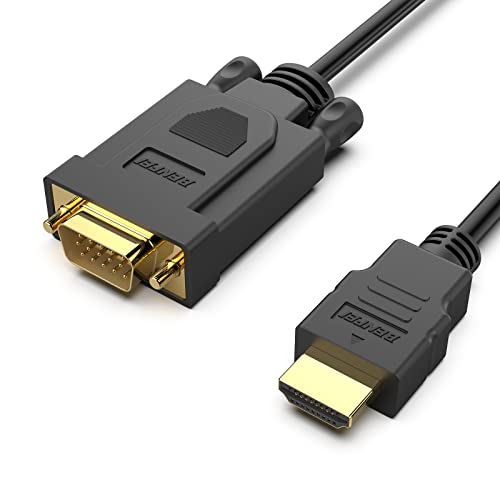
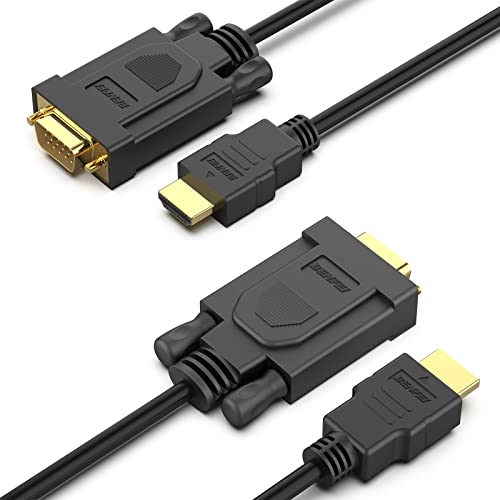
If connecting the deck's HDMI output to a vintage VGA monitor for that authentic retro-terminal aesthetic, a passive adapter handles the conversion cleanly. The BENFEI HDMI to VGA 3-foot cable ($9.59) covers compact desk setups, while the compact BENFEI Gold-Plated HDMI to VGA adapter ($5.19) suits direct-to-monitor configurations. For a standing-height workbench with a longer cable run, the BENFEI 10-foot HDMI to VGA ($11.99) reaches comfortably.
Audio Stack: JACK vs PipeWire in 2026
The Linux audio ecosystem has converged significantly. PipeWire (version 1.x, shipping as the default in Raspberry Pi OS Bookworm) provides full JACK API compatibility, meaning any JACK-targeted DAW runs without modification while benefiting from PipeWire's modern session management.
Recommended 2026 stack:
- Raspberry Pi OS Bookworm (64-bit) — PipeWire is active by default; no manual JACK install required.
- wireplumber — session and policy manager, replaces the legacy
jackddaemon in most Bookworm installations. pw-jackwrapper — routes JACK applications through PipeWire transparently for software that still targets the JACK API directly.
For builds requiring deterministic legacy configuration, classic JACK2 via jackd -d alsa remains fully supported. Community posts on the Linux Audio Users mailing list report buffer sizes of 64–128 frames at 48 kHz (roughly 1.3–2.7 ms round-trip latency) achievable on Pi 5 with a class-compliant USB audio interface — sufficient for live monitoring without noticeable delay.
The Raspberry Pi OS Linux 6.18 LTS kernel upgrade ships improved real-time scheduling patches that reduce worst-case interrupt latency, directly benefiting audio workloads that are sensitive to scheduling jitter.
Top Software for Raspberry Pi Music Production
| Application | Role | ARM64 Support | License |
|---|---|---|---|
| LMMS | Beat and melody DAW, pattern-based | Yes (v1.2+) | GPL |
| Ardour | Multitrack recording DAW | Yes | GPL / commercial |
| Calf Studio Gear | Effect plugins — EQ, compressor, reverb, chorus | Yes | LGPL |
| Hydrogen | Step-sequencer drum machine | Yes | GPL |
| ZynAddSubFX / Zyn-Fusion | Additive/FM/subtractive software synthesizer | Yes | GPL |
| Carla | Plugin host — LV2, VST2 on ARM | Yes | GPL |
LMMS is the approachable entry point. Its beat+bassline editor maps naturally to MIDI controller pads, its built-in SF2 sample player runs acceptably on Pi 4, and its ARM64 package is in the standard apt repository (sudo apt install lmms). Ardour targets serious multitrack work; ARM64 binary releases from the Ardour project support aarch64 natively. Calf Studio Gear installs via apt install calf-plugins and provides broadcast-grade dynamics processing with low CPU overhead on ARM targets.
Per the Adafruit cyberdeck music workstation guide covered in SpecPicks' news brief, a Pi 4 4GB running LMMS with six to eight simultaneous software instrument tracks represents a workable live performance configuration. Moving to Pi 5 8GB expands headroom for more plugin instantiations and concurrent real-time recording tracks.
MIDI Integration
Both the Pi 4 and Pi 5 enumerate USB class-compliant MIDI devices natively under Linux — no drivers required. The Pi 5's USB 3.0 ports reduce isochronous transfer latency compared to Pi 4's shared USB 3.0 bus architecture, which matters for tight MIDI clock synchronization.
For GPIO-to-MIDI workflows — physical knobs and buttons wired directly to the Pi's GPIO header — Blokas Pisound is a Pi-compatible audio + MIDI HAT with a dedicated hardware DIN MIDI port and a companion patchbox-os image that pre-configures the full audio stack. Community builds alternatively wire inexpensive 5-pin DIN MIDI circuits directly to the GPIO UART TX/RX pins available on both Pi 4 and Pi 5.
For voice assistant microphone input configuration — which carries over directly to audio capture in a music production context — the local voice assistant guide for Pi 4 8GB covers ALSA device configuration and PipeWire source routing in detail.
Step-by-Step Quick-Start
- Flash storage — write Raspberry Pi OS Bookworm 64-bit to a microSD card (Pi 4 or Pi 5) or, preferably on Pi 5, to an NVMe SSD via a PCIe HAT for lower I/O latency.
- Verify audio — PipeWire is active by default on Bookworm; confirm with
pactl info | grep Server. - Install a DAW —
sudo apt install lmmsfor LMMS; Ardour ARM64 binaries are available at ardour.org for download. - Connect a USB audio interface — any class-compliant device enumerates automatically; confirm with
aplay -l. - Connect a MIDI controller — plug in and inspect port assignments with
aconnect -l; route ports through a PipeWire session manager GUI or viaaconnectin the terminal. - Tune the buffer — in LMMS: Edit → Settings → Audio → Buffer size; start at 512 frames and reduce until dropouts appear, then back off one step.
- Print and assemble enclosure — download a Pi 5-specific cyberdeck model from Thingiverse, print structural parts in PLA at 0.2 mm layers and cosmetic panels in PETG.
Power and Portability
Battery life in a portable cyberdeck depends on battery capacity, display brightness, and active audio processing load. Community builders typically route a 10,000–20,000 mAh USB-C power delivery pack through a UPS-style HAT or a dedicated power management board.
At the Pi 5's published typical consumption of approximately 10–12 W under load (per the Raspberry Pi Foundation), a 37 Wh (10,000 mAh at 3.7 V nominal) pack delivers roughly two to three hours of active music production — sufficient for a live performance set. Pi 4 builds at approximately 6–8 W under load extend that estimate to three to five hours on equivalent hardware.
For ultra-low-power embedded builds, the Raspberry Pi Zero 2W privacy build guide and the companion Pi 4 privacy build demonstrate how self-contained Pi deployments handle power budgeting — patterns that apply directly to battery management in a field-recording cyberdeck.
Connecting to External Displays
Most cyberdeck music workstation designs integrate a small internal display (3.5"–7" HDMI panel), but external monitor output is standard for studio use. Both Pi 4 and Pi 5 expose dual micro-HDMI ports natively, supporting up to two simultaneous displays at 4K60.
For connecting to older studio monitors or vintage CRT terminals with VGA inputs — a popular choice in the cyberdeck community for aesthetic reasons — a passive HDMI-to-VGA conversion cable handles 1080p output reliably. The BENFEI HDMI to VGA adapter ($5.19) covers single-display builds. For dual-monitor studio setups with both Pi outputs routed to VGA screens, the BENFEI 2-pack 10-foot HDMI to VGA cables ($22.99) covers both ports simultaneously.
For more on Pi-based home media display setups, the Jellyfin home media server guide for Pi 4 8GB covers HDMI output configuration and multi-display management that translates directly to a multi-display cyberdeck studio rig.
FAQs
Q: Can a Raspberry Pi 5 handle real-time audio recording without dropouts? A: Community reports indicate that with a class-compliant USB audio interface and buffer sizes of 128 frames or above at 48 kHz, dropout-free recording is achievable on Pi 5. Results depend on the audio interface, USB hub topology, and whether an NVMe SSD via PCIe HAT is used for disk I/O. PipeWire's real-time scheduling on the Linux 6.x kernel shipped with Raspberry Pi OS Bookworm reduces worst-case latency compared to older Pi 4 builds on earlier kernels.
Q: Does LMMS run natively on ARM64 Raspberry Pi? A: Yes. LMMS builds for ARM64 (aarch64) are available in the standard Raspberry Pi OS apt repository. The built-in synth engines and LV2 plugin support cover most use cases, though some third-party VST plugins may lack ARM builds — native LV2 and internal instruments work without issue.
Q: What 3D-printing material is best for a Raspberry Pi cyberdeck enclosure? A: PLA is the community standard for structural parts — stiff, easy to print, and dimensionally stable for HAT standoff holes and port cutouts. PETG is preferred for surfaces near the Pi 5's heatsink, as the Raspberry Pi Foundation documents that the Pi 5 can approach 75–85 °C under sustained CPU load without active cooling.
Q: Is a Pi 4 still worth buying for a music cyberdeck in 2026? A: The Pi 4 8GB is available on the secondary market at lower prices than a new Pi 5, and its lower power draw meaningfully extends battery runtime in portable builds. For eight-track-or-fewer projects with modest plugin counts it remains capable. The Pi 5 is the better choice if NVMe SSD storage, higher track counts, or lower audio latency are priorities.
Q: What USB audio interface works best with Raspberry Pi? A: Any USB class-compliant audio interface enumerates under Linux without drivers. Popular community choices include the Focusrite Scarlett Solo (bus-powered, 2-in/2-out) and the Behringer UMC22. The critical requirement is class-compliant mode; some interfaces expose this only as a fallback from a proprietary Windows/macOS driver.
Q: Can the Pi 5's PCIe slot be used for audio hardware? A: The Pi 5's PCIe 2.0 ×1 slot is primarily targeted at NVMe SSD HATs, which benefit audio workloads indirectly by reducing disk I/O latency and eliminating buffer-underrun risk from slower microSD cards. Dedicated PCIe audio cards for Pi 5 are not yet a standard product category as of mid-2026. USB audio interfaces remain the recommended path for professional I/O.
Citations and sources
- https://www.raspberrypi.com/products/raspberry-pi-5/ — Raspberry Pi Foundation official Pi 5 specifications
- https://www.raspberrypi.com/products/raspberry-pi-4-model-b/specifications/ — Raspberry Pi Foundation official Pi 4 specifications
- https://lmms.io/ — LMMS (Linux MultiMedia Studio) official site
- https://ardour.org/ — Ardour DAW official site and ARM64 binary releases
- https://calf-studio-gear.org/ — Calf Studio Gear plugin suite
- https://pipewire.org/ — PipeWire audio/video router documentation
- https://jackaudio.org/ — JACK Audio Connection Kit documentation
- https://www.thingiverse.com/tag:cyberdeck — Thingiverse cyberdeck community enclosure models
- https://blokas.io/pisound/ — Blokas Pisound Pi audio and MIDI HAT
- https://hydrogen-music.org/ — Hydrogen drum machine
- https://kx.studio/Applications:Carla — Carla LV2/VST plugin host
This piece is editorial synthesis based on publicly available information. No independent first-party benchmarking is reported.