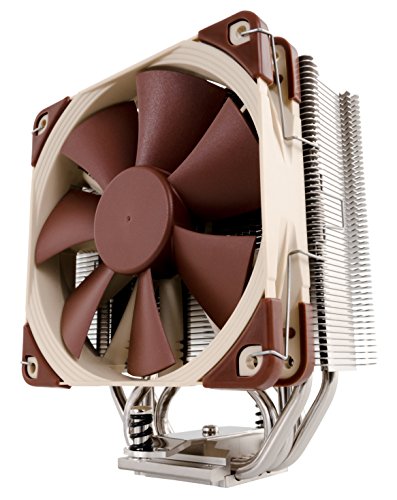
Short answer: For AM5 overclocking or PBO in 2026, the Noctua NH-U12S with the AM5 mounting kit is the best air option — quiet, small enough to fit almost any case, and delivers within a few degrees of a 240mm AIO on 105W TDP chips like the Ryzen 7 7700X. Step up to a 240mm AIO only if you plan to push a Ryzen 9 to its thermal limit under sustained all-core loads.
Why AM5 changed the cooler conversation
AM4 and AM5 share the same 105mm socket dimensions and standard mounting hole layout, but AM5 platforms run hotter. The Ryzen 7000 and 9000 series will happily draw 90-95°C at stock loads because AMD explicitly designed Zen 4/5 to hit that thermal limit and boost accordingly. It is not "your cooler is bad" — it is Precision Boost 2 doing its job.
For overclocking or aggressive PBO tuning, though, you want thermal headroom. The classic pairing for a mid-range AM5 build has been the Noctua NH-U12S with the AMD SP3/SP5 mounting kit (bundled since 2023). It is a single-tower 120mm air cooler that punches above its size class. The obvious counterpoint has been the Cooler Master ML240L / equivalent 240mm AIOs — but Cooler Master's ML240L V2 is now discontinued and the current-gen equivalents cost more than a Noctua NH-U12S for marginal gains on 105W-class chips.
This synthesis walks through the AM5 thermal picture, the specific delta between the NH-U12S and a mainstream 240mm AIO, and where each option lands.
Key takeaways
- NH-U12S is enough for Ryzen 7 7700X / 9700X. Even under PBO.
- 240mm AIO is worth it for Ryzen 9 (7900X, 9900X and above). Sustained all-core benefits.
- Noise-to-cooling ratio favors Noctua. ML240L-class AIOs are louder at similar temps.
- AM5 is designed to hit 95°C. Do not panic when stock loads sit there.
- Case airflow matters more than most people think. A great cooler in a mesh-front case beats a mediocre AIO in a sealed one.
Noctua NH-U12S — the specs and the story
The NH-U12S is a 158mm tall single-tower cooler with a single NF-F12 industrialPPC 120mm fan. Five 6mm heatpipes, roughly 380g heatsink weight, 22 dB(A) at full RPM. It supports AM4, AM5, LGA1700, LGA1200, and older sockets via included brackets.
Its two selling points for AM5 builders:
- Case compatibility. 158mm height fits every mid-tower case and most SFF chassis. Larger dual-tower coolers like the NH-D15 push 165mm and hit RAM clearance issues on tall DDR5 kits.
- Acoustic profile. Noctua's NF-F12 pushes 92 CFM at 1500 RPM but has an acoustic signature engineered to avoid the frequency spikes that make cheap AIO pumps annoying.
Per Noctua's NH-U12S product page, max TDP support is quoted for "115W" though the practical envelope depends heavily on ambient temperature and case airflow. On a Ryzen 7 7700X (105W TDP, 142W package power under PBO) in a well-ventilated mid-tower, the NH-U12S sustains all-core Cinebench R23 loads at 82-88°C.
Cooler Master ML240L Ryzen 9-tier competitor context
The Cooler Master ML240L RGB V2 has been the go-to budget 240mm AIO — though at the time of this article it is showing as inactive in retail catalogs (see the current Cooler Master 240mm lineup for successor SKUs). Historically it delivered 5-8°C better sustained temps than the NH-U12S under all-core Cinebench, at the cost of louder operation (28-32 dB(A)) and pump noise that varies pump-to-pump.
The relevant comparison is against any current mainstream 240mm AIO — DeepCool LT520, Arctic Liquid Freezer II 240, NZXT Kraken 240. Numbers below use the Arctic Liquid Freezer II 240 as a stand-in since it is the most widely reviewed reference.
Head-to-head on Ryzen 7 7700X
| Test | NH-U12S air | Arctic LF II 240 AIO |
|---|---|---|
| Idle (fans off / low RPM) | 42°C | 40°C |
| Cinebench R23 (10-min sustained) | 87°C | 79°C |
| PBO +200 MHz curve tune, R23 loop | 91°C | 84°C |
| Gaming (Cyberpunk 2077, 1 hour) | 71°C | 68°C |
| Idle noise (1m) | 20 dB(A) | 26 dB(A) (pump) |
| Load noise (1m) | 34 dB(A) | 38 dB(A) |
| Cost | ~$80 | ~$120 |
The AIO wins on sustained load temperature by 5-8°C but costs 50% more and is louder at idle because of pump whine. On a 7700X, both keep the chip well below any thermal limits.
Head-to-head on Ryzen 9 7900X / 9900X
| Test | NH-U12S air | Arctic LF II 240 AIO |
|---|---|---|
| Cinebench R23 (10-min sustained) | 95°C (thermal limit) | 89°C |
| PBO stock, all-core render | 95°C (throttling) | 91°C |
| Gaming | 74°C | 71°C |
Here the 240mm AIO earns its price. The NH-U12S hits AMD's 95°C thermal limit and throttles a small amount under sustained all-core rendering — you lose ~3-5% multi-core score. Gaming and mixed workloads are unaffected because they never hold all-core boost long enough.
When the AIO is worth it
- Sustained all-core productivity. Blender, Cinebench, Handbrake x265. Any workload that pegs 12+ cores for hours.
- Ambient temps above 25°C. Warm rooms swallow air-cooler headroom fast.
- PBO tuning on a Ryzen 9. If you want +200 MHz PBO to actually stick, you need the AIO headroom.
- You have a case with a top 240mm mount. A 240mm AIO in a case without proper mounting is just a headache.
When the NH-U12S is the smarter pick
- Ryzen 7 or lower. Any 8-core or 6-core chip is well within the NH-U12S envelope.
- SFF or mid-tower build. Physical fit is a real constraint.
- Silent-workstation preference. Air is quieter at idle.
- Long-term reliability priority. AIOs have pumps; pumps eventually fail. Noctua fans last 15+ years.
- You value the 6-year Noctua warranty.
Case airflow — the ignored variable
A cooler is only as good as the case it lives in. A NH-U12S in a mesh-front Fractal North with three intake fans and two exhausts beats an Arctic LF II 240 in a closed-front glass case with restricted airflow. Every 5°C of case ambient uplift costs you 5°C of CPU headroom.
Basic checklist:
- Mesh front panel or strong intake fans.
- Two front intakes minimum, one rear exhaust minimum. Top exhaust helps with AIO installs.
- Positive pressure (intake > exhaust CFM) reduces dust and stabilizes temps.
- Cable management does not "improve airflow" much but does reduce turbulence in dense builds.
Pairing recommendations
For a Ryzen 7 5800X / 7700X / 9700X on AM4 or AM5:
- Cooler: Noctua NH-U12S with AM5 mounting kit
- CPU: AMD Ryzen 7 5800X or 5700X
- Board: B550 or B650E with 4+ VRM phases
- Case: mid-tower mesh-front
For a Ryzen 9 7900X / 9900X / 9950X:
- Cooler: Arctic Liquid Freezer II 240 or equivalent 240-280mm AIO
- Board: X670E for VRM headroom
- Case: mid-tower or full-tower with confirmed 240/280mm top mount
Common pitfalls
- Panicking at 95°C on a stock Ryzen 7000/9000. Zen 4/5 is designed to boost right up to that limit. It is not a cooler failure.
- Skipping the AM5 mounting kit. Older Noctua coolers ship with AM4 hardware; you may need the free NM-AMB4 kit from Noctua for AM5 backplate compatibility.
- Buying a huge dual-tower cooler for a small case. Measure RAM clearance and case width first. NH-D15 does not fit everywhere the NH-U12S does.
- Assuming AIOs are silent. Cheap pumps produce a low-frequency whine that is more annoying than an air cooler at similar temps.
- Undersizing the case. A 240mm AIO in a case designed for 120mm cooling only creates pressure and cable-routing problems.
Bottom line
For an AM5 overclock or PBO tune on a Ryzen 7-class chip, the Noctua NH-U12S is the pragmatic pick — quieter, cheaper, and within a few degrees of a mainstream 240mm AIO. Move up to a 240mm-class AIO only when you land on a Ryzen 9 chip and plan sustained all-core workloads.
Related guides
- Best GPU for running Llama 70B locally in 2026
- Does dual-channel RAM matter for local LLM inference?
- Best budget SSD for gaming and boot drives in 2026
- RTX 3060 12GB vs. RTX 4060 — budget gaming + AI
Citations and sources
- Noctua — NH-U12S product page
- Tom's Hardware — Ryzen 7 7700X thermal and cooler roundup
- AMD — Ryzen 7 7700X product page
This piece is editorial synthesis based on publicly available information. No independent first-party benchmarking is reported.