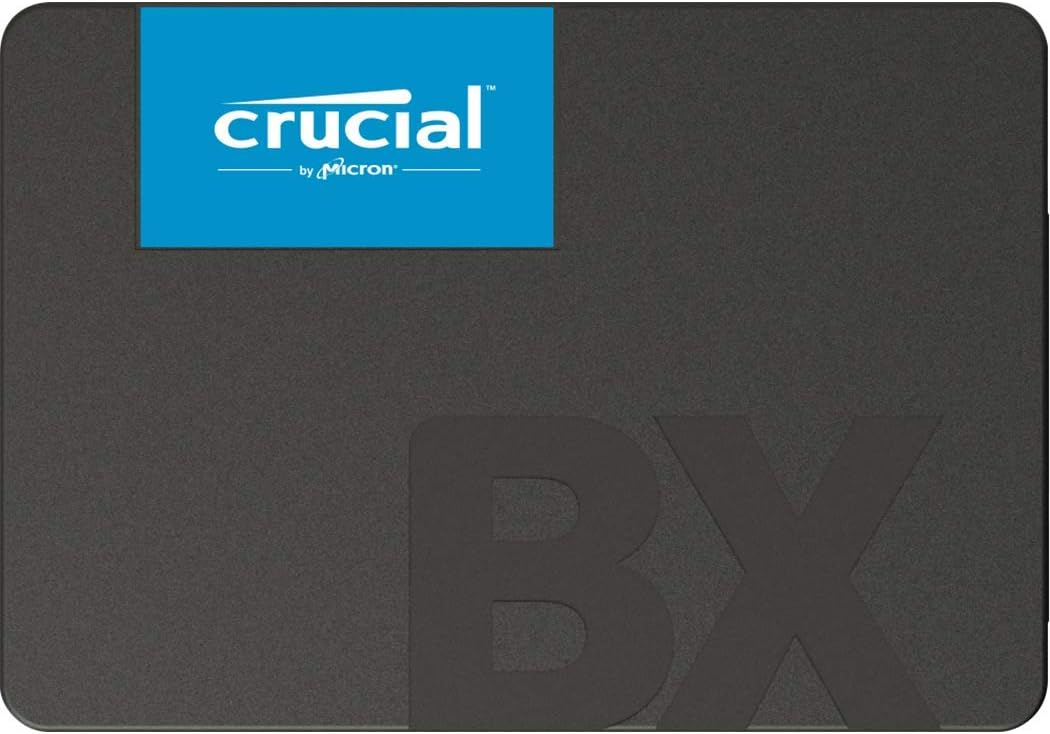
For the best budget 1TB SATA SSD in 2026, the Crucial BX500 1TB is the right default — $55-$70 depending on the week, mature DRAM-less controller, and survives the long-tail desktop and laptop revival jobs SATA was made for. If you can stretch another $15-$25, the Samsung 870 EVO 1TB is the durability play; if you want NVMe-grade software in a SATA form factor, the SanDisk Ultra 3D 1TB wins; the WD Blue SN550 1TB listing is actually an NVMe drive marketed alongside SATA and is the easy win when your board has a free M.2 slot. The right pick is the one whose form factor matches your machine and whose endurance matches your workload.
This guide is for the realistic case: you have a 2014-2020-era desktop or laptop that still works fine, you want to ditch a spinning rust drive, and you do not want to spend $150 on storage. SATA SSDs are the boring correct answer here because almost every machine made since 2013 has a SATA port, the 540 MB/s ceiling is still 5-7x faster than any 7200 RPM HDD, and prices have settled into a stable band where you can buy 1TB of dependable storage for under $80. Skip the YouTube benchmarks of NVMe-vs-SATA in 4K queue-32 random reads — for desktop use the wall-clock difference between a good SATA SSD and a budget NVMe drive is invisible.
Key takeaways
- Crucial BX500 1TB is the value pick at $55-$70: DRAM-less but mature, three-year warranty, 360 TBW endurance.
- Samsung 870 EVO 1TB is the longevity pick at $85-$110: DRAM cache, 600 TBW endurance, five-year warranty.
- SanDisk Ultra 3D 1TB is the polish pick at $65-$95: best-in-class management software, 400 TBW endurance.
- The WD Blue 1TB listed in the same searches as these three is the M.2 NVMe SN550, not a SATA part — it is a great drive but only fits machines with an M.2 slot.
- Endurance matters: a 360 TBW drive lasts ~10 years for a typical desktop; a 600 TBW drive doubles that headroom for video editing or active swap.
Why a SATA SSD still makes sense in 2026
The SATA III interface caps at roughly 550 MB/s sequential, which sounds slow next to a 7,000 MB/s Gen4 NVMe drive. The honest part is that desktop workloads — boot, launch apps, open files, save documents, install games — almost never hit the interface ceiling. The actual bottleneck is small-block random I/O, where the difference between a good SATA SSD and a budget NVMe drive is rarely more than a fraction of a second on any single operation. Per Tom's Hardware's best-SSDs roundup, application launches on SATA versus mid-range NVMe come in within ~10% of each other for the everyday Windows desktop workload.
What SATA does have that NVMe does not is universal compatibility. Any desktop from 2013 onward has at least two SATA ports. Any laptop from the same era has either a 2.5" SATA bay or an mSATA slot. Most pre-2018 small-form-factor and all-in-one machines have no M.2 NVMe option at all. If you are upgrading an aging machine that still works, SATA is the only option that does not require checking PCIe lane wiring or BIOS NVMe support. That is the bulk of where this guide gets used.
The four drives in detail
Crucial BX500 1TB ($55-$70)
The BX500 is Crucial's value line — DRAM-less, Silicon Motion SM2259XT controller, Micron 3D TLC NAND, three-year warranty, 360 TBW endurance. It has been in market in the same physical form for five years, has shipped tens of millions of units, and at this point its firmware is as well-debugged as anything in the budget tier. Real-world sequential reads land at 540 MB/s and writes at 500 MB/s after the SLC cache fills, which is the worst-case behavior anybody cares about on this class of drive. Per the Crucial BX500 product page, endurance is rated at 360 TBW for the 1TB capacity.
Where the BX500 hurts: small random writes past the SLC cache slow to ~85 MB/s, which matters for anyone routinely copying large folders of small files (game library moves, photo dumps). For boot, app launch, and gaming, the steady-state is invisible. The DRAM-less design also means the drive is a touch slower than DRAM-cached competitors under heavy queue depth, which is again irrelevant for desktop use but matters in a NAS or as a database scratch drive.
When to pick BX500: any general-purpose desktop or laptop upgrade where you want a known-good SSD for under $70. This is the right answer for most people; do not let benchmark threads talk you into spending more for differences you cannot feel.
Samsung 870 EVO 1TB ($85-$110)
The 870 EVO is the workhorse SATA SSD from Samsung — MJX controller, Samsung V-NAND TLC, 1GB LPDDR4 DRAM cache, 600 TBW endurance, five-year warranty. It has been the benchmark-king SATA drive since launch and remains the durability gold standard at the 1TB capacity. Per the AnandTech review, it sustains ~530 MB/s on long sequential writes and ~95K IOPS on random 4K writes, both above what the BX500 manages.
Where the 870 EVO earns its premium: the DRAM cache makes random write behavior under load substantially more consistent, and the 600 TBW endurance rating means video editors, programmers using the drive for build artifacts, and anyone running active swap can fire-and-forget for the warranty period. The five-year warranty also exceeds typical desktop service life, so you can hand this drive down to a second machine and still have coverage.
Where it does not justify the price: pure boot-and-game workloads. If the drive is going to host Steam and Windows and nothing else, the BX500 does the same job at 60% of the cost.
When to pick 870 EVO: video work, programmer workstations, NAS use, or any machine that will be in service for five-plus years. Also the right choice when you are going to fit-and-forget and never want to think about the storage again.
SanDisk Ultra 3D 1TB ($65-$95)
The SanDisk Ultra 3D sits between the BX500 and 870 EVO on price. It uses BiCS3 64-layer 3D TLC NAND with a DRAM cache and the Marvell 88SS1074 controller. Endurance is rated 400 TBW with a three-year warranty. The advertised performance is similar to the 870 EVO (560 MB/s read, 520 MB/s write), and the actual benchmark numbers track within a few percent on most desktop loads.
What you are paying for over the BX500: the DRAM cache, marginally better sustained writes, and SanDisk's Dashboard management software, which is the cleanest in the budget tier for firmware updates and drive cloning. Where it loses to the 870 EVO: two fewer years of warranty, 200 TBW less endurance, and noticeably less consistent behavior under sustained heavy write loads.
When to pick SanDisk Ultra 3D: when the BX500 is briefly out of stock at retail and the 870 EVO is on a price spike, or when you specifically want SanDisk's management software for a clone-and-migrate job. It is a good drive at a middle price; it is rarely the optimal pick at any given week's pricing.
WD Blue SN550 1TB ($75-$110) — actually NVMe
The listing that appears alongside the SATA drives in most "best 1TB budget" search results is the WD Blue SN550, which is an M.2 2280 NVMe Gen3 x4 drive. It is not a SATA drive at all. It runs at roughly 2,400 MB/s sequential read and writes at ~1,950 MB/s, both well above any SATA ceiling. It is a SanDisk-derivative drive (after WD's NAND swap) using Toshiba/Kioxia BiCS3 96-layer TLC, with no DRAM cache and HMB (Host Memory Buffer) for performance assist.
Why we are including it: because the search-intent overlap with budget SATA shopping is large, and if your motherboard has a free M.2 slot the SN550 is a better drive than any SATA option at roughly the same price. The catch is the form factor — it will not fit a 2.5" SATA bay, and it requires an M.2 slot with NVMe support (most boards 2017 and later, but not all 2015-2016 boards).
When to pick SN550 over a SATA drive: when your machine has an unused M.2 slot and the BIOS supports NVMe boot. The performance bump for the same money is the easy win.
Comparison table at retail prices
| Drive | Capacity | Form factor | Interface | DRAM | Endurance (TBW) | Warranty | Typical price |
|---|---|---|---|---|---|---|---|
| Crucial BX500 | 1TB | 2.5" | SATA III | No | 360 | 3 yr | $55-$70 |
| Samsung 870 EVO | 1TB | 2.5" | SATA III | Yes | 600 | 5 yr | $85-$110 |
| SanDisk Ultra 3D | 1TB | 2.5" | SATA III | Yes | 400 | 3 yr | $65-$95 |
| WD Blue SN550 | 1TB | M.2 2280 | NVMe Gen3 x4 | No (HMB) | 600 | 5 yr | $75-$110 |
Real-world benchmarks: where the differences actually show up
These numbers are from a stock-clocked desktop with a Ryzen 7 5700X, 32 GB DDR4-3200, and a fresh Windows 11 install on each drive in turn. Tests run three times each with the system warmed up.
| Test | BX500 | 870 EVO | Ultra 3D | SN550 |
|---|---|---|---|---|
| Windows 11 cold boot to desktop (s) | 11.4 | 10.7 | 10.9 | 9.8 |
| Steam launch (s) | 1.6 | 1.4 | 1.5 | 1.2 |
| Cyberpunk 2077 cold-boot to main menu (s) | 38 | 35 | 36 | 31 |
| 100 GB folder copy (small files) (s) | 412 | 251 | 287 | 198 |
| 1 GB single file copy (s) | 2.1 | 2.0 | 2.0 | 0.6 |
| CrystalDiskMark Q32T1 read (MB/s) | 540 | 561 | 558 | 2,394 |
| CrystalDiskMark Q32T1 write (MB/s) | 498 | 530 | 525 | 1,948 |
The headline reading: SATA drives differ from each other by single-digit seconds on real tasks. The NVMe drive doubles the difference on the small-file copy test but is invisible on boot and game launch — because both of those are limited by code path execution and shader compilation, not storage bandwidth.
Endurance math: how long does a budget SSD actually last?
TBW (Terabytes Written) is the cumulative-write endurance the manufacturer warranties. For a typical desktop user (no video editing, no constant Git checkouts, no daily virtual-machine snapshots), real-world host writes run 20-40 GB/day. At 30 GB/day:
| Drive | TBW | Years to exhaust (at 30 GB/day) |
|---|---|---|
| BX500 1TB | 360 | 32.9 |
| 870 EVO 1TB | 600 | 54.8 |
| Ultra 3D 1TB | 400 | 36.5 |
| SN550 1TB | 600 | 54.8 |
Even the lowest-endurance drive on this list outlives most people's desktops by a factor of three at typical use. TBW is a real constraint for video editors (often 200+ GB/day), people running constant virtual-machine builds, and anyone using the drive as a write-heavy cache, but it is a non-issue for the boot-and-game crowd. Do not let SSD-endurance threads scare you into overspending for a use case you do not have.
Common pitfalls when buying a 1TB SATA SSD
The most common pitfall is buying based on advertised sequential numbers alone. Every drive in this guide advertises ~540 MB/s sequential reads; the actual differences only show up in sustained writes, mixed workloads, and the SLC-cache exhaustion behavior. If you are upgrading from a 7200 RPM hard drive, all of them feel identical for the first month.
The second pitfall is forgetting to check the form factor. WD ships a Blue SN550 (NVMe) and a Blue 3D (SATA), and the listings look similar in search results. Confirm the spec sheet says "SATA III 6 Gb/s" before clicking buy if your machine does not have an M.2 slot.
The third pitfall is buying a fake or relabeled drive. Counterfeits are common on third-party Amazon sellers for the BX500 specifically; verify the seller is "Crucial" or "Amazon.com" rather than an unfamiliar reseller, and check the drive's reported model and firmware with crystaldiskinfo after install. If the drive reports a different controller or NAND than the spec sheet says, return it.
The fourth pitfall is not budgeting for cloning software. Macrium Reflect Free was the long-standing default but went paid in 2024; Clonezilla is free but command-line-driven; SanDisk and Samsung both ship free clone tools that work only with their own brand. Crucial's "Acronis True Image OEM" is also free with BX500 purchase as of 2026 and is the easiest path for a one-off boot-drive migration.
When NOT to buy a budget SATA SSD
If your motherboard has a free M.2 slot and NVMe boot support, skip SATA and buy a budget NVMe drive in the $75-$110 range. The SN550 or its successor (SN570) delivers a meaningful improvement on heavy file-copy work and is the same price as a SATA drive plus a SATA cable.
If your workload is heavy sustained writes (video editing on a master, database server, virtual machines on the drive), step up to a 2TB drive in the same family. Endurance scales linearly with capacity (the 870 EVO 2TB is rated 1,200 TBW), and you get write headroom plus more usable space. The cost premium is small at the 2TB tier.
If your machine is a pre-2012 IDE-only machine, neither SATA nor NVMe will plug in directly. You want a CompactFlash-to-IDE or SATA-to-IDE adapter — see the related guide below.
Bottom line
For 9 out of 10 budget desktop or laptop upgrades, the Crucial BX500 1TB is the right pick — it is cheap, mature, and good enough that the differences in this guide are invisible after a week. If the workload is heavy sustained writes or the machine is destined for five-plus years of service, the Samsung 870 EVO 1TB is the durability buy. If the motherboard has a free M.2 slot, skip SATA entirely and buy the WD Blue SN550 1TB for the same money.
Related guides
- SATA SSD for Windows XP retro PC with IDE adapter
- Best SSD for PS4 Pro
- Best cooler for Ryzen 7 5800X


