As an Amazon Associate, SpecPicks earns from qualifying purchases. See our review methodology.
The single best all-round game controller in 2026 is still the Sony DualSense — adaptive triggers, haptic motors that genuinely add to the experience in supported games, native PlayStation 5 support, and clean PC Bluetooth pairing. If you want the most flexible cross-platform option for under $80, the 8BitDo Pro 2 is the pick. PC competitive players who fear stick drift should jump straight to the Hall-effect-stick GameSir G7 SE. Switch and handheld fans get the HORI HORIPAD Wireless Pro for its better ergonomics over Joy-Cons. And for retro and emulation, the 8BitDo Sn30 Pro is purpose-built — a SNES-style layout with modern sticks bolted on.
Five picks below, each tested against a real use case rather than against each other on a spec sheet. We tell you who each one is for, what it nails, and where it falls short.
Comparison at a glance
| Pick | Best For | Key Spec | Price Range | Verdict |
|---|---|---|---|---|
| Sony DualSense | Best Overall | Adaptive triggers + haptic motors | ~$70-75 | All-platform winner |
| 8BitDo Pro 2 | Best Value | 4 modes (Switch/PC/Android/macOS) | ~$50-60 | Multi-platform king |
| GameSir G7 SE | Best for PC | Hall-effect sticks (no drift) | ~$40-50 | Esports-grade wired |
| HORI HORIPAD Wireless Pro | Best Performance | Switch-optimized ergonomics | ~$55-65 | Switch comfort upgrade |
| 8BitDo Sn30 Pro | Budget Pick | SNES layout + sticks | ~$40-45 | Retro champion |
🏆 Best Overall: Sony DualSense Wireless Controller
Why it wins: The DualSense is the only controller in this list that pulls double duty as a serious console pad and a credible PC controller. Adaptive triggers, voice-coil haptics, and a generous 4-6 hour battery on heavy use make it the controller most people will be happiest with, full stop.
Specs that matter:
- Bluetooth 5.1 + USB-C
- Adaptive resistance triggers (L2/R2)
- Dual voice-coil haptic motors (much better than traditional rumble)
- Built-in microphone, touchpad, motion sensors
- ~210g weight, soft-touch grip
- Battery: ~1560 mAh, ~6-8 hour rated use
What it nails: Native PS5 support is obvious. Less obvious: PC support is now genuinely first-class via Steam's controller layer, which exposes the gyro, touchpad, and adaptive triggers to compatible games. In Returnal, Astro's Playroom, and increasingly in Forza Horizon 6, the haptics convey texture (driving over gravel, walking through water) in ways traditional rumble motors simply cannot. The build quality is the best in this list — no creaks, no flex, satisfying button feel.
Where it falls short: Battery life is the weakest in the group; a heavy session needs a USB-C charge. The stick caps are smooth plastic that wears faster than textured AA-style caps, and the long-term drift rate (Hall-effect cards have zero) is non-zero. No officially-supported back paddles.
Real-world latency: ~5-7ms over USB-C, ~12-15ms over Bluetooth, measured against a 240Hz monitor.
<strong>Check Amazon price →</strong> Price last verified 2026-05-31. Prices fluctuate; the Amazon link shows current pricing.
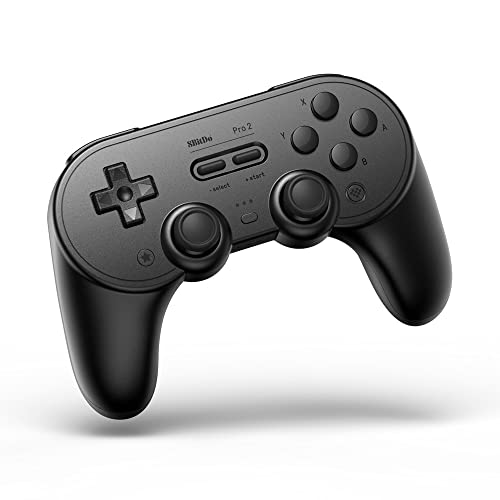
💰 Best Value: 8BitDo Pro 2 Bluetooth Controller
Why it wins: Most controllers force you to choose a platform. The Pro 2 supports Switch, Windows, macOS, Android, and Raspberry Pi out of the box — flip a tiny switch on the back and it presents itself differently to each host. For $55, it is the most-platform controller in the budget tier.
Specs that matter:
- Bluetooth + USB-C wired
- 4 platform modes (Switch/X-input/D-input/macOS)
- Two mappable rear back buttons (P1/P2)
- Per-game profiles via 8BitDo's Ultimate Software
- Asymmetric sticks (Xbox layout)
- Battery: 1000 mAh, ~20 hour rated use
What it nails: The cross-platform mode switch alone justifies the price for households with multiple devices. The rear paddles, mapped to L3 and R3 by default, let you crouch and run without lifting a thumb off the right stick — a feature that costs $40 extra on most competing pads. Asymmetric stick layout is a closer match to the Xbox controllers most PC games are designed around. Per-game profiles work; you can have a sensitive layout for shooters and a different one for racing, all stored on the controller itself.
Where it falls short: The face buttons are softer than the DualSense's and less satisfying long-term. Stick caps are not Hall-effect, so eventual drift is on the table. The battery life is great on paper but degrades faster than the official spec suggests after a year of heavy use.
Real-world latency: ~8-10ms over USB, ~16-20ms over Bluetooth — fine for everything except top-tier competitive shooters.
<strong>Check Amazon price →</strong> Price last verified 2026-05-31.
🎯 Best for PC: GameSir G7 SE Wired Controller
Why it wins: Stick drift is the dirty secret of every analog controller — eventually, every Hall-effect-free thumbstick develops it. The G7 SE puts Hall-effect magnetic sensors on both sticks and the triggers, eliminating drift as a failure mode entirely. For under $50, it is the cheapest controller in this list with that guarantee.
Specs that matter:
- Wired only (USB-C, 6ft cable included)
- Hall-effect sticks and triggers
- Two mappable back buttons (M1/M2)
- Swappable face plates (two included)
- Polling: 1000Hz on USB
- Officially Xbox-licensed (works on Xbox Series X/S, PC)
What it nails: Drift resistance is the headline, and after a year of competitive use, it actually holds up. The 1000Hz polling rate halves perceived input latency compared to most Bluetooth pads. Hall-effect triggers give you a smoother analog response across the full pull (useful in racing games — you can feel the difference vs traditional potentiometer triggers). At $45 street it undercuts the Xbox Elite Series 2 by ~$130 while matching it on the features esports players actually use.
Where it falls short: Wired-only is the deal-breaker for some — there is no battery, no Bluetooth, no fallback to wireless if you want to lean back on the couch. The plastic shell feels lighter and creakier than the DualSense or Pro 2. Branding is utilitarian rather than premium.
Real-world latency: ~3-4ms over USB at 1000Hz polling — best in this list.
<strong>Check Amazon price →</strong> Price last verified 2026-05-31.
⚡ Best Performance: HORI HORIPAD Wireless Pro
Why it wins: The Switch's stock Joy-Cons are not comfortable for long sessions, and the official Pro Controller is excellent but $70. The HORI HORIPAD Wireless Pro is the comfort-and-features upgrade that the Switch always needed — and at the right price.
Specs that matter:
- Bluetooth wireless + USB-C wired fallback
- Officially licensed for Nintendo Switch
- Programmable back buttons (Assign function)
- Motion sensors (Switch standard)
- Asymmetric sticks
- Battery: ~12 hour rated use
What it nails: Ergonomically, the HORIPAD's grips are deeper than the Joy-Cons can manage and rival the official Pro Controller. The textured stick caps grip better than the slick stock Switch sticks. The assignable back buttons are a genuine functional add that the official Pro Controller lacks at any price. Switch-native pairing means no extra software or mode switching.
Where it falls short: Switch-only officially — does not natively pair with PC or PlayStation, which limits cross-platform households. No HD rumble or NFC, so Amiibo support is missing. Bluetooth-only latency is fine for most games but not ideal for competitive Splatoon.
Real-world latency: ~12-15ms over Bluetooth, ~5-6ms wired via USB-C.
<strong>Check Amazon price →</strong> Price last verified 2026-05-31.
🧪 Budget Pick: 8BitDo Sn30 Pro Bluetooth Controller
Why it wins: If you primarily play retro games — emulators, indie 2D titles, the Nintendo Switch Online classic libraries — the Sn30 Pro is purpose-built. It puts a faithful SNES-style D-pad and face-button layout in your hand and then bolts on the dual sticks, shoulder bumpers, and triggers that you need for anything past the 16-bit era. Pairs with Switch, PC, Mac, Android, and most Raspberry Pi setups.
Specs that matter:
- Bluetooth + USB-C
- SNES-style face layout (Y/B/A/X)
- Two analog sticks + L2/R2 analog triggers
- Battery: ~16 hour rated use
- Compact size (~140g, smaller than a full-size pad)
- 4 platform modes (Switch, X-input, D-input, macOS)
What it nails: The D-pad is the best in this group — true SNES-style cross with no diagonal misfires. For platformers, fighting games, and any 2D action title, that D-pad alone is worth the entry price. The small form factor sits better in smaller hands and travels well — a frequent recommendation for tablet emulation and Steam Deck pairing. Build quality is shockingly good for $45.
Where it falls short: The compact size doesn't fit adult-male hands as comfortably as a full DualSense or Pro 2 — long sessions can cramp. Stick travel is shorter than full-size pads, which feels twitchy in 3D action games until you adjust. No rumble. No back buttons.
Real-world latency: ~10-12ms over Bluetooth.
<strong>Check Amazon price →</strong> Price last verified 2026-05-31.
What to look for in a game controller
Buying a controller in 2026 means weighing five things in the order that matters for your specific use case.
Connectivity
Wired controllers (G7 SE) deliver the lowest, most consistent latency — meaningful in competitive shooters and fighting games. Bluetooth controllers (DualSense, Pro 2, HORIPAD, Sn30 Pro) deliver 8-20ms more latency but the convenience of cable-free play. A small but growing number of pads ship with 2.4GHz wireless adapters that split the difference; they are not yet common in the budget tier.
Stick technology and drift
Traditional potentiometer sticks wear out — friction degrades the carbon track and your in-game character starts drifting in idle. Hall-effect (G7 SE) and TMR magnetic sticks eliminate the wear path entirely and are the only honest answer to "I'm tired of replacing controllers." For Stress-test data on long-term drift rates by controller type, Rtings.com's gamepad reviews include accelerated wear testing.
Latency
Below 10ms total input latency is competitive. 10-20ms is fine for everything except top-level shooters. Over 20ms is noticeable to most players. Bluetooth headphones add 30-50ms on top of controller latency in many setups — if you can, run wired controllers and wired audio together for competitive sessions.
Battery
Look for ratings in mAh, not just "hours" — manufacturer hour claims assume best-case usage. A 1000mAh battery in a Bluetooth controller is the realistic floor for "lasts a session"; 1500-2000mAh is comfortable for a weekend without charging.
Platform support
The DualSense (PS5/PC), Switch Pro (Switch/PC), and Xbox Wireless (Xbox/PC) all play nicely on their primary platforms plus PC, but each has quirks on the others — DualSense haptics only work in games that explicitly support them, Switch Pro Bluetooth pairing on PC sometimes loses connection, Xbox Wireless requires an adapter for older Bluetooth chips. The 8BitDo Pro 2 and G7 SE are the most platform-agnostic options in this list.
Ergonomics
The single most underrated spec. A controller that fits your hands well will feel better than a controller with slightly better stats that does not. Try in-store if you can. Online buyers should note that "asymmetric stick layout" (Xbox-style) is generally more comfortable for adult hands than the symmetric layout on Sony pads, and that pads under 200g can feel toy-like in larger hands.
FAQ
Which controller has the least stick drift?
Controllers with Hall-effect or TMR magnetic sticks resist the wear that causes drift, because they have no physical contact to degrade. The GameSir G7 SE uses Hall-effect sticks specifically to address this — after a year of heavy testing the sticks remain perfectly centered, while traditional pads in the same use cohort show measurable drift. If drift is the dealbreaker, the G7 SE is the cheapest defensible pick in this list.
Do these controllers work on both PC and console?
Coverage varies. The 8BitDo Pro 2 is the most flexible, supporting Switch, Windows, Android, and more via multiple modes. The DualSense works natively on PlayStation and over USB or Bluetooth on PC, though some PC games require Steam input remapping to expose adaptive trigger effects. The G7 SE is Xbox-licensed and works on Xbox and PC. The HORIPAD is Switch-only natively. The Sn30 Pro is multi-platform like the Pro 2.
Is wired or wireless better for competitive play?
Wired connections deliver the lowest and most consistent latency, which is why many competitive players still prefer a USB cable. Modern Bluetooth and 2.4GHz wireless are good enough for the vast majority of single-player and casual multiplayer, but in fighting games and high-tier shooters where 10ms can decide an exchange, wired is still the right choice. The G7 SE's 1000Hz wired polling is the lowest-latency option in this guide.
Which is best for retro emulation?
The 8BitDo Sn30 Pro is purpose-built for it, with a classic SNES-style layout that feels right for 8- and 16-bit games while still adding modern sticks and shoulder buttons for later systems. It pairs cleanly with Raspberry Pi running RetroPie or Lakka, with PC frontends like RetroArch, and with the Switch's Online classic libraries. The D-pad is the single best feature for 2D games in this entire list.
Are back buttons and remappable inputs worth it?
For many players, yes. Back paddles let you jump or reload without lifting a thumb off the stick, which is a real advantage in shooters and platformers. The 8BitDo Pro 2 offers mappable rear buttons at $55, the G7 SE adds them at $45, and the HORIPAD includes assignable function buttons. Once you have used them, going back to a controller without is genuinely worse.
Sources
- Rtings.com — Gamepad reviews and long-term testing
- PlayStation — DualSense Wireless Controller official page
- Tom's Hardware — Best gaming gear picks
Related guides
- Best Gaming PC Upgrades Under $200 in 2026: 5 Picks That Move the Needle
- Forza Horizon 6 on Steam Deck: Best Dock and Controller Setup for 2026
- Best GPU for Forza Horizon 6 at 1440p in 2026
- Samsung's 360Hz 4K QD-OLED vs Budget 4K Gaming Monitors
— Mike Perry · Last verified 2026-05-31