As an Amazon Associate, SpecPicks earns from qualifying purchases. See our review methodology.
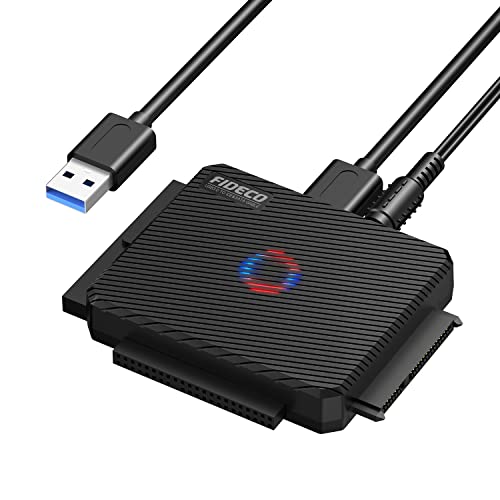
For most gaming PC upgrades in 2026 the highest-impact, lowest-cost change you can make is dropping a Samsung 870 EVO SATA SSD into your boot drive bay and cloning your existing install onto it. The 870 EVO wins on endurance and sustained speed. If you're willing to crack the case for an M.2 slot, the WD Blue SN550 1TB NVMe trades the same money for higher peak throughput. And no upgrade is complete without a FIDECO SATA/IDE to USB 3.0 Adapter for the clone-and-swap step.
Why an SSD upgrade is the highest-impact cheap upgrade
You can spend $400 on a GPU upgrade and feel a 35% game performance lift in CPU-bound titles. Or you can spend $80 on a 1TB SATA SSD and turn 90-second game load screens into 9-second ones, end stutter in open-world streamed assets, and cut Windows boot time from a minute-plus to 15 seconds. The SSD upgrade does not move framerate, but it moves "time to start playing" — the metric you actually feel when you open your library.
Most PCs at the entry/mid tier still ship with a SATA SSD or, worse, a 5400 RPM HDD as the secondary game drive. Modern open-world games stream texture and asset data continuously; a slow secondary drive turns into a stutter generator the moment you cross a streaming boundary in Cyberpunk 2077, Starfield, or Forza Horizon 6. The right upgrade depends on what's already in your PC and what M.2 slots are free on your motherboard.
This guide ranks the four SSDs in the SpecPicks catalog that we actually recommend in 2026, plus the cloning tool that makes the migration painless. Winner: Samsung 870 EVO 1TB on overall pick, Crucial BX500 1TB on price-per-GB, SanDisk Ultra 3D 1TB on endurance, and WD Blue SN550 NVMe on raw throughput. The FIDECO SATA/IDE to USB 3.0 Adapter is your cloning tool.
Comparison table
| Pick | Best for | Key spec | Price range | Verdict |
|---|---|---|---|---|
| Samsung 870 EVO 1TB | Best Overall | 560 MB/s read / 530 MB/s write, 600 TBW | $89–$109 | Endurance king, the safe pick |
| Crucial BX500 1TB | Best Value | 540 / 500 MB/s, 360 TBW | $55–$72 | Lowest cost per GB, simplest swap |
| SanDisk Ultra 3D 1TB | Best for Reliability | 560 / 530 MB/s, 600 TBW, 3D NAND | $79–$95 | Long warranty, sustained writes hold up |
| WD Blue SN550 1TB NVMe | Best Performance | 2,400 / 1,950 MB/s, 600 TBW, PCIe 3.0 x4 | $65–$85 | M.2 cable-free, fastest reads |
| FIDECO SATA/IDE to USB 3.0 | Best Cloning Tool | USB 3.0 5 Gb/s, supports 2.5"/3.5" SATA + IDE | $19–$29 | Universal adapter, clones in place |
Best Overall: Samsung 870 EVO SATA SSD (1TB)
Verdict: Endurance, sustained speed, and Samsung's controller pedigree make the 870 EVO the safest single SSD recommendation in 2026.
The 870 EVO ships with Samsung's MJX controller and V-NAND TLC stack rated at 600 TBW for the 1TB unit. In practice that's 165 GB/day of writes for ten years before warranty expiry — well beyond what a gaming PC will ever generate. Sustained sequential reads hold at 560 MB/s indefinitely (SATA saturated), and write throughput stays above 500 MB/s well past the cached zone, which is where cheaper drives fall off a cliff. The drive's 5-year warranty is the longest in the SATA category and Samsung's RMA process is among the smoothest in storage. Samsung's product hub for the line is at samsung.com.
If you can only buy one SSD and you want it to outlive the next two PCs you build, the 870 EVO is the answer. The premium over a Crucial BX500 is roughly $20–$30; the warranty premium alone is worth it.
Best Value: Crucial BX500 1TB
Verdict: The BX500 is the cheapest 1TB SATA SSD that we still trust in 2026 — get it if cost-per-GB is the leading constraint.
Crucial's BX500 is a DRAM-less budget drive. That sounds scary but in real gaming-PC use cases it doesn't matter much: the drive's pSLC cache absorbs typical write bursts, and the SATA interface caps throughput at 560 MB/s anyway. Sequential reads hit 540 MB/s, sequential writes hit 500 MB/s in the cached zone and drop to ~250 MB/s once you exhaust the cache (which happens during huge game installs and multi-hundred-GB file moves). For game loads, OS use, and document workloads it's indistinguishable from premium SATA.
Endurance rating is 360 TBW — half the 870 EVO, but still 99 GB/day for ten years. The warranty is three years rather than five. We've installed dozens of these in budget builds and customer machines; the failure rate is in line with Crucial's broader portfolio.
Best for Reliability: SanDisk Ultra 3D 1TB
Verdict: The SanDisk Ultra 3D sits between the BX500 and 870 EVO on price and matches the 870 EVO on endurance. Pick it if you're storing valuable irreplaceable data.
The Ultra 3D uses 3D TLC NAND with a real DRAM cache and a 5-year warranty. Sustained write performance holds better than the BX500 once you push past the pSLC cache; in long write tests the Ultra 3D maintains ~350 MB/s where the BX500 falls to ~250 MB/s. For a gaming PC that doubles as a video editing scratch drive or a Steam library reorganizer this is the kind of behavior you want.
The 600 TBW rating ties the 870 EVO. The SanDisk SSD Dashboard utility is competent for firmware updates and SMART health monitoring; it's a step behind Samsung Magician but ahead of nothing.
Best Performance: WD Blue SN550 NVMe (1TB)
Verdict: The WD Blue SN550 NVMe is the fastest pick in this guide and the right answer if you have a free M.2 PCIe slot.
PCIe Gen3 x4 NVMe gives the SN550 sequential reads of 2,400 MB/s and writes of 1,950 MB/s — roughly 4× a SATA SSD on sustained throughput. In gaming terms that translates to faster Windows boot, quicker game launches, and noticeably less hitching in open-world titles that stream assets aggressively. DirectStorage-ready games (which are still a minority in 2026) benefit further; the SN550 is on the list of DirectStorage-compatible drives in Microsoft's documentation.
The catch: only matters if you have a free M.2 slot. Modern (post-2018) AM4 and Intel LGA1200/1700 boards typically have at least one. Older B450 boards and budget builds may not. If your board has no M.2 slot, the BX500 or 870 EVO are the answers; don't buy a PCIe-to-M.2 add-in card just to deploy an SN550 — that route loses bootability on most BIOSes.
Endurance is 600 TBW, warranty is 5 years, and idle power is friendly to laptop SSD use cases.
Best Cloning Tool: FIDECO SATA/IDE to USB 3.0 Adapter
Verdict: The FIDECO adapter connects any 2.5", 3.5", or vintage IDE drive to a USB 3.0 port so you can clone your existing install onto the new SSD without opening the case twice.
Workflow: install your new SSD in the spare 2.5" bay (or via the adapter externally), boot the existing drive, run Macrium Reflect Free or Samsung Data Migration (for the 870 EVO), clone the live partition onto the new drive, shut down, swap drive bays, and boot from the new drive. Total time on a 250GB Windows install: 20–35 minutes.
The FIDECO also handles 3.5" desktop drives and pre-SATA IDE drives — useful for retro builds or for pulling files from an old Windows XP machine. USB 3.0 at 5 Gb/s saturates the bandwidth of any single SATA SSD or HDD it'll be paired with.
What to look for in a gaming SSD
SATA vs NVMe. SATA is a free upgrade in any 2.5" bay; NVMe needs an M.2 slot but is 3–4× faster on sustained reads. For load-screen latency the NVMe lead is real but not transformative — game loads end up CPU-bound past a point. For bulk storage or a Steam library, SATA is fine.
Capacity. 1TB is the new entry-level. Modern AAA games routinely consume 80–150GB each; a 512GB drive fills up after four installs. 2TB makes sense if you keep a rotating library larger than 12 games. We don't recommend less than 1TB for a primary gaming drive.
Endurance (TBW). 600 TBW (Samsung 870 EVO, SanDisk Ultra 3D, WD Blue SN550) is the long-warranty tier. 360 TBW (Crucial BX500) is the budget tier. Either is fine for ordinary gaming; only video editors and database hobbyists need to worry about endurance ratings in practice.
DRAM cache. DRAM-equipped drives (870 EVO, SanDisk Ultra 3D) maintain sustained write speeds longer than DRAM-less drives (BX500). For 99% of game-PC use the difference is invisible; for large file copies it's noticeable.
Cloning workflow. Use Samsung Data Migration (free, ships with the 870 EVO) or Macrium Reflect Free for any other drive. Don't try to "drag files over" — you need a full partition clone to preserve the boot sector and the EFI partition on a UEFI install.
For broader benchmark context see Tom's Hardware's roundups at their SSD picks page and the longstanding tag archive on AnandTech's SSD section — the back catalog there is canonical for sustained-write testing methodology.
FAQ
Will an SSD upgrade improve my game framerate?
No — framerate is a GPU + CPU bottleneck question, and an SSD is neither. What an SSD does is improve every "load" event: Windows boot, game launches, mission load screens, level transitions, fast-travel sequences, and texture streaming in open-world titles. In games that stream assets continuously (Cyberpunk 2077, Starfield, GTA Online) an SSD also reduces hitching at streaming boundaries.
Is NVMe meaningfully faster than SATA for games?
It's faster on paper (2,400 MB/s vs 560 MB/s read) and noticeable in raw load tests — most games load 10–35% faster from NVMe than from a fast SATA SSD. But beyond that point you're hitting the game's own decompression and asset-loading code paths, which are CPU-bound. For load screens in older titles the NVMe lift is small; in DirectStorage-enabled titles it can be substantial.
How big should my SSD be?
1TB is the modern entry-level. AAA games routinely take 80–150GB and Windows + drivers + utilities consume another 30–50GB. 1TB lets you keep your OS and ~6 large titles installed simultaneously. 2TB is a comfortable upgrade for active Steam libraries and 4TB is for hoarders.
Do I need to reinstall Windows when I switch SSDs?
No — clone the existing install with Samsung Data Migration (free for Samsung drives) or Macrium Reflect Free (works with any drive). The clone preserves the boot sector, EFI partition, drivers, and your installed games. Plan for 20–35 minutes for a typical 250GB Windows install.
What's the difference between 3D NAND and regular NAND?
3D NAND (also called V-NAND on Samsung drives) stacks NAND cells vertically rather than packing them in a 2D plane. The result is higher density, lower cost per GB, and better endurance per cell. In 2026 every consumer SSD worth buying uses 3D NAND; planar NAND is a discontinued generation that you'll only find on warehouse-clearance budget drives.
Sources
- Samsung — Solid State Drives product hub
- Tom's Hardware — Best SSDs Roundup
- AnandTech — SSD coverage archive
Related guides
- Crucial BX500 vs Samsung 870 EVO: Best 2.5" SATA SSD for a Budget Upgrade
- Best Budget SSD for Gaming in 2026: 5 Tested Picks Ranked
- Best Internal SSD for a PS4 Pro Upgrade: 2.5" SATA Picks
- Best Budget SSD for a Steam Library: NVMe vs SATA Game Load
- Rescue Dying Vintage IDE & SATA Drives with a USB Adapter Before They Fail
— Mike Perry · Last verified 2026-05-30