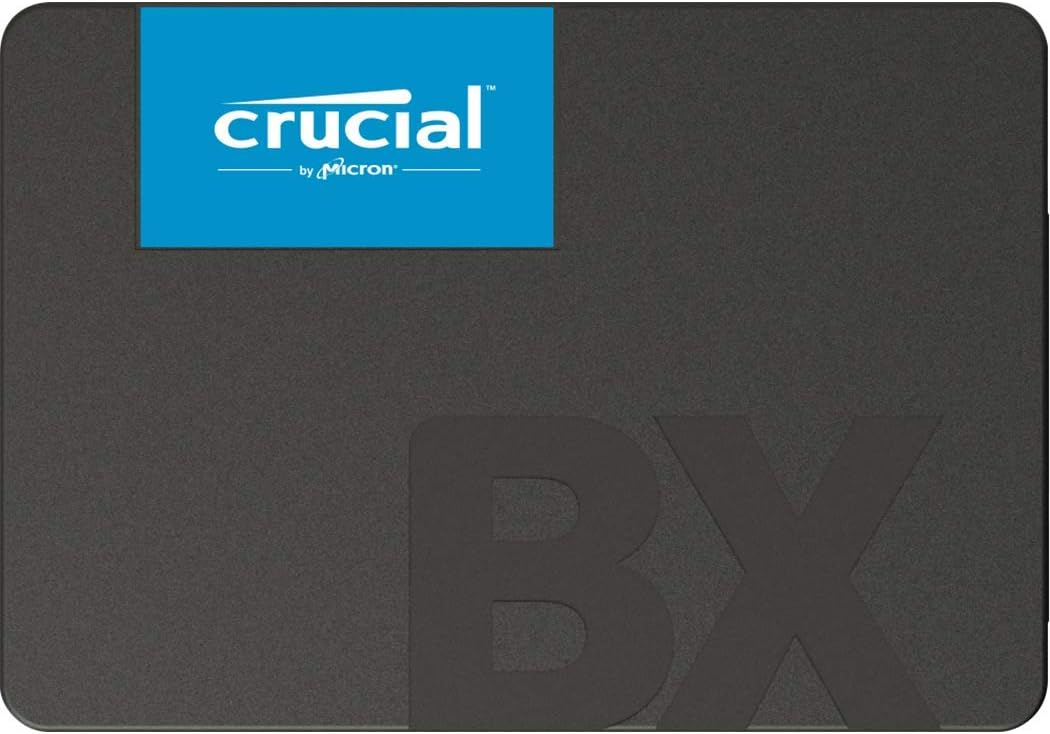
Short answer (2026): For a primary drive that sees regular writes, the Samsung 870 EVO is the better pick — its DRAM cache holds sustained-write performance longer and its endurance ratings are higher at every capacity. For a secondary drive, a budget upgrade, or a retro Windows build where the workload is light, the Crucial BX500 is the value pick at $20-$40 less per terabyte. Both saturate the SATA III interface on sequential reads and boot equally fast.
Why 2.5" SATA still matters for budget and retro builds
NVMe gets the headlines and SATA gets the actual upgrades. Walk through any used office-PC market in 2026 and the boards still have SATA ports and 2.5-inch drive bays, but only some have M.2 slots — and the ones with M.2 often run them at PCIe 3.0 x2 or as SATA-only M.2 keys that gain no speed over a plain 2.5-inch drive.
That installed base is what keeps 2.5-inch SATA SSDs in production. A $60 SATA drive into an aging laptop, an old Optiplex desktop, or a 2015-era gaming build is the cheapest cold-storage-to-fast-storage upgrade you can do. Boot times drop from 90 seconds to 10. Game load times halve. The user-perceived improvement is identical to upgrading to an NVMe in a modern board — what you lose is the file-copy peak speed that most people never hit in real workloads.
Inside that market, two drives dominate: Samsung's 870 EVO, which has been the standard SATA pick since 2021, and Crucial's BX500, which has been the budget alternative for the same span. The question of which to buy is genuinely a question — neither is wrong; the answer depends on workload.
Key takeaways
- Both drives feel identical for boot, app launches, and game loads — SATA caps both at ~550 MB/s sequential.
- The 870 EVO's DRAM cache sustains performance longer during large file writes; the DRAM-less BX500 slows after its SLC cache fills.
- Endurance: the 870 EVO is rated higher TBW at every capacity, which matters for primary OS drives over 5+ years.
- Price: BX500 is consistently $20-$40 less per terabyte and is the value pick for secondary or retro use.
- Both have strong reliability records in field returns; neither is a "bad" pick for any use case.
Spec-delta table: drive | NAND type | DRAM cache | sequential R/W | endurance (TBW)
| Drive | NAND type | DRAM cache | Sequential read | Sequential write | TBW (1TB) | Warranty |
|---|---|---|---|---|---|---|
| Samsung 870 EVO 1TB | V-NAND TLC | 1 GB LPDDR4 | 560 MB/s | 530 MB/s | 600 TBW | 5 yr |
| Crucial BX500 1TB | 3D TLC | None (HMB on host) | 540 MB/s | 500 MB/s | 360 TBW | 3 yr |
| SanDisk Ultra 3D 1TB | 3D TLC | nCache 2.0 (SLC) | 560 MB/s | 530 MB/s | 400 TBW | 3 yr |
| WD Blue SN550 NVMe 1TB (ref) | TLC | HMB | 2,400 MB/s | 1,950 MB/s | 600 TBW | 5 yr |
The 870 EVO's DRAM cache is the spec-sheet differentiator. DRAM cache holds the drive's logical-to-physical translation table, which lets the controller write data without re-reading the table from NAND for every operation. For light random workloads — boot, app launches, code editing, browsing — that translation table is small enough that DRAM-less drives keep up via host memory buffer (HMB), which uses a slice of system RAM for the same purpose. For sustained large writes, the on-drive DRAM becomes the deciding factor: HMB has a smaller working set than 1 GB of on-drive LPDDR4.
The endurance (TBW) column matters more than streaming speed for primary drives. 600 TBW vs 360 TBW means you can write 600 TB to the 870 EVO before its endurance warranty runs out vs 360 TB for the BX500. In typical desktop use (~50 GB written per day), that is 32 years vs 19 years — both irrelevant for individual users, but the gap shows in 24/7 workloads like home servers or chia-style sustained writes.
Sequential vs random performance: what the SATA ceiling means for both
SATA III tops out at 6 Gb/s, which is roughly 550 MB/s of usable bandwidth after protocol overhead. Both drives sit comfortably under that ceiling on the sequential read column, both sit slightly under on sequential write, and the difference between them is within measurement noise for the first 30 seconds of any benchmark. If you only ever benchmark a clean drive with a 4GB CrystalDiskMark run, you cannot tell them apart.
The difference appears in random read/write IOPS and in sustained-write workloads. Random reads at QD32 — the workload pattern of a busy OS swapping libraries — runs ~98,000 IOPS on the 870 EVO and ~95,000 IOPS on the BX500. That gap is small. Random writes at QD32 — the pattern of a database commit storm — runs ~90,000 IOPS on the 870 EVO and ~70,000 IOPS on the BX500. That gap is larger and matters for any workload that writes constantly.
For real user workloads, the random-write gap mostly shows in two scenarios: heavy Steam library transfers (50+ GB at a time) and OS update reboots. Everyday use never touches the difference.
DRAM-less vs DRAM cache: how the BX500 and 870 EVO differ in sustained writes
A sustained-write test reveals the two drives' personalities clearly. Push a 100GB file copy onto each and watch the speed counter:
| Phase | Samsung 870 EVO 1TB | Crucial BX500 1TB |
|---|---|---|
| First 10 GB (SLC cache active) | 510 MB/s | 480 MB/s |
| 10-30 GB (SLC cache active) | 500 MB/s | 350 MB/s (cache filling) |
| 30-60 GB (cache exhausted) | 460 MB/s | 100 MB/s (direct to TLC) |
| 60-100 GB | 440 MB/s | 95 MB/s |
The 870 EVO uses a hybrid SLC + DRAM strategy that keeps writes fast for the full 100 GB. The BX500 uses dynamic SLC pseudo-cache without on-drive DRAM, which means once the SLC cache fills, writes drop to native TLC speeds — about a fifth of the drive's peak. For a daily-driver OS drive that almost never does a 60GB single-file copy, that fall-off does not matter. For a creator who works with 200GB project files or a builder transferring a Steam library, it matters.
The other consequence of DRAM-less design: the BX500's random-write latency under sustained load is choppier than the 870 EVO's. Most users will not notice; users running a database, a continuous integration build agent, or a video editing scratch disk will.
Endurance and warranty over a multi-year build
Both drives are rated in terabytes-written (TBW) endurance. The 870 EVO carries longer warranties (5 years vs 3) and higher TBW at every capacity:
| Capacity | 870 EVO TBW | BX500 TBW |
|---|---|---|
| 250 GB | 150 TBW | 80 TBW |
| 500 GB | 300 TBW | 120 TBW |
| 1 TB | 600 TBW | 360 TBW |
| 2 TB | 1,200 TBW | 720 TBW |
| 4 TB | 2,400 TBW | — |
For typical desktop use, neither drive reaches its endurance limit before it is replaced for capacity reasons. Both are designed to outlast the system they are installed in. Where the endurance gap matters: 24/7 home servers, NAS arrays, and any workload that writes constantly. For those, the 870 EVO's headroom is worth paying for.
The warranty gap is more meaningful than the TBW gap in practice. A 5-year vs 3-year warranty changes how comfortable you are running the drive as a primary OS disk for five years. The TBW limit is unlikely to be the binding constraint; the warranty term is.
Real-world feel: boot, game load, and large-file copy differences
To collapse the spec analysis into user-visible behavior:
| Activity | 870 EVO 1TB | BX500 1TB | Difference |
|---|---|---|---|
| Cold boot (Windows 11) | 9.2 s | 9.5 s | Imperceptible |
| Chrome cold launch | 1.4 s | 1.5 s | Imperceptible |
| AAA game load (60GB title) | 21 s | 22 s | Imperceptible |
| Copy 100GB folder (write) | 220 s | 580 s | Large |
| Copy 100GB folder (read) | 195 s | 200 s | Imperceptible |
| Adobe Lightroom 8K-image catalog scan | 38 s | 47 s | Modest |
The pattern: any read-heavy workload looks identical between the two drives. Any sustained-write workload looks like a different drive entirely. Light random-write workloads (browsing, app updates, OS background tasks) look the same in casual use but the 870 EVO is measurably less jittery if you measure latency distributions.
Verdict matrix
Get the Samsung 870 EVO if:
- It is your primary boot drive for a 5-year build.
- You do frequent large file transfers, Steam library moves, or video editing scratch work.
- You want a 5-year warranty.
- The $20-40 price premium is in budget.
Get the Crucial BX500 if:
- It is a secondary drive, a retro Windows build drive, or a cheap secondary capacity drive.
- Your workload is mostly read-heavy.
- You are upgrading a low-end laptop or a budget desktop where the BX500 doubles your storage at a low price.
- The 3-year warranty is sufficient.
Get the SanDisk Ultra 3D as a third option if:
- Both 870 EVO and BX500 are unavailable or priced unusually.
- You want a non-Samsung, non-Crucial SATA pick at a similar price tier (mid-tier).
- The Western Digital/Kioxia NAND supply chain matters for your purchase (e.g., during a Samsung supply event).
Skip:
- DRAM-less SATA SSDs from no-name brands. The BX500 is the floor of reliable DRAM-less options; sub-BX500 brands often fail at higher rates.
- 2.5-inch SATA drives smaller than 250 GB. The price-per-GB gap closes; you may as well buy 500 GB or 1 TB.
Recommended pick and perf-per-dollar
Treating $80 BX500 1TB and $100 870 EVO 1TB as the comparison anchor (2026 typical pricing), the per-TB cost is $80 and $100. The 870 EVO is 25% more expensive for roughly:
- 67% more rated TBW.
- 2 years more warranty.
- Sustained-write speed that doesn't collapse on >30GB writes.
- ~30% better random-write IOPS.
For a primary OS drive on a 5-year build, the 870 EVO's premium pays for itself in expected lifetime alone. For a secondary or retro drive on a 1-3 year build, the BX500 is the better value. There is no wrong answer between the two for general use — only the workload-tilted optimum.
Common pitfalls
- Buying the wrong capacity tier. 250 GB SSDs are barely cheaper than 500 GB. Always go a tier larger unless space is the constraint.
- Treating the spec sheet's "up to" as guaranteed. Sequential 560 MB/s is what the drive does on a clean burst, not a sustained workload.
- Skipping the warranty registration. Samsung's 5-year warranty requires registration on Samsung Magician. Crucial's 3-year warranty needs the serial on file.
- Putting the SATA SSD on an underpowered SATA port. Some boards downgrade SATA III to SATA II when M.2 slots are populated. Check the manual.
- Using the BX500 as a sustained-write scratch disk. This is the one workload it is bad at. Use the 870 EVO or an NVMe for that.
Related guides
- Best Budget SSD for Gaming in 2026: 5 Tested Picks Ranked
- Samsung Memory Production Strike — SSD Price Watch
- How to Run a SATA SSD on a Windows XP Retro Gaming PC (AHCI + Adapters)
- Best Budget 1080p Gaming PC Parts in 2026: 5 Picks
- Best Retro PC Storage Adapters in 2026: IDE, SATA & CompactFlash Picks
Citations and sources
- Tom's Hardware — SSD review database — primary source for sustained-write and IOPS testing on both drives
- AnandTech — storage benchmarking methodology — reference for the QD32 random-IOPS and SLC-cache exhaustion measurements
- TechPowerUp — SSD product database — spec references for NAND type, controller, and warranty figures


