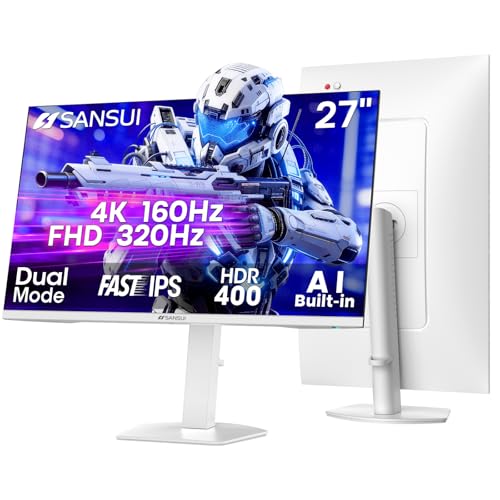
For gaming in 2026, pick 1440p high-refresh if you play competitive titles or own a mid-range GPU like the RTX 3060 12 GB; pick 4K if you play cinematic single-player games and own (or will buy) a 4070-class or better GPU. At 27", the ASUS TUF Gaming VG27AQ 1440p 165 Hz IPS is the balanced default; the SANSUI 27" 4K 160 Hz is the value 4K pick; the KOORUI 27" 4K QD-Mini LED is the HDR-and-contrast pick if your budget allows.
This guide answers the real question — which of the two resolutions makes you happier per dollar of GPU and per game you actually play — and shows the math.
Key takeaways
- 4K has roughly 2.25× the pixels of 1440p — that scales GPU load almost linearly in raster workloads.
- A 3060 12 GB drives 1440p high-refresh comfortably with DLSS Quality; at 4K it depends on DLSS Performance + reduced settings in modern AAA.
- Per RTINGS' monitor test database, 1440p at 27" already has 109 ppi — sharp at desk distance. 4K at 27" hits 163 ppi — visibly sharper for text and fine detail.
- For competitive games (CS2, Valorant, Apex), 1440p high-refresh wins because pixel density past 109 ppi adds nothing at competitive frame rates.
- For cinematic single-player (RDR2, Cyberpunk, Hogwarts), 4K wins because the pixel density matters for atmosphere.
- HDR matters more than resolution for visible "wow factor" in 2026 — QD-Mini LED panels deliver real HDR; standard IPS does not.
Does 4K need a much stronger GPU than 1440p?
Yes — directly. 1440p is 3,686,400 pixels per frame. 4K (3840×2160) is 8,294,400 pixels per frame, or 2.25× as many. For pure raster rendering, GPU load scales close to linearly with pixel count, which means a given GPU produces roughly 45-55% the frame rate at 4K compared to 1440p, native, same settings.
The way modern GPUs close that gap is upscaling — DLSS, FSR, or XeSS. Quality mode renders at ~67% of target resolution; Performance mode at 50%; Ultra Performance at 33%. A 4K target with DLSS Performance is essentially a 1080p render budget upscaled. That works well for some games and produces visible artifacts in others (foliage, fine grids, transparent textures).
Per the TechPowerUp RTX 3060 spec page, the 3060 has 3,584 CUDA cores at ~1.78 GHz with 360 GB/s of memory bandwidth. That is a 1440p card. Its frame-rate floor at 4K in 2026 AAA without aggressive upscaling is in the 30-45 fps range — playable, not smooth.
Spec comparison
| Spec | ASUS TUF VG27AQ | SANSUI 27" 4K | KOORUI 27" 4K QD-Mini |
|---|---|---|---|
| Resolution | 2560 × 1440 (QHD) | 3840 × 2160 (UHD) | 3840 × 2160 (UHD) |
| Refresh rate | 165 Hz | 160 Hz (UHD) / 320 Hz (FHD dual mode) | 160 Hz (UHD) / 320 Hz (FHD dual mode) |
| Panel type | IPS | IPS / Fast IPS | QD-Mini LED |
| Response time (GtG) | 1 ms | 1 ms | 1 ms |
| Adaptive sync | G-Sync Compatible, FreeSync | FreeSync, G-Sync Compatible | FreeSync, G-Sync Compatible |
| Brightness (SDR) | 350 nits | 400 nits | 600+ nits |
| HDR | HDR10 (entry-level) | HDR10 | True HDR via mini-LED zones |
| Local dimming zones | none (IPS) | none (IPS) | 1,000+ (mini-LED) |
| Color gamut | 99% sRGB / 90% DCI-P3 | 95% DCI-P3 | 95% DCI-P3 / 99% Adobe RGB |
| Inputs | 2× HDMI 2.0, 1× DisplayPort | HDMI 2.1, DisplayPort 1.4 | HDMI 2.1, DisplayPort 1.4 |
| USB-C | no | optional revisions | yes (PD) |
| Typical 2026 price | $250 | $290 | $450 |
Frame-rate reality: a 3060 12 GB on each panel
These are typical 1440p / 4K frame rates with the 3060 12 GB paired with a Ryzen 7 / equivalent CPU, drawn from community benchmark hubs and the Tom's Hardware gaming-monitor roundup. All numbers include DLSS / FSR Quality unless noted.
| Game | 1440p (3060) avg fps | 4K (3060) avg fps |
|---|---|---|
| Counter-Strike 2 | 165 (panel-capped) | 110 |
| Apex Legends | 132 | 78 |
| Fortnite Epic + DLSS Quality | 96 | 56 |
| Cyberpunk 2077 High + DLSS Q | 64 | 36 |
| Cyberpunk 2077 RT Medium + DLSS Perf | 45 | 28 |
| Hogwarts Legacy Ultra + DLSS Q | 56 | 32 |
| Baldur's Gate 3 Ultra | 60 | 38 |
| Starfield High + FSR Q | 48 | 30 |
| Helldivers 2 High | 70 | 42 |
| Forza Motorsport (2026) High + DLSS Q | 78 | 48 |
| Black Myth Wukong High + FSR Q | 52 | 30 |
The takeaway: at 1440p the 3060 lands in the 60-130 fps range across modern AAA. At 4K the same card lands in the 30-50 fps range. A 4K monitor with a 3060 means accepting either reduced settings + aggressive upscaling or sub-60 fps gaming. A 1440p monitor with a 3060 means smooth, native (or DLSS Quality) high-refresh gaming.
For users with 4070-class or better GPUs the picture inverts — those cards drive 4K at 100+ fps in most titles and can absorb the resolution.
Pixel density at 27": when 4K is worth it
Pixel density (ppi) measures sharpness regardless of viewing distance. At 27":
- 1080p is 82 ppi — visibly soft at desk distance; not recommended.
- 1440p is 109 ppi — sharp at desk distance; the comfort zone.
- 4K is 163 ppi — visibly sharper for text and fine UI elements.
The honest answer: at typical 22-30" desk viewing distance, 4K at 27" is visibly sharper than 1440p, but the gap narrows past 30" viewing distance. If you sit close (productivity work, content creation, photo editing), 4K's density pays back. If you sit at couch distance or push your monitor back, 1440p delivers indistinguishable sharpness.
For gaming specifically: the difference is most visible in stationary UI (HUDs, inventory screens, menus) and least visible in motion. In a fast-paced FPS, you cannot resolve 4K's pixel density at 165 fps because the frames change too fast for your eye to lock detail. In a cinematic single-player game with slow camera movement, you can resolve it.
HDR and panel tech: why mini-LED matters
The most underrated 2026 monitor decision is HDR quality. Standard IPS panels — including both the ASUS TUF VG27AQ and the SANSUI 4K — list "HDR10" support but cannot reproduce HDR's intended dynamic range. They lack local dimming, their black levels are typical IPS (1500:1 contrast), and their peak brightness is 350-400 nits. "HDR10" on an IPS without local dimming is mostly cosmetic.
QD-Mini LED, as used in the KOORUI 4K QD-Mini LED, is a different story. The panel has hundreds to thousands of local-dimming zones via a mini-LED backlight, hits 600+ nits peak brightness, and reaches the 100,000:1 contrast range that HDR was designed for. Quantum-dot color delivers 95% DCI-P3 with high accuracy. Per RTINGS' monitor reviews, QD-Mini LED panels are the consumer-monitor sweet spot for HDR in 2026 — not as expensive as OLED, immune to OLED's burn-in risk, and visually close to OLED's contrast in dark-scene HDR.
If your game library is light on HDR titles (CS2, Valorant, Apex), HDR matters less and the IPS panels suffice. If you play HDR-mastered cinematic games (RDR2, Death Stranding, Cyberpunk, Forza, Hellblade 2), the QD-Mini LED upgrade is the single biggest visual quality jump available at this monitor tier.
Perf-per-dollar by GPU budget
| Total budget (GPU + monitor) | Optimal pair |
|---|---|
| $500-650 | 3060 12 GB + ASUS TUF VG27AQ 1440p |
| $650-850 | 4060 Ti 16 GB / 4070 + ASUS TUF VG27AQ or SANSUI 4K (if mostly single-player) |
| $850-1100 | 4070 Super / 4070 Ti + SANSUI 4K |
| $1100-1600 | 4070 Ti Super / 4080 + KOORUI 4K QD-Mini LED |
| $1600+ | 4090 / 5080 + QD-Mini LED or OLED 4K |
The honest rule: do not buy a 4K monitor unless your GPU is at the tier that drives 4K at >60 fps native (or 100+ fps with DLSS Quality). Mismatched GPU + 4K monitor is the most common "I regret my monitor purchase" complaint on hardware forums.
Verdict matrix
Get 1440p high-refresh if:
- Your GPU is a 3060 / 3070 / 4060 / 4060 Ti class.
- You play competitive games at high refresh rates.
- You sit at a typical desk distance (22-30").
- Your monitor budget is under $300.
Get 4K if:
- Your GPU is a 4070 Super / 4080 / 4090 / 5080 class.
- You play single-player cinematic games at the top of the priority list.
- You sit closer than 22" or do significant productivity work alongside gaming.
- HDR matters to you (in which case, specifically the QD-Mini LED).
Common pitfalls
- Buying 4K with a mid-range GPU. The most common monitor regret. The card cannot drive the resolution at the refresh rate the panel advertises.
- Trusting "HDR10" on a cheap IPS. Without local dimming, HDR10 is a sticker. Look for true mini-LED or OLED if HDR matters.
- Skipping the response-time spec. Modern IPS panels are fast; older ones are not. 1 ms GtG is the floor for high-refresh gaming.
- Ignoring DisplayPort version. 1440p 165 Hz fits comfortably on DP 1.4. 4K 160 Hz needs DP 1.4 with DSC; older cables and KVMs may not support it.
- Pairing a 4K monitor with a 1080p webcam. No problem technically, but the contrast between the sharp display and the soft webcam preview is jarring on calls.
When NOT to buy either
A few cases where neither monitor in this comparison is the right buy:
- You play primarily on a couch from 8-12 feet away. Buy a 4K TV instead. At that distance the desktop monitor's pixel density advantage disappears and a 55" 4K OLED TV is a better gaming display.
- You have a 1080p GPU and a 1080p budget. A 1080p 144 Hz IPS panel at $130 delivers the best in-class experience. Do not stretch to 1440p on a card that cannot drive it.
- You are buying a monitor primarily for productivity. A 27" 4K is the productivity sweet spot — but neither of the SANSUI/KOORUI 4K gaming panels here has the productivity ergonomics (matte coating, USB-C with PD ≥ 90 W, height-adjustable stand) of a dedicated productivity 4K like the Dell U2723QE. Buy the right tool for the job.
- You want to keep your monitor for 8+ years. Then OLED is the better long-term buy than QD-Mini LED — burn-in risk has come down, and OLED's response time + contrast advantage compounds. Stretch to a 27" OLED if your budget allows.
Bottom line
The 2026 answer: most readers should buy 1440p high-refresh. The ASUS TUF VG27AQ is the proven default at $250, drives beautifully off a 3060 12 GB or any current mid-range GPU, and delivers smooth high-refresh play in competitive and AAA alike. The pixel density is sharp at desk distance; the IPS color is good; the warranty is solid.
For readers with high-end GPUs and a preference for cinematic single-player gaming, the SANSUI 4K 160 Hz is the value entry; the KOORUI 4K QD-Mini LED is the upgrade that delivers real HDR + dark-scene contrast. Both are right at different budgets; both require the GPU horsepower to feed them.
The wrong answer for everyone is "4K with a mid-range GPU." The visual upgrade does not survive the frame-rate downgrade.
Related guides
- Best Budget GPU for 1080p Gaming in 2026
- Best CPU Cooler for the Ryzen 7 5800X in 2026
- Best Mouse and Mousepad for FPS in 2026
- Best Controller for Steam Deck and PC in 2026
Citations and sources
- RTINGS — monitor test database
- Tom's Hardware — best gaming monitors
- TechPowerUp — GeForce RTX 3060 specifications
This piece is editorial synthesis based on publicly available information. No independent first-party benchmarking is reported.