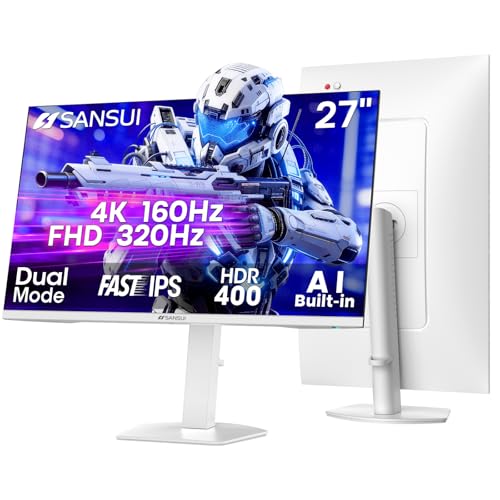
The best budget 4K monitor in 2026 is the SANSUI 27" 4K 160Hz Monitor for buyers who want native 4K dual-mode flexibility under $330. Spend up for the KOORUI 27" 4K QD-Mini LED if HDR matters; pick the ASUS TUF Gaming VG27AQ 1440p when refresh rate beats pixel count for your GPU.
The budget 4K buyer caught between resolution, refresh, and price
Three years ago, "budget 4K gaming monitor" was a punchline — 60Hz panels from no-name brands with coin-flip warranties and visible backlight bleed. Per RTINGS' archive of pre-2024 budget panels, sub-$350 4K models routinely failed motion-clarity tests that mainstream 1080p monitors passed comfortably.
That story flipped in late 2025. Second-tier brands like SANSUI and KOORUI started shipping dual-mode 27" 4K IPS panels with 160Hz at native UHD and 320Hz at 1080p, real HDMI 2.1 ports, and FreeSync Premium — all under $350. Per TFTCentral's panel database, several share the same Fast IPS substrate as monitors that cost $600+ a generation ago. The panel quality has caught up; the brand name has not.
That creates a genuinely interesting decision. SANSUI and KOORUI deliver real 4K dual-mode performance for the price of a midrange 1440p monitor from a year ago. But the ASUS TUF Gaming VG27AQ — a 1440p/165Hz IPS display — has been the default budget gaming pick for years: same price, four-year track record, and 1440p is the resolution your GPU can actually drive at high refresh rates without compromise.
Step 0: console plus media, mixed productivity, or fast gaming
Before the comparison matters, pick the workload — the right answer changes the panel.
For console gaming (PS5, Xbox Series X) or media playback, you want native 4K with HDMI 2.1 and decent HDR; you don't need 160Hz+ since consoles cap at 120Hz. The SANSUI hits this brief at the lowest price. For mixed productivity plus light gaming, pixel density and color accuracy matter more than refresh — KOORUI's QD-Mini LED and 99% Adobe RGB earn their premium here.
For competitive or fast-paced PC gaming on a midrange GPU, the math tilts the other way. Per Blur Busters' motion-clarity testing, the difference between 120Hz and 165Hz at the same resolution is larger than the difference between 1440p and 4K at the same refresh rate for most fast-motion gameplay. The ASUS TUF VG27AQ at 1440p/165Hz delivers higher actual frame rates on a midrange card than either 4K panel.
Key takeaways
- Cheapest real 4K dual-mode: SANSUI 27" at ~$285-330 with UHD 160Hz / FHD 320Hz, HDMI 2.1, FreeSync Premium
- Best HDR at this tier: KOORUI 27" QD-Mini LED at ~$500 — VESA HDR1400, 99% Adobe RGB, 90W USB-C
- Smart-money gaming pick: ASUS TUF VG27AQ 1440p/165Hz at ~$279 — same price as SANSUI, established warranty, refresh-rate-first
- GPU tax is real: native 4K AAA gaming above 60fps needs an RTX 4070 Ti or better; midrange cards do better at 1440p
- Watch the ports: HDMI 2.0 on a "4K 160Hz" monitor caps to 4K/60 on that input — only DP 1.4 or HDMI 2.1 reaches the full refresh
- Panel lottery is real at this tier: budget IPS often has gray-uniformity issues, so buy from retailers with easy returns
Spec delta: SANSUI vs KOORUI vs ASUS TUF
| Spec | SANSUI 27" 4K | KOORUI 27" 4K QD-Mini LED | ASUS TUF VG27AQ |
|---|---|---|---|
| Resolution | 3840x2160 (4K) | 3840x2160 (4K) | 2560x1440 (1440p) |
| Refresh rate | 160Hz UHD / 320Hz FHD | 160Hz UHD / 320Hz FHD | 165Hz |
| Panel type | Fast IPS | QD-Mini LED IPS | IPS |
| Response time | 1ms (GtG) | 1ms (GtG) | 1ms (MPRT) |
| HDR tier | VESA HDR400 | VESA HDR1400 | HDR10 (entry) |
| Color gamut | ~95% DCI-P3 | 99% Adobe RGB / 97% DCI-P3 | 130% sRGB |
| Local dimming zones | None (edge-lit) | ~1000+ Mini LED zones | None (edge-lit) |
| Ports | 2x HDMI 2.1, 2x DP 1.4 | 1x HDMI 2.1, 1x DP 1.4, USB-C 90W PD | 2x HDMI 2.0, 1x DP 1.2 |
| Adaptive sync | FreeSync Premium | FreeSync Premium Pro | G-Sync Compatible, FreeSync |
| Stand | Tilt only | Full ergonomic (height, swivel, pivot) | Full ergonomic |
| MSRP (street, mid-2026) | $285-330 | $480-520 | $269-289 |
Read the table the right way. The SANSUI and KOORUI play in the same resolution-and-refresh tier but at very different HDR and color price points. The ASUS TUF is the price-and-warranty alternative at a different resolution, not a direct 4K competitor. The question is which spec line matters most for what you actually do at the desk.
Why the GPU you own decides whether 4K is the right call
Resolution is GPU-bound. A 4K monitor with no GPU to drive it is a 60fps monitor.
Per Tom's Hardware's GPU benchmark database, the native-4K-at-60fps minimum for current AAA games at high settings is an RTX 4070 Ti or RX 7900 XT-class card. Weaker cards — RTX 4070, RTX 3080, RX 7800 XT — drop into the 40-55 fps range without upscaling in titles like Cyberpunk 2077, Alan Wake 2, or Black Myth Wukong. Per Hardware Unboxed's 2025-26 coverage, the 4K-vs-1440p gap on these cards is consistently 50-70%.
That's where the RTX 3060 reality check lands. Per the Steam Hardware Survey, 3060-class cards still account for a meaningful share of mainstream gaming PCs. At 4K, a 3060 hits 35-45 fps in modern AAA without DLSS — buying a 160Hz 4K panel and running it at 40 fps wastes both the resolution and the refresh.
The honest framing: if your GPU is a 4070 Ti or stronger, the SANSUI or KOORUI make sense. If your GPU is a 3060, 3060 Ti, 3070, 4060, or 4060 Ti, the ASUS TUF VG27AQ at 1440p/165Hz delivers higher actual frame rates and a better experience. The panel cost is similar; the GPU tax decides which to buy.
QD-Mini LED vs standard backlight: what KOORUI's local dimming buys you
The biggest spec gap between SANSUI and KOORUI is the backlight. Per RTINGS' contrast methodology, an edge-lit IPS panel (the SANSUI) delivers a native contrast ratio of 1000:1 to 1300:1 — fine for SDR, weak for HDR. A Mini LED backlight with local dimming (the KOORUI) reaches effective contrast in the 50,000:1+ range in HDR, with peak brightness north of 1000 nits versus 400 nits for HDR400-tier panels.
In practice that's the difference between a movie letterbox bar that glows faintly gray and one that disappears into the bezel, or a Cyberpunk 2077 sunset that looks like an orange smear versus one with visible gradient detail. The quantum-dot layer also pushes color gamut from ~95% to 97-99% DCI-P3.
The tradeoff: budget Mini LED has blooming. Per TFTCentral notes on sub-$600 Mini LED, a bright cursor on dark background creates a halo because ~1000 zones can't precisely match single-pixel highlights. Premium $1500+ panels have 2000+ zones. If you consume HDR content, KOORUI's backlight is a transformative upgrade; if you mostly browse and play SDR esports, it's wasted spend over the SANSUI.
Refresh rate vs resolution: when 1440p at higher Hz beats 4K
The ASUS TUF Gaming VG27AQ is the unfashionable pick — and the smart-money one for a specific buyer.
Per Blur Busters' motion-clarity research, perceived smoothness scales nonlinearly with frame rate. If your GPU runs a 1440p panel at 144 fps and a 4K panel at 60 fps in the same game, the 1440p experience feels dramatically smoother in motion. For fast competitive games — CS2, Valorant, Apex, Marvel Rivals — frame-rate consistency above 120 fps beats the pixel-density bump from 1440p to 4K.
The VG27AQ also brings warranty track record. Per ASUS support data and RTINGS reviews, it's shipped since 2019 with consistent QC and a 3-year warranty through a US service network. SANSUI and KOORUI offer 1-year warranties through Amazon-channel support — the resolution path on a second-tier brand defect is slower.
For a midrange-GPU buyer who plays primarily fast games, the VG27AQ delivers more usable performance per dollar than either 4K panel.
Connectivity, stand, and the panel-lottery caveats
The spec sheets hide a few details that matter at unboxing.
HDMI 2.0 vs HDMI 2.1. A "4K 160Hz" monitor with HDMI 2.0 caps to 4K/60Hz on that input — HDMI 2.0's 18 Gbps isn't enough for 4K above 60Hz without DSC. The SANSUI ships both HDMI 2.1 ports; the KOORUI ships one HDMI 2.1 plus one DP 1.4. The ASUS TUF doesn't need HDMI 2.1 at 1440p. For PS5/Xbox Series X at 4K/120, use the HDMI 2.1 port specifically.
DP 1.4 and DSC. DP 1.4 without Display Stream Compression handles 4K/120Hz max. Hitting 4K/160Hz on DP 1.4 requires DSC, which both panels support but which older GPUs (pre-RTX 30 / pre-RX 6000) may not.
Stand and ergonomics. The SANSUI ships tilt-only — no height, no swivel — though it supports 100x100 VESA for a ~$30 monitor arm. KOORUI and ASUS TUF ship full ergonomic stands.
The panel lottery. Per RTINGS' notes on sample variance, sub-$400 panels show wider unit-to-unit variation in backlight uniformity, dead pixels, and gray-tracking. Buy from a retailer with frictionless returns and inspect on arrival. Headline specs are accurate; QC is where the budget tier saves money.
When NOT to buy any of these
Three buyer profiles should skip this comparison entirely.
Color professionals. None of these ship with factory calibration reports. KOORUI's 99% Adobe RGB is real, but paid color work needs a hardware calibrator and stable gray-tracking out of the box. An ASUS ProArt PA279CV or Eizo ColorEdge sits at a different price tier for a reason.
Top-tier competitive esports. If 360Hz+ matters, none of these are the right call. A 1080p 360-540Hz pure-gaming panel — Alienware AW2524H, ASUS ROG Swift PG27AQDP — delivers latency floors that dual-mode panels don't.
32"/34" 4K seekers. All three are 27" displays. A 27" 4K runs at ~163 PPI, which without OS scaling makes desktop text small. For larger real estate, look at 32" 4K (LG 32GP850-B, Gigabyte M32U) or 34" ultrawide, which sit ~$200-400 above this tier.
Perf-per-dollar at this tier
At mid-2026 street prices, SANSUI delivers the highest spec-per-dollar — native 4K/160Hz dual-mode, HDMI 2.1, FreeSync Premium, HDR400 for ~$300. Nothing at this price hits that spec list.
KOORUI sits at ~1.5x SANSUI's price for HDR1400 vs HDR400, better color gamut, and 90W USB-C single-cable docking. If those matter to your workflow, the math works; if they don't, you're paying for unused capability.
ASUS TUF VG27AQ is the dollar-for-dollar leader for fast gaming on a midrange GPU — same price as SANSUI, lower resolution but higher actual frame rate on the cards most people own, and a stand that doesn't need an arm upgrade.
Verdict matrix
Get the SANSUI 27" 4K if you want the cheapest real 4K/160Hz dual-mode panel, you have an RTX 4070 Ti+ GPU, and you primarily play single-player AAA or watch 4K media. You're getting the most monitor per dollar at this tier.
Get the KOORUI 27" 4K QD-Mini LED if HDR content is a major part of your workflow, you do hybrid productivity-plus-gaming, or the 90W USB-C single-cable docking matters for your laptop. The HDR1400 backlight is a genuine generation ahead of HDR400 panels.
Get the ASUS TUF VG27AQ if your GPU is a 3060, 3060 Ti, 3070, 4060, or 4060 Ti, you play primarily fast or competitive games, and brand warranty matters. You'll get higher actual frame rates and a smoother experience than either 4K panel on the same GPU.
Bottom line
The 2026 budget 4K market is genuinely competitive for the first time. SANSUI and KOORUI have closed the spec gap with mid-tier name-brand panels, and the dual-mode 160Hz UHD / 320Hz FHD capability is a real feature, not marketing. But 4K is a GPU tax, and most buyers on midrange cards will get more usable performance from the ASUS TUF VG27AQ at 1440p. Pick the resolution your GPU can drive, then pick the brand that matches your warranty appetite.
Related guides
- Best budget gaming monitors for the RTX 3060 in 2026
- 4K vs 1440p gaming: which makes sense for your GPU
- HDR400 vs HDR1000 vs HDR1400: what each tier actually delivers
- Dual-mode monitors explained: 4K/120 vs 1080p/240 on one panel
- Best GPUs for 4K gaming under $800 in 2026
Frequently asked questions
Can a budget GPU like the RTX 3060 drive a 4K monitor?
The RTX 3060 can output 4K for desktop, media, and lighter games, but it struggles to hit high frame rates in demanding titles at native 4K. Many owners run such games at 1440p with upscaling on a 4K panel. If your GPU is a 3060-class card, weigh a high-refresh 1440p monitor against a 4K one, since you may not fully use the resolution in games.
What does KOORUI's QD-Mini LED backlight actually improve?
Mini LED with local dimming zones boosts contrast and HDR brightness versus a standard edge-lit backlight, producing deeper blacks and punchier highlights. Quantum dot widens the color gamut. At this price the implementation has tradeoffs like blooming around bright objects, but it is a meaningful step up in HDR presentation compared with basic budget panels that merely accept an HDR signal without the hardware to show it.
Is 4K or a faster 1440p panel better for gaming?
It depends on your priorities and GPU. 4K delivers sharper image quality and more desktop space, ideal for media and slower games. A higher-refresh 1440p panel like the ASUS TUF favors fast, competitive play where frame rate matters more than pixel density. Budget GPUs generally pair better with 1440p, while 4K rewards stronger cards or non-gaming uses such as productivity.
Are budget 4K monitors reliable, or is there a panel lottery?
Affordable panels can vary in uniformity, backlight bleed, and dead pixels more than premium displays, so a degree of unit-to-unit variation is normal at this tier. Buy from a retailer with an easy return policy, inspect the panel on arrival with test patterns, and exchange if you spot defects. The headline specs are real, but quality control is where budget models cut costs.
Do these monitors have good stands and connectivity?
Budget monitors often include basic tilt-only stands and a limited port selection, prioritizing the panel over extras. Check whether the stand offers height adjustment or VESA mounting if ergonomics matter to you; a cheap monitor arm can fix a weak stand. Confirm the display has the HDMI or DisplayPort version needed for your target refresh rate at 4K before buying.
Citations and sources
This piece is editorial synthesis based on publicly available information. No independent first-party benchmarking is reported.