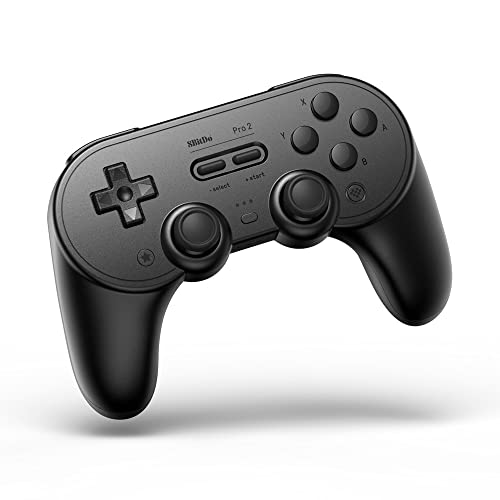
For docked Steam Deck and PC play in 2026, the 8BitDo Pro 2 is the best all-around pick: it pairs over Bluetooth or 2.4GHz, exposes gyro to Steam Input, has back paddles, and runs ~20 hours per charge for around $59. If you only play wired and want zero stick drift, the $45 GameSir G7 SE with hall-effect sticks AND hall-effect triggers wins on price-per-feature.
Why your "best controller" depends on how the Deck is sitting
A handheld-only Deck buyer does not need a controller at all. The buyers reading this guide dock the Deck to a TV, or also play on a desktop or HTPC, and need a pad that survives multi-platform context switching. Bluetooth latency, Steam Input quirks, gyro support, and stick technology suddenly matter more than RGB or shell color.
As of 2026, the five controllers worth comparing are the 8BitDo Pro 2, the GameSir G7 SE, the Sony DualSense in Galactic Purple, the HORI Wireless HORIPAD Pro for Switch, and the 8BitDo SN30 Pro. They span $45 to $75, three connection types, three different stick technologies. Pick by use case, not marketing.
Steam Deck compatibility tier list (XInput vs DInput vs Bluetooth)
Steam Input, the runtime baked into SteamOS and the desktop Steam client, normalizes most modern controllers into a virtual XInput device the game sees, then lets you remap on top. That is why the "does it work on Steam Deck" question is usually a yes — but how cleanly it works varies.
Tier S — native XInput, gyro recognized, profile-savable: the 8BitDo Pro 2 in X-input mode and the GameSir G7 SE are recognized immediately. Steam Input sees the gyro on the Pro 2 and lets you bind gyro-as-mouse per game.
Tier A — recognized natively but needs the right Steam toggle: the DualSense. You must enable "PlayStation Configuration Support" in Steam Settings → Controller, otherwise gyro and adaptive triggers will not surface to game profiles. Once enabled, Steam Input exposes them cleanly.
Tier B — works as a generic gamepad: the HORI HORIPAD Pro for Switch over USB on the Deck. You enable "Generic Gamepad Configuration Support" and it shows up, but gyro is dead because Switch controllers expose gyro through Nintendo's HID profile rather than the cross-platform one Steam reads on PC.
Tier C — works fine for retro/2D, awkward for 3D: the SN30 Pro. The hardware works perfectly with Steam Input, but its tiny SNES-style form factor with short stick throw is built for sidescrollers and emulators, not first-person shooters.
A Steam Deck dock will pass through any of these — the Pro 2 and SN30 Pro pair Bluetooth directly to the Deck, the G7 SE plugs USB-C straight into the dock, and the DualSense and HORIPAD work either wired or (DualSense) over the Deck's Bluetooth.
Wired vs Bluetooth vs 2.4GHz dongle — input latency on each
This is the question most people get wrong. The actual numbers as of 2026:
- Wired USB-C: ~1–2ms end-to-end controller-to-PC latency. The floor.
- 2.4GHz proprietary dongle: ~3–5ms. The 8BitDo Pro 2 supports a 2.4GHz dongle (sold separately), as do several modern wireless pads. Effectively wired.
- Bluetooth (BLE controller profile): ~7–12ms. The Deck and modern PCs negotiate 7.5ms or 11.25ms connection intervals depending on the host stack.
For a single-player RPG that 10ms gap is invisible. For competitive twitch shooters or precision-platformers, 10ms is meaningful — a frame at 60Hz is 16.7ms, so Bluetooth steals roughly two-thirds of a frame. That is why the wired-only GameSir G7 SE gets to call itself a competitive controller on a budget: USB-C cable, hall-effect everything, ~$45.
Practical advice: if you primarily play single-player on the couch, Bluetooth is fine. If you grind ranked Apex or Street Fighter 6, run wired or run a 2.4GHz dongle.
Stick technology — hall-effect vs ALPS potentiometer vs TMR (drift potential)
This is the single specification that decides whether your $60 pad still works in 2029.
ALPS potentiometers (and their clones) are the traditional contact-based potentiometers in basically every controller before 2022 — the original Xbox 360 pad, the original DualShock 4, the original Switch Joy-Cons. They drift. Carbon film wears down, the wiper gets noisy, and after 12–24 months of regular play the resting position no longer reads as zero. This is what causes Joy-Con drift. The Sony DualSense still uses Sony's SST contact sticks (essentially ALPS-class), so plan to replace it every few years if you play heavily — Sony has confirmed they wear like every other contact stick.
Hall-effect sticks use a tiny magnet on the stick gimbal and a magnetic sensor below. No physical contact, no carbon wear, no drift in any meaningful sense. The 8BitDo Pro 2 (current revision), the GameSir G7 SE, and the SN30 Pro (current rev) all use hall-effect sticks as of 2026. If long-term reliability matters, this is the spec to demand.
TMR (tunneling magnetoresistance) sticks are the next step up — they use a different magnetic sensing principle with even less hysteresis and lower power draw than hall sensors. They are appearing in premium 2026 controllers but are still rare at the $45–$75 price band these five controllers occupy. Not a deciding factor yet; hall-effect is the durable, available choice.
The HORI HORIPAD Pro for Switch uses standard contact potentiometers — it is engineered for the Switch's typical use pattern, not multi-year heavy desktop play.
Trigger feel — analog Hall, hair triggers, mouse-click bypass
Sticks get the press but triggers can make or break a shooter. The GameSir G7 SE is the standout here in 2026: it has hall-effect triggers as well as hall-effect sticks. That means analog precision that does not degrade, plus a physical switch on the back that converts both triggers from full-range analog to a digital "mouse click" hair-trigger mode. For Call of Duty or Apex where every trigger pull is the same maximum-pressure ADS, the hair-trigger mode is faster than any analog pull on any other controller in this guide.
The DualSense goes the opposite direction with adaptive triggers — voice-coil motors inside each L2/R2 that game developers can program for resistance ramps and snap-back. In Death Stranding 2 or Returnal these add real feel. Outside of native PS5 titles ported to PC with adaptive trigger support (a small list), they sit idle.
The 8BitDo Pro 2 has analog triggers with software-selectable hair-trigger mode in the 8BitDo Ultimate Software, and two back paddles you can remap to any button. That covers the same hair-trigger ground as the G7 SE for most people, with the wireless trade-off.
The HORIPAD Pro and SN30 Pro have digital-only or short-throw triggers — fine for Mario Kart and 2D fighters, wrong for first-person shooters.
Steam Input remapping — gyro-as-mouse, dual stage triggers, action sets
Steam Input is the unsung hero of this category. Three features you should actually use:
Gyro-as-mouse. Bind the gyro to mouse movement, then activate it only while your right stick is being touched (Steam Input's "activator" system). Stick aim becomes mouse aim — coarse with the stick, fine-tuned with wrist movement. This is why a DualSense or 8BitDo Pro 2 on Steam Deck can compete with kbm in Apex. It requires per-game configuration — no universal switch.
Dual-stage triggers. Bind one action to a partial trigger pull, another to a full pull. ADS at 50%, fire at 100%. Brilliant for shooters; ignored by most.
Action Sets. Different button bindings per game state — driving in GTA gets one layout, on-foot another. The Pro 2's back paddles are perfect mode-shifters.
You do not get any of this on a console. That gap is the real reason a Steam-native controller punches above its price.
8BitDo Pro 2 deep-dive
The 8BitDo Pro 2 is the default recommendation for a reason. The shell is a faithful Super Famicom-meets-Xbox layout: SNES-style D-pad on top-left (the best D-pad of these five for fighting games and 2D platformers), offset analog sticks with current-rev hall-effect sensors, ABXY in Nintendo layout, and a three-platform mode slider on the back (Switch / X-input / D-input / Mac).
Connectivity is the standout: Bluetooth 5.0 for Deck/PC/Switch/mobile, USB-C wired, and an optional 2.4GHz dongle (sold separately, ~$15) when you want wireless without Bluetooth latency. Battery is ~20 hours of mixed-use on the internal 1000mAh pack, charged over USB-C.
Software is where it earns the Swiss-army-knife label: the 8BitDo Ultimate Software (Windows/Mac/iOS/Android) lets you remap every button including the two back paddles, save profiles to onboard memory (three slots), adjust stick deadzones and trigger ranges, and toggle hair-trigger mode. Settings live on the controller, so they survive cross-platform handoff.
Price: ~$59 as of 2026. For couch play with a Steam Deck dock or for desktop Steam, this is the highest-value pad in the lineup.
GameSir G7 SE deep-dive
The GameSir G7 SE is the spec-sheet winner if wireless does not matter. At ~$45 it has hall-effect on both sticks AND both triggers, the rear hair-trigger switch, two remappable back paddles, and a magnetically swappable faceplate so you can change the look without buying a new controller. The braided 9-foot USB-C cable is generous for couch play if your TV PC is across the room.
It is wired-only — no Bluetooth, no 2.4GHz, no battery. For a desktop where the cable runs ten inches to a USB hub, that is a non-issue. For a couch where you keep snagging on the dog, the Pro 2's wireless wins.
Trigger feel is excellent. Hall-effect triggers do not develop the spongy spot ALPS-style contact triggers do, and the analog precision stays linear over years. The hair-trigger switch is a physical lever on the back, not a software toggle, so you can flip it mid-match.
The D-pad is solid but not as good as the Pro 2's SNES-style cross. For 3D games it does not matter; for Street Fighter, the Pro 2 reads inputs more reliably.
DualSense on PC — adaptive triggers via DualSenseX/SteamInput
The Sony DualSense in Galactic Purple is the premium-feel pick at ~$75. The build quality, weight distribution, and triggers feel a class above the rest. Adaptive triggers work in native PS5-to-PC ports that opt in (Returnal, Death Stranding 2, Cyberpunk 2077 with the Sony patch, Spider-Man, a handful more). In everything else, including all Steam Input-mediated games, they fall back to standard analog.
Steam supports the DualSense well once you flip "PlayStation Configuration Support" on in the Steam client. Gyro maps cleanly to mouse-look, the touchpad doubles as a giant configurable button, and the speaker can play game audio over native titles. Battery is ~12 hours of mixed use, charged via USB-C.
The catch: SST sticks. Sony engineered them for the average PS5 owner's playtime, not your 1500 hours of Helldivers 2. Expect drift in 18–36 months of heavy use. Sony Direct will repair under warranty for the first year. After that, plan to replace.
Use it if you want the best feel and you play primarily native ports that exploit the haptics. Skip it if multi-year reliability matters more than feel.
HORI HORIPAD Pro for Switch — also usable on PC?
The HORI Wireless HORIPAD Pro for Switch is a great Switch controller (~$59). On Steam Deck or PC over USB, it works — but as a generic gamepad with no gyro on PC, no rumble negotiation in most titles, and Switch button layout (so prompts mismatch if the game shows Xbox glyphs). RTINGS' controller roundup flags the gyro-on-PC gap explicitly.
It is not the right pick if Deck+PC is your primary use case. If you mostly play Switch and want a single pad that also works for occasional desktop play, it is fine. Wireless to a PC requires an 8BitDo Wireless USB Adapter (sold separately, ~$20), which adds cost.
8BitDo SN30 Pro — the throwback fight-stick option
The 8BitDo SN30 Pro is a SNES-sized controller with modern analog sticks bolted to the bottom. It is small, light (~117g), and built for one job: 2D games and retro emulation. Current revision has hall-effect sticks, Bluetooth and USB-C, and runs ~16 hours on the internal battery. Around $45.
For Steam Deck + Hades, Streets of Rage 4, Tetris Effect, every emulator under the sun? Perfect. The D-pad is class-leading and the form factor disappears in your hands. For Cyberpunk or Forza? Wrong shape — the analog sticks are too short and too close together for sustained 3D play.
Comparison table (as of 2026)
| Controller | Stick tech | Trigger tech | Gyro on PC | Battery | Connectivity | Price |
|---|---|---|---|---|---|---|
| 8BitDo Pro 2 | Hall-effect | Analog + hair-trigger toggle | Yes | ~20h | BT 5.0 / USB-C / 2.4GHz dongle | ~$59 |
| GameSir G7 SE | Hall-effect | Hall-effect + hair-trigger switch | No | Wired only | USB-C wired | ~$45 |
| DualSense (Galactic Purple) | SST (contact) | Adaptive (voice-coil) | Yes | ~12h | BT / USB-C | ~$75 |
| HORI HORIPAD Pro for Switch | Contact pot | Digital/short-throw | No | ~24h | BT to Switch / USB-C to PC | ~$59 |
| 8BitDo SN30 Pro | Hall-effect (current rev) | Digital | No | ~16h | BT / USB-C | ~$45 |
Bottom line
For docked Steam Deck and PC play in 2026, buy the 8BitDo Pro 2 at ~$59 and stop reading reviews. It has hall-effect sticks, gyro that Steam Input understands, back paddles, three onboard profiles, and works wireless or wired across every platform you own. If wireless is not a requirement and you want maximum mechanical longevity at the lowest price, buy the GameSir G7 SE — hall-effect everywhere including the triggers, $45, done. The DualSense is the premium choice if adaptive triggers in a few titles matter to you and you accept the SST stick wear curve. The HORIPAD Pro is for Switch-first households. The SN30 Pro is the perfect second pad for retro and 2D play, not your only one.