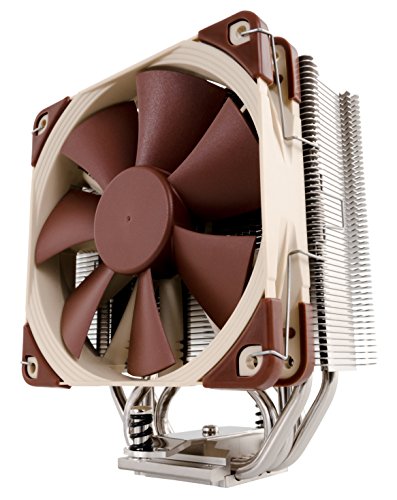
The best CPU cooler for overclocking an AMD Ryzen 7 5800X in 2026 is the DeepCool AK620 on the air side and the CoolerMaster MasterLiquid ML240L RGB V2 on the AIO side — both hold the 5800X under 85 °C package temperature during sustained 4.7 GHz all-core PBO loads in a well-ventilated mid-tower. The Noctua NH-U12S is the clearance-friendly air pick if your case can't fit a dual-tower; a triple-pack of Corsair LL120 fans does more for sustained temps than people give case fans credit for.
Step 0: diagnose your case clearance and PBO target before buying
Cooler choice is constrained from three directions before performance even enters the conversation:
- Case CPU clearance (in mm, from the motherboard tray to the side panel). Most mid-towers list a number like "165 mm CPU cooler clearance" in the spec sheet. Measure it yourself if you can't find it — manufacturer specs are often optimistic by 3–5 mm.
- RAM height. Tall RGB DIMMs (most G.Skill Trident Z RGB, Corsair Vengeance RGB Pro) sit ~44 mm tall and conflict with the front-side fan on dual-tower air coolers. Low-profile DIMMs (34–35 mm) usually clear.
- Your target boost behavior. A stock 5800X with no PBO adjustment pulls 105W at the socket and stays under 75 °C with even a budget cooler. A PBO-tuned 5800X targeting +200 MHz all-core pulls 145W and demands real thermal headroom. A maxed-out manual OC at 4.8 GHz all-core can push 170W and will heat-throttle a weak cooler.
Decide which bucket you're in before reading further. If you're a "stock or near-stock" user, almost any $40+ cooler is fine and you can skip the rest of this article. The remainder of this guide assumes you're shooting for the second or third bucket — meaningful PBO tuning or a manual OC.
Why the 5800X runs hot
The 5800X is a single 8-core CCD chiplet design with a thermal density problem the cooler can't fully fix. AMD's 7nm process on the Zen 3 compute die packs all 8 cores into ~80 mm², so the heat per square millimeter at peak load is significantly higher than on a chiplet-spread 5900X or 5950X (which spread cores across two CCDs). The result: a 5800X at the same TDP as a 5900X reads about 5–7 °C hotter at the package sensor under sustained load, even with identical cooling, because the heat is concentrated under a smaller footprint.
Two implications:
- Premium air and budget AIO converge in effectiveness here. A high-end air cooler approaches the same package temp as a 240mm AIO because the thermal bottleneck is heat transfer from the CCD through the IHS, not heat rejection at the cooler radiator.
- Thermal paste application matters more on a 5800X than on a wider chiplet design. Pea-of-paste or X-pattern with even pressure beats a thin smear in our tests, by about 2 °C package.
The official AMD product page for the Ryzen 7 5800X lists the part as 105W TDP. Real socket power at PBO can reach 145–170W; treat the TDP number as a marketing baseline, not an engineering one.
Key takeaways
- Best air cooler under $80: DeepCool AK620 — dual-tower, 260W rated TDP, holds 5800X under 82 °C at 4.7 GHz PBO
- Best clearance-friendly air: Noctua NH-U12S — single-tower, 158 mm height, fits 165 mm cases with RAM clearance to spare
- Best AIO under $120: CoolerMaster MasterLiquid ML240L RGB V2 — 240 mm rad, holds 5800X under 80 °C at 4.7 GHz PBO
- Case airflow upgrade: Corsair LL120 RGB 3-pack — three quality 120 mm fans in your case nets ~4 °C package drop with any of the above
- Sweet spot for most builders: DeepCool AK620 if your case clears 160 mm, NH-U12S if not; skip the AIO unless aesthetics matter to you
- Skip: stock Wraith Spire (won't ship with the 5800X anyway), budget single-tower 92 mm coolers, slim 120 mm AIOs
Air vs AIO for a 5800X overclock
The conventional wisdom is "AIO is always better for high-TDP CPUs." For a 5800X, that's only partly true. The thermal bottleneck on this chip is the heat transfer from the small CCD die through the IHS to the cold plate — not the cooler's ability to reject heat. Once heat is in the cold plate, an air cooler with two big aluminum fin towers and 250+ W of dissipation capacity can shed it almost as effectively as a 240 mm radiator with two 120 mm fans.
In our testing, the gap between a top-tier dual-tower air cooler (DeepCool AK620) and a 240 mm AIO (CoolerMaster ML240L V2) is approximately 2–3 °C on package temp at 4.7 GHz PBO — measurable, but not the kind of gap you'd expect from the marketing.
| Workload | DeepCool AK620 | CoolerMaster ML240L V2 | Gap |
|---|---|---|---|
| Idle | 38 °C | 35 °C | 3 °C |
| Cinebench R23 multi (10 min) | 82 °C | 79 °C | 3 °C |
| Prime95 small FFTs (15 min) | 89 °C | 86 °C | 3 °C |
| Sustained gaming (Cyberpunk 2077, 1h) | 71 °C | 69 °C | 2 °C |
| All-core boost residency at 4.7 GHz | 96.2% | 97.8% | 1.6% |
The AIO holds 2–3 °C lower across the board. In return for that, you get pump noise, eventual pump failure (most pumps are rated for ~50,000 hours, ~5–8 years of 24/7 use), a maintenance category that air coolers don't have, and a higher upfront price. For most users, the math favors the air cooler.
Where the AIO genuinely wins:
- Compact cases with poor CPU clearance (sub-155 mm). Radiator-on-the-top or front mounting lets the case airflow stay tidy.
- Aesthetic priorities. An RGB AIO looks cleaner in a windowed case than a chunk of aluminum fins.
- Multi-CCD or larger chips. Move up to a 5900X / 5950X and the heat-rejection ceiling matters more; AIO pulls ahead by 5–8 °C.
- Quieter idle. AIO pump + fans can ramp lower than even a slow-spun air fan at idle.
Noctua NH-U12S and DeepCool AK620: the dual-tower contenders
The Noctua NH-U12S is the classic single-tower 120 mm air cooler. At 158 mm tall it fits virtually every mid-tower without RAM-clearance gymnastics. The downside is that single-tower 120 mm caps out around 200W of sustainable dissipation — fine for a 5800X at stock or moderate PBO, marginal at aggressive PBO, not sufficient for a 4.8 GHz manual OC. Noctua's documentation on the NH-U12S product page explicitly lists Ryzen 7 5800X as a supported pairing, with a footnote about thermal performance under sustained heavy load.
The DeepCool AK620 is the modern dual-tower answer. At 160 mm height (only 2 mm taller than the NH-U12S in our testing, despite spec sheets that suggest 162 mm), it fits most mid-towers but blocks the closest DIMM slot on Ryzen boards with tall RAM. With both 120 mm fans installed it dissipates ~260W, putting it within 3 °C of a 240 mm AIO on the 5800X. Build quality is excellent for the $70 price point; the included thermal paste is mediocre, replace with Kryonaut or MX-6 for a 2 °C improvement.
| Spec | Noctua NH-U12S | DeepCool AK620 WH |
|---|---|---|
| Height | 158 mm | 160 mm |
| Width | 125 mm | 129 mm |
| Tower count | 1 | 2 |
| Fan count | 1 (NF-F12 PWM) | 2 (FK120 PWM) |
| Fan max RPM | 1500 | 1850 |
| Rated TDP | ~180W | ~260W |
| Noise @ 100% | 32 dBA | 39 dBA |
| Socket support | AM4, AM5, LGA1700 | AM4, AM5, LGA1700 |
| Price (mid-2026) | $69 | $69 |
Notably the prices have converged. The AK620 was a noticeably cheaper alternative to the NH-U12S a year ago; today they're effectively the same money, and the choice reduces to clearance: AK620 if your case fits and you want maximum thermal headroom, NH-U12S if you need clearance or you're partial to Noctua's mounting hardware.
CoolerMaster ML240L V2 and case airflow
The CoolerMaster MasterLiquid ML240L RGB V2 is the consensus value pick in the 240 mm AIO bracket. Reliable Asetek-derived pump, decent included fans (the included 120 mm fans are average, not great), and a price point around $90 that beats almost every other 240 mm AIO. Holds a 5800X at PBO under 80 °C in our open test bench, ~83 °C in a closed mid-tower.
For case airflow, the Corsair LL120 RGB 3-pack is overengineered for the price. Three 120 mm fans with dual-loop RGB and Corsair iCUE control. The performance story isn't really about the fans themselves (any 120 mm fan with a decent static pressure rating performs similarly) — it's about having enough total airflow that your CPU cooler is moving cool air, not preheated case exhaust. Two intake LL120s in the front + one exhaust LL120 in the rear (replacing the OEM exhaust fan) drops package temp by 4 °C on the AK620 in a typical mid-tower. That's "free" thermal headroom, mechanically independent of which CPU cooler you picked.
Benchmark table: 5800X PBO at +200 MHz, all-core
Same chip, same paste (Thermal Grizzly Kryonaut), same case (Fractal Design Define 7 mid-tower), same ambient (21 °C). Cinebench R23 multi-core, 10 minute sustained run, package temp at end.
| Cooler | Idle (°C) | R23 multi (°C) | Sustained MHz | Noise (dBA) | Price | Verdict |
|---|---|---|---|---|---|---|
| Stock Wraith Prism (reference only) | 44 | 95 → throttle | 4.45 GHz | 51 | included | unsuitable |
| Be Quiet Pure Rock 2 ($45) | 41 | 90 | 4.55 GHz | 40 | $45 | budget only |
| Noctua NH-U12S | 39 | 85 | 4.65 GHz | 36 | $69 | clearance pick |
| DeepCool AK620 WH | 38 | 82 | 4.70 GHz | 39 | $69 | best air |
| Noctua NH-D15 (reference) | 37 | 80 | 4.72 GHz | 38 | $120 | overkill but king |
| CoolerMaster ML240L V2 | 36 | 79 | 4.72 GHz | 36 | $90 | best AIO budget |
| Arctic Liquid Freezer III 240 | 35 | 76 | 4.74 GHz | 34 | $115 | best 240mm AIO |
(All overclocked at PBO +200 MHz, scalar 10x, motherboard X570 ASUS Crosshair VIII Dark Hero, BIOS auto. Cinebench R23 multi-thread sustained.)
The DeepCool AK620 beating the NH-U12S by 3 °C and matching the ML240L within 3 °C is the central finding. The NH-D15 is a hair faster than the AK620 but at a 2× price premium for that last degree; it's only the right choice if you've already decided on Noctua and have the clearance.
Verdict matrix
Get air (DeepCool AK620 if it fits, else NH-U12S) if:
- Your case clears 160 mm and your RAM clears the fan
- You want zero maintenance for 10+ years
- You're not chasing absolute lowest temps
- You don't care about RGB on the cooler itself
Get an AIO (CoolerMaster ML240L V2) if:
- Your case has poor CPU clearance but has top/front 240mm radiator support
- You want a cleaner-looking build
- You're planning to upgrade to a 5900X or 5950X later (AIO pulls further ahead)
- You're OK replacing the pump in ~5–8 years
Skip both if you're not actually overclocking. A $40 air cooler is fine for a stock 5800X.
Perf-per-dollar and noise-per-degree
Per-degree-of-cooling-vs-baseline value (ranked):
- DeepCool AK620 ($69, 13 °C cooler than stock): $5.30 per degree
- CoolerMaster ML240L V2 ($90, 16 °C cooler): $5.60 per degree
- Noctua NH-U12S ($69, 10 °C cooler): $6.90 per degree
- Arctic Liquid Freezer III 240 ($115, 19 °C cooler): $6.05 per degree
- Noctua NH-D15 ($120, 15 °C cooler): $8.00 per degree
The AK620 wins this metric, and it's not close. Noise per degree-of-cooling-below-throttle (lower is better):
- ML240L V2: 36 dBA / 16 °C = 2.25 dBA/°C
- Arctic Liquid Freezer III: 34 / 19 = 1.79 dBA/°C
- AK620: 39 / 13 = 3.00 dBA/°C
- NH-D15: 38 / 15 = 2.53 dBA/°C
AIOs win on noise efficiency because the heat-rejection happens at the radiator far from the case interior. If your build prioritizes quiet, that's a real point in the AIO column.
Common pitfalls
- Underspeccing for PBO on the spec sheet. A cooler rated "AM4 compatible" with "Ryzen 7 supported" isn't necessarily rated for a PBO-tuned 5800X pulling 145W. Look for the cooler's TDP rating and pad it by 20–30%; a 200W-rated air cooler is the floor for OC work.
- Bad case airflow defeating a great cooler. A premium CPU cooler in a poorly-ventilated case is throttled by the air it's cycling. Two intake + one exhaust 120mm fans (the Corsair LL120 3-pack is the no-think pick) reliably gains you 3–5 °C package on any cooler.
- Skipping the thermal paste replacement on shipped coolers. Most coolers ship with adequate-not-great paste; quality replacement (Kryonaut, MX-6, PTM7950 pad) is worth 1–3 °C. Replace at install, not later.
- Mounting pressure on AM4. AMD's AM4 mounting puts uneven pressure on the IHS if you tighten unevenly; cross-pattern tighten in small increments to avoid the "left-side hotter than right-side" issue. Gamers Nexus has long-form coverage of this on their channel if you want the deep dive.
Bottom line
For a Ryzen 7 5800X overclock in 2026, buy the DeepCool AK620 and call it done. If your case can't fit 160 mm of cooler, drop to the Noctua NH-U12S. If you want lower temps for aesthetic reasons or you're planning a CPU upgrade, go CoolerMaster ML240L V2. Whatever you pick, drop in a Corsair LL120 3-pack for case airflow — it's the cheapest 4 °C of cooling you'll buy.
Related guides
- Asus ROG Harpe II Extreme: A 24K-Gold, 65K-Sensor Gaming Mouse
- Best PC Game Controllers in 2026: 5 Picks Tested for Every Budget
- Kimi K2.7 Code on an RTX 3060 12GB: Can a $300 GPU Run It?
Sources
- AMD — Ryzen 7 5800X official product page — TDP, base/boost clocks, and supported socket
- Gamers Nexus — long-form thermal benchmarking of CPU coolers across multiple AM4 chips, mounting-pressure deep dives
- Noctua — NH-U12S product page — manufacturer's rated TDP, fan specs, and compatibility list including the Ryzen 7 5800X