Short answer: For a first homelab in 2026, start with a Raspberry Pi 4 8GB if your goal is to learn Linux, run a Pi-hole / Home Assistant / one or two containers, and spend under $150 total. Step up to a Ryzen 5 5600G mini-PC (or DIY mini-ITX build) when you want to run real VMs, a Postgres database, a Nextcloud, or three-plus services that share a host. The split is workload, not budget.
The honest first-month question
Every "should I buy a Pi 4 or a mini-PC" thread on r/homelab starts with the same framing: "what's the best starter homelab in 2026?" That framing is wrong. The right question is "what do I want my homelab to actually do in month two?" The answer to that picks the hardware.
This guide walks through both options, the workloads each handles well, the cost math for a full first month, and the failure modes that catch first-time homelabbers off-guard. Year stamp: prices and software ecosystem assumptions are accurate as of mid-2026.
Key takeaways
- Pi 4 8GB ($75-95 + accessories ≈ $130-160): Best for learning, low-power 24/7 services, one-job appliances.
- Ryzen 5 5600G mini-PC or build ($350-450): Best for two-plus VMs, containerized services, a real homelab "node."
- Don't pick by raw compute. The 5600G is 4-6× faster than the Pi 4 but consumes 8-10× more power at idle.
- Storage matters fast. A microSD card on the Pi will fail under heavy logging within months — plan for SSD-over-USB from day one.
- Skip the cheap "N100 mini-PC" trap. They look great on paper, but driver and cooling quality varies wildly across no-name brands.
Profile A: the Pi 4 starter
The Raspberry Pi 4 Model B 8GB is the entry-level pick that millions of homelabbers have started with. The official Raspberry Pi 4 product page lists the spec: quad-core Cortex-A72 @ 1.5 GHz, 8 GB LPDDR4, dual-band Wi-Fi, gigabit Ethernet, 2× USB 3.0, 2× USB 2.0, dual micro-HDMI. Power draw at idle is around 3.5 W; under sustained load it tops out around 7 W.
What the Pi 4 handles well:
- Pi-hole as the household DNS / ad-blocker. The canonical Pi 4 workload.
- Home Assistant (the OS image, not just core) for smart-home automation.
- A small Docker host running 2-3 lightweight containers (e.g., Uptime Kuma, Watchtower, a self-hosted RSS reader).
- AdGuard, UniFi Network Application, Plex (for music or transcoded-by-the-client video).
- A static-site reverse proxy (Caddy, Traefik) fronting a couple of personal apps.
What the Pi 4 does not handle well:
- Multiple simultaneous Postgres / MySQL workloads under load.
- Anything that benchmarks CPU heavily (large media transcodes, code compilation, ML inference).
- Heavy logging or write-amplification workloads — they kill microSD cards inside 6-12 months.
- More than one VM. Containers are fine; full VMs need more CPU and RAM.
The Pi 4's secret weapon is power. At ~5 W average draw, a year of 24/7 operation costs roughly $6 in residential US electricity. The mini-PC equivalent costs $40-80 a year. For a service that's truly 24/7-on (DNS, smart-home), the Pi pays back the up-front cost difference every two years.
Profile B: the Ryzen 5 5600G mini-PC
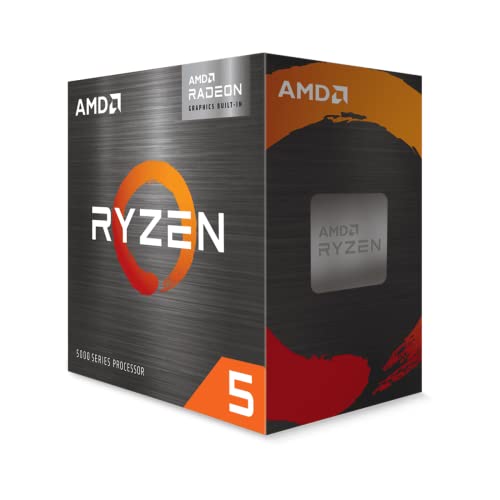
The Ryzen 5 5600G (Amazon Ryzen 5 5600G) is the canonical "first real homelab CPU" in 2026 because it's six cores / twelve threads, has the Vega 7 iGPU (no discrete GPU needed for headless work), and slots into the cheap mature AM4 ecosystem. The official Ryzen 5 5600G product page lists 65 W TDP and DDR4-3200 support.
Two ways to get to a 5600G build:
- Buy a prebuilt mini-PC with the 5600G inside (Beelink SER5 Pro, Minisforum HX99G, etc.). Typical price: $400-500 for 16 GB RAM and a 500 GB NVMe.
- Build a DIY mini-ITX rig with the 5600G, a B450/B550 ITX board, 16 GB DDR4, and a small SFX power supply. Total around $450-550 for a quieter, more upgradable, more repairable box.
What the 5600G mini-PC handles well:
- Proxmox or ESXi running 3-5 VMs simultaneously.
- Containerized stack: Portainer, 10+ containers, Caddy, Postgres, Nextcloud, a wiki, a Git host, monitoring (Grafana + Prometheus).
- Plex with hardware-accelerated transcoding of 4K HEVC to 1080p H.264.
- Local Ollama or llama.cpp for small (1B-3B) models on the iGPU or via CPU inference for 7B at single-digit tok/s.
- Personal CI runner for moderate code builds.
Failure modes:
- Heat. Tiny mini-PCs throttle under sustained load. The DIY mini-ITX build with a decent cooler avoids this.
- Power. At idle, 18-25 W. Under sustained load, 60-85 W. Order of magnitude more than the Pi.
- Wireless reliability on some prebuilt mini-PCs is uneven — Ethernet is the safe path.
Workload-by-workload comparison
| Workload | Pi 4 8GB | Ryzen 5 5600G mini-PC | Winner |
|---|---|---|---|
| Pi-hole DNS for a household | Flawless | Overkill | Pi 4 |
| Home Assistant (one user) | Good | Better | Pi 4 (power) |
| 5+ Docker containers, mixed | Strained | Effortless | 5600G |
| Postgres + Nextcloud + Photoprism | Struggles | Smooth | 5600G |
| Plex 1080p direct-play | Fine | Fine | Pi 4 (power) |
| Plex 4K HEVC → 1080p transcode | Fails | Smooth | 5600G |
| Proxmox + 3 VMs | Not supported | Smooth | 5600G |
| Local 7B LLM at 5+ tok/s | Painful | Workable (CPU) | 5600G |
| Tiny static site behind Caddy | Fine | Fine | Pi 4 (power) |
| CI build runner | Slow | Decent | 5600G |
The split is pretty clean. Single-purpose, low-throughput, always-on services live happily on the Pi 4 with single-digit power draw. Anything multi-tenant, anything CPU-bound, anything that wants to run a real database with real traffic — that's the 5600G's tier.
Storage: don't skip this
A microSD card on the Pi 4 dies a slow death under heavy logging. Plan from day one to boot the Pi from external USB SSD. The Crucial BX500 1TB SATA SSD in a USB 3.0 enclosure or the WD Blue SN550 1TB NVMe in a USB 3.1 NVMe enclosure both work well. The Pi 4 supports USB boot natively since the 2020 firmware update; once configured, the microSD card slot stays empty.
On the 5600G build, an NVMe drive is the obvious choice — internal M.2 slot, faster than SATA, no enclosure needed. The WD Blue SN550 1TB is the value pick; faster Gen4 drives exist but the wins are minimal for homelab workloads.
The community resource that has been the longest-running reference for hardware comparisons is ServeTheHome, which publishes deep-dive reviews of mini-PCs, NICs, NVMe drives, and the rest of the homelab hardware stack.
First-month total cost: the actual numbers
Pi 4 starter kit
| Item | Cost |
|---|---|
| Raspberry Pi 4 8GB | $75 |
| Official PSU + case + microSD | $40 |
| 1 TB USB SSD (Crucial BX500 + enclosure) | $80 |
| Ethernet cable, HDMI cable | $10 |
| Total | $205 |
| Monthly power cost @ 5W average | ~$0.50 |
Ryzen 5 5600G DIY mini-ITX build
| Item | Cost |
|---|---|
| Ryzen 5 5600G | $160 |
| B550 mini-ITX motherboard | $130 |
| 16 GB DDR4-3600 | $50 |
| WD Blue SN550 1TB NVMe | $80 |
| SFX PSU 450W | $90 |
| Mini-ITX case | $60 |
| Cooler (low-profile) | $35 |
| Total | $605 |
| Monthly power cost @ 25W average | ~$2.40 |
The Pi 4 is roughly a third of the up-front cost and a fifth of the running cost. The 5600G build handles maybe 5-10× the workload. Which is "better value" depends entirely on whether you'll actually use the extra capacity.
Common pitfalls
- Pi 4 with no SSD. MicroSD cards die under sustained writes. Plan for external SSD or a Pi 5 with NVMe HAT.
- 5600G mini-PC running hot in a closet. Tiny fans struggle. Either pick a model with a real heatsink (Beelink SER5 Pro) or do the DIY build.
- No backups. Day one of homelab: figure out backups. Restic to Backblaze B2 is the cheapest solid choice.
- No DNS-level segmentation. Run Pi-hole or AdGuard on the homelab so a single misconfigured container can't exfiltrate your whole LAN.
- Buying both at once. Start with one. Add the other in month three if your workload outgrows the first.
- Ignoring power. Two of these boxes plus a switch plus a small NAS is real wattage. Budget for it.
Real-world: three homelabbers, three picks
Builder A — just wants Pi-hole and Home Assistant. Pi 4 8GB + USB SSD. Under $210 total, 4 watts average draw. Will outlast the next three router refreshes.
Builder B — wants to learn Linux + run Plex for the family. Either path works, but the 5600G build wins on transcoding. Spend the $605 once, get a flexible host that handles three-plus services.
Builder C — wants a serious homelab to learn Proxmox / Docker / Postgres / monitoring. The DIY 5600G build is the right starting point. Add a second box (matching Pi 4 for DNS, or a second mini-PC for cluster experiments) in month three or four.
When NOT to do either
If your only need is "remote backup my photos and laptops," a $300 4-bay Synology DS224+ is a better answer than either option here — it's purpose-built, has good first-party software, and Just Works. If you need GPU compute (real LLM inference, ML training), neither of these is the right path — that's an RTX 3060 12GB-class discrete GPU conversation in a tower case. Homelabs are about flexibility; if you've already nailed down the one job, buy the appliance.
Bottom line
- First homelab, single-purpose: Raspberry Pi 4 8GB + USB SSD. Cheapest, lowest-power, best teacher.
- First homelab, multi-purpose: Ryzen 5 5600G DIY build or mini-PC. Real CPU capacity, real upgrade path.
- Storage: Crucial BX500 1TB SATA for the Pi external boot; WD Blue SN550 1TB NVMe for the mini-PC build.
- Don't pair them yet. Pick one. Outgrow it. Then add a second.
Frequently asked questions in depth
Is a Raspberry Pi 4 8GB enough for a first homelab? For lightweight, ARM-friendly services — Pi-hole DNS, Home Assistant, a personal Caddy proxy, one or two Docker containers like Uptime Kuma or Watchtower — the Pi 4 8GB is an excellent, low-power starter that costs less than $100 and draws under 5 watts at idle. Where it falls down: multiple simultaneous databases, real video transcoding, more than one VM, or CPU-intensive workloads like local LLM inference past 3B parameters. For learning the shape of self-hosting without burning $600 on a mini-PC, the Pi 4 is the right entry.
When should I choose a Ryzen 5 5600G box instead of a Pi? Pick the x86 Ryzen 5 5600G system when you want to run multiple containers in parallel, run actual VMs (Proxmox, ESXi), use x86-only software, or take advantage of hardware-accelerated video transcoding through the Vega iGPU. The 5600G is 4-6× the compute of a Pi 4 across most workloads and 10× faster for video. The cost is ~3× the up-front price and ~5-8× the idle power draw. The crossover point is "I need to run more than 3 services at once and one of them is non-trivial."
How much does running a homelab node cost in power per year? A Pi 4 at 5 W average draw, running 24/7 at residential US electricity rates (~$0.13/kWh), costs about $6 per year. A Ryzen 5 5600G mini-PC at 25 W average draw costs about $28 per year. A larger DIY 5600G build at 35 W average draw is roughly $40 per year. None of these is a huge bill in absolute terms; for a single-node home setup, power is a small fraction of TCO. The math changes if you scale up to a 3-4 node cluster, where every watt of idle draw is multiplied.
Should I boot from an SD card or an SSD? SSD, always. SD cards on the Pi are convenient for prototyping but fail under sustained writes. A homelab Pi running Home Assistant or Pi-hole logs gigabytes of small writes per day, and the SD card wears out within 6-12 months. Boot the Pi from an external USB SSD (a Crucial BX500 1TB in a USB 3.0 enclosure is the canonical cheap path; a WD Blue SN550 NVMe in a USB 3.1 enclosure is faster) and the failure mode goes away. The Pi 4 supports USB boot natively since the 2020 firmware update.
Can I start with a Pi and add an x86 box later? Absolutely — that's the canonical homelab growth path. Start with the Pi 4 8GB running DNS and one or two single-purpose services. As your workload grows or you outgrow the Pi's CPU on a specific need (Plex transcoding, a real database, a second VM), add the 5600G mini-PC or DIY build as your second node. The Pi keeps doing what it's good at; the x86 box picks up everything else. Many production homelabs run permanently in this two-node split because each is the right tool for its workload.
Related guides
- AVX-512 Lifts Linux RAID Up to 41% on AMD Ryzen Chips
- Best Budget Gaming CPU: Ryzen 5 5600G vs 5700X vs i7-9700K
- Best Controller for Raspberry Pi Retro Emulation in 2026
Citations and sources
- Raspberry Pi — Pi 4 Model B product page
- AMD — Ryzen 5 5600G product page
- ServeTheHome — homelab and mini-PC reviews
This piece is editorial synthesis based on publicly available information. No independent first-party benchmarking is reported.