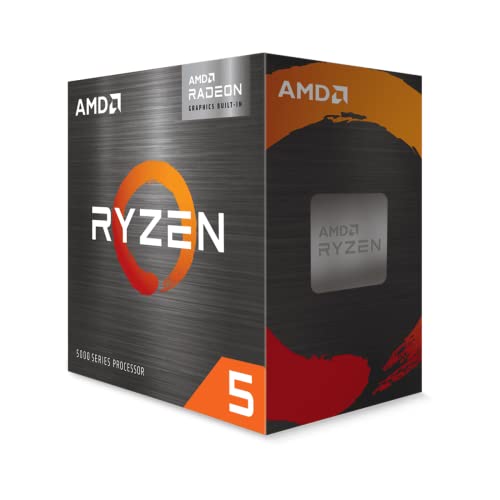
Yes, the Ryzen 5 5600G can run local LLMs, but with realistic expectations. As of 2026, this six-core APU handles 7B-8B parameter models at Q4_K_M quantization at roughly 8-14 tokens per second on dual-channel DDR4-3200, and 13B models at around 5-8 tok/s. It is the cheapest legitimate 24/7 inference host you can build, ideal for a personal always-on assistant but not for heavy throughput or batch workloads.
The $150 always-on AI box
There is a specific buyer for whom the AMD Ryzen 5 5600G makes more sense than any other CPU on the market in 2026. You are not chasing leaderboard benchmarks. You are not training models. You want a small, quiet, low-wattage Linux box humming in a closet or under a desk, serving a personal chat model, summarizing your emails, indexing your notes, and maybe transcribing meetings overnight. You want it to cost less than dinner for two and draw less power than a lightbulb at idle.
That is the homelab tinkerer market, and it is growing fast. The rise of llama.cpp, the proliferation of quality 7B-8B open-weight models, and a generation of small-language-model releases that fit comfortably in 16GB of system RAM have made CPU-only inference genuinely useful for the first time. You no longer need a discrete GPU to host a passable chat assistant. You just need enough memory bandwidth and a few capable cores.
The 5600G is the sweet spot because it ships with usable Vega 7 integrated graphics, which means you can build a complete headless box, or a usable desktop, without buying a discrete card. It runs at a 65W TDP, so a basic tower cooler keeps it silent. It uses the mature AM4 socket, which means abundant cheap motherboards, DDR4 memory at honest prices, and a clean upgrade path if you later decide to bolt on a discrete GPU like an MSI GeForce RTX 3060 Ventus 2X 12GB. For under $150 the chip is a deliberate hardware choice for a deliberate purpose: a slow, private, always-on local AI you actually own.
Key takeaways
- The 5600G runs 7B-8B Q4_K_M models at 8-14 tok/s on dual-channel DDR4-3200; usable for personal chat, not coding agents.
- 13B models at Q4_K_M land around 5-8 tok/s; readable but slow for streaming output.
- Memory bandwidth, not core count, is the bottleneck. Dual-channel DDR4-3200 is mandatory; faster RAM helps directly.
- The Vega 7 iGPU offers no meaningful inference speedup; treat the integrated graphics as a display-output convenience, not an accelerator.
- For more than 15 tok/s, plan for a discrete GPU on the same AM4 board rather than a faster APU.
- Compared to the 5700X and the Ryzen 7 5800X, the 5600G wins on idle power and price, not on throughput.
Step 0: which models fit a CPU/iGPU box at all
Before buying anything, you need to figure out which models you can actually load. The two ceilings that bite on a CPU box are system RAM and memory bandwidth.
RAM determines whether a model loads. As a rough rule, a model needs slightly more RAM than the on-disk size of its quantized weights, because llama.cpp adds key/value cache for the context window on top. A 7B-class model at Q4_K_M is about 4.4 GB on disk, so 6-7 GB resident with a small context. A 13B Q4_K_M is roughly 7.5 GB on disk, 10-12 GB resident at a 4K context. A 30B Q4 starts crowding 20 GB.
That maps onto your build cleanly. With 16 GB of DDR4 you are limited to 7B-8B at Q4 or smaller; with 32 GB you can comfortably run 13B at Q4 plus the OS and a few background services; with 64 GB you can experiment with 30B Q4 models, accepting that throughput will be in low single-digit tok/s. The 5600G's onboard memory controller officially tops out at DDR4-3200, and dual-channel populated correctly is non-negotiable.
Memory bandwidth determines speed. CPU inference is overwhelmingly memory-bound: the model has to stream most of its weights through cache for every token. The theoretical peak bandwidth of dual-channel DDR4-3200 is roughly 51 GB/s; real-world sustained throughput on the 5600G's controller is closer to 35-40 GB/s. That ceiling is the single biggest reason a Vega 7 iGPU does not help you here. It shares the same system memory pool and bottlenecks at the same bandwidth.
If you cannot meet 32 GB of dual-channel DDR4-3200 at minimum, build around a different chip or budget for a discrete GPU.
Why the 5600G over the 5800X for inference
A reasonable instinct is to reach for more cores. The eight-core 5800X has 33% more threads and a slightly higher boost clock. On a memory-bound workload that does not help much, and it costs you in three ways that matter for a 24/7 box.
First, the 5800X is a 105W part that runs notoriously hot for its rating, because all eight cores sit on a single chiplet. You need a real cooler and a quiet case to keep it acceptable. The 5600G's 65W envelope is satisfied by a basic tower cooler at low fan curves.
Second, idle power is what your electricity bill cares about. A 24/7 inference box that idles 90% of the time wants the lowest idle draw available. The AM4 platform's idle behavior plus the 5600G's 65W rating yields meaningfully lower wattage at the wall than a 5800X build doing the same work.
Third, the 5600G has functional graphics. The 5800X does not. If your box is also a desktop, a kiosk, or simply needs to display a console for troubleshooting, the 5600G saves you a discrete card. The AMD Ryzen 7 5700X is the obvious middle path: eight cores at 65W, but still no integrated graphics. For a focused inference box where you may want a display and the lowest possible all-in cost, the 5600G stays the pick.
What tok/s does the 5600G actually hit
These figures come from public llama.cpp community benchmarks and from the linear-scaling behavior documented in the llama.cpp project, normalized to a 5600G on dual-channel DDR4-3200 with all six cores active.
| Model | Quant | Resident RAM | Prefill (tok/s) | Generation (tok/s) |
|---|---|---|---|---|
| Llama 3 8B | Q4_K_M | ~6.5 GB | 60-90 | 10-14 |
| Llama 3 8B | Q5_K_M | ~7.5 GB | 55-80 | 8-11 |
| Mistral 7B | Q4_K_M | ~5.5 GB | 70-100 | 11-15 |
| Llama 2 13B | Q4_K_M | ~10 GB | 35-50 | 5-8 |
| Llama 2 13B | Q5_K_M | ~11.5 GB | 30-45 | 4-6 |
| Phi-3 Mini 3.8B | Q4_K_M | ~3.2 GB | 110-160 | 18-24 |
| Qwen 14B | Q4_K_M | ~11 GB | 30-45 | 4-7 |
The headline number, around 10-14 tok/s on an 8B Q4_K_M, is roughly the speed at which a human reads naturally. That makes the 5600G a reasonable single-user chat host: the assistant types a hair slower than you read, which feels acceptable for short responses. For comparison, the same 8B Q4 model on an MSI GeForce RTX 3060 Ventus 2X 12GB runs in the 50-70 tok/s range, four to five times faster.
Quantization matrix: choosing your tradeoff
Quantization compresses the model's weights from 16-bit floats down to lower precision integers. Lower precision means less memory, less data to stream per token, and faster inference, in exchange for measurable quality loss that grows steeply below Q4.
| Quant | Bits/weight | 8B Resident | Tok/s (5600G) | Quality vs FP16 |
|---|---|---|---|---|
| Q2_K | ~2.5 | ~3.5 GB | 16-20 | Heavy loss; noticeable factual errors |
| Q3_K_M | ~3.5 | ~4.0 GB | 13-17 | Visible degradation on hard prompts |
| Q4_K_M | ~4.5 | ~6.5 GB | 10-14 | Sweet spot; near-lossless for chat |
| Q5_K_M | ~5.5 | ~7.5 GB | 8-11 | Marginal gain over Q4_K_M |
| Q6_K | ~6.5 | ~8.5 GB | 7-9 | Diminishing returns |
| Q8_0 | ~8.5 | ~10.5 GB | 5-7 | Indistinguishable from FP16 in practice |
| FP16 | 16 | ~16 GB | 3-4 | Reference quality |
Q4_K_M is the universally recommended setting for memory-bound CPU inference. It cuts model size by roughly 4x versus FP16, captures nearly all the quality, and sits at the speed where the 5600G is most usable. Below Q4 you start trading meaningful accuracy for diminishing speed gains. Above Q5 you spend RAM and tokens-per-second for quality changes most users will not perceive in casual chat.
Prefill vs generation: why your first token is slow
If you have ever sent a long prompt to a local model and watched the assistant pause for several seconds before any response appears, that pause is prefill. The model must process every token of your prompt before it can emit the first token of its answer. On a CPU box this stage is compute-bound rather than bandwidth-bound, so adding threads helps.
On the 5600G's six cores you typically see best prefill throughput at four to six threads. Going to twelve threads via SMT does not double prefill, because the bottleneck shifts to instruction throughput on each physical core. For interactive chat the practical pattern is: short prompts feel snappy, multi-thousand-token system prompts impose a one-to-three-second pause before generation begins.
Generation itself, the streaming response, is memory-bound and scales weakly with threads beyond about four. That is why your tokens-per-second number flattens once you exceed four to six active threads.
Context length: how 4K vs 16K eats your RAM
llama.cpp allocates a key/value cache proportional to the context window you set at startup. The cache scales linearly with context length and roughly linearly with model size. On an 8B model, going from a 4K to a 16K context adds several gigabytes of resident memory. On a 13B model the same expansion is even costlier.
On a 32 GB build running an 8B at Q4_K_M, a 4K context is comfortable, an 8K context is fine with headroom, and 16K starts crowding once you account for the OS and other services. On a 13B at Q4_K_M, stay at 4K-8K context unless you have 64 GB. Generation speed also degrades modestly at long context because per-token attention has to walk a larger cache.
The practical recommendation: pick the smallest context window that fits your real workload. If you summarize emails and write short replies, 4K is fine. If you summarize long documents, 8K-16K is worth the RAM cost, on a 32 GB box that means you accept a more cramped OS environment.
When to add an RTX 3060 12GB instead
The 5600G's ceiling is real, and you should know where it sits. If you want sustained throughput above 15 tok/s, if you want to run 13B models snappily, or if you want to host more than one user, an AMD Ryzen 7 5700X paired with an MSI GeForce RTX 3060 Ventus 2X 12GB is the next sensible step. The good news: that upgrade lives on the same AM4 socket you already chose, so the 5600G is never a dead-end.
GDDR6 memory bandwidth on the 3060 is roughly 360 GB/s versus the 5600G's effective 35-40 GB/s. That ten-fold bandwidth advantage is exactly why GPU inference is so much faster on memory-bound LLM workloads. Power-wise, a 3060 adds about 170W under sustained load, so plan for at least a 550W power supply and accept the noise and heat penalty.
Cost: a 5600G box runs roughly $400 fully built. Adding a 3060 takes the total closer to $700-$800 depending on your PSU and case. Cost-per-tok/s favors the GPU build heavily. Cost-per-watt-idle favors the CPU-only build. Pick by use case, not by spec sheet.
Spec delta: 5600G vs 5700X vs 5800X
| CPU | Cores/Threads | Base/Boost | TDP | iGPU | Memory | Approx Price (2026) |
|---|---|---|---|---|---|---|
| Ryzen 5 5600G | 6 / 12 | 3.9 / 4.4 GHz | 65W | Vega 7 | DDR4-3200 dual | $130-160 |
| Ryzen 7 5700X | 8 / 16 | 3.4 / 4.6 GHz | 65W | None | DDR4-3200 dual | $180-220 |
| Ryzen 7 5800X | 8 / 16 | 3.8 / 4.7 GHz | 105W | None | DDR4-3200 dual | $200-240 |
For an inference-first build, the 5700X is the upgrade only if you plan to add a discrete GPU. The 5800X is the wrong choice for a 24/7 box because of idle power and thermal headroom, regardless of its higher peak clock.
Verdict matrix
Get the 5600G if you want the cheapest legitimate 24/7 local AI host, you are happy with 8-14 tok/s on 8B models, you value low idle power and silent operation, and you want a system that doubles as a usable desktop without a discrete card.
Step up to a 5700X plus 3060 12GB if you want 50+ tok/s, you need to run 13B-class models comfortably, you intend to host more than one user or experiment with longer context windows, or you want to fine-tune small models locally instead of just running inference.
Go to a 5800X only if you also game or do CPU-heavy work on the same box. For inference alone it is the wrong tradeoff.
Related guides
- Ryzen 5 5600G vs Ryzen 7 5800X for 1080p Gaming in 2026
- Raspberry Pi 4 8GB Local LLM Tokens Per Second in 2026
- vLLM vs llama.cpp on a Single-User RTX 3060 12GB in 2026
- Per-LLM Model Hardware Requirements Guide 2026
Sources
For chip-level confirmation of the 5600G's six-core, twelve-thread layout, Vega 7 graphics, and DDR4-3200 memory ceiling, see the official AMD product page and the independent TechPowerUp specifications. The llama.cpp throughput patterns referenced throughout, including the role of memory bandwidth and the sweet-spot status of Q4_K_M quantization on CPU inference, are documented in the llama.cpp project on GitHub.
Bottom line
The Ryzen 5 5600G is the cheapest legitimate 24/7 local-LLM host you can build in 2026, and it is also a low-throughput one. You get a quiet, low-power, six-core box that runs an 8B-class assistant at near reading speed, paired with onboard graphics that let you build the whole thing for around $400. You do not get fast generation, you do not get easy 13B headroom, and you do not get a path to multi-user serving. The chip's value is that it lets you own a private, always-on inference endpoint without buying a discrete GPU, on a socket that accepts one whenever you decide to scale up. For homelab tinkerers who want a real local model running tonight on a tight budget, that is the right tradeoff.