The best RTX 3060 12GB card to buy in 2026 is the MSI GeForce RTX 3060 12GB Twin Fan OC at $399 for new builds, or the ZOTAC RTX 3060 Twin Edge OC 12GB at $323 for budget builds where every dollar matters. Both are reference-clock-speed AIB designs with proven cooling, 3+ year warranties from the manufacturer, and resale value that has held up better than any other 60-class GPU since the 2021 mining-boom inventory glut.
Why are we recommending an Ampere card in 2026?
The RTX 3060 12GB occupies an unusual niche in 2026. It launched in February 2021 at $329 MSRP, was effectively unbuyable through the 2021-2022 mining boom (real prices $700-$900), and has spent the last three years aging into a sweet spot: NVIDIA never gave the RTX 4060 (Ada) or RTX 5060 (Blackwell) more than 8GB of VRAM, which means the 3060 12GB remains the cheapest current-generation-stack consumer GPU with enough VRAM for modern AI workloads, 1080p ultra textures, and 1440p high settings. Used prices have settled at $280-$340 on eBay and the secondary Amazon market, and Amazon-Renewed listings from the original AIBs sit at $330-$420.
This guide is for builders evaluating which RTX 3060 12GB AIB card to buy in 2026 — typically for: a 1080p high-refresh gaming rig at $700-$900 total system cost, a local LLM coding setup where 12GB VRAM is the unlock for 14B-parameter quantized coding models, a Plex/Jellyfin transcode workstation where the 3060's NVENC encoder handles 4K HEVC at low power, or a budget Stable Diffusion / Flux.1 image generation workstation. We are not recommending the 3060 12GB as a 4K gaming card — it can't sustain 60fps in 2024+ AAA titles at 4K with modern settings, and you'd want a 4070 Super or 5070 instead.
The headline pick is the MSI Gaming GeForce RTX 3060 12GB Twin Fan OC at $399 because it has the best price-to-cooling ratio in the lineup, runs at NVIDIA's reference 1807 MHz boost clock, and MSI's Twin Frozr 8 dual-fan design idles silent (zero-fan-stop below 60 °C). The ZOTAC RTX 3060 Twin Edge OC at $323 is the best value if you want the cheapest 12GB 3060 from a reputable AIB. The ASUS Dual NVIDIA GeForce RTX 3060 V2 OC at $379 is the premium pick for users wanting axial-tech fans and the 3-year ASUS warranty.
Comparison: the five RTX 3060 12GB cards at a glance
| Pick | Best For | Key Spec | Length | Price Range |
|---|---|---|---|---|
| MSI RTX 3060 12GB Twin Fan OC | Best Overall | 1807 MHz boost, dual fan | 235mm | $390-$420 |
| ZOTAC RTX 3060 Twin Edge OC | Best Value | 1807 MHz boost, dual fan | 224mm | $300-$340 |
| MSI RTX 3060 Ventus 2X 12G OC | Best Compact | 1807 MHz boost, dual fan | 232mm | $390-$420 |
| GIGABYTE RTX 3060 Gaming OC 12G | Best Cooling | 1837 MHz boost, triple fan | 282mm | $440-$480 |
| ASUS Dual RTX 3060 V2 OC 12GB | Best Premium | 1837 MHz boost, dual axial fan | 247mm | $370-$400 |
All five cards have the same NVIDIA-provided GA106 GPU silicon, 3584 CUDA cores, 12GB GDDR6 on a 192-bit bus, and 360 GB/s memory bandwidth. Performance differences between cards are within 2-3% in benchmark testing — pick on price, length, cooling, and warranty rather than raw specs.
🏆 Best Overall: MSI RTX 3060 12GB Twin Fan OC ($390-$420)
MSI's Twin Fan OC is the consensus mainstream pick for an RTX 3060 in 2026. Two 92mm Torx Fan 4.0 fans use traction-paired blades to push higher static pressure through the heatsink than competitor blower or single-fan designs. The cooler is rated to keep GPU package temperatures below 70 °C under sustained 165W TDP load, with the fans staying under 1900 RPM — quiet for a dual-slot card. Zero-fan-stop below 60 °C means it idles silent during desktop workloads. Factory OC pushes boost clock to 1807 MHz vs the 1777 MHz NVIDIA reference. Three DisplayPort 1.4a + one HDMI 2.1 output, drawing power through a single 8-pin PCIe connector (no 12VHPWR — a feature, not a bug, given the well-documented 12VHPWR melting issues on 40-series cards).
Pros: mature MSI Twin Frozr 8 cooling proven over 4+ years of field use; zero-fan-stop idle; HDMI 2.1 for 4K @ 120Hz output to TVs; single 8-pin connector (no 12VHPWR cable risk); MSI's 3-year warranty applies to original purchaser. Cons: the OC headroom on Ampere is limited — you'll see at most a 5% performance gain over reference clocks even with manual overclocking; 235mm length requires verifying mid-tower clearance.
Buy it for: any 1080p ultra or 1440p high gaming rig, local AI inference rigs running 14B-parameter Qwen 2.5 Coder or DeepSeek Coder V2 Lite, or Plex transcoding workstations.
💰 Best Value: ZOTAC RTX 3060 Twin Edge OC 12GB ($300-$340)
ZOTAC's Twin Edge OC is the cheapest reliable RTX 3060 12GB from a major AIB. The IceStorm 2.0 cooler uses two 90mm fans on a 224mm-long PCB — shorter than the MSI Twin Fan, easier to fit in compact cases. Factory OC matches the MSI at 1807 MHz boost. ZOTAC's manufacturer warranty is 2 years (extendable to 5 years with online product registration within 30 days of purchase — set a calendar reminder). Cooling performance is within 2-3 °C of the MSI under sustained load; the fans run slightly louder at peak (about 36 dBA vs MSI's 33 dBA) but most users won't notice the delta with case fans running.
Pros: cheapest 12GB 3060 from a tier-1 AIB; 224mm length fits cases the MSI doesn't; 5-year warranty when registered; IceStorm 2.0 cooling adequate for sustained load. Cons: fan noise slightly higher than competitors at peak; warranty requires registration step you'll forget — set the calendar reminder; some early production runs had ICY paste application that benefited from a repaste at the 1-year mark.
Buy it for: budget builders prioritizing dollar-per-FPS, mITX builds with tight clearance, or anyone willing to register for the extended warranty.
🎯 Best Compact: MSI RTX 3060 Ventus 2X 12G OC ($390-$420)
The pick: MSI GeForce RTX 3060 Ventus 2X 12G OC.
The Ventus 2X is MSI's compact-design 3060 12GB — 232mm long, 130mm tall, dual-slot. Two TORX Fan 3.0 fans (slightly older fan design than the Twin Fan pick), zero-fan-stop, single 8-pin power input, three DisplayPort 1.4a + one HDMI 2.1 output. Boost clock factory OC'd to 1807 MHz, identical to the Twin Fan pick. Cooler is sufficient for sustained load but runs 2-4 °C hotter than the Twin Frozr 8 design, with fans spinning slightly faster to compensate.
Pros: slightly shorter than Twin Fan; identical electrical specs; same MSI 3-year warranty; works in cases where the Twin Fan won't fit. Cons: thermals trail Twin Fan by 2-4 °C under sustained load; the older TORX 3.0 fan design is louder than 4.0 at high RPM; same MSRP as Twin Fan with worse cooling — only pick this if Twin Fan won't physically fit.
Buy it for: SFF builds (Mini-ITX, mid-tower with vertical GPU mount) where 235mm cards don't fit but you still want the MSI quality and warranty.
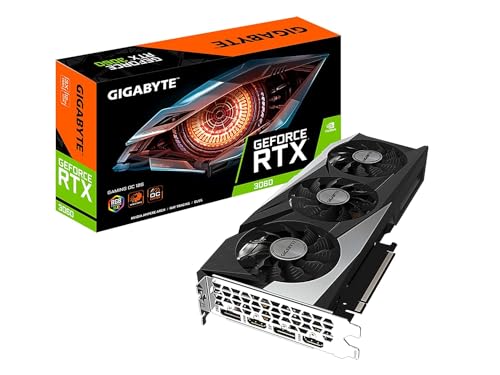
⚡ Best Cooling: GIGABYTE RTX 3060 Gaming OC 12G ($440-$480)
The pick: GIGABYTE GeForce RTX 3060 Gaming OC 12G (REV2.0) Graphics Card, 3X WINDFORCE Fans.
GIGABYTE's Gaming OC is the only triple-fan RTX 3060 in our recommended lineup. Three 80mm WINDFORCE fans with alternating-spin blade design, RGB lighting on the side accent, and a 282mm-long PCB. The factory OC pushes boost clock to 1837 MHz (the highest in our lineup, though Ampere's thermal-limited boost rarely exercises the difference). GIGABYTE rates the cooler at 200W sustained — significantly more headroom than the card's 170W stock TDP — which means very low fan RPM under typical load and accordingly low noise. Three-year manufacturer warranty.
Pros: quietest card in the lineup at full load due to oversized cooler; lowest GPU temperatures; striking RGB aesthetic; 3-year warranty. Cons: 282mm length blocks some mid-tower cases; the highest-priced card in the lineup at $469.99 MSRP; the RGB requires GIGABYTE Control Center software which is heavier than necessary for desktop use.
Buy it for: quiet gaming builds, large mid-tower or full-tower cases where length isn't an issue, or aesthetic builds with matching GIGABYTE RGB ecosystem.
🧪 Best Premium: ASUS Dual RTX 3060 V2 OC 12GB ($370-$400)
The pick: ASUS Dual NVIDIA GeForce RTX 3060 V2 OC Edition 12GB GDDR6.
The ASUS Dual line is the entry-tier card from ASUS, sitting below the ROG Strix and TUF Gaming tiers. Two Axial-tech fans with 0dB technology (zero-fan-stop below 55 °C), boost clock 1837 MHz factory OC'd, 247mm length. ASUS Dual's signature feature is the IP5X dust resistance certification — the cards have sealed-bearing axial fans that resist dust intrusion over long-term use, which matters more than people realize for cards that live 4+ years in a gaming rig. Single 8-pin power, three DisplayPort 1.4a + one HDMI 2.1 output. Three-year ASUS warranty with their cross-shipping RMA program.
Pros: Axial-tech fans known for quiet operation; IP5X dust resistance for long-term reliability; ASUS's strong RMA / cross-ship warranty experience; clean black-and-grey aesthetic without aggressive RGB; same factory OC as GIGABYTE Gaming OC. Cons: 247mm length still requires mid-tower verification; price premium over the cheaper picks isn't justified by performance — pay this only for the warranty and dust-resistance long-term reliability story; the "V2" revision uses a refreshed PCB but identical silicon, so don't pay extra hunting "V2" specifically.
Buy it for: builders who keep cards for 5+ years and value warranty support over raw cooling capacity. Also the best aesthetic pick for non-RGB clean builds.
What to look for in an RTX 3060 12GB AIB card
1. New vs Amazon-Renewed. Amazon-Renewed listings ship with a 90-day Amazon warranty but no manufacturer warranty. New cards from MSI/ASUS/GIGABYTE/ZOTAC ship with 2-3 year manufacturer warranties. For a card you'll keep 4+ years, the difference matters — pay the $30-$50 premium for new.
2. Card length is the most common compatibility issue. Measure your case's GPU clearance from the back of the case to the front fan/HDD cage. Add a 10mm safety margin for power-cable bend radius. Cards under 240mm fit almost anywhere; cards 280mm+ require a mid-tower or larger case verified for that length.
3. Power: single 8-pin only. Every RTX 3060 12GB in our recommended lineup uses a single 8-pin PCIe connector — no 12VHPWR, no dual-8-pin. This is good. The 12VHPWR connector issues on 40-series and 50-series cards (overheating, melting) are well-documented; the 30-series single-8-pin is mechanically simple and bulletproof. A 550W 80+ Bronze PSU runs an RTX 3060 12GB system comfortably.
4. Used market vs new. Used RTX 3060 12GB cards on eBay run $280-$340. Most ex-mining-rig cards have been pulled to the secondary market and are not currently a glut — supply has thinned. If buying used, verify a non-mining seller, check the GPU under stress test (FurMark or 3DMark Time Spy Extreme) for 30+ minutes before the return window closes, and accept that there's no manufacturer warranty transfer.
5. NVENC for streaming and Plex. The RTX 3060's 7th-gen NVENC encoder handles 4K HEVC at <40W, transcoding 4-6 simultaneous 4K streams without dropping frames. This is one of the strongest non-gaming reasons to buy this card in 2026 — it remains the cheapest 12GB card with current-gen NVENC.
RTX 3060 12GB cards — FAQ
Why buy an RTX 3060 12GB in 2026 instead of the RTX 5060 or RTX 4060?
The 5060 and 4060 both ship with only 8GB of VRAM. For 1080p gaming alone, 8GB is "fine" today but increasingly limiting in newer titles (Indiana Jones and the Great Circle requires 12GB+ for ultra textures; Stalker 2 patches added 12GB+ texture options; many UE5 games shift textures above 8GB at high settings). For any AI workload — local LLMs, Stable Diffusion / Flux.1 image generation, even basic ML notebooks — 8GB is a hard wall that 12GB clears. The RTX 3060 12GB is the cheapest current-gen-stack card with the VRAM most modern workloads actually require.
How does the 3060 12GB compare to the AMD RX 6700 XT or 7600 XT?
The RX 6700 XT (12GB, 192-bit) outperforms the RTX 3060 12GB by 15-25% in pure rasterization but at $50-$100 higher used-market pricing. AMD's ROCm support for local LLMs has improved dramatically through 2024-2025 but still lags CUDA's mature tooling — if AI inference is part of your use case, the NVIDIA card's CUDA support is more valuable than the AMD card's raw FPS. The RX 7600 XT (16GB) is interesting at $329 new but has narrower memory bus (128-bit, 288 GB/s) and weaker AI ecosystem support.
Can the RTX 3060 12GB run DLSS 3.5 / Frame Generation in modern games?
The 3060 12GB supports DLSS Super Resolution (upscaling), DLAA (anti-aliasing), and Ray Reconstruction — all of which work well and are valuable for hitting 60fps in newer titles. DLSS 3 Frame Generation (DLSS 3.5 with FG) is locked to RTX 40-series and newer cards — the 3060 cannot run frame generation. This means in games where frame generation is a meaningful uplift (Cyberpunk 2077 Phantom Liberty, Alan Wake 2), the 3060 12GB lags behind the 4060 / 5060 / 7800 XT despite the VRAM advantage.
Do these cards work in a 75W-TDP PCIe slot without an external power cable?
No — every RTX 3060 12GB on the market requires a single 8-pin PCIe power connector (drawing up to 150W from the cable plus 75W from the slot). The RTX 3050 6GB is the only 30-series card with a 75W slot-only variant. If you're upgrading a small-form-factor OEM machine (Dell Optiplex, HP small-tower, Lenovo ThinkCentre), verify your PSU has a free 8-pin PCIe connector before buying.
What CPU pairs well with an RTX 3060 12GB?
Modern entry-tier CPUs (Ryzen 5 7600, Ryzen 5 9600X, Core i5-13600K, Core i5-14600K, Core Ultra 5 245K) are the sweet spot. The 3060 12GB doesn't bottleneck on the CPU side at 1080p ultra or 1440p high in modern titles. Pairing it with an older Ryzen 5 5600 / Core i5-12400 also works and saves $100+ on the platform. Don't pair it with a Ryzen 9 / Core i9 — that's an unbalanced build; spend the CPU surcharge on a faster GPU instead.
Sources
- NVIDIA GeForce RTX 3060 specifications — NVIDIA
- MSI Twin Frozr 8 cooling technology overview — MSI
- ZOTAC IceStorm 2.0 cooling technology — ZOTAC
- ASUS Dual GPU technical overview and IP5X certification — ASUS
- GIGABYTE WINDFORCE cooling architecture — GIGABYTE
- TechPowerUp RTX 3060 12GB benchmark database